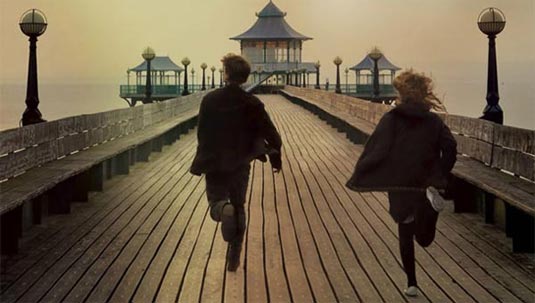
Review: Never Let Me Go (2010)

In 2005, Kazuo Ishiguro wrote a nifty science fiction novel named Never Let Me Go. Despite the fact that Ishiguro’s narrative was steeped in speculative fiction cliches (organ harvesting, parallel universes, extended human lifespan creating an underclass, the belabored philosophical inquiry over whether an artificial creation has as much of a soul as its creator, et al.), the novel was inexplicably categorized in the fiction section, leading to many uncounted stoned conversations among frustrated geeks over the question of whether twenty dollar bills had been slipped into the hands of bookstore managers. But it was more likely that Ishiguro eluded the genre ghetto, garnering that vital all-access pass awarded to certain literary titans, by way of putting together imagery and story considered graceful and/or beautiful by the cultural elite. (To cite one example, Tommy reacting to a piece of news as if the messenger was “a rare butterfly he’d come across on a fence-post.”)

The literary critics at the time, mostly unfamiliar (as always) with speculative fiction, praised the novel as if nobody had told similar stories before, or as if the “genre” was confined to certain moonlighters. The New Yorker‘s Louis Menand smugly declared that “the book belongs to the same genre as Philip Roth’s The Plot Against America, counterfactual historical fiction,” as if Harry Turtledove (or Fritz Leiber’s wonderful novel, The Big Time, for that matter) could not exist in the same bookstore. The fiery and often superficial Michiko Kakutani was even more dismissive, writing, “So subtle is Mr. Ishiguro’s depiction of this alternate world that it never feels like a cheesy set from The Twilight Zone, but rather a warped but recognizable version of our own.” (Never mind that the majority of The Twilight Zone was truly brilliant and paradigm-changing because of its commitment to writing and acting. Only a superficially bourgeois critic would condemn art purely on its aesthetic.)

And for those of us who read literary and pulp novels because we genuinely appreciated both, it was a bit embarrassing to witness all this ignorance. And let’s be honest here. Take away Ishiguro’s beauty and Never Let Me Go is little more than a rewrite of the Star Trek: The Next Generation episode, “The Measure of a Man.” At least the British Science Fiction Association had the decency to shortlist Never Let Me Go for the Arthur C. Clarke Award, where Ishiguro lost to Geoff Ryman. (A few years later, the critical elite would deliver similar plaudits towards Cormac McCarthy’s YA dystopian novel, The Road. The great irony is that Oprah Winfrey would be the one to push the book hardest. Through the populist medium of television, Winfrey’s endorsement dwarfed all the fulsome praise eked out by a handful of pedantic mice.)

Now Ishiguro’s book has made its way to the big screen, where the mass medium of cinema hopes to reframe it yet again. Never Let Me Go is hardly the first time Ishiguro has tangoed with celluloid. In 1993, there was a film version of The Remains of the Day put together by the Merchant-Ivory team, a cold and highly overrated team of collaborators who are more committed to putting audiences to sleep than producing art that pops. I have tried to watch the movie three times over the past seventeen years and was only able to make it to film’s end once without falling asleep – and this was only because I wished to respect my sexy videowatching companion, who counted herself as a Merchant-Ivory fan. Yet despite the film’s bland and soporific qualities, it was afford all sorts of award nominations. A more successful Ishiguro collaboration was Guy Maddin’s The Saddest Music in the World (2003), but one suspects its giddy qualities emerged only because Maddin and his co-writer George Toles had the decency to rewrite a hypothetical dud. I avoided 2005’s The White Countess, largely because James Ivory had directed the film and I had no desire to relive the trauma of The Remains of the Day in any form.

So when I learned that director Mark Romanek (the man behind the underrated One Hour Photo and several music videos) and hit-or-miss screenwriter Alex Garland (once a brilliant novelist) were involved with Never Let Me Go, I figured that this adaptation would be more Maddin than Ivory, that the Ishiguro cinematic stigma would be salvaged. I regret to report that this was not the case. Never Let Me Go bored me to fucking tears.

The film’s sloooooooooooooooooooooow pace, presumably intended to invite comparisons to needlessly protracted slideshows or weekend corporate retreats, is perhaps best epitomized by the following exchange (character names replaced by variables to avoid spoilers):

A: We’re going to do it.

(Unfathomably long pause before cutting to B.)

B: You’re going to apply.

(Another needlessly fucking long pause before the next line; never mind that all this would have been tightened by the line, “We’re going to apply.”)

A: Yes.

(A pregnant pause. Good Christ, Garland, you should know better than this.)

B: Good.

And that’s it. That’s Romanek and Garland’s idea of exposition. And we’re supposed to accept this weak narrative because the characters here, as the film telegraphs without subtlety, are sequestered from society and committed to providing organs through “donations.” (That’s not really giving anything away. If you don’t figure this out in the first twenty minutes, then you’re not paying attention.) But the atmosphere never feels particularly disturbing (as Romanek’s last feature film did, perhaps more because he had the smarts to tap into Robin Williams’s undeniably discomfiting qualities), which is odd given that Romanek has a great visual knack at conveying isolation (such as the mostly barren blue wall of an apartment or the Gordon Willis-like amber glow of a dark hospital corridor illuminated solely by the sun). Romanek gets the feel of the class structure here by framing many of his shots with the backs of heads to the camera. He gets a great performance from Carey Mulligan, who is especially good at disguising her unshakable sadness, pretending to be human with tragically feeble smiles and fine cheekbones. But scenes from the novel that should feel creepy, such as the scripted laughter at a television sitcom, feel more like obligatory than vital.

The fault here must be leveled at Alex Garland, who has clearly traded in his fiction talent for the lucre of video games and passable screenplays. It’s almost inconceivable to be reminded that Garland once had his finger firmly on the pulse of his generation. Clearly, those days are gone. Garland doesn’t seem to understand that Faulkner and Fitzgerald aren’t remembered for their Hollywood work, but the attentions they committed to the page. And Garland’s failure to evoke Ishiguro’s subtle style on screen isn’t just the indication of a screenwriter out of his depth. It’s the sad story of a burned out talent, once capable of reaching a mass audience and defying myopic critics, who doesn’t even have new novels to atone for the hackwork.


Notice to Readers: Offline for Uncertain Period

I’m typing this in my neighborhood cafe. I just moved and I thought that the broadband transfer would be flawless. It has been anything but. An evil company* by the name of Ace Innovative lied and misrepresented what the true nature of service was in my new neighborhood was. (I will have more on this later. Also, please pardon the lack of contractions. I am typing this on a keyboard where I cannot do apostophres. This probably explains why I sound like Data from Star Trek.) I have also lost my landline number. So I cannot be contacted for a while. What this means is that I am essentially out of commission for the foreseeable future. Bat Segundo is now on hiatus. I cannot respond to email. Content has slowed to a halt. I hope to be back up and running sometime in the next few weeks. And hopefully I will be able to offer reviews of films that I have seen (which have apparently been released) and audio interviews that I have conducted. My apologies to the publicists who were counting upon timed release of said content and the readers and listeners who regularly come here. If you need to get in touch with me, try friends or email (very slow response time).

* — As is often the wont for expanding companies, Ace was wonderful until they decided to grow. It was a company run by Russian geeks. Now it is a company run by closet sociopaths.

9-1-10 UPDATE: I appear to have found alternative broadband service. A small independent company who has been nothing less than polite, professional, and transparent about getting this done. Should be back in about two weeks.

February 15th! Reader of a Lonely Heart!

Read your work. You always read your work. Never thinking of the future. Prove yourself. You are the book you make. Take your chances win or loser.

This silly lyrical reference is a roundabout way of saying that the exuberant Russ Marshalek has organized yet another fantastic installment of his infamous reading series, “Just Working on My Novel.” It’s set to go down on February 15, 2010, whereby new and established writers read unpublished and/or new novels. The latest episode will center around love letters, breakup stories, sad sack notes, and other harrowing emotional indictments befitting the day after Valentine’s Day.

The sexier-than-you Jami Attenberg be hosting this event, and I can think of few people better suited to the exigencies. In addition, due to the unexpected reception of Hate Mail Dramatic Reading Project, it appears that I’ve been enlisted to read one of the proffered pieces in a wildly theatrical manner that may involve the breaking of glass. And as an added incentive for curiosity seekers, I’ll also be performing an excerpt from my sprawling novel-in-progress, Humanity Unlimited, which will involve a pregnant attorney, an eccentric restaurant, and a dissolving relationship and contains the striking sentence, “Perhaps maternal canvassing was a form of social suicide.” This section has not been read before and it may perplex some audience members unfamiliar with recent developments in upscale cuisine.

But more importantly, there are the readers! Sign-up spots before the event are limited. But you can email Russ directly to secure your spot.

It all goes down on Monday, February 15, 2010, starting at 7:00 PM, at The Tank, located at 354 West 45th Street (near 9th Avenue).

The Bat Segundo Show: Sue Grafton

Sue Grafton recently appeared on The Bat Segundo Show #320. Grafton is most recently the author of U is for Undertow.

Condition of Mr. Segundo: Looking for a man named Snake to help him escape from Santa Teresa.

Author: Sue Grafton

Subjects Discussed: Kinsey Millhone’s early announcement to the readers regarding the bad guys, foreshadowing murder, not writing the same book twice, the ethics of investigation, the emotions associated with kidnapped children, Jaycee Dugard, Scott Smith’s A Simple Plan, gray areas of moral conduct, the difficulties reconciling real crime and fictional crime, the horror of people killing each other over a pair of tennis shoes, Grafton’s comfort level, working from an arsenal of journals, juggling voices and large character canvases, the writer’s fantasy of having the luxury of time, the solace of observing creative struggle in past books, being influenced by the complaints of a single reader, the motivation behind creating a mystery writer character, Howard Unruh and Grafton’s “Unruh,” why Grafton wishes to take the alphabet series to Z, Grafton’s reluctance to embrace Hollywood and Grafton’s early career as a screenwriter, Nabokov’s The Original of Laura, and Grafton’s relationship with readers and the mystery community.

EXCERPT FROM SHOW:

Grafton: I don’t like to repel readers. I mean, we’re always dealing with homicide and violence of this sort, which is difficult enough. I don’t want to rub that in my reader’s face.

Correspondent: So it’s like, on the one hand, with this crime, you wanted to keep it off stage so that the gory details didn’t come front and center.

Grafton: Right.

Correspondent: But in other instances, like what we just talked about, you like to foreshadow and give the reader a taste of what’s going on. Do you feel these are contradictory impulses?

Grafton: I don’t know. If they are contradictory, I hope it’s an interesting contradiction. In some ways, in the reports you get about the crime itself from another child who is involved, by hook or by crook, nothing evil happens. And I hope I’ve gained a little sense. This is a story about people who make mistakes, people who use poor judgment. It is not the act of wicked evil men. These are kids who do something stupid and it backfires.

Correspondent: But in a way, at least when I was reading you, it almost struck me as being more horrible — not to get into Hannah Arendt’s banality of evil, but that’s essentially what you set up here. These people are sucked into the situation by virtue of their own stupidity. Their drug use, who they hang out with. And it almost feels — have you read A Simple Plan by Scott Smith?

Grafton: No.

Correspondent: It was made into a movie with Billy Bob Thornton and the like. But it’s a similar thing, where you start off with one guy and he does one act, and then another action. And you suddenly realize you’re drawn into a world as he’s doing really horrible things. And there’s a justification for everything. And I really did find that you did establish that there’s a weird little justification for how things developed. And even though these are horrible crimes, there’s some underlying motivation. This goes back to structure and the like. What did you know about you prior to setting it all down? And I do want to get into the writing process a bit. But what did you know first off?

Grafton: Well, part of what I feel I’m doing here is — and some of this I discover after the fact. I think of this as the anatomy of a crime. This is that strange subterranean accumulation of events that results in a crime. And I thought it was interesting to look at it from that perspective. One thing I’m fascinated by, at this pace in my career, is gray areas. Black and white and evil, while repellent, are not as representative of the public at large. Many people, I think, cross the line. That’s always a question to me. What makes people cross the line? Most people are law-abiding, good-natured, and yet circumstances. You know, I think many criminals are not evil people. They’re not pathologically twisted. Many ordinary folk somehow wander from the straight and narrow. And those kinds of deviations, and those kinds of crimes, are interesting to me. Because they’re a little closer to the norm. They are still outside what I consider acceptable behavior. But it’s not as cut and dried as many types of crime might be.

The Bat Segundo Show #320 (Download MP3)

This text will be replaced

Too Much Kirsch in the Fondue

At some unspecified point in the future, words will be transmitted along these pages at the older frequency. But my services, such as they are, have been increasingly required elsewhere. For now, this space serves as a depository for podcasts, odd video clips (many of my own making), quick quips, short announcements, and the odd review or essay every now and then.