More background here and here.
Category / Verizon

The History of Verizon, Part Four (November 2000 to December 2000)
[EDITOR’S NOTE: This post continues my comprehensive history about the expansion of Verizon. This most recent installment takes the story through the end of 2000. Part One, which concerns itself with April to August 2000, can be found here. Part Two, which concerns itself with August 2000, can be found here. Part Three, which concerns itself with September and October 2000, can be found here.]
Like any mushrooming company hoping to discharge its spores upon every square mile in a new field, Verizon had its lobbyists. In 1999 and 2000, Verizon, BellSouth, and SBC gave more than $7.1 million to political parties and federal campaigns, ensuring that they were among the top 25 donors. The funds were well-timed, arriving in Washington just as Congress was in the process of loosening restrictions.
AT&T perhaps had the most to lose from attempting to influence the reordering of the telecom guard. Faced with the October surprise of splitting itself up into four parts, AT&T alone had contributed $4.3 million during the 2000 election cycle. It was facing complaints from its investors.
Meanwhile, the telecommunications companies were beginning to enter more long-distance markets. Verizon, of course, knew when to steer clear of federal legislation or, more accurately, precisely when to time its actions in relation to governmental and competitive developments. Near the close of 2000, it withdrew its application for Massachusetts long-distance services. (Verizon was then under scrutiny from other telecom providers. In April 2001, it would receive federal approval in Massachusetts, where the competition would heat up.)
 By the end of October, Verizon may have been doing okay in the stock market. But its third-quarter profit was flat. The money that Verizon had spent to dominate DSL and long-distance markets with discount pricing had remained the same from the year earlier. Verizon profits in Q3 2000 were $1.99 billion, whereas Bell Atlantic profits had been $2 billion a year earlier. The m.o. involved spending and undercutting. But this seemed enough to assuage Wall Street.
Profits needed to come from somewhere. But there was also the matter of eager consumers trying to find the cheapest possible price on DSL. Local telephone service was the logical place to start jacking up prices. On November 1, 2000, while Verizon New Jersey proposed to double basic telephone rates from $8.19 a month to anywhere from $15-17 a month, regulators called a hearing. Elderly customers complained that they would be saddled with undesired expenses and undesired services. Verizon’s argument was that it cost them much more than $8.19 a month to provide basic telephone service to its customers, but Verizon spokeswoman Soraya Rodriguez did confess that there wasn’t much in the way of competition for local service
These sentiments were in sharp contrast to the Bell Atlantic days. In 1992, Bell Atlantic had brokered a deal with Trenton. They would rewire Jersey lines if the state loosened Bell Atlantic from a regulative loophole that forced it to lower rates if it made an unreasonable profit. In 1997, the New Jersey Board of Public Utilities had stood its ground. The result was that Trenton had managed to get its line rewired and New Jersey customers had experienced some of the cheapest local telephone service in the country. But Anthony Wright, the program director for New Jersey Citizen Action, would organize opposition to the plan and score a victory later in the year. This was, however, not the end of Verizon’s efforts to squeeze profits out of local telephone service, as subequent 2004 efforts in the Northwest would eventually reveal. (Indeed, in early 2008, Verizon would play this card again when telephone deregulation was on the table. Regulation was retained, but, by 2011, local Verizon telephone service in New Jersey will be set at $16.54 a month. Verizon, as it turned out, could fight just as hard as New Jersey Citizen Action could.)
Verizon had, by this time, seemingly escaped from the lingering smoke wafting from the August strike. In New York State, the backlog for new lines had been eliminated by October 23, 2000. Or so Verizon claimed. In November, there were still reports of new apartments waiting for service in a 33-story tower declared “The Ultimate in Brooklyn Heights Luxury.”
Verizon continued to expand. Verizon Communications owned 40% of Venezuela’s national telephone company. And there was the $1.5 billion acquisition of Price Communications Wireless, which served the Southeast, but also faced $550 million in debt that Verizon also took on. And, as previously documented, Verizon backed out of the NorthPoint deal.
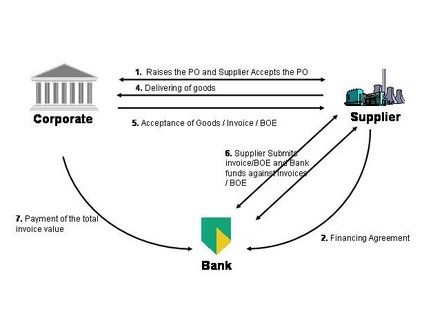
But what was particularly interesting was the amount of debt held by seven major telecommunications companies. In August 2000, Lehman Brothers analyst Ravi Suria wrote a report titled “The Other Side of Leverage,” which pointed to the weaknesses of vendor financing. Vendor financing was precisely what Verizon specialized in. It was a practice that permitted customers to buy their own equipment through unseen financial burdens managed by the company. Suria pointed out that the telecom companies had increased their share of the convertibles market from 5% in 1998 to 20% in 1999. (A convertible is a type of security that can be converted into another form of security — such as a share in a company.) Verizon had managed to pass off much of its debt through their convertibles, because there was no way to squeeze out significant profit from the networks at the time and there was no way to cover the interest payments on accumulating debt. Over the course of four years, the combined debt and convertible bonds of the seven telecoms that Suria was studying had dwarfed to $275 billion. As the New York Times‘s Gretchen Morgenson observed, this was a significant change from the $160 billion in junk bonds generated between 1983 and 1990.
And yet even Suria seemed convinced that there were promising possibilities in the telecom industry. Perhaps Verizon’s faith emerged from the possibilities of keeping customers on-board for life. After all, if you could wipe out the competition, eventually the customer would have no other choice but the Verizon network. And if you could lock a Verizon Wireless customer into a two-year contract, you could then tell your investors that convertibles were merely a “temporary” high-yield debt taken on while waiting for the almighty profits. Perhaps vendor financing represented a new method for Verizon to utilize Ricardo’s comparative advantage theory.
 The equipment vendors buying into this infrastructure had to be somewhat concerned about this high-stakes gamble, but the possibilities of profit seemed to negate financial pragmatism. In Lisa Endlich’s Optical Illusions, Endlich reports that, in 1996, Lucent’s Controller was initially skeptical about expanding on such a significant lending risk. Jim Lusk, the Controller at the time, was an old-fashioned finance type who needed to see how the money was going to pay out and who believed that Lucent should stick to selling equipment rather than lending money, even he turned around for a contract that secured 60% of Sprint PCS’s contract. The cost? $1.8 billion, with payment of principal deferred for four years. Small wonder then when, four years later, Lucent was in bad shape, with the CEO replaced and investors demanding an overhaul. But then, by the end of 2000, the nine largest telecom equipment suppliers had a combined $25.6 billion in vendor financing loans to customers.
While such measures of financing may seem extraordinary from the perspective of 2009’s deep recession, keep in mind that such actions came shortly after the unprecedented economic boom of the 1990s. But, as we shall later see, Verizon’s investments in other properties were predicated on these companies, in turn, subsisting through additional vendor financing strategies. (By August 2001, Verizon was forced to write off half of its $5.9 billion investment portfolio.)
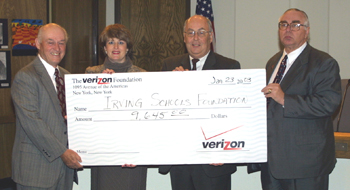 Verizon also established the Verizon Foundation, with the intent to distribute 4,000 grants of $70 million, through an all-online process. This, of course, replicated the funds and the efforts of the Bell Atlantic Foundation. (Not counting for inflation, this figure would remain more or less consistent throughout the years. In 2008, the Verizon Foundation awarded $68 million in grants, roughly 6.4% of its profits from Q1 2008. The Verizon Foundation’s financial statements can be examined here.)
There were also advertising costs. The tab at Draft Worldwide and Zenith Media was $500 million.
The now ubiquitous practice of SMS text messaging was, near the end of 2000, not widely practiced in the United States. This was a bucolic and more innocent time in which people ate dinner with each other and actually had to wait several hours before telling other friends who they were hanging out with. You might say that before 9/11 “changed everything,” SMS “changed everything.”
While businessmen in Japan and Europe texted each other during meetings, it was not until the fourth quarter of 2000 that telecom communities began rolling out two-way SMS service, and cell phone customers could send text messages to each other of no more than 160 characters. The problem, in the United States, involved conflicting and competing standards.
It is necessary to begin at the beginning and briefly (but, by no means, sufficiently) explain these developments. In the early 1980s, emerging cellular telephone systems were creating numerous incompatibilities and frustrations. Enter a group of fussy European telecommunications administrators determined to solve the problem with a compatible system called Global System for Mobile, or GSM. At the risk of skipping over some vital SMS/GSM history and leaving out a good deal of important and interesting figures, let’s just say that they sorted everything out. (I hope to expand this section in the future.)
On December 3, 1992, in the United Kingdom, the first SMS message was sent by engineer Neil Papworth through the Vodafone network (before it was merged into Verizon Wireless). It read MERRY CHRISTMAS. But it would take seven years before the phrase, “Text me,” would enter into the lingua franca.
It took some time. But upon establishing a cost of about 10 cents per message, text messaging became popular in Europe, particularly in Scandinavia, where many of the GSM originators resided. In October 2000, 157 million European wireless customers were SMS-ready. 9 billion SMS messages were sent every month. The price point created a premium that seemed affordable to teenagers and doctors alike, but this was a lucrative markup that remains a source of controversy today. (Indeed, in October 2008, Verizon Wireless had plans to tack on an additional 3 cents per text message.)
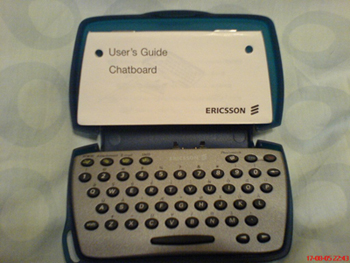 The SMS standard used in Europe was GSM, but the US used three separate standards: TDMA (Time Division Multiple Access), CDMA (Code Division Multiple Access), and a GSM variation that, much like the American NTSC television standard abandoned in 2009, was incompatible with numerous global territories. A Verizon Wireless customer in 2000 could not send a text message to a AT&T Wireless customer. And this lack of global SMS compatibility, together with the then-awkward requirement of typing an email address before sending a text, didn’t exactly win customers over.
AT&T Wireless got many of its customers hooked on text messages by offering SMS for free through February 2001. (AT&T would initially charge $4.99 for 500 messages a month, a considerable bargain compared to Verizon’s text message rates today.)
One unexamined consideration is whether Verizon, which owned and maintained all the pay phones in the New York subway stations, deliberately let these pay phones fall into disrepair. After all, why not move these disgruntled pay phone customers onto cell phone plans? And why not work with the city to establish a cell phone network within the cavernous subway system? Verizon, as it turns out, was better at repairing pay phones in 2000 than the year before under Bell Atlantic. According to the Straphangers Campaign, 18% of subway station pay phones were broken in October and November of 2000 (compared to 25% in August 1999). Whether the drop came from reduced crime or reduced pay phone use, it is difficult to say. But as Farouk Abdallah of the Straphangers pointed out at the time, Verizon’s contract with the MTA called for 95% of the pay phones to be “fully operative and in service at all times.”
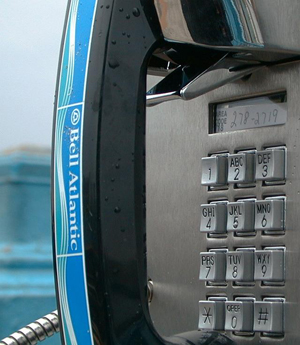 Pay phones, however, were on the wane. When the City of New York announced that it would construct 2,262 new public pay phones, a number of Upper East Side residents, who presumably possessed the expendable income needed to pay for a cell phone, complained about the 1,000 pay phones appearing in their neighborhood. Never mind that only half of New York residents had cell phones and 20% of residents in poorer neighborhoods didn’t even have regular phones. The pay phone kiosks would be an eyesore. Verizon, interestingly enough, did not apply to operate the new phones.
Three months before the United States would enter a nine-month recession in 2001, shares in Verizon fell $3.94 on December 20, 2000 to $51.88. Despite the 3,500 DSL lines that Verizon claimed it was installing daily, Verizon seemed more interested in promulgating financial projections for 2001 and 2002 rather than coughing up any data about the present. (Lucent, that seemingly dependable equipment vendor who had bet the farm on vendor financing, announced two days later that it would lose more than it had anticipated and that layoffs were forthcoming.)
And the customers wanted more. They wanted nationwide coverage that wasn’t lossy. Analysts suggested that the infrastructure wasn’t there and couldn’t support the dramatic uptick in customers. Could the customer understand that a cell phone was entirely different from a landline? Did they know the difference between an analog and a digital phone? Did they understand that using all those minutes in the package was a trap to get customers reliant upon cell phones? Did they consider that maybe it was the telecom companies who held all the cards in the relationship? Or perhaps increasing and often unreasonable demands were a way for the customer to feel that he had some power or confidence?
The History of Verizon, Part Three (September to October 2000)
[EDITOR’S NOTE: About a year ago, I began a comprehensive history about the expansion of Verizon. I don’t know if I will ever finish the narrative, because the story is quite complicated. But here is the next installment in the series. Part One, which concerns itself with April to August 2000, can be found here. Part Two, which concerns itself with August 2000, can be found here.]
With the August strike eating eighteen days of steady service, Verizon Communications faced a considerable delay in work orders. There were 50,000 delayed repairs and over 200,000 orders for new service that needed to be fulfilled. And if a customer wanted to go to another competitor — such as AT&T or MCI WorldCon — well, that customer would end up facing the same delays. Because by the summer of 2000, these companies relied heavily on Verizon’s networks.
There were, however, positive developments from the new contract emerging from the strike. In early September, Verizon offered its 210,000 employees 55 million shares of stock options. 85,000 union workers would receive 100 shares a piece. Verizon Wireless employees weren’t included in the contract, but this was a victory for the unionized workers. For analysts were also suggesting that Verizon stock was a good buy.
Customers service reps, bearing the brunt of too much stress, were given five 30-minute breaks each week. The new contract also made it difficult for workers to be shuttled around from one national region to another, which caused BusinessWeek to raise an opportunistic eyebrow. The New Economy demanded “labor flexibility,” which seemed to BusinessWeek to involve unhitching one’s residential roots like a serviceman constantly on the move from one military base to another. (Ironically, there had been four rounds of base closures over the past twelve years, where some 152 bases were closed or curtailed courtesy of legislative efforts from Rep. Dick Armey. Perhaps it was believed that the New Economy’s private entrepreneurship might miraculously provide for government workers shifting around in the Old.)
Still, as New York Times labor reporter Steven Greenhouse pointed out, the Verizon contract — like the Firestone and United deals at the time — had worked out somewhat well for workers because the industry was unionized. Unions had sacrificed their power in the past four decades, but at least one remaining bundle of workers was able to secure a victory. Not even the steel or the auto industries had been able to do this in the 1980s without some serious backpedaling.
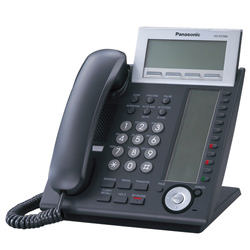 For eager customers, however, the more important question was whether or not Verizon could roll out its DSL services faster. Verizon, like Flashcom, was sometimes taking as long as six months to install DSL service, particularly in New York. In New York, Verizon blamed the problem on the ancient wiring systems. But since Verizon remained in control of the telephone wires, perhaps Verizon’s failure to roll out DSL service had more to do with the competitors. If Verizon held out in New York, other companies would have to expend considerable resources building their own wires. Road Runner, however, continued to flourish with its cable services.
Verizon approached this competitive dilemma by slashing its DSL prices in some territories from $49.95/month to $39.95/month. The augmented coverage territory secured by the GTE-Bell Atlantic merger would result in reduced prices for both residential and business DSL service. And the DSL modem was free if the customer committed to a one-year contract. But was it really free? Sure, you’d save $120 in one year if you signed up for a one-year contract. But the modem itself was worth only $99.
As Forbes‘s David Simons observed, the $39.95 price point was a boon for mass adoption, even if it wasn’t particularly profitable for ISPs. (And if you were a smaller ISP, you’d pay more for the installation and upkeep of a DSL line. ISP Planet‘s Jim Wagner pointed out that the $39.95 price point gave other providers only $7.45 a month to earn back service costs, as wel as the $400 installation.) Perhaps the strategy here was to get Verizon customers hooked on long-term contracts, with an emphasis on high-volume profit by giving customers extra incentives to sign on for other services under the “savings” imprimatur. Verizon also offered two other deals that year: a 30-day money back guarantee and $5 off every month if you also had one of Verizon’s local calling packages. Aggressive marketing helped spread the message.
The question of just how aggressive Verizon was in 2000 with its customer sales representatives may not be easily answerable. But there are some suggestions that Verizon customers were not only signed up for DSL service that was not only unavailable in their area, but forced into two-year contracts. A former Verizon worker posted this story to complaints.com in July 2001 (I preserve the spelling and grammatical mistakes):
After going through the so called ‘training’. A group of about 20 of us were thrown to the ‘wolves’, so to speak. After a few weeks of lying to people…my conscience started bothering me. It was a particular customer, an old lady…very sweet. She reminded me of my grandma. She literally started crying on the phone, About how she could never get connected to the internet. The first thing I did was to check to see if service was even available in her area, or if some ass had sold her “verizon high speed internet” some where, where it wasnt even available.(I had already seen a few cases where customers had signed 2 year contracts, and they didnt even have service in their area!). And sure enough, after I checked on the system…the service wasnt even available in her area. I just told her the truth “mam, verizon high speed dsl internet service is not even available in your area….” she had been going back and forth with “Technical Support Agents” for about a year…and no one had even told her that service wasnt even available in her area. Yet she was signed up for a 2 year contract and was even paying!
The Associated Press’s Peter Svensson reported in September 2000 that Verizon was even putting a stop to other ISPs who were using Covad lines. A Brooklyn customer named Dana Smith hoped to get DSL service through a smaller provider who used Covad. But since the DSL installation involved her Verizon landline, Verizon was uncooperative and hindered Covad’s attempts to fix problems on her line. And when she called Verizon, the company tried to sell her on its DSL service.
The FCC became Verizon’s unwitting accomplice. In October 2000, the FCC considered rules forcing commercial landlords to allow any telecommunications carrier (referred to as a “CLEC,” which stands for “competitive local exchange carrier”) access into its buildings to install new lines. In mid-October, the FCC ruled 4-1 in favor of the CLECs. The landlords lost. And it seemed as if the tenants had won freedom of choice. But how many of the tenants had to contend with Dana Smith’s scenario? If “choice” involved being steamrolled into one-year contracts through deep discount price cutting and uncooperative skirmishes with Covad, did the customer really opt for the service?
 It’s worth pointing out that Verizon did listen to its customer base from time to time. The company had pulled its ads from Dr. Laura Schlessinger’s show after Schlessinger had uttered hateful remarks about gays.
While Verizon wasn’t winning any friends among the early adopters, the telecommunications giant was then boasting that those who called for directory assistance were now spending 3.6 seconds on the phone, compared to 5.5 seconds in 1996 under Bell Atlantic. (Customer service, of course, would prove to be an issue for Verizon in the years to come.)
In mid-September 2000, the Justice Department had also approved Verizon’s purchase of OnePoint. (Here are the FCC documents.) OnePoint, known for providing high-speed Internet services in nine major metropolitan markets (particularly apartment buildings), would permit Verizon to expand its DSL service. (Indeed, Verizon didn’t waste any time. Only one month later, OnePoint was building a 4,000 square foot telecommunications facility in Atlanta.)
Meanwhile, on the mobile phone front, on August 31, 2000, the Justice Department granted approval for a merger between SBC Communication and BellSouth, making it the nation’s second-largest mobile-phone company. The new venture combined 17.9 million subscribers, just trailing Verizon’s 25.4 million customers. (The competition was also heating up on the local phone service front. By October 2000, SBC had revealed hopes to nab $1 billion in local service revenue over the next two years.)
Verizon responded to this competitive threat by amping up its advertising. In addition, Verizon had settled upon Burrell Communications Group to handle a brand introduction campaign. These advertising costs were estimated somewhere between $20 million to $30 million.
As Verizon continued to expand its operations, the erection of copious cell phone towers spawned some controversy. In addition to the cell phone tower’s eyesore aesthetic, Tiburon telecommunciations consultant Ted Kreines observed real estate prices drop for property near the towers. At the time, Verizon spokeswoman Tracey Kennedy noted that Verizon was doing its best to keep facilities from looking unsightly.
Verizon’s aggressive efforts to woo its customers for flashy services at cut-rate prices weren’t limited to DSL. Near the end of September, Verizon hit upon a strategy to target mobile phone consumers. A new program called New Every Two offered a customer a free cell phone if the customer signed on for a two-year contract. There was also the option of a phone upgrade. Verizon was the first of the then six wireless carriers to offer these options.
And in October 2000, the Vodafone Group, which was Verizon Communications’s partner in Verizon Wireless, was also eyeing Eircom, an Irish telecommunications conglomerate. A brief summary of Irish telecommunications: Telecom Éireann was a company assigned to overhaul the Irish telecommunications structure. The company, with a majority stake owned by the Irish government, exceeded its expectations and converted the entire network to digital by the 1990s. But in 1999, the Irish government sold off its 65% stake. Eircom was the parent company of Eircell, which represented the mobile division of Telecom Éireann. In other words, a company, largely bankrolled by a government, that had built up one of the most effective telecommunications networks in the world was gobbled up by one of Verizon Wireless’s principals. Innovation built with public money was snatched up by Vodafone in 2001, and Eircell became Vodafone Ireland, a private entity that sponsored Who Wants to Be a Millionaire? without apparent irony.
Verizon Wireless was also expanding on local fronts. On October 10, Verizon Wireless acquired 24.2% of Sacramento Valley L.P., which provided cell phone service in Northern California and Nevada. (Verizon’s stake in Sacramento Valley L.P. was now more than 76%.)
With all this buying and all this expansion, was an initial public offering in the cards? There was an initial plan in mid-October and the IPO was expected to bag about $5 billion, but economic conditions scrapped that. It was expected that the IPO would take place by the end of 2000. (As it turned out, the IPO was delayed considerably longer.)
There were also a few innovations that anticipated application developments on the smartphone. Years before Snaptell, Verizon teamed up with BarPoint, where Verizon customers could punch a bar code into their phone and determine how much it was at an online store. (BarPoint, which would wither away like many companies of its type, may have had the right idea at the wrong time.) Verizon also had an idea of charging customers $36 a year to list their email addresses in the phone book, little realizing that such information would be instantly findable through search engines in very little time.
 Verizon took great care in presenting itself as a corporation that cared about the public. In October, Verizon spokesman Kevin Moore praised a New Jersey Senate study to examine whether cell phones distracted drivers. (Of course, Verizon’s message always changed with legislative developments. A mere seven months later, another Verizon spokesman named Howard Waterman begged then New York Governor George Pataki to wait three years on banning cell phones in cars. Waterman didn’t mention public safety or distracted drivers. His motivation for the delay was “to allow wireless customers time to upgrade their phones because some of them simply do no have handsfree capability.”)
Verizon had a terrifying knack for transforming its message and its motivations seemingly overnight. The spokesman you dealt with today might be somebody else tomorrow. One division might be another or absorbed into another next month. A small carrier leveraged out during this expansionist fervor might have its stationery replaced by Verizon in weeks. At least the unionized workers still had some protection. But the customers accepted all this without question. The economy was in bad shape. There were exciting technological advancements, such as cell phones and DSL, to be had for a pittance. But would any of us know the real prices we paid for our convenience?
The History of Verizon, Part Two (August 2000)
[EDITOR’S NOTE: This is a continuation of my ongoing history of Verizon. Part One, which covers the months of April through August 2000, can be found here. Part Three, which covers the months of September through October 2000, can be found here.]
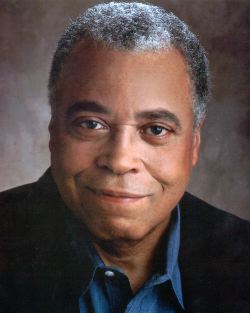
James Earl Jones, the voice of Darth Vader, became the voice of Verizon. Jones had proved popular as the voice of Bell Atlantic and his services were extended to talking up this new brand with his instantly recognizable baritone. But the Baltimore City Paper‘s Joe MacLeod was having none of this. “You never once in your whole entire life said the word, ‘Verizon,’ I’ll bet, unless you knocked back too many highballs or were wacked out on that Special K or Vitamin C or one of those other letters, but now you’re going to say ‘Verizon’ all the time like it’s a real word, and you’re going to write checks to Verizon and call Verizon, and say stuff like, ‘The goddam Verizon’s on the fritz again.’ But it’s not. There’s no such thing as a Verizon. Don’t believe James Earl Jones. It’s a made up bullshit word, and they (and you know who ‘they’ are) probably paid James Earl an ass-load of money to pitch the Verizon on the teevee.”
Whatever “ass-load of money” was paid to Jones, eight years later, Verizon’s name now trickles across the cochlea without cognitive dissonance, thanks in part to Jones’s efforts. The campaign, overseen by Bozell, ensured that the last dregs of Bell Atlantic would be cast asunder for this great leap forward. Jones would later use his position at Verizon to siphon off a hearty combo of Verizon and NEA money for a Magna Carta exhibit, present a $25,000 literary-tech grant to a San Ysidro school, present literary grants, and hand off awards to Russian cinematic talent. In 2002, Jones, testifying before a House Subcommittee on Education Reform, would declare, “I could not be more proud to be associated with an exceptional company like Verizon.” Even when speaking at the 2007 Buffalo Book Fair on literacy, Verizon was indelibly attached to Jones’s words.
In 2007, Jones walked away. While Jones served as a pitchman, Verizon’s contract had restricted Jones from any long-term commitments. Jones’s contract kept him off the Broadway stage until 2005. Jones, in fact, would not appear in any films between 2001 and 2004. In an interview with NWA WorldTraveler, Jones explained, “[Verizon] let me be silly for 15 years on camera — breakdancing and all that. I was as silly as I dared get. They understood that this guy usually is taken as dignified, with a big voice, so they said, ‘Let him be silly,’ and it’s worked!”
But was this really a position for an actor of Jones’s dignified stature to be in? How many dramatic presentations or Broadway performances were lost because Verizon required his services? With a strike heating up in August 2000, the Workers World News Service went further: “Who’s on the board of directors? Not James Earl Jones.” The WWNS proceeded to name names. “Your may not see these folks in the Verizon ads. You may not see their faces on your telephone bill. But these corporate interests are part of the system of exploitation that dominates our lives from telephones to political offices.”
But was Verizon really maintaining a system of exploitation? Or was it just practicing the most ruthless business practices necessary to get ahead?
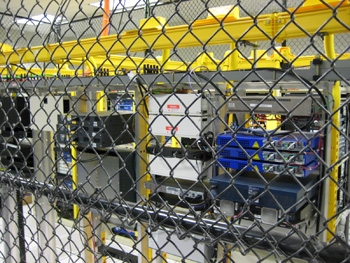 With the Bell Atlantic-GTE deal receiving FCC approval, Verizon began making quiet payments to ensure its continued expansion. GTE paid $2.7 million to end an inquiry concerning allegations that it had refused to let local phone equipment in GTE offices without the construction of special facilities. Even though the FCC permitted local phone companies to place equipment at their central offices, GTE had insisted upon special equipment cages. The FCC had permitted the local phone companies to place their equipment in COs without the cages, but that hadn’t stopped the phone companies from complaining. Thankfully, money was one of those magical mechanisms that helped end such gripes.
Meanwhile, the forthcoming strike threatened to halt Verizon operations. More than 86,000 telephone workers from Maine to Virginia planned to walk out. On August 4, 2000, Verizon submitted a proposal to the unions. Verizon agreed that it would increase wages by 3 to 4 percent a year for union employees and improve pension plans. But with the income disparity between union and nonunion workers still unaddressed, and the details on job security and very specific demands still unclear, the unions balked. As one particularly prescient Verizon worker said, “Because the company would rather farm out work, this means one company installs the line on the outside of the building, which is us, and another on the inside, which is them. This results in a big headache for the customer, who has to be at home for two days instead of one, and a loss of income to a nonunion company.”
There are other interesting figures to consider here. In 2000, Verizon’s wireless operations generated $532 a year in revenue from each customer. A telephone company customer earned a meager $324 a year. Verizon’s wireless employees were nonunion and its telephone company employees were union, thus resulting in considerably more revenue from its wireless operations. In other words, Verizon had a vested interest in ensuring that its wireless employee basis would remain nonunion. In a competitive market and a declining economy, profit was king. And one Wall Street analyst, speaking to the New York Times under anonymity, suggested that if Verizon’s wireless unit were completely unionized, it would cost the company $300 million a year.
On August 7, 2000, with no negotiations in sight, the workers walked out. Basic services were not affected, but repairs and installations were. Verizon created a stopgap by deploying 30,000 managers — all working 12-hour shifts — to cover services that were normally performed by employees. One technician opined of the managers, “‘I think none of them are qualified to do what we do. Most of [the managers] were educated in college, but they’re not technically inclined.”
The union members were dressed in red, picketing in solidarity. One customer service reporter told the New York Times that she was “tired of being treated like a second-class citizen within the company,” but declined to give her name. Verizon had informed employees that they would be fired if they discussed joining the union at work. Most of the striking workers were former Bell Atlantic workers. The GTE units were not directly involved.
News of the Verizon strike hit many outlets, but some overlooked the company’s considerable expansive efforts. As The Motley Fool‘s Chris Rugaber reported, “While that story is important, investors interested in the telecom sector should pay just as much attention to the company’s announcement yesterday that it has already signed up 1 million long-distance customers in New York.” The company’s goal was to reach the one million mark by the end of 2000, but Verizon was five months ahead of schedule. Verizon pledged to donate $1 million to New York charities to celebrate this achievement.
By August 8, 2000, the strike had gone on for three days, with neither side coming to an agreement. “We continue to frankly plug through some of the more difficult issues that confront us,” said Verizon spokesman Eric Rabe. “It’s become sort of an intense, exhausting sort of a process.” Rabe claimed that there had been 455 acts of vandalism, violence, and harassment of Verizon managers over the previous six days. Eggs and bottles were thrown at those who crossed picket lines. Verizon offered a $250,000 reward. These acts went further. On August 8, 2000, the New York Times reported that vandals had begun slashing telephone cables in New York, causing thousands of New Yorkers to lose service. But Communications Workers of America vice president Al Luzzi declared, “We don’t condone vandalism; we never did, we never well.” Luzzi suggested that Verizon managers might be responsible for the cut cables. Nevertheless, two striking Verizon workers were nearly electrocuted when they confusedly cut through a power cable that they believed to be a phone line.
James Henry, a Bear Stearns analyst, observed that if the company could maintain service without its 85,000 employees, this would be an effective marketing tool. One that would give the company solvency, so long as the strike didn’t last beyond a week. Indeed, in the early days of the strike, Verizon customers did not experience considerable disruptions in phone service.
That same day, Verizon announced that it would be teaming up with NorthPoint to build a new broadband company. The move was on to shift broadband services to DSL. Lawrence T. Babbio, Verizon’s vice chairman and president, boasted that he was putting in 3,000 DSL lines a day. With the new company under NorthPoint’s name, Verizon was looking at a service capacity of 600,000 DSL lines. With Verizon making an $800 million investment in the new company, with $450 million of these funds allocated to network expansion and product development, NorthPoint only needed federal approval, which was expected in mid-2001. NorthPoint was an appealing acquisition because of its business customer base. Business customers could be counted upon to generate more revenue than the garden-variety consumers that Verizon had within the Bell Atlantic network.
But in November, Verizon decided to pull out. Verizon claimed that it terminated the deal because it didn’t care for NorthPoint’s deteriorating business and operating conditions. NorthPoint, counting upon the $800 million, was apoplectic. Said Liz Fetter, NorthPoint’s Communications President and CEO, “I am stunned to get the news after months of conversations with Verizon on the strong business opportunities available to the combined entities. Verizon was not entitled to terminate these agreements, and we are exploring all our options, including funding options and legal remedies.”
There was no breakup fee for terminating the deal.
NorthPoint had seen its stock decline from $39.12 a share to $2.50 a share in just under a year. The Verizon setback caused NorthPoint stock to plunge to a mere 75 cents per share. Verizon’s stock, by contrast, gained 81 cents that same day. Brown analyst Michael Bowen said to CNN, “If they lose Verizon they don’t have much of a future.” Sure enough, Bowen was right. After a round of lawsuits that NorthPoint had filed against Verizon, a NorthPoint shareholder sued NorthPoint about accounting malpractice. Because of these circumstances, 19% of NorthPoint’s workforce was laid off just before Christmas. In March 2001, NorthPoint would eventually file for Chapter 11.
Did Verizon have every intention of backing out of the NorthPoint deal? It is difficult to say with any accuracy, but I do intend to investigate this.
 It should be pointed out that NorthPoint enjoyed a great success between 1999-2000, with its stock rising 68% on its first day of trading (like many dot coms) and alliances brokered with the likes of Microsoft. Led by CEO Elizabeth Fetter, a 41-year-old antique collector with a penchant for restoring historic homes, NorthPoint had relied on the Baby Bells to install DSL, but was often dissatisfied with the speed at which it could roll out its service. And although the future looked bright for NorthPoint (and fellow competitor Covad) in light of recent regulatory advantages, NorthPoint had been hit, like many, by the downturn in the economy. Verizon’s cash influx was just the kickstart that would help NorthPoint expand. But NorthPoint, expecting a fair deal, relied on the money instead of questioning it.
So why did Verizon go after NorthPoint? Did it make similar overtures to Covad? Was NorthPoint simply too hungry to expand? And why didn’t NorthPoint’s counsel ensure that the Verizon deal was airtight? Did Verizon see NorthPoint as a competitor it could whittle down? Or did it have even some intention of cooperating with Verizon all along? These questions will require investigation.
On August 9, 2000, the New York Times reported that Verizon and the unions were nearing a negotiation that “might make it easier for the unions to organize workers” at the Verizon Wireless unit. But the strike had heated up. Verizon reported 455 strike-related incidents of assault, harassment, and vandalism to the police in twelve states. With the New York summer heat rising, tempers were too. A Verizon maintenance truck run by a nonunion Verizon contractor was battered and remained stuck under a maintenance gate when a striker gained access to the gate’s remote control. New York State Supreme Court Judge Louis York granted a temporary restraining order that barred picketers from preventing workers and managers from conducting their work. Verizon increased its $10,000 bounty to $25,000.
On August 8, 2000, Verizon’s shares plunged, dropping 14%. It was Verizon’s sharpest one-day freefall since 1987. The NorthPoint deal hadn’t helped. Nor had Verizon’s bid to acquire OnePoint Communications. The terms of the OnePoint sale were not disclosed, but OnePoint was known for the DSL services it provided to apartments and office buildings in nine major U.S. metropolitan markets. Unlike NorthPoint, OnePoint had remained private.
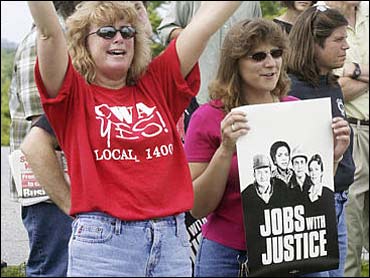 Back on the picket lines, the struggle remained tense. 24 union members had been arrested. Waste and birdshit were tossed upon five Midtown South Precinct officers monitoring picket lines, dumped from the top of Verizon’s 41-story headquarters. The police did not plan to rule out management or strikers. And the 8,000 workers protesting outside Verizon’s headquarters participated in a rally the next day that spilled over into Bryant Park. Even presidential candidate Ralph Nader made an appearance on the Fall Churchs, Virginia picket line. Meanwhile, one advertisement featuring a Verizon worker in a hardhat with the slogan, “Bell Atlantic has a new name,” remained in circulation.
Some commentators, such as the New York Times‘s Mary Williams Walsh, suggested that the customer-service complaints had become a new labor issue. Walsh pointed to Verizon’s requirement by CSRs to ask customers, “Did I provide you with outstanding service today?,” which made at least one feel like an idiot. But if the CSR did not answer the question, then a supervisor listening into the call would deduct points from the performance score. Was the burden of having to be nice all the time something to fight over? Walsh depicted the typical Verizon worker working four hours in the morning, four hours in the afternoon, with an hour off for lunch and two 15-minute breaks. But the stress arose because a supervisor kept track of every workstation using a color-coded grid. In one glance, the multihued squares would reveal whether a CSR was keeping someone on hold for too long and when a CSR signed on and off. One CSR named Patti Egan pointed out that there was only a two-second window between calls, without time to type up the order of the last caller. Often, unfinished orders were set aside, to be presumably completed during one spare two-second moment. Factor in the pressure for CSRs to upsell callers on features and the incentive for a call center to sell $60,000 worth of products a month if the CSRs want to move out of customer service and into jobs without sales duties, and the pressures that the workers were fighting for became all too clear.
By August 14, 2000, Verizon had made a new offer to the unions. But Communications Workers of America spokesman Robert Master declared it “old wine in new bottles.” But the picketeers has started to thin. The thousands of workers who had struck in the previous week had been reduced to 750. Nine days into the strike, employee Danny Marino remarked, “I didn’t think that it would come to this, definitely; I thought this would last only two or three days.” He had been married the previous month. Meanwhile, managers continued to take care of the 80,000 requests Verizon was receiving each day.
On August 16, 2000, the unions declared that they would break off negotiations with Verizon if they could not reach an agreement by midnight the next day. Mandatory overtime and job security remained the two 900 pound gorillas swinging in the room. But the next day, the workers continued talking past this deadline
As the strike took a considerable toll on Verizon’s stock share and federal rules prohibited companies from owning more than one license in a metropolitan market, Verizon unloaded wireless franchises in Chicago and Cincinnati to an investment group led by J.P. Morgan.
Finally, Verizon and the unions reached a tentative agreement. Nonunion wireless employees were permitted to organize. Two-thirds of the strikers settled on a contract two days later. The workers agreed to a three-year contract, procuring a 12% wage increase over three years. And Verizon had imposed a condition upon wireless union organization: if 55% of the employees at a work location agreed to sign cards, they’d have a union. Union telephone workers won the right to conduct more work, such as the installation of high-speed Internet lines. Mandatory overtime would be reduced, but it would still be mandatory. On the work stress issue, the unions were given five 30-minute periods each week whereby the CSRs could perform work that didn’t involve calls. But the two-second window between phone calls had gone unacknowledged.
Three years later, when the contract ran out, there would be another strike. But the next time around, Verizon would not cave. Verizon and the unions would agree to a new contract in September 3, 2003, with a one-year wage freeze, new hires not covered by the job security provisions, and one that would last five years. Five years. The precise length that Verizon had insisted in 2000. The precise length that had worried the unions because of the rapid changes in the telecom industry.
Yesterday, the New York Times reported that the unions were preparing to strike again. The numbers now? 86,000 in 2000. 65,000 in 2008. I will examine how this workforce figure was reduced and go into the 2003 strike in forthcoming installments. But for now, I’ll simply observe that the renegotiated five year contract expires on August 2, 2008. Whether the Communications Workers of America and the International Brotherhood of Electrical Workers will learn a few lessons from these previous two strikes remains to be seen.

The History of Verizon, Part One (April to August 2000)
[EDITOR’S NOTE: This is an experiment to see how blogging might be used to make sense of a rather enormous series of events. In an effort to understand why Verizon (formerly Bell Atlantic) became such a dominant force in the telecommunications industry, I am initiating the first in an open-ended series of inquiries that will be relying upon newspaper articles, public records, interviews, and any additional information I can get my hands on. My first step is to assemble a timeline with the available information. From here, I will then begin interviewing related parties to put these facts into perspective. I will be updating all of the posts as new information comes in. Please feel free to contribute any additional thoughts or leads in the comments section.]
[Subsequent installments: Part Two (August 2000). Part Three, which covers the months of September and October 2000, can be found here.]
In April 2000, Bell Atlantic was working out the details of a merger with GTE it had initiated the previous year. The deal was nearly done, awaiting FCC approval. But Bell Atlantic’s wireless communication unit needed a new name. Bell Atlantic’s wireless unit was in the process of merging with the wireless division of Vodafone AirTouch.
Bell Atlantic had been formed in 1983. It was one of seven Baby Bells that had been formed in the aftermath of an antitrust suit filed against AT&T by the Department of Justice. Seventeen years later, with the Bell Atlantic-GTE merger set to make the new entity the largest local telephone carrier in the nation, Bell brass believed that the Bell brand was too old school, too dowdy, to fit in with the then contemporary emphasis on cutting-edge technology.
“‘We believe that we need to separate ourselves on a going-forward basis from the tradition and the limited perspective that a Bell name assigns to us,” said Bell Atlantic executive Bruce S. Gordon at the time.
The new name was Verizon, a clever case of lexical blending between “veritas” and “horizon” that was to find its way in only a few short years onto millions of cell phones, the logo attached to the apices of many skyscrapers.
 Bell Atlantic had been perfecting an ambitious advertising campaign over several months that hoped to convert both Bell Atlantic wireless customers and Vodafone customers over to the new Verizon brand. Bell had employed the services of the Bozell Group, part of True North Communications. Bozell was best known at the time for its milk moustache campaign, which had featured pop culture figures such as Austin Powers and Lisa Simpson smiling with a thin strip of milk just above their upper lip. (When True North purchased Bozell in 1997, the deal made True North the sixth largest advertising company in the world. Bozell had rejected an offer from Omnicom, but True North had pledged to respect Bozell’s autonomy. This purported autonomy, however, proved incompatible with economic realities. In 2001, Bozell laid off 6% of its staff and “restructured” the creative department.)
The early Verizon logo featured the “V” sign in red, an attempt to mimic the Nike swoosh symbol. Was it an accident that both Vodafone and Verizon began with a V? According to New York Times reporters Stuart Elliott and Seth Schiesel, one person close to the campaign revealed that it was not.
By June, Lucent Technologies was named the primary equipment supplier to Verizon Wireless. Its stock jumped up from 3 1/4 to 59 7/8 a share on June 15, 2000. According to a letter of intent issued by Lucent, Lucent would provide network equipment to Verizon. And this relationship would then help Verizon to expand from the wireless business to high-speed Internet services, among other telecommunications possibilities. Verizon hoped that the Internet access might be one way to encourage customers to use their phones more frequently.
Two days later, on June 17, 2000, the FCC approved the Bell Atlantic-GTE merger, with the proviso that GTE would agree to spin off its Internet backbone operations. Verizon became the nation’s largest local telephony company.
Numerous documents about the merger, including the FCC’s specified conditions, can be located here. In his statement issued after FCC approval, FCC Chairman William E. Kennard noted, “By requiring that the Internet backbone asset be spun-off and through the other merger conditions, we have preserved the fundamental incentive structure of the Act, sought to stimulate competition, and to promote more and better service offerings for consumers. For these reasons, I support this merger.” In light of recent Verizon developments that have called these “more and better service offerings” into question and Verizon’s current presence on the Internet (to say nothing about the way in which Verizon skirted around the GTE condition, described below), and notwithstanding Kennard’s competitive position as a member of the Board of Directors at Sprint Nextel, one wonders whether Kennard would still support this merger. I hope to contact Kennard and see if he might offer an answer.
However, it’s worth observing that Kennard joined the Carlyle Group as a managing director shortly after resigning from the FCC in February 2001. Carlyle purchased Verizon Hawaii for $1.65 billion. On May 22, 2004, Kennard was quoted by the Honolulu Star-Bulletin about this deal: “A big part of our plan is to return Verizon Hawaii to its roots as a local phone company, empowering local management. It’s sort of a version of ‘Back to the Future,’ if you will.” Whether this flippant comparison to a Hollywood blockbuster movie was intended to insult the journalist who posed the question is unknown. But the purchase did earn the endorsement of Verizon’s union, even if competitors and Hawaiian locals expressed dismay with the Carlyle Group’s inexperience and connections with high-level political contacts. By 2007, however, Hawaiian Telecom (the new name of the company) had experienced serious problems when BearingPoint, Inc. — the consulting firm hoping to overhaul Verizon’s systems — couldn’t make it work and was ousted in favor of Accenture, Ltd. — best known for its role in Enron. If this was a case of Back to the Future, perhaps Kennard was more accurate than he realized. Relying on outside consulting firms seemed decidedly against Kennard’s promise to “empower local management.” And indeed, earlier this year, Hawaiian Telecom’s CEO was ousted in favor of interim CEO Stephen Cooper (Kenneth Lay’s replacement), more than 100 positions were axed, and Hawaiian Telecom was still pursuing a decidedly nonlocal restructuring plan to recover from its problems.
 Whatever Kennard’s current feelings are for Verizon, one thing is beyond dispute. The FCC’s approval of the Bell Atlantic-GTE merger made Verizon the 2nd largest telecom company (after AT&T), permitted it to become the nation’s largest wireless operation, and made it a local telephone juggernaut. Verizon now had 63 million landlines across the country. In its first day of trading, Verizon’s stock rose $4.625 to $55 a share.
On July 4, 2000, the New York Times reported that Verizon was trying to sell off its GTE cable systems in Florida, California, and Hawaii. And to get new customers hooked, Verizon cut the prices of DSL by 20% in some parts of the United States. So while the GTE cable backbone was, per the FCC condition, technically being cut off, Verizon managed to augment its Internet services through the phone lines. Verizon, in other words, was merely swapping one type of broadband services for another. (And, indeed, that same month, the New York Times‘s Seth Schiesel would report that Verizon hoped retake ownership of Genuity, the cable network in question, in a few years.)
But it wasn’t enough for Verizon to use its legerdemain to flaunt the deal of the Bell Atlantic-GTE deal. Verizon’s legal team also felt compelled to rail against the FCC. On August 21, 2000, William Barr, the top attorney for Verizon and a man who had served as the 77th Attorney General under President George H.W. Bush, fulminated against the FCC at the Progress & Freedom Foundation’s Aspen Summit 2000 conference. In a panel titled “Perspectives on the Future of Telecom Regulation,” Barr took issue with the language of the 1996 Telecommunications Act: specifically, the manner in which the Bells were instructed to charge competitors at affordable prices in order to use their networks and discourage monopolization.
“Rather than letting the market drive competition,” said Barr, “[the] FCC has issued a host of rules to try to manage that competition and, in doing so, they have preserved a siloed approach.” This “siloed approach” also extended to the FCC’s organization itself, which was divided into separate divisions devoted to wirelsss, broadband, and telecommunications. “This comes at direct expense of intermodal communications, and it is disfiguring the telecom landscape as it evolves into the Internet landscape.”
(Eighteen months later, Barr would get his wish. At the beginning of 2002, the FCC began a campaign to reorganize its bureau. A Wireline Competition Bureau was established, containing the vestiges of the Common Carrier Bureau. In March, additional structural changes were made. The impact of these internal structural changes at the FCC, as they pertain to Verizon and the telecommunications industry, will be revisited in a future installment.)
Meanwhile, with AT&T facing both the burgeoning success of Verizon, as well as SBC Communications’s entry into the long-distance business in Texas, AT&T chairman C. Michael Armstrong was starting to get nervous. The man who had made IBM shine was now fighting for his life, working 18 hours a day, trying to figure out a way to combat flagging revenue. But what Armstrong didn’t know was that long distance plans were about to change in a very big way.
But Armstrong wasn’t going down without a fight. In July 2000, AT&T filed a federal complaint charging that Verizon was steering its customers illegally to its own long-distance service. AT&T charged that Verizon had failed to offer new phone customers a listing of long distance providers, as required by law.
Adding insult to injury on the long distance front, on July 18, 2000, a Federal appeals court ruled in a case that has serious consequences for AT&T and granted Bell Atlantic a great victory. The court, overturning rules established by the FCC, ruled that outside long distance companies (such as AT&T) using copper lines owned by a local telephone company (such as Bell Atlantic) would have to pay an increased fee to the local telephone companies. Thus, with Verizon offering long distance service through its “local” landlines, it could evade the fees. But AT&T customers would have to pay.
Verizon was also looking to wireless data as a source of revenue. The company had observed the success of Sprint PCS’s Wireless Web, which had been in place since November 1999. (And while Sprint was then the wireless web leader, its wireless network ranked fourth behind Verizon, SBC, and AT&T Wireless. It did not help Sprint any when it was forced the next month to abandon its attempted $115 billion merger with WorldCom.) But how could Verizon get customers to pay a monthly fee of $7 to $10, along with a per-minute fee through wireless data? Web access? With the telecoms engaged in aggressive price wars, they were looking to any possible form of additional income to obtain some leverage. And the then snail-paced wireless web access was having difficulties catching on with consumers. The wireless data revenue would come later through an unexpected source that nobody had anticipated: text messaging. But this was still sometime away.
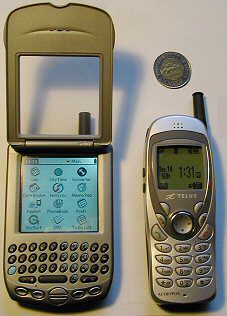 There was some concern over the relationship between third-party vendors offering products to Verizon and Verizon’s dominance in the telecom industry. In July 2000, the New York Times reported that Audiovox, a mobile handset provider, was selling 80% of its handsets to Verizon. “When you have one customer that controls 80 percent of your revenue, they’re basically telling you what to price it at,” said a portfolio manager who had sold 50,000 of her 300,000 Audiovox shares. Sure enough, this portfolio manager’s predictions proved true. In February 2004, Audiovox sold off its cell phone division to Curitel, a Korean manufacturer. Was Verizon’s advantage here one of the motivating factors that caused Audiovox to sell? It’s worth noting that Toshiba had a 25% ownership of Toshiba. One clue into the internecine struggle might be divined by this press release. David Kerr, Vice President of the Strategy Analytics Global Wireless practice, was quoted as follows:
Toshiba wished to be free to exploit its own strong brand with flow-through impacts from its high performance notebooks and other electronics product portfolio. Now, Toshiba is faced with bowing to the wishes of a threatening competitor targeting the same segment Toshiba has traditionally targeted. Toshiba, a minority interest holder at Audiovox, is likely to lose its opportunity for garnering a meaningful share of the 19 million units flowing through to end users at Verizon Wireless.
While Verizon expanded and earned more profits, its workforce was becoming increasingly unhappy. On July 28, 2000, the Communications Workers of America authorized its leaders to call a strike at 12:01 AM on August 6, if Verizon would not meet its demands.
With both Verizon and the unions unable to settle upon a new contract, telephone operators and line technicians walked off the job. Two unions — the CWA and the International Brotherhood of America — represented 33% of Verizon’s workforce. (The CWA represented 72,500 Verizon workers.) One of the major stumbling blocks for this strike involved the employees at Verizon Wireless, the majority of whom did not have union representation. The CWA’s Jeff Miller pointed out at the time that there was a staggering pay difference between a union-covered customer service representative (topping out at a $44,000 annual salary) and a non-union CSR ($33,000). There were also concerns by the unions about undue stress placed upon CSRs. The workers weren’t getting adequate breaks and were often working forced overtime. And the nonunion workers were paying out of pocket for their health plans. In the days before the strike, Verizon took steps to prevent pro-union literature from being distributed at call centers and further asked which of its workers supported the unions. Like the treatment that Verizon would extend to its customers, Verizon was insisting on a five-year contract instead of a short-term contract accounting for the rapid changes in the telecom industry.
Of course, just as it had eluded the FCC, Verizon also had a plan in place to deal with its workers that would eventually involve outsourcing its labor to India. And the exact way in which Verizon overhauled its workforce will be taken up in future installments of this series.