I recently had the opportunity to talk with underground animator Ralph Bakshi. A portion of our conversation appears this afternoon at Vulture, where you will discover the song that was originally going to play during the finale of American Pop. (For the specific reasons why, you will have to wait for the podcast.) Unfortunately, there were space constraints. So what follows is some of the additional material that didn’t make it into the piece. The entire conversation, which includes even more from Bakshi, will be released as a future installment of The Bat Segundo Show. (Please note that edited elements of the same conversation appear both here and at Vulture.)
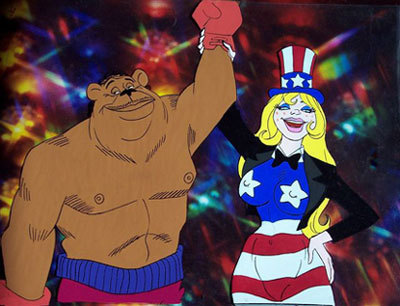
Correspondent: I wanted to ask you about music in your films. It’s certainly important in American Pop. You pilfered from your record collection for that, as well as the “Maybelline” sequence in Heavy Traffic. And there’s “Ah’m a Niggerman” from Coonskin, which you wrote. I’m wondering if you did this because you have an aversion to Carl Stalling-style orchestral music.
Bakshi: First of all, I love music. I’ve always loved music. And I’ve loved various kinds of music. Music is part of our lives. It’s part of the soundtrack that what we all grow up with. Especially in my day. I don’t know today. There’s so many things going on. I’m talking about yesterday and my day, which are the 40s, 50s, 60s, and 70s. Music is so emotionally important to the movie. It’s just as important as anything else. If the song is emotionally correct for a scene, the scene plays better. Or the scene plays better than it would have with a different song. So music is so critical to movies. I chose songs that I knew emotionally worked with these scenes that I wrote. Because whenever I listened to music while either driving in a car or sitting at a bar or listening to Coltrane or Billy Holiday – you daydream. If you don’t daydream to music, then you’re not listening to good music.
I went out and I bought every record that I’ve ever loved that was right for the scene. “Yesterday” by Billie Holiday for Fritz the Cat was perfect for Big Bertha and coming into Harlem. You know, it was a classic song. “Maybelline” and “Twist and Shout.” And all these records. “Scarborough Fair.” All these records I used, I got for fifty to a hundred bucks. They were dirt cheap. I could buy any record I wanted for under two hundred dollars. Why was that? Unbelievable.
Because everybody else was scoring their films. And why were they scoring their films? Because if they had a hit, they’d own the music. They’d make money from the score. They’d own their own records. I can’t release Billie Holiday’s “Yesterday” and make any money out of it. I never considered that. The issue was what was right for the movie. I couldn’t believe the cheap prices I was getting. And I had a low-budget film! So I could afford to get anything I wanted.
Correspondent: But you had Andrew Belling on Wizards. I’m curious if you gave these composers specific instructions.
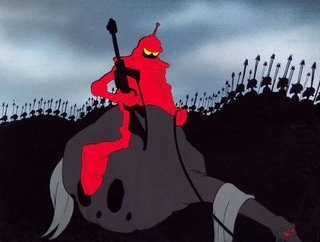 Bakshi: Well, Andrew Belling on Wizards did an absolutely brilliant job. Let’s talk about Wizards. Wizards is very low-budget. One million two. Okay. I’m not going to fall back on my records, because it’s not that kind of movie. I need a score. But I need a score that I love. And I don’t remember how I got to Belling. I’d been to New York with a lot of other guys. But Belling came with a little synthesizer. One little machine which was a very big deal. We didn’t have any orchestra. We had synthesizers. All that music was done with Belling in the room. And he said the right things and he did the right things. And he came back and he played me a piece of music that was beautiful. I think Belling did an incredible job in that song he wrote. And the battle scenes. And the emotion. Belling nailed it. He did it himself and everything. It was all done without an orchestra. It was good.
Correspondent: This is an interesting conundrum. I think one of the reasons why the “Maybelline” sequence in Heavy Traffic is so stirring is largely because of that music. But here you have a scenario in which someone else is composing music that doesn’t originate from another source.
Bakshi: I was terrified what he would do. I was scared. I was nervous. I had nightmares that it wouldn’t work. And he nailed it. I don’t know how he did it. I had nothing to do with it. How do you talk to another composer about music? Now look. Let’s talk about freedom. I demand freedom as a director. I demand the right to fuck up, to do what I want. I am not about to take that freedom away from another artist. If Belling walks in and says that he’s a composer, and I believe what he has to say and I believe that he’s sensitive enough and I believe it, man, prove it. Go do your music. It’s not my job to write the music for him.
(I also discussed with Baskhi why he hired Thomas Kinkade. In addition to the remarks at Vulture, Bakshi also had this to say.)
Bakshi: In the middle of the picture, [Kinkade] stands up and he says, “I’m going away with Gurney for three weeks. We’re traveling cross country.” And I said, “Well, wait a minute. We’re doing a picture.” “All right. We’ll be back on a certain date. We will paint enough before we go. And when we get back, we’ll double paintings.”
He worked with Frank Frazetta. Those kids, Gurney and Kinkade, painted wonderful paintings so fast. And Frank Frazetta would come in — he was a great illustrator – and show Kinkade a lot of tricks. Both of those guys, when they painted other stuff, when Kinkade painted closer to the Ashcan school, which I loved very much, wonderful. He can sell anything. He opened up galleries. He’s building a city now. He’s raised hundreds of millions of dollars. He owns half of California. So I have nothing against Kinkade. He’s funny. He is like Elmer Gantry. He’s ‘s a great painter. But he likes to make money. And he does. He doesn’t like the stuff he’s painting.
Correspondent: But that’s anathema to your position, which is about making it as true and as honest as possible.
Bakshi: By the time I got to Fire and Ice, I was bitter. It’s not my picture. I was burned out. I was through. Though people may like it, I don’t consider that a Bakshi film. That’s a Frazetta film. That’s me not caring. I was burned out. I was tired. At that point, I was gone. And I did. I closed the studio and then I left. I had no emotional interest in Fire and Ice to tell you the truth.
© 2008, Edward Champion. All rights reserved.
Bakshi’s movies scared the shit out of me when I was a kid, especially American Pop.
Jeebus! I grew up in Mpls and used to read HeavyMetal religiously and made the big mistake of showing Wizards to our East German exchange student in 1980.
Thanks Ed for the blast!
[…] excerpts from this program can be found here and here.) BSS #214: Ralph Bakshi [43:33m]: Play Now | Play in Popup | Download […]
[…] excerpts from this program can be found here and here.) The Bat Segundo Show #214: Ralph Bakshi [43:33m]: Play Now | Play in Popup […]