[This is the tenth part in an open series of reports from the New York Film Festival.]
In considering The Northern Land (aka A Corte do Norte), adapted from a Agustina Bessa-Luís novel by director João Botelho and José Álvaro Morais (mysteriously listed in the IMDB as dead, which suggests an intriguing collaboration if you believe in the afterlife), I am compelled to present the following positive facts about Portugal:
- Portugal has a high Human Development Index and is among the world’s 20 highest countries rated in terms of quality of life.
- Portugal is ranked as the 8th freest press in the world. (This beats out the United States, quite a bit, in case you were wondering.
- Portugal has its own form of martial arts called jogo du pau, in which fighters kick the asses of other fighters using staffs.
- As we all know, Portugal’s capital is Lisbon. And as names for capital cities go, this is quite pleasant to say. Because it sounds much colder than it really is. And then after you’ve said “Lisbon” for the seventy-seventh time, you realize that this is a city name with some character.
- According to the CIA World Factbook’s page on Portugal, “Azores and Madeira Islands occupy strategic locations along western sea approaches to Strait of Gibraltar.” I do not know the degree to which the Portuguese population itself is aware of these places of beauty as “strategic locations,” but given that The Northern Land is set in this area, I suspect that, on this level, filmmaker Botelho knew what he was doing.
- You can expect to live about 74.78 years if you are a Portuguese man and 81.53 years if you are a Portuguese woman.
- Portugal’s literacy rate? 93.3%!
And this is only scratching the surface. There are many good things that one can say about Portugal. I am trying to stay positive. This film’s muddled digital look did not help matters. (And should one call this a film if it does not look like a film?)
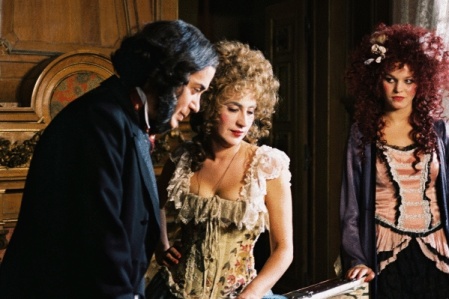
However, I am struggling to find something cheery to say about this film. (Let us be fair and aesthetically progressive here.) On a rather base T&A level, Botelho is to be commended for including one interesting costume featuring a single boob sticking out. No doubt the intention here was to bring a peculiar sartorial quality to the proceedings. But this is essentially a Merchant-Ivory-style film that will put any sensible person to sleep. I should note that I checked my cell phone five times during the course of this film to determine the time, and I am a very patient person. I should also note that this film attempts to express sympathy for a family that is squandering its considerable affluence over the course of a century. In light of the current economic disaster and the egregious bailout bill (a zombie in Congress?) that is currently scaring the hell out of anyone with money, this was not exactly a theme that floated my own particular dinghy.
Botelho also has a rather intrusive narrator describing the action for us. The narrator was so lifeless that I longed for a bon mot from Guy Debord. But here’s the thing. Botelho resists dramatizing this action. And what’s more, he has the characters on the screen frozen in their actions while the narrator continues her plodding narration. And the actors deliver their most impassioned performances while they are frozen. When they are released by the narrator, they became less interesting to me. And I was so disinterested in their lives that I longed for them to kill themselves. Fortunately, Botelho does kill a few of them off. But it’s simply not enough.
This, I would contend, is a bad cinematic strategy. When the most compelling visual that a filmmaker presents is a smug and affluent man sitting naked in a large bathing dish, waiting for servants to douse him with water, I likewise must suggest that the filmmaker has failed in some sense. Let me put it this way. I longed to revisit Bullet in the Head and Serbis.
But that’s just me. This is, after all, the New York Film Festival. And that cultural imprimatur will persuade enough misguided cineastes that The Northern Land is a beautiful film. And it certainly is beautiful in the same way that a particularly striking postcard purchased at Duane Reade is beautiful. The people who inhabit this film are not beautiful. Nor are they particularly interesting.
“This island is killing me,” says one member of the spoiled Barros family. And I suppose that this individual had a point. When your biggest worry in life is a bunch of people laughing at you, and when you declare such a common snafu to be an unmitigated “disaster,” and when the insult itself involves being called a “smelly Boal” (about as tepid an insult in any epoch), chances are that just about anything is going to kill your oversensitive soul. Such is the Barros family.
But if you’re the kind of person who genuinely believes that “I have never looked upon my father as a rich man” is the worst insult known to humankind, I suspect you’ll have a better time at this film than I did.
© 2008, Edward Champion. All rights reserved.
I have yet to see this particular film, but i’m Portuguese, and – of course – i’ve seen several Portuguese films.
All i can say is… thank you!
Yours is a finger from *another* country politely pointing to the big fucking elephant in our national room – our cinema SUCKS big time.
And Ana Moreira, the leading actress… well, she embodies all that is wrong in acting in Portugal.
There, i’ve vented, thank you again!