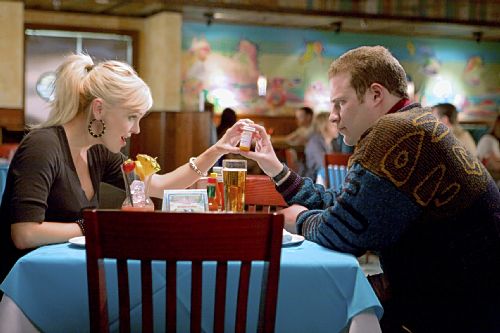
Review: Observe and Report (2009)

observeandreport

Observe and Report‘s most memorable moment involves the appropriately named Randy Gambill’s penis, which flaps in slow motion beneath Gambill’s developing pot belly as Seth Rogen chases him in a mall. Gambill, who the IMDB reports is making his big screen debut with this scrotal ballet, is not an actor of much range. His character has spent a good portion of the film flashing people. And now he has flashed us. I was neither shocked nor offended by Gambill’s flaccid member, but I must commend Gambill and writer-director Jody Hill for going out of their way to give us a flapping penis in a mainstream comedy. Alas, the moment is neither funny nor amusing. Indeed, the penis here is quite gratuitous. It simply just is. Beyond pushing the penis camera time beyond Graham Chapman’s famous flash in Life of Brian, the penis remind us that we’re watching a film that may have been cooked up in a locker room. (To give you a sense of the stillborn thrust here, let’s dispense with Gambill’s penis and observe how disarming it is to see a grown and limited man like Gambill act like a predictable teenager.) The penis bouncing up and down in this mall scene is not really a revolutionary act, but it does tell us that the moment in which dicks are afforded the same cinematic exposure as breasts is inevitable. Cocks are coming to middle America whether the red states like it or not.

I just wish that the occasion for the third leg peek was more momentous. This movie isn’t an outright travesty. I’ve seen many films that are worse. Whoever cast this movie was smart enough to give Collette Wolfe a thankless role as a handicapped employee who gives Seth Rogen his free daily coffee. But Wolfe is good enough to transcend the material with her eyes and her winning solicitude, even if her doting over a jerk is sexist and stereotypical. I am, however, losing patience with Anna Faris’s overacting, particularly with the eye-bulging and chronic face-expanding that is less about making the other actors look good, and more about hijacking a scene for attention. Faris appears destined to play Scary Movie-like bimbos for the rest of her career and she makes Drew Barrymore’s occasional hysterics look like Meryl Streep’s subtle craftsmanship. I’ve set down my issues with Ray Liotta’s acting before. The man once again keeps his mouth hanging open through most of the movie, and the audience feels compelled to bolt Liotta’s mandible in place. Nevertheless, before Liotta explodes on Rogen, he’s actually somewhat interesting as a contained cop trying to stay professional.

As for Seth Rogen, I should note that I’ve performed my constitutional duties. Without really trying, I have seen a good number of the films in which Rogen has played a prominent or supporting role. I have seen Zack and Miri Make a Porno, Pineapple Express, Knocked Up, Superbad, and The 40 Year Old Virgin. And I have liked the majority of these films. But the upshot is that Rogen does the same schtick every time: that chortle suggesting a cross between Beavis and Butt-Head and some avuncular fortysomething in the making watching the last of his twenties wash away and that deep voice sounding like a harmless Canadian stoner. In fact, it’s fairly effortless to impersonate Seth Rogen. I should report, in the interest of cultural journalism, that a friend and I recently had a twenty-minute conversation, both of us doing Rogen, one of us hungover. Scholars believe that just about any male living in North America can impersonate Rogen, rub his belly, walk, and chew bubble gum at the same time. I don’t really have too many problems with Rogen, but I have a feeling that if he doesn’t shake up his routine in the next few films, his audiences will lose patience with him. Needless to say, Observe and Report doesn’t really give Rogen much to do except, well, play a slightly more psychotic version of Seth Rogen. (The psychosis, of course, is underdeveloped and makes no sense. For example, Rogen effortlessly kils six criminals at one point, but he evades arrest? Rogen takes on the entire police department single-handedly, but he’s still allowed to walk the streets? I guess, if you’re a Seth Rogen character in a movie, you can rape some random stranger’s pet at a Starbucks and invite all surrounding children to join in a bestial gangbang. And you’d still be able to get away with it.)

So, yeah, the movie here is pretty bad. It has some promising ideas, such as Rogen cracking skateboarders over the head with their skateboards, but it has no clue about how to make these ideas funny. To offer one example, there’s a moment in which cop Ray Liotta and rent-a-cop Seth Rogen are talking with a Spanish-speaking employee, hoping to find out who is robbing the mall. Rogen is jealous of Liotta’s attention and gets more frenetic. He claims to know Spanish, but he doesn’t. Jody Hill could have had Liotta effortlessly speak Spanish to the employee and then escalate the conflict between the two characters. With one simple decision, we then would have zeroed in on the conflict. How does a screwup like Rogen operate in a world in which calm competence like Liotta’s is valued? (And had Liotta not freaked out, then Jody Hill would have reversed our expectations. For nearly everybody associates Liotta with his crazy or psychotic roles.) But Jody Hill doesn’t understand that Rogen’s appeal lies in the audience’s capacity to relate to him. Instead of giving the audience what it wants, he simply has Rogen go crazy (the violence described above) and it’s just not funny.

Having not seen Paul Blart: Mall Cop (I presume its success will unleash an endless spate of mall cop movies in the Police Academy vein), I cannot make any serious artistic comparisons between the two films. But Observe and Report has a flapping penis and Paul Blart doesn’t. Given this superficial criteria, I can probably make the wholly uninformed conclusion that Observe and Report may be a better film. The film has the courage to flap a penis, but it doesn’t have the courage to push Rogen beyond type.

The Bat Segundo Show: Eric Kraft

One of the difficulties of managing so many projects is that I continue to forget that I am committing some of these conversations to video. So I must now atone for the slightly delayed missing component. If you missed out on the elaborate roundtable discussion for Flying, or you don’t have the 2+ hour investment to listen to the three-part podcast (Part One) (Part Two) (Part Three), or you just want to get a sense of how much remarkable vivacity Mr. Kraft has, then the above four-minute video excerpt should offer a dutiful encapsulation of what became, over the course of March, quite a momentous undertaking. And if you haven’t yet picked up Flying, and wish to plunge into some crazed postmodernist fun that may keep you occupied for some time, well, the bookstore still awaits.

(For those who tire of my continuous Kraft boosterism, don’t worry. This will likely be the last post related to Mr. Kraft for quite some time.)

IPG Keeping Authors in the Dark About Sales Figures?

I have learned from several sources that book distributor Independent Publishers Group is not permitting its authors to know the number of books that still sit in their warehouses. Authors hoping to call up the distributor and get that pivotal figure that just about any book distributor will give them — so, you know, they can plan to either buy the remainders or figure out new ways of marketing their books — are being told that sales figures are secret. And not even a friendly “Abracadabra” or “Open Sesame” will persuade IPG to be transparent.

You may recall last November’s brouhaha, in which IPG President Mark Suchomel boasted of “having a record sales year” on these pages, while simultaneously demanding that I retract a memo that had been sent to publishers from IPG alerting them to troubles with Borders. I just don’t understand. If Suchomel is “having a record sales year,” why not boast to his authors who are asking for accountability? Unless, of course, Suchomel’s “record sales year” is subject to an altogether different definition.

I’ve sent an email to Suchomel asking him to clarify why he’s not being transparent to the authors who, you know, are writing the books that he’s going to the trouble to distribute. If Suchomel doesn’t feel comfortable with email, he can always leave a comment here, demanding further “retractions” as his secretive policies are disclosed.

Come to My Arms, My Beamish Boy!

The kernel, reviving himself for the fourth time since the specialist had pressed him into this messy business, slowly hauled his sticky, still healing corpse up from the Formica. Before he was a kernel, he’d been a major part of the trail mix. But he’d kept in his martial duties, staving his private thoughts from the messes that were unavoidable. The chain of command was fallible. He hadn’t had a heart-to-heart with the specialist for some time, and resented the constant erasing of memories. But he knew that the specialist profited handsomely with every financial conquest and that those disgraceful citizens who still craved their petty addiction needed to be corrected. If they couldn’t be taxed, they’d have to be brainwashed. It was part of the five-year recovery plan that had been vigorously debated in Congress, and the plan had proved so controversial that two Republican representatives had strangled each other to death while debating the flaws and merits of this daring and unprecedented moral stimulus package.

While it was painful to the kernel to have these addicts continually decapitate his head, the specialist made sure that the kernel received a fringe benefit: namely, a dutiful blowjob from a peanut past her prime not long after revival. Peanuts, particularly the salted ones that had been soaked in brine, were perhaps the most slatternly snack. There really wasn’t much subtlety to cracking a shell open. I mean, how was that seductive? You cracked open a hard scrotum and popped two nuts down a gullet as if they were aspirin. It was the kind of pathetic judapatow that had been vigorously argued on television decades ago. Alas, the executioners were a bit out of practice. Beyond the lack of culinary eclat, the citizens hadn’t caught on to any of the homoerotic imputations. And it was rather amazing that the religious forces hadn’t yet connected the dots. But the kernel knew of a few peanut fellatio operations in the Utah underground.

Not that any of the peanuts cared. They were happy to stimulate many penises, if only because “penis” sounded very close to “peanut.” And the holy books indicated that Father Planter (the great deity riding with his grand top hat on a rare elephant brought back from extinction!) had insisted on regularly pleasuring the citizens and the snacks. Fellatio was the path to salvation.

Why? Well, the citizens had respected the peanuts in ways that the elephants hadn’t. (One could make a case that humans had manipulated the results. But if the elephants had really wanted to respect the peanuts, surely they would have revolted at the circuses.) The humans had stopped throwing shells on the floors of Los Angeles restaurants. When potato chips had been removed from the market (courtesy of dutiful lobbying by the prominent candy company that the specialist had quietly mentioned to the Bavarian), demand for peanuts grew. But the peanut farmers had thought to expand the peanut’s duties to cure loneliness and quell those who were randy. It wasn’t too long until peanuts served not only as a sentient aphrodisiac, but a guarantee for the citizen who came home from the bar empty-handed on a Friday night.

The kernel accepted all this not just because the peanut’s connection with sex was second-nature, but because he liked working in a behind-the-scenes capacity. He wasn’t whoring himself out like the peanuts were. He was performing a more valuable service steering the citizens away from temptation. And the hell of it was that he didn’t need ethics. He could save humanity and let the peanuts service his licentious needs, and not feel any guilt whatsoever. For deep down, he truly didn’t care for the Puritanical direction that the country was heading in. These were dilemmas for the specialist. He would have to figure this all out eventually. The specialist’s sentient snack design had deliberately made the popcorn and the peanuts amoral. He could animate as skillfully as he wanted. But in the end, he couldn’t find an ethical reason to dabble sexually with his creations. The kernel could. And it was worth all the head-bashing that came with his occupation.

“And Hast Thou Slain the Jabberwock?”

“I’ve never been to Bavaria,” said the specialist. “Is it nice?”

“I wouldn’t know,” said the Bavarian, who was still staring at the barren kernel corpse that the specialist had left on the Formica as a reminder.

“Just so you know, I didn’t enjoy that task.”

“Oh?”

“I give the snacks their feelings and I figure that people will respect them.”

“Treat them as pets?”

“Well, hopefully more than that,” said the specialist, who stroked his beard to suggest to the Bavarian that he actually had some authority when he, in fact, didn’t really know what the fuck he was talking about.

“How did you get into this racket?” asked the Bavarian.

“It started when a prominent candy company, which shall remain unnamed, hoped to revive sales of their flagging chocolate candy product. They had put out a series of commercials featuring this candy with thin pipecleaner arms and legs, and injecting a bit of personality. If you saw these commercials stoned, you’d come down bad. Because chances are that one of your pals had a bowl of these candies lying around.”

“You speak from personal experience.”

“Not really. That’s what the candy company had pointed out on the dossier.”

The Bavarian poured herself a shot of Courvoisier.

“Continue,” she said. “I’m interested.”

“It was thought to create a sentient snack. One that would make the eating experience more engaging and interactive. More importantly, this would lead to an increase in sales, with the customer believing that a snack with feelings would bring extra value to his purchase. It was suggested by the candy company that since these commercials featuring anthropomorphic snacks had managed to get their message out, the experiment should start there.”

“And why did they approach you?”

“I was a professional animator. We were just beginning to animate the world around us. You may recall that Pixar was becoming very concerned about how cartoon street theater was cutting into their profits. But then, how many people had $25 to see a movie?”

“I want to assure you,” said the Bavarian, “that this was my first time eating sentient snacks.”

“Why didn’t you listen to my instructions?”

“I was bored! All right! They banned alcohol. They banned cigarettes. They banned coffee. There’s nothing left but the snacks. And most of them are sentient.”

“Is that your Twinkie defense?”

“What?”

“A well-known case from decades ago. In simpler times.”

“I had to kill something,” said the Bavarian.

But the specialist knew that snack homicide, thankfully not yet on the books, left long-standing effects. He could see the headless kernel twitching. He could see new arms stretching. The machete had taken the lopsided popcorn out for a few hours. But it would resuscitate itself as often as necessary before settling into the intestinal tract of an easily duped consumer.