Michael Czobit is a writer based in Mississauga, Ontario. He’s not fond of lengthy writer biographies. So the editor has provided two additional sentences to this introduction to provide Mr. Czobit with some necessary heft.
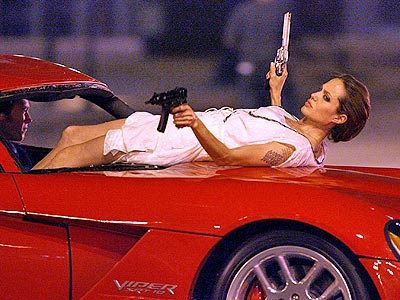
When the credits rolled, many people watching last summer’s film adaptation of Wanted didn’t really know Mark Millar. The audience may have known that he created, with artist J.G. Jones, the comic book series that the film was based upon. And “based upon” is important. Despite Wanted‘s (potentially offensive) violence, the movie was scrubbed of some of the comic’s more controversial details. But unlike Alan Moore, Millar didn’t demand that his name be removed from the film. No, Millar was content to leave his name in Wanted’s credits. If he hadn’t, the 38-year-old Scot might risk missing out on mainstream attention.
Film audiences shouldn’t be disappointed by the comic’s missing details. Published in 2003, Wanted is unapologetically crass. Wesley Gibson narrates his life story, from office boredom to joining a fraternity of supervillains in a post-superhero world. (The comic’s supervillains and superheroes were replaced with superassassins. The comic’s opening homosexual sex scene was also dropped from the film, along with a lot of needless killing. And Gibson no longer resembled Eminem.) According to Millar, the director of the movie, Timur Bekmambetov, kept “70% of the book” and saved the film from becoming a straight crime story. Millar said producers had legal concerns about the story’s supervillains because of their similarities to Marvel and DC characters; a strange concern, considering the comic book had no legal trouble.
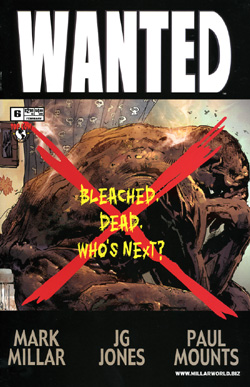 In the comic, Gibson is an unlikable narrator, who lacks the subtlety of another unlikeable narrator Millar wrote — Nazi Major Bauman in “Prisoner Number Zero,” which is one Millar’s best Wolverine stories. In Wanted, Gibson says, “I didn’t realize how much I hated the human race until I had the fuckers swanning around between my crosshairs.” This narration isn’t particularly antagonizing to the reader, but Gibson’s jokes about Down syndrome and babies born with spina bifida may be. Perhaps lazily, Millar titled the second issue, “Fuck You,” a charming name when considering some of the stale comic book in-jokes: in one scene, Mr Rictus, the super-supervillain (what do you call the villain in a story about supervillains?), kills the parents but spares their child, saying, “Leave him. With any luck, he’ll spend the next eighteen years training himself to avenge these idiots and give me someone interesting to fight when I’m an old man.”
For Millar, Wanted was a break from the mainstream comic work he had written for Marvel and DC Comics. So perhaps it’s especially ironic that Wanted ended up as the title that brought Millar to the mainstream. Gone were the normal editorial guidelines of superhero comics, though Millar had pushed against those for several years before this comic series. With the freedom, Millar created a story that lacked the moral complexity contained within his best mainstream work. Wanted is constructed in the summer blockbuster mold, but it’s more violent and profane, and it sold very well. Like in any entertainment industry, these strong sales meant that the comic was a success.
Less successful was Millar’s single issue of Youngblood: Bloodsport. Until June, the series seemed destined never to be concluded — if Millar’s fans could be so lucky. The artist of the series, the notorious Rob Liefeld, announced a fall continuation for Bloodsport. The first issue featured superheroes discussing blowjobs they’d received; Seahawk: “I’m just sick of all the decadence, Battlestone. Sick of the drugs, sick of the champagne, sick of Scott and Logan here dressing up as their girlfriends and giving us head.” Millar pushed his superheroes-in-the-real-world theme to its extreme and it failed in that first issue. Whether Millar is able to make the remaining issues compelling enough for his fans to forgive the novelty of Liefeld’s poorly illustrated art is the series’s remaining question.
If you were to only read Wanted and (somehow come across) Bloodsport, you’d think Millar’s work was a complete waste of time. But those two series display why Millar deserves attention: he risks the scorn of fans and commentators in attempting to entertain the majority of his readership. It is this reason that Millar attracts the best superhero artists in comics (aside from Liefeld). This year, Millar has comics being published with major artists including Bryan Hitch, Tony Harris, John Romita Jr. and Steve McNiven.
Millar broke into mainstream comics by embracing a populist philosophy. In comics, that means writing almost exclusively about superheroes. Other than his stay on Swamp Thing in the early 1990s, Millar stuck to this formula. What made Millar so different from other superhero comic writers was his courting of controversy. He unapologetically wrote stories with violent and political themes. His run on the series The Authority in 2000 ended when the publisher, DC Comics, censored the final issues. Millar jumped to Marvel and started Ultimate X-Men and later, The Ultimates. Writing the latter, Millar came closest to writing a superhero book on the level of Frank Miller’s Dark Knight Returns and Alan Moore and Dave Gibbons’s The Watchmen. The Ultimates was Millar’s first collaboration with artist Bryan Hitch as they re-imagined Marvel’s Avengers team in a modern setting, free from decades of continuity. Millar and Hitch created two critically-acclaimed 13-issue volumes of the series, published from 2002 to 2007.
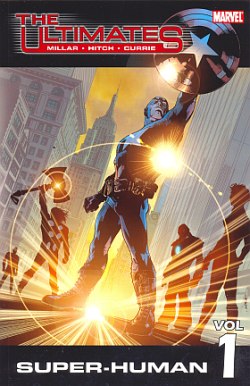 The Ultimates embraced a decompressed narrative – what Millar called novelistic – where characters didn’t appear in every issue, and the plot developed at a pace that strengthened suspension of disbelief; Millar and Hitch created a superhero story that reads as how it would really happen. The decompressed narrative was hardly the revolution Millar claimed it was in commentary of the first volume of the series, but a style characteristic that made The Ultimates distinct from the typical mainstream superhero book. Millar set the series in today’s pop culture world, dropping references to Shannon Elizabeth, Jennifer Tilly, President Bush, Samuel L. Jackson, Johnny Depp, and Robert Downey Jr. (Downey was used in a joke about drug use.) Millar also addressed U.S. politics as the country fought its “War on Terror” and its war in Iraq. Thor resists working for the U.S.-backed Ultimates team because of the country’s military operations and oil obsession. When Thor complains to Nick Fury about the U.S. negotiating with the terrorists, Quicksilver and Scarlet Witch, Fury says, “Ain’t the first time the security services done deals with terrorists, big man.” Millar risked alienating readers who did not agree with his politics, though it’s unlikely he cared. The aforementioned Frank Miller and Alan Moore commented on politics in their most famous superhero stories.
In his commentary to the second volume, which began running in December 2004, Millar wrote, “Hollywood is just touching on this stuff now, three years later, and that makes me very proud of comics—how immediate we can be. It’s like being newspaper cartoonists. We don’t have a legal department watching over us.”
One problem with Millar’s political commentary is its bluntness and how it may be perceived as unnecessary preaching. In Superman: Red Son (2003), Millar writes about Superman landing and growing up in Kiev during the Cold War. By the end of the series, Superman, who has become the dictator of the world, realizes the underlying effect of his actions. He says, “We weren’t born here and we’ve no right to interfere.” Millar’s political analysis can be simplistic, but he shouldn’t need to defend writing about politics. But one does wonder what Red Son‘s dumbed down material says about Millar’s readership. The reason Millar sometimes may offer blunt political commentary is the worry that people will miss the point. Regarding his new comic War Heroes, Millar said in an interview last month, “It’s amazing how many people seem to think this is a neo-con comic. Same thing happened on [Marvel’s] Ultimates, when it was clearly anti-war through and through. I feel like [director Paul] Verhoeven must have felt after Starship Troopers, in the sense that many people are missing the political satire.”
So why is Millar one of the most popular writers in comics? In an interview in the summer, Millar said, “It’s the worst kind of snobbery to want to be into stuff that most people aren’t. It’s a defect in character. Whereas being into something that everybody’s into, what could be nicer?” Millar — despite or because of his politics — has succeeded in creating comics that will appeal to the largest readership. His 2006 Marvel mini-series with artist Steve McNiven, Civil War, sold as if it was the speculator boom of the 1990s. Millar is not an experimental writer with theme or storytelling; the ones he uses, he twists only slightly. And he is not yet the legend Marvel claims he is in its monthly solicitations. Millar infuriates some with his writing and disappoints others when he deviates from established characterizations. Millar is not comics’ best writer, but he is one of the comic world’s best personalities; his ambition may lead to another Dark Knight Returns.
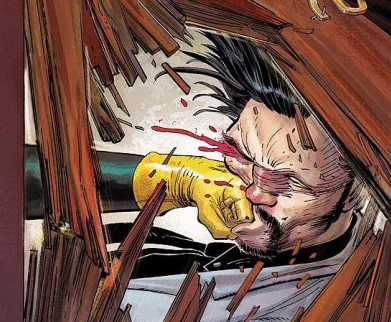 Millar has conquered one mainstream, and could conquer the larger one. His new series with John Romita Jr., Kick-Ass, is already being filmed and there are plans for a Wanted sequel. But it should be observed that both of those creator-owned series lack the politics of Millar’s best company-owned work. Both are violent superhero stories, and because they remain apolitical, the mainstream may still not know who Mark Millar really is. If the upcoming War Heroes film adaptation retains the writer’s political satire, what we may finally learn is whether Millar’s mix of superheroes, violence and politics was the right formula to break into the mainstream.