The Bat Segundo Show: Charlie Kaufman

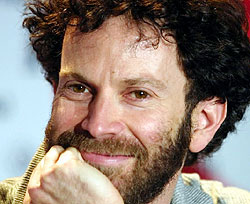
Charlie Kaufman recently appeared on The Bat Segundo Show #243. Kaufman is most recently the writer-director of Synecdoche, New York, now playing in limited theaters.
Condition of Mr. Segundo: Lost in the endless ebb and flow of emotional and cerebral ideas.

Guest: Charlie Kaufman

Subjects Discussed: Mr. Kaufman confronting more energy than he is accustomed to, whether or not Mr. Kaufman is an idea man, Mr. Kaufman’s slow conceptual process, exploring the possibilities of an idea peer review process for Mr. Kaufman, whether an idea can be emotional, what Mr. Kaufman has to do to impress our interviewer and the audience, how Mr. Kaufman changes, the issues that arise from Mr. Kaufman’s experiences, coming closer to a complete resolution of the world, shots of clocks in Synecdoche, New York, misunderstandings from Hollywood journalists, initial assemblies, how time seems to speed up as Mr. Kaufman gets older, walking by a clock that was a piece of graffiti on the wall, Caden and his colors, how Mr. Kaufman talks with the costume designer, whether or not clothes are comfortable on Philip Seymour Hoffman, Beckett’s Act Without Words, Mr. Kaufman trying to get closer to who he is, trying to avoid copying presentations of relationships from movies, Death of a Salesman, The Trial, literary influences, Equus, Proust, near literalisms, writing the Harold Pinter scene when revising the screenplay, and verifying real world headlines through the act of writing.

EXCERPT FROM SHOW:
Correspondent: It’s safe to say that you are an idea man. So I must ask you: to what degree do you worry about an idea? Does your mind brim with more ideas — even correct ideas — than you can possibly use? Are you thinking of ideas right now? Is there a slight sense of panic with any idea? What is your idea of ideas?

Kaufman: Well, this whole question is based on the premise that I am an idea man, which I’m not sure that I agree with.

Correspondent: Oh.

Kaufman: So I’m trying to break down what you asked me. And I don’t know. How am I an idea man? To turn this around. On you, Ed.

Correspondent: Well, I would argue that this film is laced with endless ideas meshing against each other.

Kaufman: Yes, it has a lot of ideas. But the ideas came over a two-year period, as I wrote the script. It’s not that I was furiously — like you or your girlfriend — furiously writing 700 pages in two days so that you could read it two days later. I mean, it’s slow. And sometimes it doesn’t happen at all for long periods of time.

Correspondent: So it’s the impression, I suppose, of being an idea man based on the final output here.

Kaufman: It’s not like it happens in real time. It’s not like there’s a two-hour movie and I wrote it in two hours.

Correspondent: Okay, well then let’s turn that…

Kaufman: I mean, I think you thought that before.

Correspondent: Oh certainly!

Kaufman: But it’s not true.

Correspondent: Let’s talk about it.

Kaufman: Let’s turn it around.

Correspondent: Okay. What is the actual ratio of you coming up with an idea? Is it one idea every 2.2 days? What’s the deal?

Kaufman: I would say that…(to himself) you figure two years….maybe it’s an idea a week.

Correspondent: And you have to determine whether…

Kaufman: And this is terribly disappointing for you.

Correspondent: Oh no! It’s actually quite interesting! I’m wondering. Do you have a certain….? Over the course of a week, do you determine whether that idea is correct in association with another idea? Is there kind of an idea peer review process that you run across in your mind? I mean, what’s the situation here?

Kaufman: There is no correct for ideas. Ideas are ideas. And if they’re interesting to me, they’re interesting to me. You know, I don’t know what an idea is actually. I think I think more in terms of emotions than ideas, although there are conceptual things that I utilize. Conceptual things that are devices or that are interesting to me. But the meat of the work for me is the emotional aspect of it. And I don’t know if you would consider those ideas or…

Correspondent: I think an emotional idea is nevertheless an idea.

Kaufman: Okay, then I…

Correspondent: You’re assuming that an idea is based entirely on cerebral terms. And I don’t think that’s necessarily the case.

Kaufman: Well, it may just be more the way that you’re presenting it. It feels….when you talk about ideas, and how many ideas you come up with, blah blah blah.

Correspondent: We’re presenting it in statistical data, yeah. (laughs)

Kaufman: It feels very cerebral.

Correspondent: Okay.

Kaufman: And scientific. And so yes, I have emotional ideas.

BSS #243: Charlie Kaufman (Download MP3)

This text will be replaced

The Bat Segundo Show: Pale Young Gentlemen

Pale Young Gentlemen appeared on The Bat Segundo Show #242. The band is currently touring across the United States, and has just released its second album, Black Forest (tra la la).

Condition of Mr. Segundo: Contending with unexpected discrimination during the economic crisis.

Guest: Michael Reisenauer (of Pale Young Gentlemen)

Subjects Discussed: [List forthcoming]

EXCERPT FROM SHOW:

Reisenauer: We’ll actually write through entire songs and entire arrangements, and then cast them away and then start over.


Correspondent: Really?

Reisenauer: That happened a lot with this album. As the songs started fitting together, certain things didn’t work at all anymore, didn’t work for the mood of the entire album anymore. So we had to change the arrangement so it fit better. Drums are one of the things that I have absolutely no knowledge about.

Correspondent: So you defer to Matt.

Reisenauer: I can’t play them. So he’ll play things. And he’ll do things. “Don’t do that anymore.” “That’s bad.” “That’s great.” Or “do that again.” You know, that kind of stuff.

Correspondent: I’m curious. Do you have any input on specific sounds? Or is that all Matthew? I note, for example, there’s that sound during “The Crook of My Good Arm,” where you have something that sounds between a cowbell and a gas station bell.

Reisenauer: Yeah, I can tell you what that is. I was having trouble with that song, and so I decided I’d just demo it in my apartment on an eight-track. So I just had the guitar line. And I was just messing around. And I was headed at a table. And at the table was a Pottery Barn-like fruit bowl. And so I just took the end of a handle on some scissors and banged on the inside of it.

Correspondent: Really?

Reisenauer: We used that on the record too. We brought that bowl into the studio.

Correspondent: It was that bowl.

Reisenauer: With the back of the scissors.

Correspondent: Did you try any other bowls out?

Reisenauer: No! It was the perfect sound right away.

Correspondent: It was one bowl and it worked out.

Reisenauer: Yeah, we didn’t mess with it at all.

Correspondent: Are there any other percussive scenarios like that? Where you banged on something and it turned out to be just that particular one? A divine act of serendipity?

Reisenauer: (laughs) Nothing like that on the album. We tried other various things. Matt had an idea for a song using a wrench. A ratchet wrench going KWHLEKT. Like that. That kind of stuff. But it didn’t end up fitting well for the album.

BSS #242: Pale Young Gentlemen (Download MP3)

This text will be replaced

The Bat Segundo Show: Megan Hustad

Megan Hustad recently appeared on The Bat Segundo Show #241. Hustad is most recently the author of How to Be Useful

Condition of Mr. Segundo: Contemplating the usefulness of political candidates.

Author: Megan Hustad

Subjects Discussed: [List forthcoming]

EXCERPT FROM SHOW:

Hustad: The book is, in part, a survey of the genre of success literature. And I spent a year of my life holed up in the New York Public Library reading all these books. How to Win Friends and Influence People, Think and Grow Rich!, the list goes on. And what they all say, at heart, is that you’re not going to be successful — in life, in your relationships, in your career, what have you — if you’re not fulfilling someone else’s needs. If you’re not being of use to someone else. And that usefulness is at the heart of success. And whatever needs you have will be fulfilled through being of service.
Correspondent: But isn’t that a bit of a Machiavellian scenario? I mean, I’m not looking at this conversation as, “Oh, Megan’s being very useful to me!” I’m actually just curious about your book.

Hustad: Well, they would say that that’s an artificial distinction. You can be sincere and yet know that you will benefit from this sort of interaction. You can be sincerely interested with the knowledge that some good will come out of it.

Correspondent: So you can be subconsciously useful perhaps? I mean, how do you factor something like the prisoner’s dilemma into this situation?

Hustad: (laughs)

Correspondent: Certainly that’s the ultimate in useful diabolic results here.

Hustad: You’re going to have to tell me exactly, and perhaps remind your audience, what is the prisoner’s dilemma.

Correspondent: Well, the prisoner’s dilemma. You have two prisoners in a cell. If you rat on your partner, you will be let go for seven years or whatever the terms of the argument are. And so what ends up happening is that — if you have a little box here, a little four square box — if one rats on the other, it depends on how the circumstances play out. It’s like a big thing in game theory. It just comes to mind when thinking about usefulness.

Hustad: How? How so? (laughs)

Correspondent: Well, how so? Because the results are so terrible no matter how they end up!

Hustad: But we’re talking about good things here. We’re talking about people doing good for one another. Not evil!

Correspondent: Okay, but in the framing of this very influential theorem, which game theory is modeled upon, this is the ultimate way to perceive usefulness. Okay, I’ll get off of that.

BSS #241: Megan Hustad (Download MP3)

This text will be replaced

David Perel: Fuckhead of the Month

Among the many media casualties on this Black Friday was Radar going down. I’ve been told that Radar staffers were asked to clear their desks by 3:00 PM and likewise asked to sign off on a voluntary layoff form. And as if these developments weren’t disgusting enough, editor David Perel announced on the same day just how happy he was to be on board. Perel, moving to Radar from the National Enquirer, had this to say to Mark Paretsky’s Cover Awards this afternoon: “I have already been contacted today by some top entertainment and news journalists who want to be part of this new venture. I am looking forward to putting together a new team that is the best of the best. We are hiring now!”

It’s possible that Perel is just too much of a fucktard to understand that writers and editors were being unmoored while he spoke these words. But surely even the biggest dunderhead in the media world could understand that any makeover into a TMZ competitor would likely involve laying a few people off. Perel’s total insensitivity to the Radar staffers who were let go earns him the rare honor of Fuckhead of the Month — never awarded to anyone in this site’s history!

(via Gawker)