Moving Forward Happily Without Twitter

I’ve had some time to revisit the events leading up to last night’s Twitter ban because I want to approach this with a clearer, less angrier, and more rational head.

It is often the practice of an inveterate addict to deny his own culpability. And I don’t want to do that here. It would be supremely dishonest if I didn’t offer a more reflective account of where I was at and how I behaved last night.

I am a highly sensitive person who responds very strongly to injustice. And I watched an act of pure beauty — Bong Joon-ho, a wonderful man from Korea deservedly winning multiple Oscars for Parasite, the best movie released last year — become completely sullied and slandered in an act of barbaric racism and gleeful ignorance from Jon Miller, an attention-seeking jackal who is now exploiting his Twitter Enemy of the Week position with unbridled hubris and calculated opportunism. Bong was attacked for not speaking English very well and for addressing the auditorium in Korean. Miller’s callous disregard of Bong as a human and as an artist, taken with his gleeful ignorance, sent me into a piping hot rage. Because this awful man had taken a steaming load upon three principles that I hold very dear to my heart — the power of art, the power of multicultural inclusiveness, and the power of creating opportunities for future voices — Miller’s tweet hit me very much like a jaw sinking its ravenous teeth into my leg. And I reacted like a caribou who had been happily dancing in a forest just before a sudden attack by a ravening wolf.

I realize that my replies to various people in the wee hours, in which I was suggesting that Jon Miller supporters then replying back to me with various vulgarities could serve as seconds to Miller during our proposed boxing match, were very much on the wild side. I had been drinking and, because I’ve lost some weight recently, the beer went to my head a little quicker than I anticipated. While I remain firm about my open boxing match offer to Miller, I’m still nevertheless responsible for the latter tweets, in which I started reciting Guns N’ Roses lyrics to random people. Were I able to respond to them, I would apologize. But I can’t. I can see now how, out of context, the Twitter Police would perceive me as a blithe maniac when we were discussing a hypothetical rather than an actual. It’s another reminder that our world now relates to each other with grandiose cartoonish notions rather than subtle nuances. I’m certainly not discounting my own responsibility here.

I’ve figured out how to put in an appeal to Twitter. Nevertheless, the Twitter ban may be the best thing that ever happened to me this year. Even if my account is somehow restored, and I don’t believe it will be, I do not think I want to return for a while. The irony is that, before my Twitter melee, I was actually getting along with people even in that wasteland. There was a nice sign hanging on the factory floor reading 180 DAYS WITHOUT A TWITTER BRAWL. But that dreadful medium, which preys on dopamine hits and loneliness, has amplified my worst flaws so that my considerable strengths are occluded. That place turned me into a crazed animal last night, much as it turns the finest minds of our planet into insane monsters.

Friends have told me for a long time that Twitter is not good for me. And I suppose I had to blow up the bridge in my own ridiculous and dependably self-destructive way to get it out of my life. But it is now pretty evident that I cannot control myself very well on Twitter, especially when alcohol is involved. The instant rush to be first rather than right. The tendency to destroy someone before you have heard the full story. How is any of this good? So I’m going to move forward with a life without Twitter. I suspect it will be a happier and more peaceful one. Besides, I have an audio drama to finish.

I Was Banned from Twitter for Protesting a Racist Man Named Jon Miller

This morning, I learned that my Twitter account was permanently suspended and that I was banned from the social media platform because I had the temerity to express anger and outrage towards a racist.

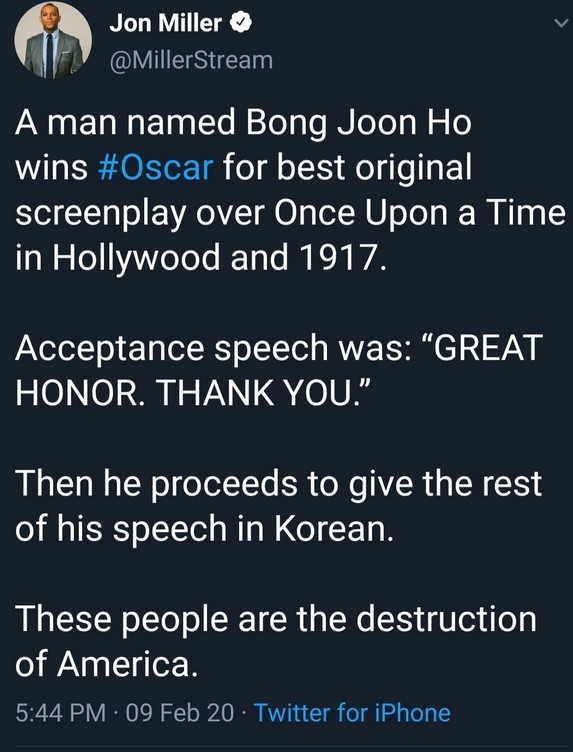
A man with a blue checkmark by the name of Jon Miller, a conservative “White House correspondent for BlazeTV,” tweeted an insulting, cruelly disparaging, and racist message mocking the great filmmaker Bong Joon-ho after he delivered one of his Oscar speeches in Korean. Miller’s disturbingly xenophobic words, which are still published on Twitter as of Monday morning, proceeded to claim that “these people are the destruction of America.” This is language that echoes anti-Semitism in 1930s Germany and any number of hate groups singled out by the Southern Poverty Law Center. Words that need to be strongly protested. Even conservative Piers Morgan protested it. Miller’s tweet was rightly ratioed, but thousands of people still retweeted and favorited this vile expression. Miller, in other words, willfully promulgated hate.
As someone who is a big proponent of democracy and multiculturalism and as someone who has a number of Korean friends, some who greatly helped me during a time of crisis in my life, it was my moral duty as a citizen to lodge my protest against this in the strongest possible terms. Bong Joon-ho’s Oscar win for Parasite is not only a historical and artistic triumph. It also rightly sends a message to Korean Americans that their dreams are possible. By any objective standard, this is a good thing and a beautiful advancement of humanity. For someone to shit on this — as Miller did — is to besmirch the very purpose of why and how we evolve as a species.

So I got angry on Twitter. One cannot stay silent when anyone is demeaned and stripped of his dignity like this. But as far as Twitter is concerned, calling someone “a xenophobic, anti-tolerance, anti-art fuckface” — as I did — for expressing such hateful language is “abuse and harassment.” Moreover, there is no appeal for Twitter’s decision. The appeal link that I received by email did not work.

On Twitter, I also challenged Miller to a ten round boxing match to see if he wanted to settle this matter like a man. I did this for a number of reasons. First, I’ve been on a fitness kick and it seemed like a playful way of opposing a racist. Second, my challenge offered a corporeal method of resolving a national cancer that needs to see more resolution in the real world. Racism has long been buried underneath the surface of this nation. And if Miller wants to claim that an entire race is “destroying America,” then let us see if he has the stones to say this in public and in the ring. If Miller still wants to take me up on my challenge, then I will be more than happy to sign up for boxing lessons immediately and get in the best shape of my life. That’s how much I care about fighting racism and intolerance. I’m willing to put my body on the line. It is my position that, when you are confronted with racism, you must not stay silent about it and you have an obligation to fight it.

My playful boxing challenge also falls into a great tradition of writers boxing other writers — seen with Craig Davidson challenging Jonathan Ames to a boxing match, a match, incidentally, that I happened to announce. I’m sure that this probably factored into Twitter’s decision. Still, challenging someone to a boxing match does not involve “wishing or hoping that someone experiences physical pain” — the codex behind Twitter’s rules. The decision to engage in a fight is on Miller. I have challenged him. He is free to take me up on the challenge. I’m willing to put myself on the line and in the ring, but my ultimate wish or hope would be to see Miller acknowledging and confronting and sincerely apologizing for his flagrant racism and unacceptable xenophobia. That’s the goal here. Since Miller proved intransigent on Twitter, I was forced to take him up with my boxing challenge. Even if Miller decides not to box me, then the point has been made. Unable to walk back his hateful remarks, he is revealed for the coward that he is.

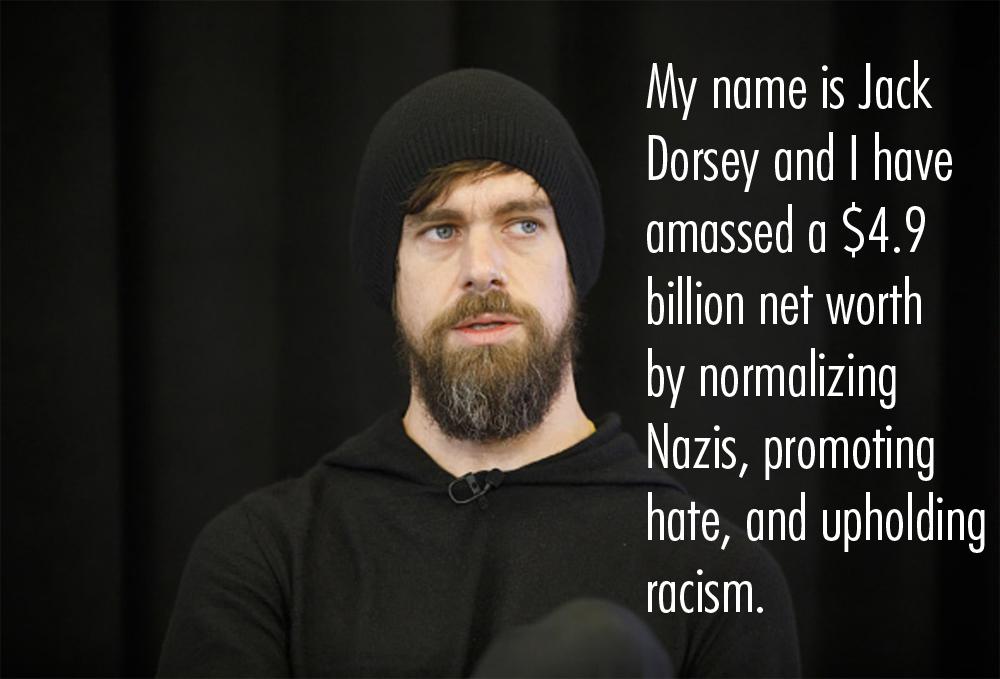
What all this does tell us is that Twitter is firmly on the side of the fascists and the racists and the doxxers and the misogynists and the Nazis and the authoritarians. Jack Dorsey’s business model is to promote hate and to block anyone who pushes strongly against it. Because hate and sustaining the status quo of hate and racism is very good for Dorsey’s business model. It’s lining his pockets right now. My words to Miller were no different than the words that got the great David Simon (temporarily) banned in 2018. As Simon put it in a blog post shortly after his suspension:

The correct response to racism, to white supremacy, to anti-Semitism, to slander and libel is to:

1. Tell the fucker he’s a piece of shit and should die of throat clap.

2. Block him. And in doing 1. and 2. you have marked the spot for the sane and sentient on Twitter, much as any good infantryman who wanders into a minefield marks the Claymores for the rest of the platoon. It’s just good soldiering, Jack.

My Twitter ban may very well be a blessing in disguise and should give me more time to practice my guitar and the new set of harmonicas I just purchased. But it is still part of a national disease that is silencing and squelching voices who speak out against hate, racism, and fascism. A few friends texted me this morning about what happened and claimed my ban to be “a badge of honor.” But I don’t see this as honorable at all. I see this as a deep stain against social justice and a blow against fighting for what’s objectively right. I see this as Jack Dorsey willfully prioritizing hate before justice and profit before human decency. But then we all know that Jack Dorsey has no soul. We know that this shallow profiteer met with Trump last year. If he possessed any qualities of actual decency and if he was truly invested in true discourse, then he would understand precisely what’s at stake here. If we cannot speak out against racism and human indignity, then how will we be able to speak out against any other significant human ills that crop up in the next few years? Especially if Trump manages to win a second presidential term and the Senate remains under control by the Republicans. You don’t win battles by keeping silent or by staying neutral against a gleeful hate merchant like Jon Miller. You call them out for the repugnant atavists and venal promoters of bigotry and intolerance that they are. You challenge them to boxing matches if you have to.

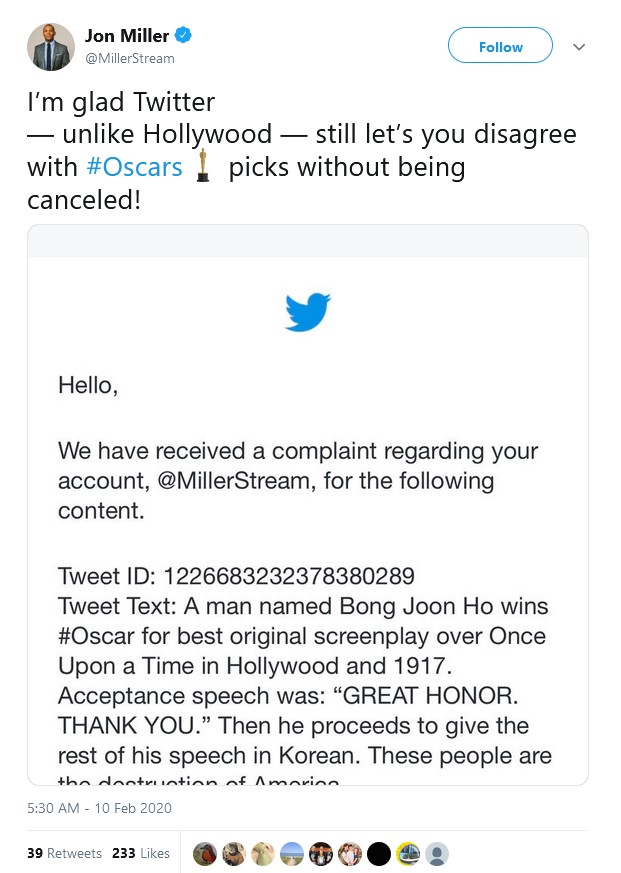
UPDATE: This morning, Jon Miller celebrated the fact that Twitter ruled his racist tweet as something that did “not identify any violations of the Twitter Rules.” Twitter, in other words, is clearly in the practice of upholding racism.

On the Problems with Selective Empathy and the Promise of Reintegration

There are people who have seriously wronged me and I have said nothing. I don’t give them a whit of my thoughts and I do everything in my power to avoid running into them, even as I leave the door open for reconciliation if they want to approach me and seek amends. That is the least we can do as human beings. It is a focus that took me five years to figure out. And I’m a lot happier and more creative as a result.

But every now and then, you find out about someone who is still unhealthily fixated on you. There is someone online who has been obsessed with me now for a good nine years. Nine years. It’s almost as if she thinks we were married or something, but I’ve never met her and I’ve had a grand total of two interactions with her.

Even so, I would rather be honest about my inadequacies rather than bask in the sham panacea of feeling better about myself. The truth of the matter is that, while I have made great strides in finding more compassion for people, I am clearly not extending enough unconditional empathy in my life. Rather than holding grudges, I simply erase people who have hurt me from my existence. I do this because to dwell on them further is to invite more anger I don’t need into my life. I view this as a great moral failure and I am hoping to make greater strides in being more understanding towards other perspectives. Some may argue that there is nothing wrong with avoiding toxic people and there is certainly some truth to this. You don’t want to surround yourself with people who belittle you. On the other hand, the definition of “toxic” has become highly malleable in recent years. We are more content to write someone off over a minor disagreement in opinion rather than an assiduous assessment of what our actual relationship is and could be with another person.

The person who is obsessed with me doesn’t seem to be happy. I keep waiting for her to stop being obsessed with me. For goodness sake, when do you let something go? It’s clear from an objective analysis that she hasn’t done much with her life and that she has creative aspirations that she hasn’t tried to pursue (or, if she has, it didn’t go as planned; Ed, you’ve been there; so what’s with the paralysis?). So I suspect that’s one of the reasons she’s projecting her wanton fury onto me. She keeps publicly comparing me to the likes of Bill Cosby, Alan Dershowitz, and other terrible people with whom I clearly share no qualities. My response has been to stay resolutely silent and keep her blocked on all social media. I suppose she’s the Annie Wilkes to my Paul Sheldon. I suppose that I should count myself fortunate that I haven’t been in a car accident in her neighborhood.

I really don’t comprehend this kind of obsessive jealousy. But if you’re actively busting your hump on the creative front and being transparent about your process to provide help and inspiration to others, it is an inevitable and unfortunate reality. Hate and jealousy tends to bubble up from people who aren’t doing anything with their lives. We rarely talk of thwarted ambitions and the way in which people project their own failures onto others rather than taking the time to see how they can make their lives happen. The jealous grudgeholder looks at some figure who is actively seizing the reins with originality, good will, and a solid work ethic and perceives weird opportunities to resent the target and tear him down. This is to be distinguished from reasonable criticism, which allows an audience to thoughtfully comprehend another person’s work and is often quite useful, but should never be taken personally.

I suppose I’m thinking about this person because there is a part of me who wants to empathize with her crazed zeal and redress this weird grievance she has with me, even as I simultaneously recognize that doing so may not be good for my wellbeing and will probably not result in anything more than further grief on my end and renewed obsession from her. There’s also the question of whether I have the emotional energy to fully empathize with her position and provide the appropriate closure for both of us. Dylan Morran has a podcast called Conversations with People Who Hate Me in which he talks with people who have made him the object of their anger. Even though I greatly commend his efforts to reach out to his enemies, I still think that Morran isn’t being entirely transparent about the selective manner in which he practices his professed empathy. Because that’s the thing. Empathy isn’t just about listening to your enemy. It’s about finding the visceral space inside you to truly feel and understand your enemy’s perspective. You can’t extend an olive branch through a pro forma gesture. You really have to demonstrate that you genuinely care.

The excellent British TV series, Back to Life, written by Daisy Haggard and Laura Solon, is one of the few recent offerings that deals with the double-edged sword of trying to empathize with someone who has committed a monstrous act. Miri Matteson (played by Haggard) has served an eighteen year prison sentence for murdering one of her best friends and returns to her small town in Kent to rebuild her life and find a second chance. The show is brilliant in the way that it doesn’t dwell specifically on Miri’s crime, but rather Miri’s life as it is now. The town vandalizes her parents’ home, where she is staying. She manages to land a job at a fish and chips place gentrifying the neighborhood (a beautifully subtle metaphor for the need to accept change), but a brick is thrown through the window during one of her shifts.

All this leaves the audience contending with a vital moral question. Does anyone deserve such treatment? If a transgressor has done her time and is peacefully trying to forge a stable life, shouldn’t we grant the transgressor that opportunity? The show counterbalances Miri’s struggles to readjust with benevolent gestures from a neighbor who is unfamiliar with Miri’s past, but who accepts Miri on her own terms, even going to the trouble of fixing her childhood swing in the dead of night and extending decency. The show suggests, through humor and a nimble attentiveness to behavior, that there is a certain human strength that emerges from simply accepting someone on their own present terms. Moreover, as the truth of Miri’s past becomes more dominantly recognized in the present, we are forced to consider the question of how prohibiting a transgressor from having a second chance may cause the transgressor to repeat the old patterns. Sure, nobody owes anyone a second chance. But what great possibilities and connections are we denying by insisting that someone’s transgressive nature is permanent? The idea of not giving a transgressor a second chance used to be a conservative staple, but now it has become increasingly practiced by ostensible liberals.

The criminologist John Braithwaite has written a number of very useful volumes on restorative justice — particularly, Crime, Shame, and Reintegration, in which he points to many statistics where disintegrative shaming — meaning the permanent stigmatization of someone who has transgressed — often leads to recidivism. Whereas reintegrative shaming, meaning a period of shaming followed by forgiveness and a slow acceptance of the transgressor back into a community (rather than making him an outcast), usually results in greater peace. Among Braithwaite’s many examples is the fact that American offenders are more than twenty times as likely to be incarcerated as Japanese offenders. The difference is that Japan takes on the shame as a collective community rather than passing the shame onto the individual.

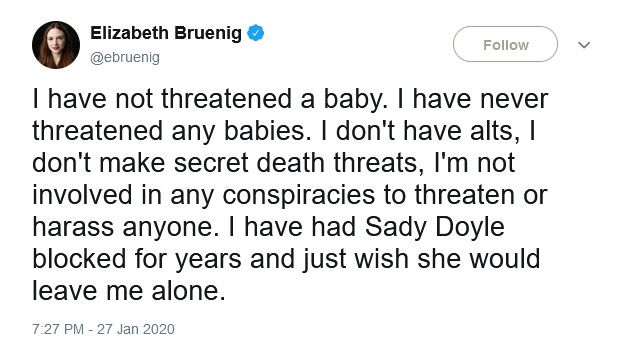
So if reintegration works better than shaming, why then can I not find it within me to settle the dispute with the person who is obsessed with me? Obviously, Braithwaite, writing in 1989, could not anticipate the rise of social media weaponized to destroy lives and careers. He could not anticipate how instant spurts of 280 character tweets result in people forming cartoonish impressions about people, such as Sady Doyle falsely accusing opinion writer Liz Bruenig last week of threats without producing a shred of evidence. What rational person can blame Bruenig for her response? Most people, faced with the mania of impressions and accusations, just want to be left alone. (The above screenshot is from a tweet that Bruenig deleted. To offer full disclosure, Doyle has also lied about and libeled me, as well as some of my friends. But I also understand from people who know her that she is suffering from mental health problems. My hope for her, despite the hurt she caused me and the translucent relish she took in meting it out, is that people close to her can get her the help and the treatment she clearly needs so that she doesn’t have to behave like this again.)

Even when we talk about the need for more empathy, you can’t escape the fact that it will always be selectively and individually applied. I’m willing to own up to my own flaws on this front. But the people who have advanced careers through this philosophical position don’t seem to have the same ability. After all, they have books to sell rather than hearts to extend. Five years ago, Jon Ronson wrote a book called So You’ve Been Publicly Shamed?. While Ronson’s volume was certainly progressive in the way that it asked us to consider the lives of people who had been hounded by the hordes, the problem with Ronson is that he can only perceive disproportionate punishment with “people who did virtually nothing wrong.” I’ve read and listened to a lot of Ronson interviews and I’ve yet to find a case where he has shown willingness to extend true empathy to people who have done something wrong and who want to make their lives better. The whole point of justice is to allow for rehabilitation and reintegration. While Ronson demonstrated how perceived transgressors suffered undue hardship, you can’t even begin to have a conversation like this until you consider how people who have been “canceled” live out their lives. Nobody’s life ends just because you decided to wipe him away from your windshield.

Perhaps we do have some collective obligation to reach out when it’s difficult. I recently settled a dispute with someone who had falsely and belligerently accused me of behavior that I never committed in a support group. Instead of getting angry with him, I took a deep breath and wrote a very careful message with him pointing out that I understood his feelings and that I had been carefully listening to him the entire time while also declaring that I genuinely cared for him and refused to feel angry towards him. He then sent a message to me apologizing for his previous message and declaring me a “good guy.” We were able to patch it up, but that’s only because we had actually met face to face and had taken a little bit of time to know each other.

Social media, despite its professed “social” qualities, doesn’t allow us that pivotal face-to-face contact. It doesn’t allow us to better understand another person’s motivations and perspective and find common points of empathy. It is a common truth that most disputes can be settled easily in person. But we have increasingly shifted to an age in which people pine for the easier method of erasing someone from existence. It is far easier to stigmatize someone if we have never gone to the trouble to know them. But it also reduces complex human beings into little more than one-dimensional transactional vessels. One can look no further than the rise of ghosting and people writing others off on flimsy pretext if you have the misfortune of being single in the metropolitan New York area.

The question we now face is whether reintegration as a virtue for a better and happier world that allows more people opportunities to live positive lives overshadowing their worst mistakes is something that we can implement in an age driven by castigatory social media. It’s certainly a tough sell. But I also recognize that, as more data about individuals becomes increasingly public and more past episodes are dredged into the bright xenon lights of public opinion, we’re going to need to find more ways of embracing this necessary difficulty. It isn’t feasible to ask anyone to live up to an impossible virtue. But there is always something very beautiful in learning how to empathize with someone once we have come to understand why they committed their worst mistakes and once we see that they, like us, are willing to change.

Tips and Tricks for Audio Drama Editing

For the past eight months, I have been editing the second season of my audio drama, The Gray Area. It’s quite a daunting endeavor: a slate of episodes that will encapsulate the length of two average seasons of audio drama. Alas, there was no other way to tell the story. I anticipate a release date of the spring of this year, although there is still much work I need to do.

During this latest postproduction round, I have learned a great deal about sound, rhythm, mixing, leveling, inventiveness, plugins, and some basic pragmatic moves that have allowed me to improve as an editor. However, like everyone, I am still learning. Since there isn’t a lot of online material out there on how to edit audio drama, I have been gradually assembling a series of quick Instagram videos to help out producers who may be new to making audio drama. I’m sure that, had such a resource existed before I figured much of this out on my own, it would have saved me an incredible amount of time. It seems only right to pay it forward. So without further ado, here are some tips and tricks that may help you out as you tell your sonic stories! Unless otherwise noted, the software I am using for these videos is Reaper, an inexpensive DAW that never crashes and contains incredible power and that I swear undying allegiance to, and iZotope RX, a costly but essential tool I use for cleaning up dialogue and removing unanticipated noise. (This article serves as a production-centered companion piece to my essay “How to Write Audio Drama.”)

1. How to Make a Homegrown Sound Effect:

For those who cannot afford expensive sound effects libraries or who cannot find the right sound within the vast depository of Free Sound, consider the enormous sonic riches you may find in the world around you. A sound in a high frequency might produce something new and unanticipated in a lower register, and vice versa. Some of the most original sounds that I have discovered and used in The Gray Area are surprisingly commonplace. Much of my homegrown sound design comes from being inspired by wildly creative people who have approached the process of searching for the new in a similar manner. My feeling is that, if something very weird sounds vaguely familiar, an exotic sound will likely land better with an audience. It’s worth remembering that the TARDIS dematerialization effect in Doctor Who, still used after more than fifty years, is essentially a slowed down version of scraping the insides of a piano and that the Smoke Monster in Lost is, in part, composed of the credit card machines that were ubiquitous in Manhattan taxis around 2010 (and that, on a separate note, proved very tricky to track down for an upcoming story set in 2011; alas, we do what we can for historical authenticity!). The above video shows how I used a percussive instrument given to me on my birthday for an ethereal effect that I layered in a scene set inside a cosmic realm. (I also recommend Jonathan Mitchell’s excellent article on sound design, in which he breaks down how he put together sounds for a particular scene. Mitchell’s audio drama, The Truth, continues to remain a great inspiration point for me. He’s really one of the best sound design practitioners out there.)

For my audio drama adaptation of The Yellow Wallpaper, I took a commonplace sound of a tray being dropped in front of a Shure KSM32 — a large diaphragm mic used by Ira Glass that offers a warm and bright sound similar to a Neumann U87, but that is not $3,000 — and double tracked it. For the second track, I adjusted the speed. And the result was an ethereal clang that represented The Woman’s psychological schism. Don’t be afraid to mess around with different microphones and double tracking. Some audio drama producers swear by flat sounds that they can manipulate through postproduction tools. But I’m more fond of using the best microphone I have in my arsenal to get a particular tone (cold, warm, high, low) that I can accentuate in postproduction.

2. You Can Deviate from Your Script a Bit

If you want to get an audience to buy into your stories, it’s essential that you have your characters speaking in the most natural rhythm possible — even when you have stylized characters. Some of the time — even when you record the stories — the rhythm won’t always announce itself. But you will find it in the editing. In the above video, I demonstrate how lightly rearranging a line in the middle of a big dialogue chunk not only improved the flow of the scene, but allowed the reactions of the characters to be more natural.

3. Take Advantage of Free Plugins

One thing that people may not realize about iZotope, the remarkable company that puts out RX, is that the company also offers two free VST plugins that you can use for your DAW. (A VST plugin, if you don’t know what this is, is an add-on that Reaper can use for an effect. Here is a simple guide on how to add them in Reaper.) The two plugins in question — both of which I have experimented with — are Vinyl, which allows you to add a scratchy effect so that you can create the sonic aesthetic of an old recording, and Vocal Doubler, which allows a very subtle double tracking effect that proved useful for a scene in which I needed to have a character calling from an ethereal space.

Another free VST plugin that I discovered was Proximity by Tokyo Dawn Labs. There were some instances during editing in which simply leveling down and EQing a character so that the voice came across as quite distant did not sound right to my ears. In some cases, Proximity did a better and quicker job to shift a sound so that it matched what I wanted to hear inside my head.

You can also use Reaper’s built-in plugin ReaEQ to add distance, as demonstrated in the above video.

4. Using EQ to Match Dialogue

View this post on Instagram

Tutorial: How to use EQ to match dialogue. Mastering is very important. This was a case where one actor was a little too trebly and didn't quite match the other actor. I needed the character to sound warm and bright and friendly. The character is a quiet healer. So it was vital to get this tone right. But the mic I used went a little above and beyond! (Hey, it happens. Sometimes mics are TOO good! Ha!) So on her track I bumped up the low frequencies, raised the mids, and stepped down the highs so that the two actors would match in this very important scene. When I do another pass on this, I will do more EQ tweaking on both actors and add more custom room tone to mask this so that it sounds very real. #mastering #eq #dialogue #matching #editing #postproduction #atmosphere #environment #engineering #audiodrama #tone

A post shared by Edward Champion (@grayareapod) on

Even in the early stages of assembly, you do need to be mindful about matching tracks that were recorded in different sessions so that it sounds as if the characters are in the same room. Getting the dialogue rhythm right is one method of doing this. But to fully sell the illusion, mastering is key. It is one part of postproduction that is often not discussed, if it is even practiced at all, among audio drama producers. In the above video, I had an actor who sounded a little too trebly. So I adjusted the EQ settings by bumping down the high frequencies, stepping up the lows, and raising the mids. I still have more fine tuning to do for this scene as of this writing, but at least I have a solid baseline to build from when I return to the story on the next pass. One resource that proved incredibly useful in learning how to master was Ian Shepherd’s excellent podcast The Mastering Show. Shepherd has spent many years fighting against the Loudness Wars, a regrettable trend in music whereby producers in the early 21st century attempted to mix the loudest possible tracks. The result was muddled compression. Because all sound contains a maximum threshold. Audio drama is a uniquely intimate form. EQ and proper mastering will help you tremendously so that you don’t make the same mistake as these music producers.

5. How to Use RX to Repair Clipping

Clipping often happens when an actor delivers a fantastic performance, but is slightly blown out in the final recording. Sometimes, you have a situation in which the actor’s best performance is the one that is slightly clipped. Enter RX 7, which comes with a De-Clip module that will automatically adjust a slightly hot take. The above video shows RX’s power. With more audio drama being produced now than ever before, you want to make sure that your final product sounds as professional as possible. There is also a method of repairing clipping in Audacity, which I have also used. But while somewhat effective, I find that Audacity doesn’t hold a candle to RX. Even so, your job is to use the tools that you can find or that are within your budget. And there are many tools out there! For audio drama producers who are just starting out, Audacity — which still comes in very handy for me in certain editing situations — remains a solid place to start from.

6. Splitting Dialogue in Reaper

I recorded more than 300 hours of audio over a period of eighteen months for the second season. Before I could even begin to put together my rough cuts, I needed to split and organize all this dialogue so that I could manage these complicated logistics. It took four months of seven day workweeks for me to get to this place. But it would have taken me much longer if I didn’t have Reaper.

Now there is a way to split audio in Adobe Audition — one that I have documented here — by adding markers to long files, merging the two points, and then exporting these files into a directory. However, I found that Reaper was a lot faster in splitting files, as I show in the above video. By splitting your long files into smaller items and then selecting them, you can use Reaper’s “Batch/File Item Converter” (found in the File dropdown menu) to add your selected files and then export them to the directory you want. Reaper allows numerous wildcards that allow you to title these newly split files in whatever manner is best for you.

I wish I would have known about this Reaper feature when I put together the first season. Because postproduction would have shuttled along much faster. But at least I discovered this hack in the second season. This has greatly sped up my workflow.

7. How to Remove Light Reverb with RX

Reverb is one of the most difficult qualities to remove from audio. Even if you aggressively filter it, you’re still going to be left with a flat, artifact-laden sound. I record with my actors in a large room in my apartment. I do this because I want to give my actors the freedom to move and gesticulate. Because this, to my mind, is essential to performance. Recording in a closet or a sound booth often hinders their ability to make interesting choices. And I am also performing with my actors when I direct them so that they have something real to react to. My own personal preference is to prioritize performance over technical restrition. However, the tradeoff of my production decision means that I sometimes have a few takes where there is light reverb. The extra space results in bouncing sound waves. And this, of course, is something that may not match across tracks.

Enter RX’s very useful Dialogue De-Reverb module, which has saved my bacon on more than one occasion. RX also comes with a very useful Dialogue Isolate feature, which is incredibly helpful in removing modest background noise. (Your goal in postproduction is to “rebuild” an audio environment. I do this by cleaning the sounds and then recording various location tones throughout New York City for a sound bed. And then I act out the characters’ physical actions as I listen to the actors perform through my headphones and use this as the starting point for my sound design.) But Dialogue Isolate doesn’t always cut it for light reverb situations. Dialogue De-Reverb does, however, and the above video demonstrates how you can do it.

In Defense of American Dirt…and Just Being a Nice White Person With Blinkered Privilege

I’ve just spent the last seven hours on the phone with my therapist, who charges at the rate of $275/hour. I have gone through six boxes of Kleenex, eaten my body weight in bonbons, and was forced to undergo the grueling indignity of cancelling my afternoon hot yoga session. You don’t know the stress I’m feeling. Or maybe you do. But this has been all over the news! (Or rather the news I read. I have heard that there are other problems going on in the world right now. But my therapist told me that I should not be paying attention to this — as it may leave me bedridden for the next six years. As you know, dear readers, I’m highly sensitive to minor vibrations.) I’m so upset that I may even pour myself a glass of pinot grigio tonight. I may not be able to make it to Sunday Funday Brunch or the next girls night out. I mean, I’m just a wreck right now. I thought I would be able to see my stylist to get my highlights done before the end of the day, but I’m just too upset about this whole mess to do anything more than weep on my buttonless tufted chaise longue. So I hope you don’t mind if I let off a little steam. (Trigger warning!)

This has gone too far! I am truly baffled by the controversial response to American Dirt. (Kobe forever!) As a mother who never has the time to read books but who has all the time in the world to supervise my kitchen staff cooking gluten-free meals for my three children (they all have special needs!) and who rats out bad mothers in Park Slope parks (it’s for the safety of the children!), I have not actually read the novel. But as someone who skims 150 books a year and as the host of a podcast (Moms with Too Much Spare Time and Disposable Income), I can say without a doubt that what Jeanine Cummins has done is nothing less than sensational! Even though I have never met Jeanine Cummins, I feel comfortable enough with her to call her by her first name. She’s that good! She speaks to me! She has written not only The Grapes of Wrath of our time, but the Ulysses of last year and the Tortilla Flat of tomorrow. I can say this with some authority because, while I haven’t actually read the book, I have read the blurbs! Blurbs are never wrong! This book simply stands apart — by which I mean that it is falling apart in my hands as I write this because the publisher sent me one of the duds that they could not sell at Barnes and Noble. However, I won’t fault them because the free copy they sent me came with a kind note reading “Please review this favorably. We’re dying here. We really need you to take one for the team.” And if there’s one thing you know about me, I’m a team player!

I don’t care that Jeanine wasn’t a Mexican refugee herself — or even Mexican. The important thing is that she is white like me. Yes, I was one of those 53% who voted the wrong way in 2016. I don’t care! What’s wrong with being Caucasian? I mean, my nanny and my housekeepers are Mexican. I pay them minimum wage, but we have a very positive relationship! A special connection! They say things in Spanish that I don’t understand. Peligro! Ella es una loca mujer blanca. I have no idea what this means, but it’s clearly a sign that my staff of twenty-five will always take care of me. Just as Jeanine cares about Mexicans.

What I care about is her book. (And Kobe! What a tragedy!) While my husband was on the phone talking in whispers with a late night colleague in the other room, and sometimes leaving not long after his important phone calls for late-night appointments that ended at 3 AM (he works so hard!), I was — much like my colleague Zibby Owens — flipping pages in the very white halogen light that I bought for $800 at Crate and Barrel. There was no time to read the book, much less understand it. While I didn’t have time to read the novel, I feel that I came to love it simply by holding it. I couldn’t bear to put it down.

American Dirt is a once-in-a-lifetime read. The sentences about embracing brown necks are so moving. Because that is precisely how I embrace my Mexican friends. I look at their brown skin, marvel in it, see that it is not my white skin, conclude that it is beautiful, and then say to my housekeeper, “Isabella, I will pay you double time today if you let me hug your brown neck.” Jeanine gives me her consent and we then spend the next hour hugging each other, although Isabella does stand frozen stiff for some reason. She tells me not to worry and seems curiously fixated on the clock when we hug. But I know she loves me as much as I love her! This book captures my meaningful relationships with Mexicans so well! The way she writes about Mexicans is so familiar to me! It speaks to me because I have this exact relationship with Mexicans on a daily basis. These characters are so real that they reminded me of my dear Isabella, who often walks into my living room with a fresh tray of smoked salmon and avocado mousse. While there is no chance that I will ever set foot outside of my neighborhood, I felt that Jeannine captured the scenery of Mexico in a way that seems real to me!

So why are so many people absolutely livid?!???!!!?????!!!???!!!??? Perhaps Jeanine’s seven figure advance has the haters jealous. I don’t understand. I mean, my husband makes $120 million each year. Doesn’t everybody?

Why?

Why do people have to be so mean?

(Poor Kobe!)

I’m all for literary criticism. I devour all the women’s magazines and bask in the constant raves. They tell me that every book that’s published is great! What’s so wrong about that? One of our own, a white woman, has produced a stellar, breathtaking work of art. Let her tell her story. White women understand the lives of Mexicans better than Mexicans themselves!

Just holding this book changed my life. Just like a great book should. You don’t have to read a great book. If you hold a book long enough, you start to absorb its power.

If you don’t have anything nice to say, don’t say anything at all.

Now if you’ll excuse me, Isabella is rolling out my fainting couch. I feel as if the day is shot.