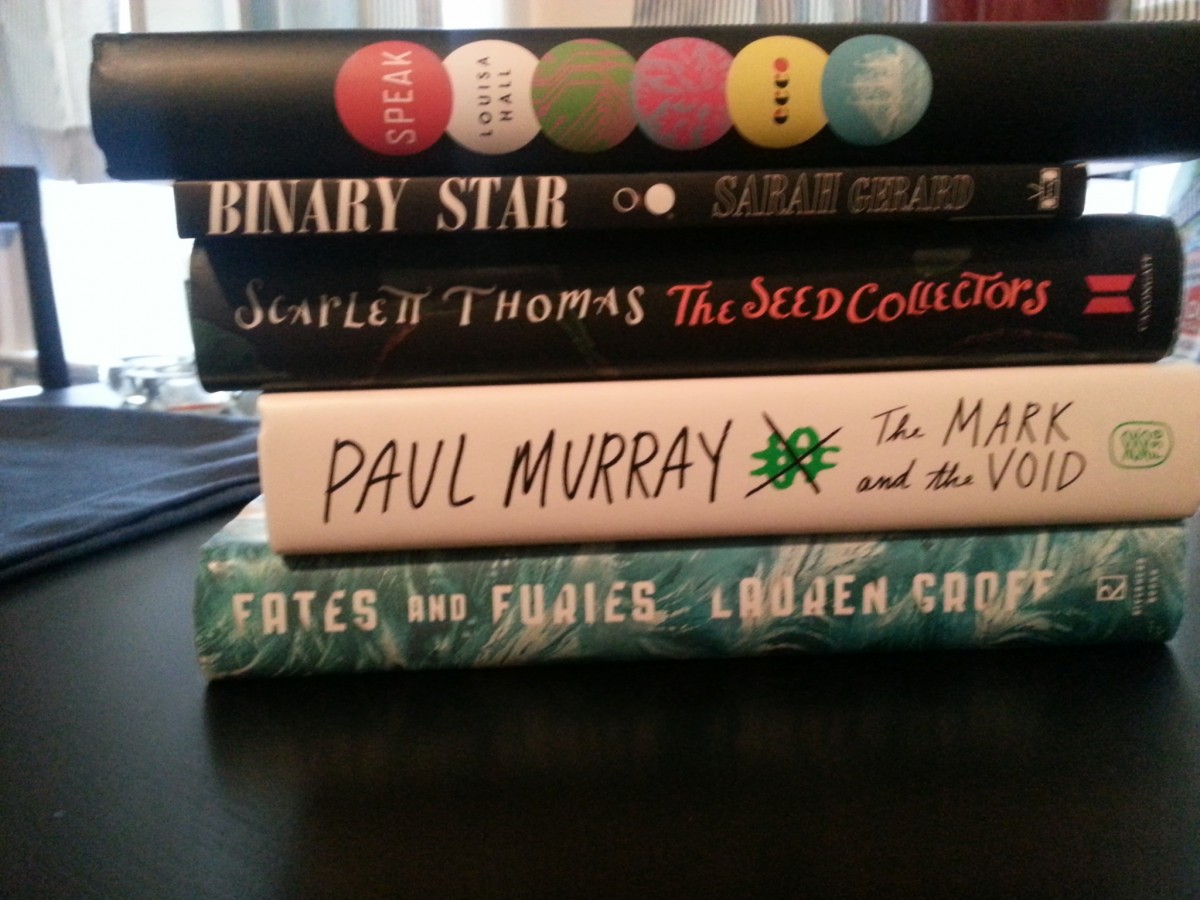
The Best Books of 2015

Most my reading this year was devoted to research for several projects and to dead authors — in particular, just about everything ever written by Henry Green, a good chunk of Penelope Fitzgerald, and many volumes of the great Iris Murdoch, whose volume of letters (forthcoming in January here in the States) I will undoubtedly opine on somewhere. The nice thing about the dead is that you never have to worry about their social media presence, much less being that hip kid on Twitter being the first to skim through a status galley that nobody will give a toss about in six months. But I did squeeze in some time for contemporary titles and what follows is a list of exceedingly worthwhile books that greatly moved me and are very much worth your time:
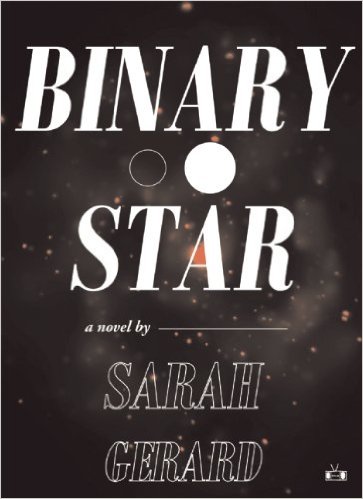
binarystarSarah Gerard, Binary Star: Among many deceptively slim volumes published this year containing great wisdom about consciousness and interconnectedness, Gerard’s road trip saga was a standout. The couple at the center of this often fierce, sometimes breezy, sometimes heartbreaking novel is a woman who suffers from aneroxia and a man who is an alcoholic. The juxtaposition of rocket imagery and the nameless anorexic woman’s physical erosion from rapid weight loss finds a painful cadence with clipped sentences and a dialectic involving vegan anarchism. One reads this book, wondering if we are living in a world of disorders, or whether judgment itself may be causing us to see disorders. The book’s epigraph to Raoul Vaneigem’s The Revolution of Everyday Life hints further at the nature of this perceptual manipulation and one is left wondering what “irreducible core of creativity” that the main character may find. Perhaps it’s not meant to be glimpsed. This woman is, after all, becoming quite blind herself. Perhaps all we have left, wherever we are, is in the stars.
fateandfuriesLauren Groff, Fate and Furies: I was late to the party, but I’m so glad I took the plunge. This is an extremely well-observed portrait of a marriage built on a mirage. Groff expertly disguises the rapid-fire courtship of Lotto and Mathilde with a fusillade of college friends who live and disappear and reemerge as the couple enters middle age. That Groff has made the troubled husband a middling playwright and submerged this harrowing man in famous Greek classics (including a riff on Antigone) attests to the time-honored theater that humans have been encasing their relationships in for time immemorial. Almost serving as counterpoint to Mark Z. Danielewski’s respectable two volumes of The Familiar, Groff has also included a mysterious commentator within the narrative who offers bracketed asides. As painful as this novel can be to read for anyone who has been through a very long and sour relationship predicated on lies (or who has to watch a friend going through something like this), the sorrow nevertheless beckons the reader to summon more honesty, openness, and communication in real life. And for that reminder alone, Groff has emerged as a writer whose every future volume I will read upon publication.
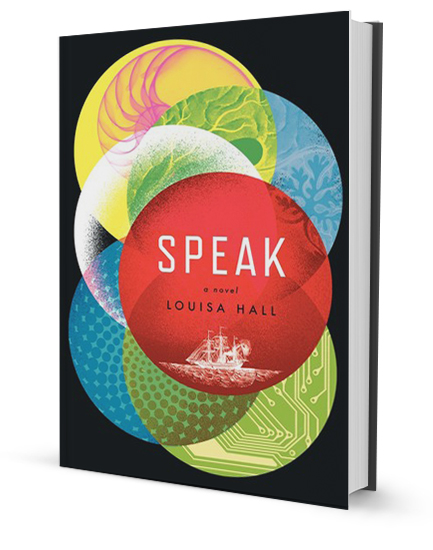
speakhallLouisa Hall, Speak: Could human beings become addicted to robots? Why not? We walk the streets staring down at our phones, saturating our Instagram accounts with relentless photos, and logging every sordid detail about our lives on social media. Suppose that level of addiction had a conscience attached to it. And suppose it was modeled on the diary of a 17th century woman. Suppose further that an ELIZA-like program was somehow an AI missing link between the diary and the robots and that Alan Turing, just on the throes of being subjected to DES and its accompanying gynecomastia by a frightened homophobic government, was involved. You begin to have some inkling of what Hall’s ever thoughtful novel, which is brave enough to explore how our seduction to technology and its many byproducts may just be dwarfing the more important seduction of real life.
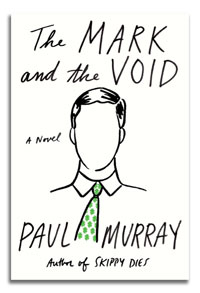
markandvoidPaul Murray, The Mark and the Void: Some critics have accused Murray of tackling too much in this hilarious, insightful, and often poignant book — almost as if the comic novel is not permitted ambition in our increasingly intolerant age. But Murray’s talent has sharpened considerably since Skippy Dies and we are all the richer for it. This penetrating tale involves a writer named Paul who asks a banker named Claude if he can follow him for a novel Paul’s writing about the Everyman. Paul, of course, has another ill-fated plan up his sleeve, one I don’t have it in my heart to give away. I’ll just say that Murray’s many twists and turns lend this book a kind of madcap momentum that, even before we’re aware of it, leads us into very heartfelt questions about what it is to be human at a moment in history in which banks resort to the most sinister plans imaginable (including building a golf course on an island fated to be flooded from climate change, under the theory that the investors can win back their investment from an insurance payout). What makes Murray such a great writer is the way he keeps his cleverness close to his chest. He is more interested in winning over readers, whoever they may be, by appealing to many brows, whether it be a Rothko-like painting that hangs in a rich man’s study or a sloppy low comedy Russian accomplice named Igor. This novel is a gripping portrait on what may be happening to our world as we surrender our invention and curiosity. At one point, an interoffice memo reading “All that glitters is not gold” is distributed throughout the bank. Not a single employee remembers this as a Shakespeare quote — indeed, a quote from one of the Bard’s most infamous plays about usury — but all take this “mantra” quite literally as a strategy to act on. Yet for all this, Murray never ridicules his subjects, which aligns this book with John P. Marquand’s underrated novel, Point of No Return (also about a banker). This novel is so terrific that I’m willing to suggest that Paul Murray may be our best shot at an Evelyn Waugh (albeit a kinder one) for the 21st century.
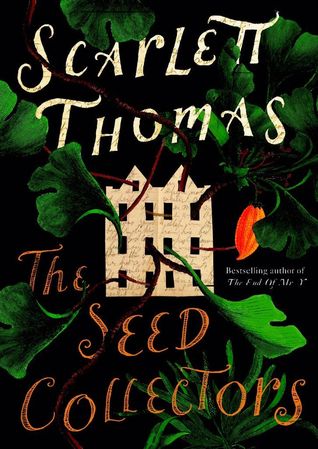
seedcolleectors2Scarlett Thomas, The Seed Collectors: As I wrote about this novel’s considerable achievements in September:

The Seed Collectors is holding up a very large mirror to the Quantified Self movement, whereby everything we do in this world creates data, collected and hawked and redistributed in ways that are not necessarily compatible with our complex feelings. The above passage, a glorious pisstake on gamification, sees Ollie, a man who Bryony is considering sleeping with, at the mercy of an Oral B Triumph SmartGuide, an alarmingly horrific (and quite real) device that demands its practitioners to brush teeth in highly specific ways, with emoticons rewarding a commonplace activity with Candy Crush-style perdition. Even a monstrous man named Charlie, who is introduced sexually violating a blind date before the thirty page mark (perhaps another reason why American houses lack the spine to publish this book), is someone who clings to a list of attributes that he’d like to see in “my perfect girlfriend.” And if quantification is the deadly condition uniting all these characters, then how do these disparate characters live? As the novel progresses, Thomas introduces a great deal of dialogue in which the speakers are never identified. And this missing data, so to speak, steers the reader towards an emotional intuition well outside any data subset. And as Thomas serves up more twists and revelations, we come to understand that it is still possible in our age of unmitigated surveillance to be attuned to our private thoughts (though for how long?). The novel, which we have believed all along to be thoroughly structured, has perhaps been a lifelike unstructured mess all along. And this unanticipated alignment between fiction and our data-plagued world feels more artful and poignant than such conceptual stunts as writing a short story composed entirely of tweets. It makes The Seed Collectors almost a cousin to Louisa Hall’s recent novel, the quite wonderful Speak, which used a computer algorithm to determine which of its five perspectives would be on deck next. But even if you don’t want to play this game of six-dimensional chess, The Seed Collectors still works as a sprightly narrative on its own terms, at times reading like an Iris Murdoch novel written for our time and beyond.
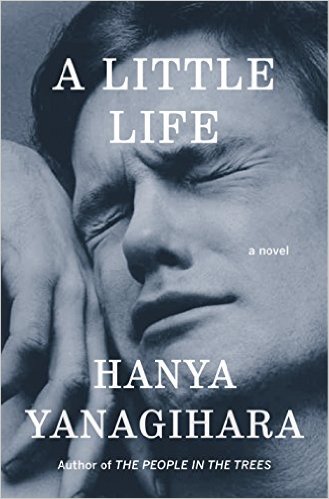
alittlelifeHanya Yanagahira, A Little Life: Nasty little men like Daniel Mendelsohn, a vicious narcissistic troll with a small penis (or so a source informed me; take it for what it is; this is a blind item I have no wish to corroborate), have no real understanding of trauma or pain or abuse, much less the painstaking empathy that friends and family must expend in helping the victim out of a self-perpetuating abyss. Thus, this critic is ill-equipped (in more ways that one) to speak of the relentless cycle of violence and vitriol that victims of abuse must not only live with, but often eke out to the people who love them. A Little Life is not a “woman’s novel.” It is a first-rate novel, independent of that belittling sobriquet, that dares to explore the uncomfortable interior of the ineffable in ways that misogynist novels like Jonathan Franzen’s Purity lack the honesty or the heart to broach. Its central character, Jude, is brilliant in all the right ways and scarred in all the wrong ones. While the prose does lean on a dismaying magazine shorthand, Yanagahira’s truths hit hard enough to overturn this stylistic cavil. “We didn’t know how to help him because we lacked the imagination needed to diagnose the problems,” a sentiment uttered by one of Jude’s friends, may sound trite to a heartless snob like Mendelsohn, but it is an especially succinct expression of America’s relationship to the afflicted. The book covers many years, often far into the future, and smartly avoids mentioning any current events. And that is because the problem of abuse needs to be isolated and examined at length, especially as we see its terrible culmination in the many mass shootings that have riddled our nation this year. As a victim of abuse, I cried tears of recognition when Jude allowed a man to assault and abuse him. For there was a time in my twenties when I allowed a lover into my life who did something quite similar. It took me years to recognize the threads that led back to an earlier life in which my very parents physically and emotionally abused me. And while I am now doing very well and am now the happiest I have been in years, I am ever on the alert for any small misstep that could send me even a few feet away from the self-destructive pit. Because as tough and as resilient and as seemingly well-adjusted as we survivors are, there’s always a chance. So Yanagahira’s novel almost served as exposure therapy, especially since I was down and out when I read it. For anyone fortunate enough to never experience abuse, I urge you to read A Little Life. Its worldview is far from “little,” unless you’re a small-minded hyperbolic attention whore paid to bray sociopathic sentences on command in one of the literary world’s declining institutions.

But if my plaudits aren’t enough to sell you on A Little Life, I should also point out that the only reason A Little Life is not pictured among the books in the header image is because, months ago, someone who had spent the night at my apartment and heard me rave about it happened to pilfer it.


Final Texts Sent to Women I’ve Dated in the Past Year: A Tale of Resilience and Emotional Maturity

Thank you for the text and for meeting me. While I enjoyed talking with you, I didn’t feel there was much of a connection. Nevertheless, I wish you the best of luck! All best, Ed

* * *

Not defensive at all. I was politely replying to your invitation and you made the leaps. I’m quite happy being who I am.

* * *

It is the best thing for me too. I feel that you are emotionally manipulative, unwilling to be honest and communicative, and deeply unfair. Nevertheless, I wish you the best of luck. Thanks for using me.

* * *

Please stop texting me. I’m not interested. Best of luck.

* * *

Do you even comprehend that men are not playthings for your deranged pleasure?

* * *

Okay, I get the hint. I hope you feel better. Thanks and best of luck.

* * *

Sounds like your life is too complicated. Best of luck.

* * *

Sounds like you’re not all that serious. And I have better things to do than have my chain dragged. Best of luck. And thank you for wasting my time.

* * *

I’m not ripping into anything. You’re doing a grand job of tearing down the house with your eleventh hour “revelations.” And I will call bullshit on people, especially unrelenting types who fire the first shot, who lack the self-awareness and the empathy to consider their own complicity. If you think I’m enjoying this (perhaps you are?), you’re gravely mistaken. But you’ve proven yourself wrong about a lot of things. I think we can both agree that there’s no profit in this exchange. So again I wish you best of luck.

* * *

And, by the way, I’m NOT nice. Your actions made me very angry. Because I once again allowed a self-absorbed woman to use me, to take advantage of my heart, to feign diffidence when she didn’t have the guts to cut her losses and declare the truth of her loneliness and her desperation. Go to hell. All you know how to do is toy with other hearts. And I won’t allow ANYONE to do that to me ever again.

* * *

Alright, one last try (because I like you) and I won’t bother you again. No need to reply back if you don’t want to. You mentioned last night that you were in a somewhat sullen mood because of your architectural comment chided by the martinet-minded boatman, that people felt intimidated by you because of your exuberance, that you rubbed some people the wrong way, that you weren’t accustomed to people treating you nice. I’m not sure if this (or perhaps the shrapnel from the businesslike unraveling of your marriage; believe me, I understand) has any bearing on your skittishness, but please know that I found you profoundly interesting, laden with great life, refreshingly independent-minded, and felt compelled to shower you with some affection that you seemed, in the way in which you shifted closer to me, to covet. You struck me as someone who was a bit surprised to receive kindness and receptive ears. Perhaps you were putting forth some front. I don’t know. What I do know is that you deserve to be treated well. You are an uncommon soul I’d like to know more. I’d be delighted to try again, if you’re ready and willing, taking things as slow as you’d like to go. Whatever you decide, whether with me or someone else, please know that some men do actually want to give to you and listen to you and respect you. As someone who adjusts her mind and body for a six week stint on the high seas in winter, you of all people know that life is always worth the risk and that goes for everything, whether the coos of romance or owning an apartment. In any event, thank you for the delightful evening and I really wish you the best and hope you find everything you’re looking for. – Ed

* * *

Many thanks for the conversation. I would be delighted to hear more about your adventures in Kenya. Good luck with the interview! Thanks, Ed

* * *

The princess’s gleaming eyes glistened with an unanticipated joy as the courtier handed her a parchment dripping with warm words written in a happy careful hand. The knight who had vowed to joust against dragons and play sweet songs for her upon his lute had delivered a letter from a faraway land that stirred some happy memory. She remembered the warmth of his hand, his easy smile, and his rather attentive ways. “Chivalry,” she had said, “is not dead.” A flowing coat shimmering against the frostiest gale was not something to be so readily dismissed. Some natural cannonball shot into the air, an ardor built not on war but on tenderness and that rather exciting quiver that accompanied more important passions.

The courtier had caught sight of a distant horse in the horizon, upon which rode the selfsame knight, who leaped from his steed and, shortly after spinning his sword into the air in the manner of a showman whirling a cane, performed an acrobatic interpretive dance that revealed the fine letters of the alphabet. “X…X…X”

This was quite a good deal of effort for a memory from so long before, certainly not the usual, but she couldn’t help smiling. The courtier opened the large book containing her many appointments and said, “The knight, ma’am. He hopes to schedule a visitation. Is there an opening?” The princess replied…

…well, how shall we continue this story?

* * *

No, you’re not. You’re one of those textbook cases Janet Malcolm wrote about.

* * *

I’d like to thank you for hurting me. It has provided me with a clarity which not only explains why X left you, but will ensure that I never make the same mistake of revealing my soul to a solipsist ever again. Best of luck. You definitely need it.

* * *

Affectionate and complimentary one moment, recoiling the next; goofy theatrical banter one minute, trilingual gymnastics almost as if you had to prove something (you didn’t) the next. You vacillated wildly in mood and I’m not interested in playing head games, whether conscious or subconscious. I’m interested in connecting with someone. Last night, you revealed yourself in ways that suggested very strongly that you could never do that with me, even though there was some part of you that wanted to. I don’t know if some of this is residual from the guy who hurt you. I’m sorry that happened, but I’m not going to be the fall guy. Get this in check. Other men won’t be nearly as patient or as understanding as I’ve been. Take good care of yourself. Truly. Nothing but empathy and good will here. Thanks and all best, Ed

* * *

First off, I’m sorry to hear about your grandmother. Having an ailing grandmother myself, I completely understand. Second, yes, I was the subject of a long, libelous, and predominantly untrue hit piece. I have been nothing less than courteous to you. I can even talk honestly about what really happened, as difficult as it is for me. But the one thing I won’t do is defend myself before someone who chooses to take stock in a distorted clickbait funhouse image of me rather than the very real and good man she met on Thursday night. I am truly sorry that you have opted to see the wrong version and apologize for any unsettling feelings caused by these disgraceful articles. All best, Ed

* * *

No problem. Glad to hear you landed a place! All best with your art and life. Many thanks, Ed

* * *

Thank you for taking the time out to meet last night. You seem nice and thoughtful, but I didn’t feel any romantic sparks. So I shall have to respectfully bow out. Nevertheless, I wish you the best in life and finishing your dissertation! Thanks and all best, Ed

* * *

Okay, I don’t want to add discomfort to an already awkward exchange. So I’m going to bow out of Thursday with all the grace I can muster, apologize for time wasted, and wish you the best. Thanks and supreme apologies, Ed

* * *

Of course we can be friends! I’m very honored that I got to meet you and your gregarious friends, enjoyed our moments, and am tremendously sorry that my heart hasn’t cooperated. For you are a very good soul who deserves nothing less than a marvelous man who will undoubtedly make you feel even more special than I possibly can. Again, my contrition and great gratitude. Please have a magnificent weekend! Thanks and all best, Ed

* * *

Good luck and take care!

* * *

Dear X: I’m very sorry to do this, but I’ve met someone in the last week who I’ve been getting very serious with. I very much enjoyed meeting you, but I’m going to have to cancel Thursday night because of this entirely unanticipated development. But I thank you for your time, hope you had a good holiday, and I wish you the best of luck! Thanks, Ed

You Can’t Stop Paris

Paris is one of the most magnificent cities of the world, burgeoning with leisurely life and bold human energy. It is a city to walk in and get lost in, a place to fall in love and find adventure, to be reborn, to stumble onto unanticipated discoveries. Cross any of the thirty-seven bridges across the Seine and you will encounter a region you never expected. The summers are warm and the cafes are plentiful.

Scale Monmartre and you will find the beautiful bleached stone of the Sacre Coeur, with some of France’s most noble figures immortalized in statuary. The city possesses many great libraries and bookstores and has welcomed such rebels as Gertrude Stein, James Baldwin, James Joyce, George Orwell, Chester Himes, Henry Miller, Anais Nin, Man Ray, Dennis Cooper, Isadora Duncan, and too many others to list. And this doesn’t even begin to account for Paris’s limitless homegrown talent. This great and glorious city will endure for all these reasons and more. It has survived revolutions, invasions, incursions, involutions, and it will endure well beyond this nightmare. Because Paris, no matter how much anybody tries to wound it or debase it, is incapable of being destroyed. It is a grand monument to romance and knowledge and enlightenment and will continue to thrive long after we have all had our giddy spin upon this mortal coil.

What happened tonight was unspeakably terrible. At least 118 innocent people are dead in the Bataclan theater alone, with at least 40 more reported dead in the six other attacks. We don’t yet know who did this. We know that the gunmen were perfunctory and methodical, taking the time to reload their Kalashnikovs for additional rounds. And this tragedy has caused a number of inhumane opportunists to emerge from their dark and unimaginative caves: waving scolding fingers at the paucity of guns, shaming college activists at Yale and Missouri for their lack of perspective, and flaunting their unfathomable xenophobia before they even know the score. In the end, none of their crass sentiments matter. Because you can’t stop Paris any more than you can halt the greatest love affair of your life.

Some people have taken the time to express their fears, to claim that, because of these attacks on a place so magical, there is no space where they can feel safe. But I’m thinking about the brave man who posted Facebook updates from inside the Bataclan. I’m thinking about the taxis who went out of their way to give people free rides home. I’m thinking about the way in which Parisians conjured the hashtag #PorteOuverte to give total strangers somewhere safe to say. There have been endless reports of kindness and generosity from the people of Paris. And that is because you can’t stop Paris. Nobody can. It is too rich in compassion and compatriotism and joy and joie de vivre for any force to stop. It has continued to recirculate its remarkable qualities so well and seemingly without effort that it is nearly impossible for any other city to measure up. Paris is a great example to us all.

So if you’re feeling paralyzed right now, if you’re feeling uncertain what the future is, just take one small look at the remarkable perseverance that Paris has already displayed. You can’t stop Paris. And you sure as hell can’t stop the human spirit.

In Cold Blood (Modern Library Nonfiction #96)

(This is the fifth entry in The Modern Library Nonfiction Challenge, an ambitious project to read and write about the Modern Library Nonfiction books from #100 to #1. There is also The Modern Library Reading Challenge, a fiction-based counterpart to this list. Previous entry: The Journalist and the Murderer.)

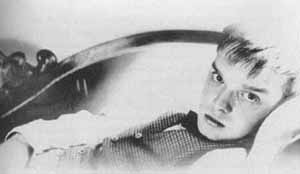
halmacapoteTruman Capote was a feverish liar and a frenzied opportunist from the first moment his high voice pierced the walls of a literary elite eager to filth up its antimacassars with gossip. He used his looks to present himself as a child prodigy, famously photographed in languorous repose by Harold Halma to incite intrigue and controversy. He claimed to win national awards for his high school writing that no scholar has ever been able to turn up. He escorted the nearly blind James Thurber to his dalliances with secretaries and deliberately put on Thurber’s socks inside out so that his wife would notice, later boasting that one secretary was “the ugliest thing you’ve ever seen.” Biographer Gerald Clarke chronicled how Capote befriended New Yorker office manager Daise Terry, who was feared and disliked by many at the magazine, because he knew she could help him. (Capote’s tactics paid off. Terry gave him the easiest job on staff: copyboy on the art department.) If Capote wanted to know you, he wanted to use you. But the beginnings of a man willing to do just about anything to get ahead can be found in his early childhood.

Capote’s cousin Jennings Faulk Carter once described young Truman coming up with the idea of charging admission for a circus. Capote had heard a story in the local paper about a two-headed chicken. Lacking the creative talent to build a chicken himself, he enlisted Carter and Harper Lee for this faux poultry con. The two accomplices never saw any of the money. Decades later, Capote would escalate this tactic on a grander scale, earning millions of dollars and great renown for hoisting a literary big top over a small Kansas town after reading a 300 word item about a family murder in The New York Times. Harper Lee would be dragged into this carnival as well.

mlnf96The tale of how two frightening men murdered four members of the Clutter family for a pittance and created a climate of fear in the surrounding rural area (and later the nation) is very familiar to nearly anyone who reads, buttressed by the gritty 1967 film (featuring a pre-The Walking Dead Scott Wilson as Dick Hickock and a pre-Bonnie Lee Bakley murder Robert Blake as Perry Smith) and a deservedly acclaimed 2005 film featuring the late great Philip Seymour Hoffman as Capote. But what is not so discussed is the rather flimsy foundation on which this “masterpiece” has been built.

Years before “based on a true story” became a risible cliche, Capote and his publicists framed In Cold Blood‘s authenticity around Capote’s purported accuracy. Yet the book itself contains many gaping holes in which we have only Smith and Hickock’s words, twisted further by Capote. What are we to make of Bill and Johnny — a boy and his grandfather who Smith and Hickock pick up for a roadside soda bottle-collecting adventure to make a few bucks? In our modern age, we would demand the competent journalist to track these two side characters down, to compare their accounts with those of Smith and Hickock. Capote claims that these two had once lived with the boy’s aunt on a farm near Shreveport, Louisiana, yet no independent party appears to have corroborated their identities. Did Capote (or Hickock and Smith) make them up? Does the episode really contribute to our understanding of the killers’ pathology? One doesn’t need to be aware of a recent DNA test that disproved Hickock and Smith’s involvement with the quadruple murder of the Walker family in Sarasota County, Florida, taking place one month after the Clutter murders, to see that Capote is more interested in holding up the funhouse mirror to impart specious complicity:

Hickock consented to take the [polygraph] test and so did Smith, who told Kansas authorities, “I remarked at the time, I said to Dick, I’ll bet whoever did this must be somebody that read about what happened out here in Kansas. A nut.” The results of the test, to the dismay of Osprey’s sheriff as well as Alvin Dewey, who does not believe in exceptional circumstances, were decisively negative.

Never mind that polygraph tests are inaccurate. It isn’t so much Hickock and Smith’s motivations that Capote was interested in. He was more concerned with stretching out a sense of amorphous terror on a wide canvas. As Hickock and Smith await to be hanged, they encounter Lowell Lee Andrews in the adjacent cell. He is a fiercely intelligent, corpulent eighteen-year-old boy who fulfilled his dormant dreams of murdering his family, but Capote’s portrait leaves little room for subtlety:

For the secret Lowell Lee, the one concealed inside the shy church going biology student, fancied himself an ice-hearted master criminal: he wanted to wear gangsterish silk shirts and drive scarlet sports cars; he wanted to be recognized as no mere bespectacled, bookish, overweight, virginal schoolboy; and while he did not dislike any member of his family, at least not consciously, murdering them seemed the swiftest, most sensible way of implementing the fantasies that possessed him.

We have modifiers (“shy,” “ice-hearted,” “gangsterish,” “silk,” “scarlet,” “bespectacled,” “bookish,” “virginal,” “swiftest,” and “sensible”) that conjure up a fantasy atop the fantasy, that suggest relativism to the two main heavies, but there is little room for subtlety or for any doubt in the reader’s mind. Capote does bring up the fact that Andrews suffered from schizophrenia, but diminishes this mental illness by calling it “simple” before dredging up the M’Naghten Rule, which was devised in 1843 (still on the books well before psychiatry existed and predicated upon a 19th century standard) to exclude any insanity defense whereby the accused recognizes right from wrong. But he has already tarnished Andrews with testimony from Dr. Joseph Satten: “He considered himself the only important, only significant person in the world. And in his own seclusive world it seemed to him just as right to kill his mother as to kill an animal or a fly.” I certainly don’t want to defend Andrews’s crime (much less the Clutter family murders), but this conveniently pat assessment does ignore more difficult and far more interesting questions that Capote lacks the coherence, the empathy, or the candor to confess his own contradictions to pursue. Many pages before, in relation to Hickock, Capote calls M’Naghten “a formula quite color-blind to any gradations between black and white.” In other words, Capote is the worst kind of journalist: a cherry-picking sensationalist who applies standards as he sees fit, heavily steering the reader’s opinion even as he feigns objectivity. The ethical reader reads In Cold Blood in the 21st century, wanting Katherine Boo to emerge from the future through a wormhole, if only to open up a can of whoopass on Capote for these egregious and often thoughtless indiscretions.

Capote’s decision to remove himself from the crisp, lurid story was commended by many during In Cold Blood‘s immediate reception as a feat of unparalleled objectivity, with the “nonfiction novel” label sticking to the book like a trendy hashtag that hipsters refuse to surrender, but I think Cynthia Ozick described the thorny predicament best in her infamous driveby on Capote (collected in Art & Ardor): “Essence without existence; to achieve the alp of truth without the risk of the footing.” If we accept any novel — whether “nonfiction” or fully imaginative — as some sinister or benign cousin to the essay, as a reasonably honest attempt to reckon with the human experience through invention, then In Cold Blood is a failure: the work of a man who sat idly in his tony Manhattan spread with cadged notebooks and totaled recall of aggressively acquired conversations even as his murderous subjects begged their “friend” to help them escape the hangman’s noose.

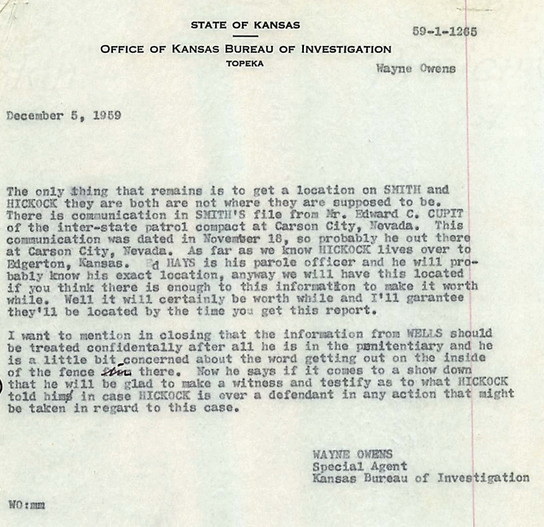
In 2013, Slate‘s Ben Yagoda described numerous factual indiscretions, revealing that editor William Shawn had penciled in “How know?” on the New Yorker galley proofs of Capote’s four part opus (In Cold Blood first appeared in magazine form). That same year, the Wall Street Journal uncovered new evidence from the Kansas Bureau of Investigation, which revealed that the KBI did not, upon receiving intelligence from informant Floyd Wells, swiftly dispatch agent Harold Nye to the farmhouse where Richard Hickock had lodged. (“It was as though some visitor were expected,” writes Capote. Expected by Hickock’s father or an author conveniently tampering his narrative like a subway commuter feverishly filling in a sudoku puzzle?) As Jack de Bellis has observed, Capote’s revisions from New Yorker articles to book form revealed Capote’s feeble command of time, directions, and even specific places. But de Bellis’s examination revealed more descriptive imprudence, such as Capote shifting a line on how Perry “couldn’t stand” another prisoner to “could have boiled him in oil” (“How know?” we can ask today), along with many efforts to coarsen the language and tweak punctuation for a sensationalist audience.

And then there is the propped up hero Alvin Dewey, presented by Capote as a tireless investigator who consumes almost nothing but coffee and who loses twenty pounds: a police procedural stereotype if ever there was one. Dewey disputes closing his eyes during the execution and the closing scene of Dewey meeting Nancy Clutter’s best friend, Susan Kidwell, in a cemetery is not only invented, but heavily mimics the belabored ending of Capote’s 1951 novel, The Grass Harp. But then “Foxy” Dewey and Capote were tighter than a pair of frisky lovers holed up for a week in a seedy motel.

Capote was not only granted unprecedented access to internal documents, but Capote’s papers reveal that Dewey provided Capote with stage directions in the police interview transcripts. (One such annotation reads “Perry turns white. Looked at the ceiling. Swallows.”) There is also the highly suspect payola of Columbia Pictures offering Dewey’s wife a job as a consultant on the 1965 film for a fairly substantial fee. Harold Nye, another investigator whose contributions have been smudged out of the history told Charles J. Shields in a December 30, 2002 interview (quoted in Mockingbird), “I really got upset when I know that Al [Dewey] gave them a full set of the reports. That was like committing the largest sin there was, because the bureau absolutely would not stand for that at all. If it would have been found out, he would have been discharged immediately from the bureau.”

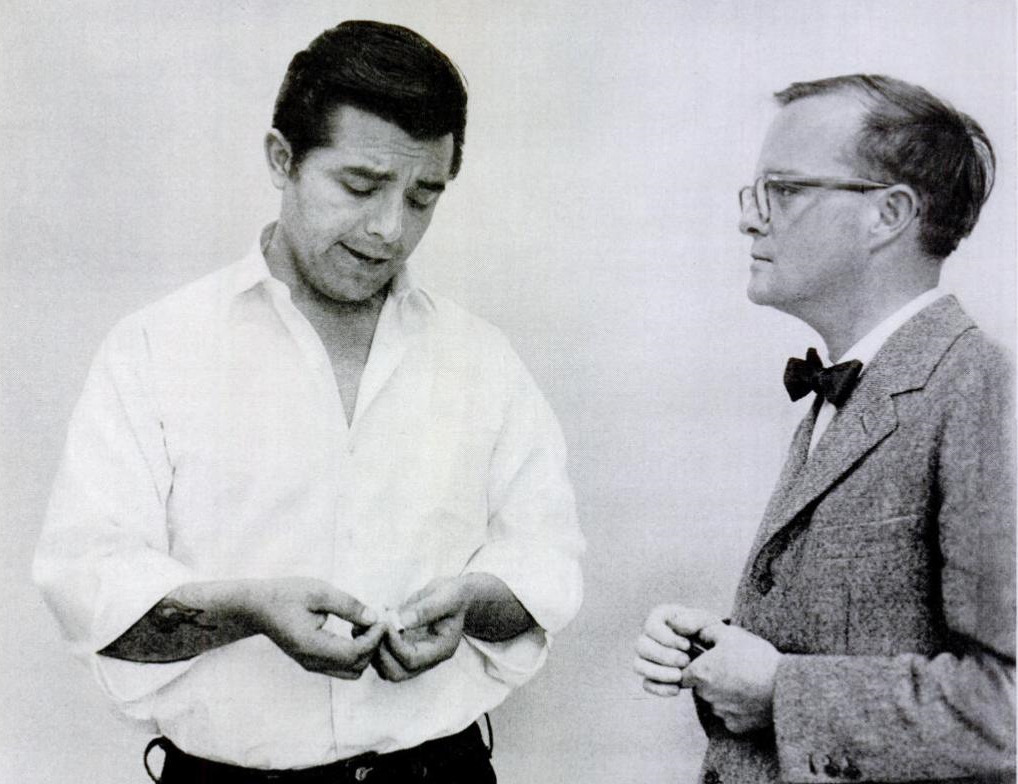
haroldnyeIn fact, Harold Nye and other KBI agents did much of the footwork that Capote attributes to Dewey. Nye was so incensed by Capote’s prevarications that he read 115 pages of In Cold Blood before hurling the book across the living room. And in the last few years, the Nye family has been fighting to reveal the details inside two tattered notebooks that contain revelations about the Clutter killings that may drastically challenge Capote’s narrative.

Yet even before this, Capote’s magnum opus was up for debate. In June 1966, Esquire published an article by Phillip K. Tompkins challenging Capote’s alleged objectivity. He journeyed to Kansas and discovered that Nancy Clutter’s boyfriend was hardly the ace athlete (“And now, after helping clear the dining table of all its holiday dishes, that was what he decided to do that — put on a sweatshirt and go for a run.”) that Capote presented him as, that Nancy’s horse was sold for a higher sum to the father of the local postmaster rather than “a Mennonite farmer who said he might use her for plowing,” and that the undersheriff’s wife disputed Capote’s account:

During our telephone conversation, Mrs. Meier repeatedly told me that she never heard Perry cry; that on the day in question she was in her bedroom, not the kitchen; that she did not turn on the radio to drown out the sound of crying; that she did not hold Perry’s hand; that she did not hear Perry say, ‘I’m embraced by shame.’ And finally – that she had never told such things to Capote. Ms. Meier told me repeatedly and firmly, in her gentle way, that these things were not true.

(For more on Capote’s libertine liberties, see Chapter 4 of Ralph F. Voss’s Truman Capote and the Legacy of In Cold Blood.)

Confronted by these many disgraceful distortions, we are left to ignore the “journalist” and assess the execution. On a strictly showboating criteria, In Cold Blood succeeds and captures our imagination, even if one feels compelled to take a cold shower knowing that Capote’s factual indiscretions were committed with a blatant disregard for the truth, not unlike two psychopaths murdering a family because they believed the Clutters possessed a safe bountiful with riches. One admires the way that Capote describes newsmen “[slapping] frozen ears with ungloved, freezing hands,” even as one winces at the way Capote plays into patriarchal shorthand when Nye “visits” Barbara Johnson (Perry Smith’s only surviving sister: the other two committed suicide), describing her father as a “real man” who had once “survived a winter alone in the Alaskan wilderness.” The strained metaphor of two gray tomcats — “thin, dirty strays with strange and clever habits” – wandering around Garden City during the Smith-Hickcock trial allows Capote to pad out his narrative after he has exhausted his supply of “flat,” “dull,” “dusty,” “austere,” and “stark” to describe Kansas in the manner of some sheltered socialite referencing the “flyover states.” Yet for all these cliches, In Cold Blood contains an inexplicably hypnotic allure, a hold upon our attention even as the book remains aggressively committed to the facile conclusion that the world is populated by people capable of murdering a family over an amount somewhere “between forty and fifty dollars.” As Jimmy Breslin put it (quoted in M. Thomas Inge’s Conversations with Truman Capote), “This Capote steps in with flat, objective, terrible realism. And suddenly there is nothing else you want to read.”

That the book endures — and is even being adapted into a forthcoming “miniseries event’ by playwright Kevin Hood — speaks to an incurable gossipy strain in Western culture, one reinforced by the recent success of the podcast Serial and the television series The Jinx. It isn’t so much the facts that concern our preoccupation with true crime, but the sense that we are vicariously aligned with the fallible journalist pursuing the story, who we can entrust to dig up scandalous dirt as we crack open our peanuts waiting for the next act. If the investigator is honest about her inadequacies, as Serial‘s Sarah Koenig most certainly was, the results can provide breathtaking insight into the manner in which we incriminate other people with our emotional assumptions and our fallible memories and superficially examined evidence. But if the “journalist” removes himself from culpability, presenting himself as some demigod beyond question or reproach (Capote’s varying percentages of total recall memory certainly feel like some newly wrangled whiz kid bragging about his chops before the knowledge bowl), then the author is not so much a sensitive artist seeking new ways inside the darkest realm of humanity, but a crude huckster occupying an outsize stage, waiting to grab his lucrative check and attentive accolades while the real victims of devastation weep over concerns that are far more human and far more deserving of our attention. We can remove the elephants from the lineup, but the circus train still rolls on.

Next Up: The Promise of American Life by Herbert Croly!

Some Ruminations on Modern Romance

Sometimes it takes only two words, uttered by someone very kind at the right place at the right time, to keep you soaring for days. There is nothing wrong with giving or receiving affection or coveting a loose ledger that is never in need of an audit. It is the gamble we all take as we stumble upon the fine intuitive glue that keeps the heart pumping in a ferociously stable place and that fills the spirit with newfound signposts to paths uncharted and untried. There is always the risk of heartbreak, but it is overshadowed by salacious quips and dancing eyes and exchanged smiles, the discovery of bright lively flora blossoming inside another soul, the enchanting unknowingness of it all.

Once the poker faces of our best selves dissolve over a few glasses of malbec, we learn of forgotten cards buried up our sleeves. The stagecraft is intuitive and vaguely mystical, transcending optical illusion, undetectable by the smartest Broadway crowd. A good pair of magicians understands that they can bring down any house through a shared glance or a sotto voce declaration or the slightest brush of fingers on a windy stage. Good living theater is all about the magic that arrives out of nowhere when no one, not even the featured players, is looking.

In recent years, we’ve abandoned our late night telephone conversations for flirty evocative texts that careen across the 4G matrix well past the midnight hour, circumventing the long established rule of never calling another after ten. But maybe we confine our expressions to words because we crave shared physicality more than ever before, perhaps because it is more easily consummated than at any other time in human history. The phones are parked in our pockets and our purses in the early stages of whatever counts for current courtship, intimating that we are occupying some private shared territory that will never be intruded upon. Dating, like show business, is all about showing up.

We sometimes succumb to cliches, but we can still be surprised by someone else even when we are exhausted. This is the magic and the fluidity of romance. The jittery excitement of meeting someone new or deepening something that seems to be tottering happily along a thrilling edge can turn a seemingly collected and rational mind into a visceral thunderball, prone to wild whims and daring moves that were never staked out on the syllabus.

It becomes easier to listen and glisten and kiss and even miss out. It becomes easier to be courteous even when the date is disastrous. It becomes easier to be honest about whatever it is you truly want. The only requirements for enjoying yourself amid a series of pleasures and mishaps are curiosity and a zest for life. And when someone emerges from the ever rotating throng who is gentle with your ventricles and willing to accept your totality, it can shoot you across the moon in ways that no cosmonaut can mimic.

It will never go the same way. This is the first thing you learn. You are more of a catch than you know. This is the second thing you learn. But there are more important lessons following these obvious revelations.

We learn of our resilience. We learn how many chances we give to other souls. We learn, even the skeptics and the bitter cynics among us, that we allow more idealism in our lives than we are willing to acknowledge. We even learn somehow to be comfortably alone during the breaks. There are patterns, but there are also deviations.

It does not matter how many there are. Equations are meaningless in this journey. There is no need to scribble gibberish upon the theoretical chalkboard of your mind. Some grand soul will emerge, even if for a brief time, if you have the courage and fortitude to go the distance.