In Defense of Alphabet Soup

I’m an advocate of alphabet soup, for many of the reasons suggested here by PBS Kids.

Some skeptics have suggested that alphabet soup is the exclusive province of children and that writers have no real reason to pay heed to this canned delicacy. But they are wrong. Dead wrong. They are wronger than Ptolemy and they simply aren’t worth your time. Don’t worry. We’re working on executing them.
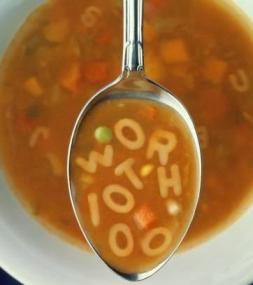
alsoup2.JPGHere’s the thing about alphabet soup: it gets results. Accept no substitute. You may not know this, but every writer named Jonathan eats nothing but alphabet soup when working on a novel. You should see the inside of Jonathan Lethem’s pantry. There’s nothing but Campbell’s cans in there.

Jonathan Franzen teaches a very unique workshop in which he manacles his students’ ankles to carrels and serves them nothing but alphabet soup. If the students complain about having a story massacred by the other students, Franzen removes their laptops and demands that the student create a story using only the alphabet noodles in his bowl. This may seem a cruel form of pedantry, but results are results. This is the kind of teaching that puts them on Granta‘s radar. (It is worth noting that the Granta staff eats alphabet soup for breakfast, lunch and dinner. 365 days a year.) Nearly every student from Franzen’s program has found a job as an underpaid editorial assistant at a New York magazine and these B&T geniuses can be readily observed on a Friday night replacing lines of fine cocaine with alphabet soup that they proudly snort up their noses, no matter how scalding hot or warm the temperature.

You may recall Jonathan Ames’ famous essay about his experimental period, when he replaced alphabet soup with saltine crackers while trying to finish a crucial chapter in Wake Up, Sir! Without the alphabet soup, Ames was insufferable to his friends and family. He began to walk the Brooklyn streets, shouting verses from “Jabberwocky” at the top of his lungs and trying to discuss the finer points of Wodehouse with any stray dogs who would listen. (The most traumatic point of this period occurred when Ames believed he heard a dog say “Jacques,” in reference to Derrida, when the dog had merely barked.) But once the alphabet soup returned into Ames’ life, Ames once again found focus and finished his novel. And he never fell off the wagon.

Even editors who face vertiginous slush piles because of this relationship between fiction writing and alphabet soup can have use for it. They can pour a tureen of alphabet soup on a pile of manuscripts and, should the writer follow up, claim “they never received it.” And aside from alphabet soup’s palliative functions, what do you think they serve in soup kitchens? Rack of lamb? Alphabet soup enables the homeless to ask for more money, thus securing our great capitalist system, which clearly distinguishes between the soup eaters and the soup eater nots.

While there is a small band of literary groupies who use alphabet soup for kinkier purposes, most literary people acknowledge that alphabet soup is the one and only way to be a writer. If you’re reading this, I’m confident you understand this fact. Let us work together to crush the other writers who think they can go about this fiction writing business without soup, without alphabet noodles, and without fulfilling their patriotic duties.

[UPDATE: Apparently, the accompanying image was unwittingly stolen from this site. We will replace it tomorrow with another photo, since certain parties have informed us that their boxers are in a bunch.]

An Interviewer Who Cannot Rise to the Occasion

If you want to know how not to interview someone, Kevin Maher offers a textbook example of journalistic ineptitude. Maher interviews Ghost Rider star Eva Mendes, declaring that she is a beautiful woman who transforms “the most insightful of male interviewers into puddles of fawning inarticulacy.” He then declares, with a journalistic swagger unseen since Norman Mailer, that “in my hands this Mendes woman will be putty!” Yeah, that’ll keep Mendes in her place! But Mendes surprises Maher by flirting with him and, instead of Maher flirting right back and not letting Mendes’ beauty get in the way of a good interview, he claims he doesn’t even remember her nude scene in Training Day and, when Mendes brings up her breasts, he doesn’t have the intelligence to tie this into the conversation. He even confesses that he “can’t think of a quick enough quip.”

The problems here are manifold: Maher’s inability to respect her Mendes as a person, Maher’s inability to be honest about her charisma (complete with the Eisenhower-inspired sexism of “the Mendes woman” becoming putty in his hands), and Maher’s inability to play right back, no matter what the subject. Spontaneity is often an ineluctable part of a great interview and, if a journalist doesn’t have the wit, confidence and playfulness to negotiate these tricky waters, he doesn’t belong on the beat.

If anything, Mendes sounds like a very interesting person with a playful streak. It’s too bad that this is an interview conducted by an idiot, signifying nothing.

Vollmann Club Update

One lingering side project: I plan to update the Vollmann Club site to incorporate all current Vollmann-related writings by VC members. Again, the only requirements of joining the Vollmann Club is (a) having a blog and (b) seeing Bill Vollmann at a reading. He’s currently on tour for Poor People. So there’s ample opportunity to fulfill the second criterion. If you want to hop on board, shoot me an email and I’ll hook you up. There are a few volumes that haven’t yet been commented upon.

Roundup

  • I was extremely bothered by this piece of wankery from the NBCC. And it wasn’t because my “nemesis” Lev Grossman was involved. The NBCC, you see, is hosting a panel on just how gosh darn hard it is to look at them crazy genre spooks that threaten to drive down the neighborhood property values, when the critic’s goal is to remain high-minded. “High-minded,” of course, meaning elitist. After all, the Grand Wizard told us that NOTHING WHATSOEVER OF LITERARY WORTH can come from mysteries, thrillers, romances, science fiction, comic books, mis lit, chick lit, cock lit, cunt lit, or whatever other bullshit lit label affixed to a book.

    For we all know that these books must drink from a different fountain and should do nothing more than carry our suitcases up to our hotel rooms. Thank goodness we all remain liberal about literature, heeding the wisdom of the great D.W. Griffith film classic The Birth of a Novel, as we continue to smile as these books say “Thankya, suh,” after we tip them generously.

    I was prepared to respond to the wholesale arrogance and anti-intellectual nature of this panel and the fact that, aside from genre-friendly EW critic Jennifer Reese, John Freeman didn’t have the good sense to, oh say, get a regular mystery columnist on the panel to discuss many sides of the issue. He seemed more content to stack the deck against genre.

    Thankfully, Jennifer Weiner has done my work for me. This is a useless panel that practices needless segregation. The NBCC stands for “National Book Critics Circle.” Last I heard, tomes that fell outside mainstream literary fiction were books too.

  • Joshua Ferris discovers the Hold Steady two years after everybody else has. Next year, Ferris plans on raving about how great LCD Soundsystem’s “Losing My Edge” is.
  • Colleen Mondor emailed Scarlett Thomas and collected her correspondence into a thoughtful interview with one of today’s most underrated writers.
  • I love these kids. (via Gwenda)
  • Callie has more on the “to MFA or not to MFA” controversy.
  • Jessa Crispin, with typical insouciant ignorance, suggests, “Pick up any other book review section — particular in Chicago [sic] — tear off the header, and you would have no idea where it came from.” Well, that’s just plain wrong. For example, I doubt you’d ever see the sentences, “The drinks mounted frightfully: a pale ale, a lager, a few beers, several gin-and-French cocktails, a double shot of gin (drunk from a toothbrush glass). I began to feel a bit lightheaded myself, and still the river flowed on: wine, gin and lime juice, more beer, whisky,” in the NYTBR (at least not under Tanenhaus’s watch).

    I think any person who follows the book review sections can probably guess where the above sentences came from. While I agree that there’s something of a homogeneity in current book review coverage (i.e., an apparent moratorium on fun and enthusiasm, which I’m doing my best to uproot with my own contributions), even an elementary literary enthusiast would be hard-pressed to look at a piece written by Daniel Mendelsohn, Liesl Schillinger, Laura Miller, David Orr, or the ever-thoughtful Ed Park and claim that it came from somebody else.

  • RIP Jean Baudrillard. Wow, there are no words. There is no reality. I will post a roundup when reactions come in.
  • A.L. Kennedy on the Granta list. (via Bookninja)
  • Newsweek asked readers the five books they’ve always wanted to read but haven’t gotten around to. Here are the top choices. (via Classical Bookworm)
  • The beginning of the end.
  • Who knew that Farnham’s Freehold was so “controversial?” I’m all for this bizarre Heinlein novel, which I first read when I was thirteen, being reissued, but I’m wondering if Heinlein is becoming so passe that publishers will resort to anything to draw attention.
  • In Praise of Ethel Muggs.
  • Maud conducts a fascinating contest.
  • If you’re a writer who needs a day job, Justine Larbalesiter has been soliciting queries on this point.

Reports of the Film Industry’s Death Have Been Greatly Exaggerated

Hollywood Reporter: “The U.S. boxoffice recovered last year from its 2005 slump as it climbed to $9.49 billion in ticket sales — a 5.5% increase over the previous year’s level of $8.99 billion. The domestic boxoffice also rebounded from a three-year decline in admissions. For 2006, according to the MPAA, admissions grew to 1.45 billion, up 3.3% from 2005’s 1.4 billion. The rise in admissions combined with a slight rise in the cost of individual tickets to produce the boost in boxoffice revenue.”