The Liminal Landscape of Valeria Luiselli

FACES IN THE CROWD
by Valeria Luiselli
Coffee House Press, 154 pages

SIDEWALKS
by Valeria Luiselli
Coffee House Press, 120 pages

On February 9, 1994, the Surrealist poet Gherasim Luca threw himself off a bridge. He was eighty years old and had lived in Paris for forty-two years without padding his pockets with the appropriate government papers. Shocked scholars searching for insights into Luca’s suicide have scoured through his book La Mort morte, seeing the five fictitious suicide attempts and fabulated notes that Luca composed in the mid-1940s as the psychoanalytic smoking gun revealing his dark and inexorable trajectory.

But in her essay “Stuttering Cities,” the perspicacious young writer Valeria Luiselli doesn’t view Luca through that cheap preordained lens. She has looked to Luca’s “Passionnément” — a staccato poem powered by a bilabial stutter that is strangely pleasurable if you listen to it (or you have the guts to recite it, which I recommend even if your French is atrocious), and sees the insight not so much in the mood, but the sputtering expression. For Luiselli, it is that liminal space between the words (“pas pas paspaspas pas”) that reveals the human, uncovering territory closely tied in feel and form to a baby joyfully exclaiming “mama” or “papa” for the first time, anchoring us to some lifelong continuity, and becoming the ultimate measure of the silence we all endure to some degree while occupying this planet. If Luca’s poem represents (as Luiselli sees it) “the downward plunge of language toward that silence,” then the liminal landscape of words and cities (or those unbridged stretches on the Seine) may be the ideal place to direct our empathy and our attentions.

Coffee House Press, a marvelous independent publisher that we are all quite fortunate to have parceling out these slim and thrilling volumes, has recently issued two of Luiselli’s books, both translated by Christina MacSweeney: Faces in the Crowd, a novel, and the essay collection, Sidewalks. Luiselli’s fascinating novel is quite occupied with the hidden pauses between paragraphs, which bristle in the text with the cillia-burning relief of a fresh cigarette staving off a narcotic need that will inevitably return. (Luiselli is a smoker and, in her essay “Other Rooms,” she observes how sharing cigarettes with a night-shift doorman is not only a great way to strike up friendship that is somewhat defiant of life’s dogged patterns, but a way to get to know yourself better.)

Faces in the Crowd is very much a cousin to Jenny Offill’s excellent novel, Dept. of Speculation, in the way that it coaxes the reader to fixate on the asterisks between the short sections. That approach pushes the reader forward in the slipstream flow of an unnamed woman who has worked as a translator, encountered professional disgrace, and may be permanently closing the door on her husband and kids (Luiselli is quite attentive to demonstratives and the degree to which her protagonist utters “this” or “that” contains multitudes). This is quite amazing! She becomes so obsessed with this poet Gilberto Owen that she not only fabricates a professed translation and his photograph, but assumes his identity, almost willing herself into a liminal space between fiction and nonfiction (and if you get your hands on both books, there’s a heavenly, head-tingling, overhead tension between Luiselli’s fiction and nonfiction that is also worth experiencing!), one that reinforces this translator’s declaration on what the text we’re readying really is: “Not a fragmented novel. A horizontal novel, narrated vertically.”

By now, just about every literary person has been forced to contend in some way with the first half of that six book, 3,600 page, Norwegian confessional sprawl professing to be the 21st century answer to Proust. But text that persuades us to slow down and examine our zealous reading obligations, whether print or digital, is becoming increasingly rare. We are ever more in need of it in this epoch where social media hopes to plunder what remains of the private, uncastigated life. In “Other Rooms,” Luiselli speaks to the impossibility “for anyone to commit a spectacular crime in his living room or to conduct a good affair (dirty, delectable, and detectable).” Liminal obliquity may be the only safeguard we have against such developments. Fiction is fated to increasingly address the surveillance state and its willing smartphone-entranced executioners. Novels that compel us to question our reliance on a landscape artificially punctuated by alerts and notifications could break us out of these reluctant habits.

Some of Luiselli’s subtleties may be lost in translation or carefully engineered to protect the reader from falling into obsessive traps. There is an editor named White who emerges in Faces in the Crowd. The translator hopes to persuade White to publish Owen. Ruminating upon the blanks between spaces, I was tempted to envisage him as Blanco in Spanish, even though he is established as a gringo (and let us not forget that gringo‘s etymology originates with one who cannot speak Castilian fluently or naturally), especially when White leaves a note to the translator: “Bring me something that really can be translated into English.” But would such an inference cause me to become obsessed with an altogether different white whale? Luiselli includes a rare book printer named Moby, whose bailiwick is publishing “Ohio poets of the twenties and thirties,” no matter how mediocre. If this novel is not fragmented, as its protagonist promises, why does it swim towards the driftwood of broken books and forgotten poets?

Near the end of Faces in the Crowd, the protagonist confesses:

I haven’t talked to my husband for over a week….I sense him getting into the bed. He smells bad. He smells of the street, restaurant. He smells of people.

Throughout the novel, in an almost inverted Lautréamont narrative approach, we witness this husband peering over the translator’s manuscript in progress — the very book we’re reading — offering joy, repellence, suspicion, and regrets. Eventually, the husband abandons his vicarious interest. The translator has abandoned her real husband, an architect who designs variations of the same house all over the world, for the Owen-like poet within her mind, a lonely ghost drifting over the landscape of books and cities. One of the reasons that Gherasim Luca killed himself was because the Parisian authorities expelled him from his apartment for “hygiene reasons.” There’s good reason to see the translator’s husband as a Luca offshoot or possibly some human answer to a Vico cycle (“Pa-pa, says the baby,” writes the translator late in Faces in the Crowd, calling back to Luca’s “Passionnément”). Maybe true freedom and happiness emerges from seeing the world as a liminal landscape in which the only points that matter are our first words and our last.
Amanda Vaill (The Bat Segundo Show #549)

Amanda Vaill is most recently the author of Hotel Florida.

Author: Amanda Vaill

Subjects Discussed: Household accidents, Robert Capa’s “Falling Soldier” and various claims attesting to its authenticity, staged photography, Capa’s origins, Ernest Hemingway’s bluster, his journalistic weaknesses, Virginia Cowles’s bravery, the dubious qualities of To Have and Have Not, John Dos Passos, journalistic skepticism, Hemingway’s disillusionment with the Spanish Civil War, Martha Gellhorn, Gellhorn’s 1983 interview with John Pilger, Gellhorn’s condemnation of government, Gellhorn’s relationship with Eleanor Roosevelt, Gellhorn making up the facts (fabricating a Mississippi lynching) for her news story, “Justice at Night,” Henry Luce’s attention to Robert Capa, what coverage of the Spanish Civil War was real, Spain as the front line against Hitler, constraints of journalists on the Nationalist side, whether or not any amount of art and journalism could have averted the fate of Spain, the Non-Internvention Agreement, American isolationism, the civil war within the Civil War, left-wing factions squabbling against each other, Arturo Barea’s The Forging of a Rebel, Barea as a late bloomer, Barea’s stint as the Unknown Voice, confidence and post-traumatic stress, how to determine the precise words that floated through someone’s head or mouth from seven decades ago, Hemingway’s The Fifth Column, The Spanish Earth and the current print status of Spain in Flames, Archibald MacLeish and Contemporary Historians, Inc., orphan business entities, the brawl between Orson Welles and Hemingway during voiceover recording sessions, the fight between Hemingway and Max Eastman, what women thought of all the needless male fighting, George Seldes’s reception in the Spanish Civil War, Henry Buckley’s The Life and Death of the Spanish Republic, the legend of the luggage that Martha Gellhorn took to Spain, Joan Didion in El Salvador, Love Goes to Press, the American matador Sid Franklin, Ilsa Kulcsar, Gellhorn’s bravery and influence upon Hemingway, the recent Russia press gag on bloggers, comparisons between the Spanish Civil War and Syria, photographs as Instagram in slow time, whether there’s any Hemingway again, and contemplating J.K. Rowling going to the Crimea to write a novel.

EXCERPT FROM SHOW:

Correspondent: You’re doing okay, I take it.

Vaill: Except for my broken finger.

Correspondent: Oh, you broke your finger?

Vaill: Yes, I did. I had one of those household accidents. I tripped over my shoes.

Correspondent: And, of course, it’s the right hand as opposed to the left hand.

Vaill: Of course it is. So I cannot write and I cannot shake hands and I cannot sign my name. Except that it is getting better so I can now do that.

Correspondent: Although you have a good shot at taking over Spain.

Vaill: I hope so.

fallingsoldier

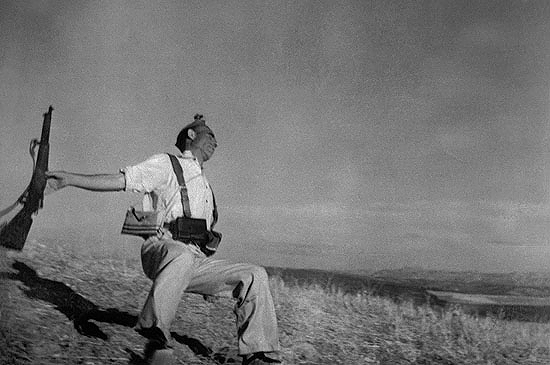
Correspondent: The Spanish Civil War. We have many characters and many figures and I’ll do my best to get to all of them. But let’s start with good old Robert Capa. One of the fascinating and oft argued issues in photography is, of course, Robert Capa’s “Falling Soldier” — the picture of the militiaman on the Andalusian hill falling to his death in battle. Some have contended that it is fake. Some have contended that it is real. Some have, as you have, tried tracking down interviews. You tried to find an NBC Radio interview with Alex Kershaw on October 20, 1947 in which Capa claimed to have killed the miliciano. But the purported truth of the story behind the photo is almost as murky as the purported truth of the photo, which in turn has us contending with the purported truth of the War. So how do even begin to come to terms with the photo — in terms of scholarship, in terms of authenticity? And how does the struggle affect our ability to wrestle with the complexities and the ideological involutions of the Spanish Civil War? Just to start off here.

Vaill: Well, that I could write a whole dissertation on. And people have. But let’s start first of all with the word “fake,” which is a…

Correspondent: Staged.

Vaill: Yes. There is a big difference. Something that is faked is in some way manipulated so that something that is not true can be made to be true. Something that is staged is something that is perhaps not quite as extreme as something that is faked. And you have to bear in mind that in 1936, when this photograph was taken, there was no history of war photography at all. No one had taken live action photographs on a battlefield. Matthew Brady took pictures of corpses, which he manipulated and moved around so that they would be in a pose that he liked. In World War I, you couldn’t go on the battlefield. You were not allowed. And furthermore there was no equipment that you could take on there. You have big cumbersome cameras and slow film. And it was only in the 1930s, when you had 35mm film and cameras that could accommodate it, that you could take your camera onto the battlefield. So there was no rulebook for how you handled photography in wartime and no one was used to allowing photographers to be where there was combat. So when Capa and Gerda Taro, his lover and cohort in photography, came to Spain, they at first were not even allowed to go onto the battlefield. They were only given access to troops behind the lines and they tried to make them look good. But this was just not happening. They couldn’t get anything that looked like real battle. And finally, when they were near the area of Córdoba, on the Córdoba front. They had this chance to take photographs of a group of soldiers and Capa has told many stories about what happened and how he got this shot. He was an inveterate tale-teller. He was a real entertainer, Capa. He loved to charm and entertain people.

Correspondent: He felt compelled to create his own legend.

Vaill: He totally did. And he did. He created his name. He was born Andrei Friedmann in Budapest. So he created a whole persona of Robert Capa, the famous photographer, and he created not just that, but this legend of himself that he felt perhaps compelled to live up to. In 1936 though, remember, he’s 22 years old. He’s just a kid. He doesn’t know what he’s doing really. And it is my belief, based on interviews — they aren’t even interviews; conversations that he had with those close to him at times when he, in fact, was not on. The conversation that I base most of my reconstruction on this incident on is one that was with a friend. He wasn’t trying to entertain this person. He wasn’t showing off for an interviewer. He was confessing something. And what he confessed was that a real man had been killed by something that he had done and he was conscious-stricken about it, which is the kind of thing that really squares with the portrait that I received of Capa. That Capa was a very kind, very generous, very loving person and easily hurt by things and didn’t want to give pain to others. And that this thing had happened, I think, was horrifying to him.

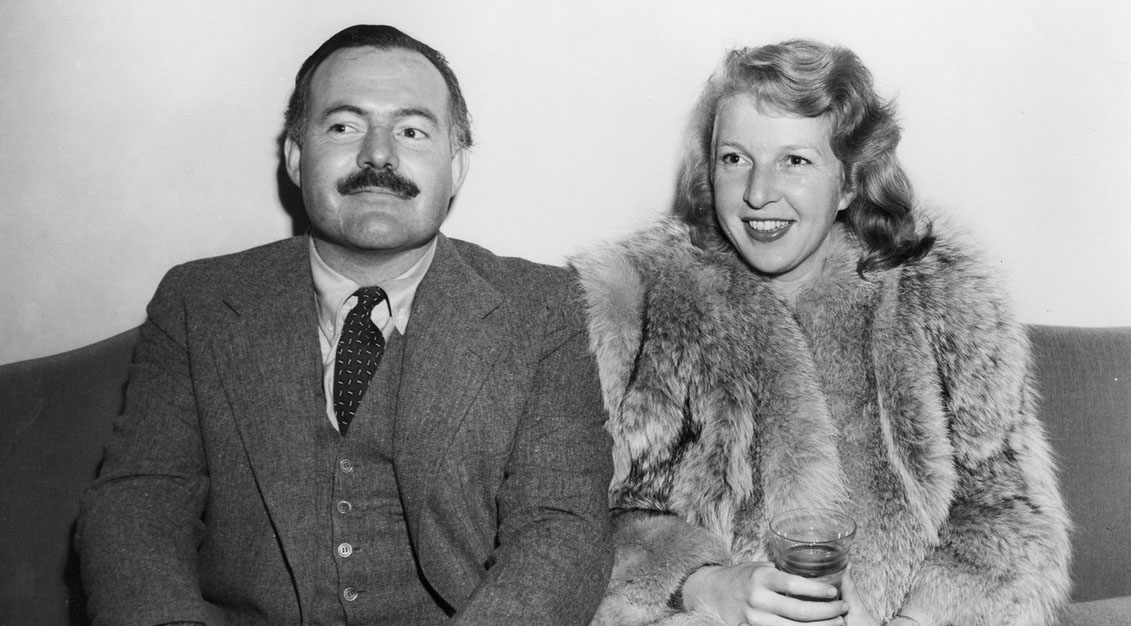
Correspondent: Since we are talking about various artists who came to Spain and essentially either set themselves up as legends or became legends later, let’s move naturally to Ernest Hemingway. For all of his bluster about being a “real man” and a “real journalist,” he didn’t actually cover Guernica in April 1937. And he didn’t mention this devastating battle in his dispatches from Spain. Virginia Cowles, on the other hand, she headed into the Nationalist zone and not only covered it, but did so when a Nationalist staff officer said, “You probably shouldn’t be writing about this.” So you write in the book that Hemingway may not have thought this important enough, but why do you think he ignored it? Was he just not that thorough of a reporter?

Vaill: Well, actually, I hate to say this, but he wasn’t that thorough of a reporter. For all that he had a great background as a gumshoe reporter back in the day, when he was at the Kansas City Star, when he was in Toronto, he was a newspaperman. He was on the city beat and he was the cub reporter sent out to cover fires and God knows what all else. But by the time he went to Spain, he had become a legend. And he was a legend, in part, in his own mind, as much as in the minds of others, and I think he got to the point where what he really wanted to do was to sit at the big table with the big boys and get the big story, and let somebody else worry about all the little details. And in this case, Guernica happened in the Basque Country. It was in a zone that it was almost impossible for him to get to without great difficulty.

Correspondent: But that didn’t stop Cowles.

Vaill: Well, it didn’t. Because, of course, she was still building her reputation. I think Hemingway felt he didn’t have to pry. I also feel that he didn’t think it was that important. And he didn’t think it was that important because the very contemporary news reports of it were very dismissive at first. It really wasn’t until people like Cowles found out what had gone on there that it became evident that there had been a horrific disaster. So Hemingway just basically thought, “I’m going to give this a bye. It’s too much trouble. I’ll risk my neck getting there. I don’t need it. I’m heading back. Screw it.”

Correspondent: I will confess that your book had me finally, after many years, reading To Have and Have Not.

Vaill: (laughs)

Correspondent: I had been avoiding this for a long time and, as it turns out, rightfully so. Brilliant in parts, terrible in others. I mean, was Hemingway just not up to snuff during this particular period?

Vaill: I think he was struggling. And I think that many writers do. They reach a period where they’re trying to break through to some other level and they’re not comfortable. The instrument isn’t sharp in the way that they want it to be sharp to do the work that they suddenly have decided they want to do. Hemingway after writing two extraordinarily well-received novels and an amazing bunch of short stories and maybe two of his, I think, finest works — “The Snows of Kilimanjaro” and “The Short Happy Life of Francis Macomber.” I think he was looking to do something different. The ’30s were a period of great relevance. The engagé writer was what you were supposed to be and he hadn’t been. And even though he scoffed at a lot of this stuff and said that he didn’t want to get that involved in politics and he didn’t want to hue to any -isms of one kind or another and all he really believed in was freedom, he couldn’t help noticing, particularly when his friend John Dos Passos ended up on the cover of Time Magazine in the summer of 1936, that writers who were writing about the big political themes were getting a lot of attention, the kind of attention he had always gotten, and I think he was looking for some way to do that and To Have and Have Not represented that kind of fiction for him. He wasn’t comfortable writing it, I think, and I think that was the problem of it.

Correspondent: Speaking of Dos Passos, I felt tremendous sympathy for this poor man. I mean, he comes to Spain. He’s looking into the mysterious disappearance of his friend, Jose Robles Pazos, and he’s spurned by Hemingway.

Vaill: Oh yeah.

Correspondent: Hemingway is well-connected with the Loyalists and he tells Dos Passos, “Don’t put your mouth to this Robles business. People disappear every day.” Which is an extraordinarily callous statement. Why did Hemingway have difficulties getting around his romantic vision of the Republicans? Why couldn’t he ask the difficult questions that Dos Passos had no problem in investigating?

Vaill: Well, I think it goes back to Hemingway’s wanting to be at the big boys table.

Correspondent: And he was.

Vaill: And he was. We’ve seen some of this same problem with journalists in our own day. The New York Times‘s Judith Miller, for example. And other writers writing about our involvement in the Iraq War, they wanted to just take the story that somebody wanted to hand out. Because that person was well-connected and high up in a tree.

Correspondent: And that trumps any journalistic integrity.

Vaill: Or any journalistic — I think it would be — doubt. Just the feeling that, oh wait.

Correspondent: Skepticism.

Vaill: Maybe I can take this story.

Correspodnent: Questioning.

Vaill: Your skepticism instrument is just not working when that happens. It’s lulled into some false quiescence by all this access that you suddenly have. And I think that’s what really happened to Hemingway here. He was so in love with the access he had and he was so taken up with his passionate identification with the cause of the Spanish Republic, which I can certainly understand. They were the democratically elected government of Spain and a bunch of right-wingers wanted to nullify an election and just take things back to the way they were before.

Correspondent: So in order to get over the crest to For Whom the Bell Tolls, an absolute masterpiece, he had to go through all these needless romance and this big review point and then he had to have his heart crushed.

Vaill: And then he had to be disillusioned. And I think the problem for him was — yes, exactly, he did have his heart broken in a way. And For Whom the Bell Tolls came out of that feeling of disillusionment. He called not just what had happened in the Republic, but also what happened at Munich — the whole thing and the dismissal of the international brigades from Spain. All that to him was what he called a carnival of treachery on both sides. And that’s pretty strong language.

The Bat Segundo Show #549: Amanda Vaill (Download MP3)

This text will be replaced

Mimi Pond (The Bat Segundo Show #548)

Mimi Pond is most recently the author of Over Easy.

Author: Mimi Pond

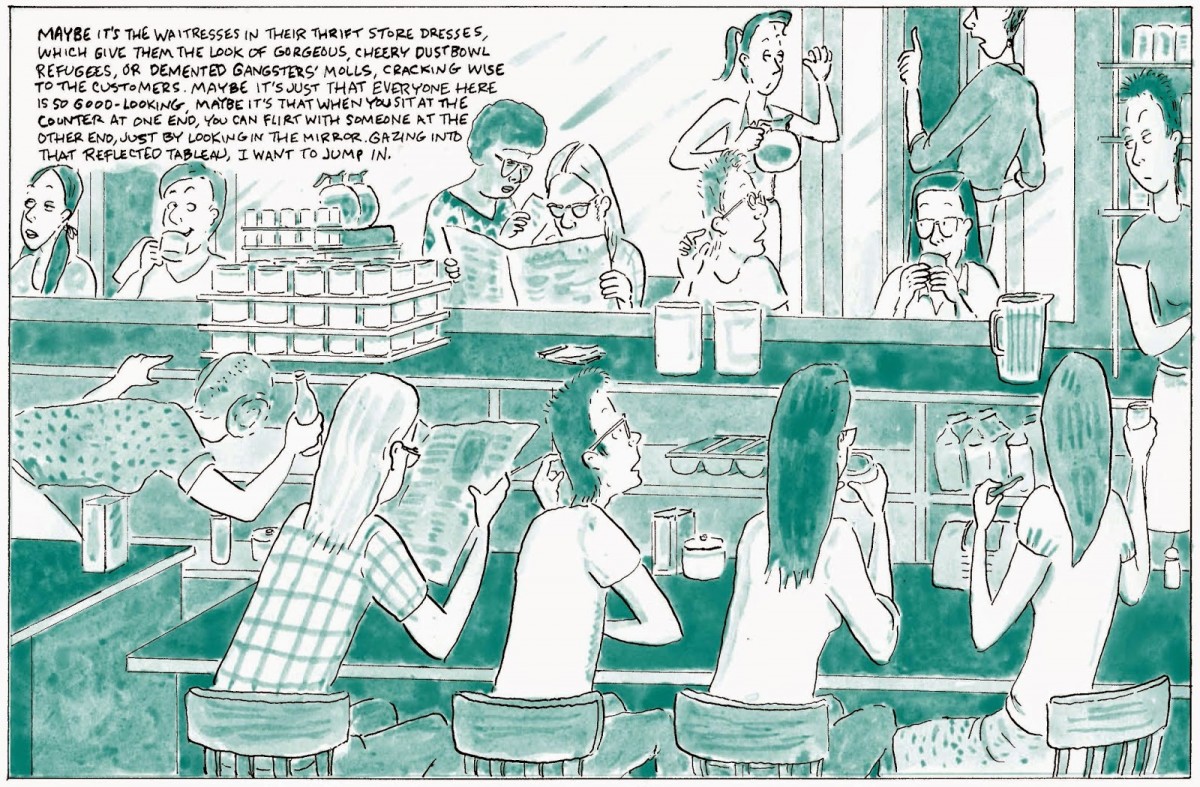
Subjects Discussed: Different forms of memoir (and related resistance by publishing), James Frey, autobiographical fiction vs. memoir in comics, realizing Over Easy from a manuscript, working from a textual framework, trash-talking line cooks, Charles Dickens, Daniel Clowes, comic book characters often cast into inevitable film adaptations, imagination, picture books, Mama’s Royal Cafe as a locational inspiration, memory vs. reference shots, the difficulty of filling up sketch books while waiting tables, the mysterious Nestor Marzipan, keeping in touch with former restaurant co-workers, keeping gossip alive, taking notes, when memories elude the nostalgia trap, what 1978 establishments can teach 21st century diners, drugs and the willful stupidity of kids, disco wars, how a rudderless culture was maintained by a manager who made waitresses feel special by listening, what people found charming about diners in 1978, Stewart O’Nan’s Last Night at the Lobster, Todd Haynes’s miniseries adaptation of Mildred Pierce, dramatizing working-class life, how dishwaters can form more legitimate claques than art school, the haziness of art school, the green chromatic feel throughout Over Easy, the one character with a jet black character in the book, the cameo appearance of Flipper‘s Ted Falconi, “Art is dead!” proclamations, maintaining aesthetic standards during a time of bad music and bad art, the oppressive nature of avocado green, young kids today who glorify the 1970s, Peter Frampton, the band America, the influence of Alison Bechdel’s Fun Home, people who overanalyze comics, the early seeds of storytelling, being nursed at the bosom of MAD Magazine, working with Shary Flenniken at the National Lampoon, learning the basics of a comic strip, circular text around objects, cartoonists and the daily grind, doing monthly strips for the Voice, social commentary in comics form, drowning babies, editorial arguments with Drawn and Quarterly, politically incorrect language excised from the finished product, ironic epithets from 1970s liberals, the importance of getting upset to understand a time, Norman Mailer’s “fug,” living in a high mesa in San Diego comparable to the unshaded area of a picnic table, public park metaphors for living circumstances, the New York Times‘s claim that Oakland is the new Brooklyn, being attracted to bad poets before knowing their poetry is bad, the lack of good coffee in the 1970s, diners that once used real linen napkins, the virtues of not being judged for sleeping with anyone in 1978, and slut shaming and Lulu.

EXCERPT FROM SHOW:

Correspondent: What specific points in 1978 did you really feel compelled to capture? I mean, how could you do 1978 right while also adhering to the exigencies of narrative, which requires a kind of linear path and all that? What was the organizational process like?

Pond: I was just remembering things the way they were then. Things that really stuck with me. And I worked on this over a fifteen-year period, from about 1998 until early this year. It wasn’t so much that I was like “I’m going to capture 1978!” It was “I’m going to remember it the way I’m going to remember it.” So it wasn’t anything that specifically deliberate. It was just the time and the place and what it felt like at the time. And I did take notes over the years from the time I left up until 1982, until about 1998, and I also went back to visit many times. And I talked to my former co-workers, who very generously shared their experiences with me, which I also incorporated into the story.

Correspondent: Were there any stories or anecdotes that were pure romantic forms of nostalgia? Or things you wish would have happened? Anything along those lines?

Pond: No. I don’t think of it as nostalgia. Because there were too many hard lessons learned.

Correspondent: It was too rough to be nostalgic. (laughs)

Pond: Yeah, it was too rough to be nostalgic and there were too many people who wound up down the rabbit hole of drug abuse for too many years to have the dewy glow of nostalgia around it. It was one of those situations where it was really following up to a point until it wasn’t fun anymore. And there’s going to be a Part Two. I’m working on that now.

Correspondent: I know that.

Pond: Part Two gets darker.

Correspondent: Well, what about Part One? Did the darkness threaten to overwhelm some of the romance of the diner? The kind of effervescent look of the place and the feel of the actual book?

Pond: No. I don’t think so. I mean, I’ve always been in love with the look of that place. The first time I walked into it, it just felt like home. So I could just draw that counter and those booths and all that stuff endlessly.

Correspondent: Well, what does a diner like the Imperial — I mean, what could it teach diners of today? What does a 21st century diner not have that the Imperial did have?

Pond: Well, there were no rules. In the ’60s, the hippies threw out all the rules. And in the ’70s, we looked up and we just said, “Oh, the rules are gone. So which ones do we put back? And which ones do we leave out? And how does this all work?” And it was kind of up to you to figure it out. There was no one saying, “Just say no.” So everyone was going, “Woohoo! Drugs! Yeah, drugs are fun!” Like no one said, “That cocaine thing? That’s not such a good idea.” “Jazz musicians used to snort cocaine in the ’30s. So it’s really cool, right?” And kids are always stupid. And this is what drug abuse is about. Like heroin, people are just stupid enough. “I’m not going to get hooked!”

Correspondent: What was the common ground of such a place? You mention early on how the disco wars were what united the punks and the hippies. And then at the end of the book, we see this poetry night in which everybody is allowed his particular moment. Does it really take a place to unite so many subcultures? So many groups? What was the cross-pollination at the time that you were trying to capture here?

Pond: Well, the uniting force in that particular place was Lazlo Meringue, the manager.

Correspondent: Who everybody told their problems to.

Pond: Yeah. Everyone told him their problems. And he was one of those people that just made you feel like you were the most important person in the room. And he validated your experiences by telling you that the fact that you had observed this and you think that about it is meaningful. Not just “Oh! You’re full of shit.” And the other thing was that, yes, this was important and we need to write this down. Because we’re going to make some kind of art about this later. And that was very important to me. And it made all the difference. I mean, I don’t think I ever could have worked in any other restaurant after that. I made a few futile stabs at putting in applications after I left that place, but luckily — I say luckily — no one ever hired me again. And then I had a career as a cartoonist and I never had to go back to that. But it never would have been the same. I mean, his motto was “The Customer is Always Wrong,” which did not really mean that you were entitled to give bad service. In fact, we all kind of prided ourselves on giving good service. It was more like he had your back. And if anyone gave you any crap, he would back you up.

Correspondent: And presumably the walls between the kitchen and the restaurant were thick enough to prevent any of the customers from hearing all of the profane screeches and all that.

Pond: I think, at the time, people were down for that too. Because that’s the kind of place it was. A cook would drop the end of his roach into an omelet and the customer would finally go, “Oh, I found this. Ha ha ha!”

Correspondent: “How charming!”

Pond: Yeah.

(Loops for this program provided by 40a, dj4real, minor2go, and platanos. )

The Bat Segundo Show #548: Mimi Pond (Download MP3)

This text will be replaced

Why Amazon’s Firefly Must Be Rejected

On Wednesday afternoon, Amazon CEO Jeff Bezos introduced Firefly, an app for its new Fire phone that can scan just about any object in the real world and, with the push of a button, allow you to purchase it from Amazon. As of today, 100 million items can be scanned and identified by Firefly. Firefly can read barcodes, a DVD cover, a QR code, damn near anything. It effectively turns every physical store into an Amazon showroom, where the customer can walk in, scan an object, and be on her merry way with an order waiting by mail or drone delivery. It remains unknown just how much Firefly tracks (such as scanned objects that the customer hesitates over) or what Amazon intends to do with the additional data it will connect through Firefly, but given Amazon’s $600 million contract with the CIA for cloud computing services, any sinister alliance is possible. What’s especially creepy is that Firefly can also recognize street addresses and phone numbers. Firefly intends to listen to any songs playing from your speakers and any movie screening on your TV, giving you the option to purchase these.

Assuming it garners substantial mass adoption, Firefly threatens to become one of the most insidious assaults upon American life, where every action and every quiet moment becomes an opportunity to squeeze dollars. It is the most salient example of Amazon reaching ever so closer to its ideal of vertical integration — a practice famously and rightly halted in United States v. Paramount Pictures, Inc. (1948), when the Supreme Court ruled that movie studios could not own their own theaters and maintain the exclusive right to show their own films. The difference with Firefly is that Amazon doesn’t have to make the products and could argue this if confronted with any serious legal challenge.

Amazon has just turned the entire physical world — the streets you walk on, the bedroom you retreat to, the shops you frequent — into a commercial marketplace. One can only imagine the fresh and awkward social hell to be experienced if a party guest points Firefly at someone wearing a snazzy dress. Rather than complimenting the partygoer on her sartorial flair, Firefly turns this into a potential sales transaction. One no longer has to seek exotic or bespoke items through languorous journeys in which one never asks for the time. With one simple app, the curatorial impulse and the quest for the obscure is traduced. Firefly threatens to deracinate the remaining tangible value of the physical world. It puts a price tag on taste, texture, hearing, sight, and smell. Will such quantitative objectification eventually extend to people? To credit poles that assess one’s financial worth along the lines of what Gary Shteyngart predicted in his satirical near future novel, Super Sad True Love Story?

The question that consumers must ask themselves is whether they want to live in such a world and whether convenience is worth pointing a phone in someone’s face. It is quite possible that establishments will fight Firefly by enacting “No Phones” policies along the lines of bars that prohibit Google Glass. But if Amazon is willing to take such a bold lead with Firefly, to truly view all humans as little more than avaricious hosts for the gargantuan corporate parasite, other companies will surely follow its lead.

We can Google any reference or half-formed remembrance with our phones. We can take photos of our families and friends. We can call anyone in the world from just about any location at a price and convenience that was inconceivable ten years ago. These are grand technological achievements that, on the whole, benefit the human race.

Firefly is a crass betrayal of this. It will cause many specialized businesses or establishments (such as indie bookstores) that operate at a precarious profit margin to go under. It could artificially inflate homogeneous products while expunging the artistic value out of the esoteric. But most importantly, it’s the first app to overtly put a price tag on everything in the universe. Think about that. Do you really want your friends to scan all the items in your house and get an instant cash value for everything you have struggled for years to build? (And how much sneaky data will Amazon grab to get a collective value on any individual’s possessions? Could this be compared against credit reports? Could this prevent working people from buying homes or small business owners from establishing credit?) Do you really want one company to encourage and profit from this rapacity?

That bald boorish billionaire has just signaled that he does not want to make your life better. He will stop at nothing to profit from you at every minute. Lex Luthor was never intended as a role model, but Bezos has set out to become just that. His efforts must be resisted by every thinking and breathing individual until the bright glow from his cretinous pate is permanently stubbed out.