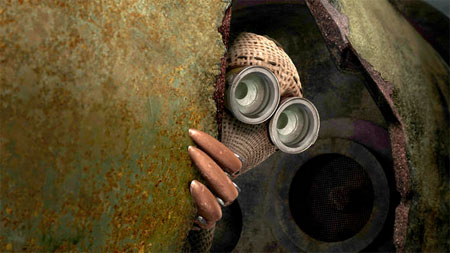
“We had such potential, such promise,” croaks an apocalyptic voice at the beginning of an apocalyptic movie. That may as well be director Shane Acker and screenwriter Pamela Pettler talking. 9 is the kind of film you expect from a mirthless marketing team stumbling onto a hip concept discovered two years too late (“Oooh! Steampunk! That’s what the kids are into!”), only to fumble so desperately in the conception. Sure, the filmmakers were given enough money to attract Christopher Plummer, Elijah Wood, Jennifer Connelly, John C. Reilly, and numerous other big name actors for voice talent. But they couldn’t be bothered to come up with a coherent or original script, characters worth caring about, or interesting dialogue. After all, when a film’s characters are given such generic names as #4, #8, #1, The Scientist, Dictator, and #8, one shouldn’t expect dialogue as commensurate. Unfortunately, Pettler can be counted upon to give us such cliched dialogue as “I know where we can find answers!” and “We have to find the source!” (One of Pettler’s forthcoming projects involves the forthcoming Monopoly movie. We shall see if she ends up writing such lines as “We have to pass Go and collect $200!”) Let me put it to you this way. Jeff VanderMeer could have written a steampunk movie in his sleep a hundred times better than this after being bloated with Belgian beer, with both hands tied around his back and using only his nose to peck at the keyboard.
The movie’s environment resembles maps that were too shopworn and derivative to make it on Team Fortress 2, with rust and squeaky wheels randomly deposited in the environment without a real sense of purpose. Acker can’t even decide if the remaining corpses of humanity are skeletal or have only partially decomposed. Acker and Pettler have a promising time period to play with for their parallel universe: what looks to be an alternative history circa 1970 after a Nazi-like empire somehow built up an analog version of Skynet. But because there’s no logic to the environment or the backstory, there isn’t much for us to latch onto except sour eye candy. Watching this film is like being promised a tasty taffy stick and being given a Now and Later that’s been melting in the sun since 1962.
I felt nothing when I watched this film. I kept hoping that the cut scene would end. But it didn’t. It went on for an interminable 80 minutes. I would have had more fun waiting for a video game level to load. At least with a video game level loading, you get some carrot at the end. Something worth your time or something you have some control over. But we aren’t given anything here in our passive roles as audience members except dolls (with a dismaying lack of expression: see the above still; Acker tries the whole wide-eyed look for his titular character and it grows tedious quite quick) who have some dim remnant of humanity to recapture here. And so 9 is nothing more than a steampunk knockoff of Wall-E. But it’s worse than a knockoff. Because Wall-E not only presented us with characters we could care about, but an environment that demonstrated the dangers of present human folly. Without any such reference points, 9 is a lackluster husk of a film.
© 2009, Edward Champion. All rights reserved.
Re: Jeff VanderMeer — I’d pay to see that.
“And so 9 is nothing more than a steampunk knockoff of Wall-E.”
Not to change your mind about the film at all (for one thing, I haven’t seen it), but it’s my understanding that this current, long-form iteration of 9 is based on a short film Shane Acker directed back in 2005.
Thanks for noting that, Mike, and I’m fully aware of the short film, which I was more impressed with. However, the movie required a protracted narrative to warrant its feature length running time. While it’s possible that the script was finished before Wall-E, it still comes across as resembling a knockoff of the film. So perhaps I should rephrase this to say that you’re better off seeing Wall-E again.
Maybe i’m just a little shit, but I thought WALL-E was a steaming pile of sentimental and illogical horse crap.
“I’m fully aware of the short film, which I was more impressed with.”
I’m sure there are examples out there, but I’m having a tough time thinking of anything that worked well in short-form (short film, short story, babies) benefitting at all from lengthening. (My personal best example is Ray Bradbury’s short story that became the too long by far novel Farenheit 451.)
(Or that one mean kid in 2nd grade who turned out to be an asshole of an adult — yeah, Trevor Carlton, I’m name-checking you.)
Mike: Theodore Sturgeon’s MORE THAN HUMAN.
VanderMeer: Eva! Wall-E! Eva! Wall-E!