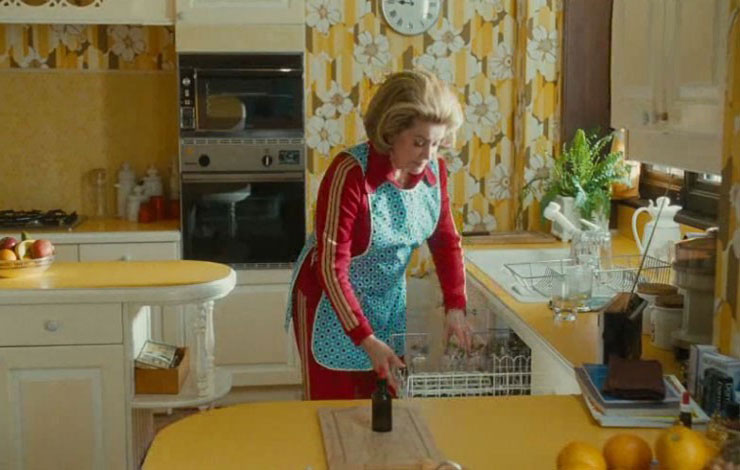
Catherine Deneuve — now 67 — is one of the few actresses in the world who will still stop a man in his tracks in her seventies and eighties. Yet François Ozon, having worked with Deneuve before in the comic murder mystery 8 Women, has rightly comprehended, much like Jacques Demy, the effervescent appeal beneath the sexy sheen.
Potiche, based on a play by Pierre Barillet and Jean-Pierre Grédy, is certainly a pleasant enough vehicle for Deneuve and her costar Gerard Depardieu. The older and middle-class critics at the screening I attended laughed at the right moments, perhaps not entirely aware that Ozon has been kind enough to toss a few goofy Molotovs over the years. For those who enjoy the more provocative side of Ozon, Potiche signals a retreat from the eye-popping fare that established this intriguing director’s career.
Whether the condition is permanent is anyone’s guess. But the gleeful assaults on bourgeois marriage, seen in such films as 5×2 and the glorious Sitcom, that imbued Ozon’s work with such mischievous zest have been replaced by a comparatively stale story involving Suzanne Pujol (Deneuve) as the titular “trophy wife” to Robert Pujol (Fabrice Luchini), an umbrella manufacturer (a nod to Demy’s The Umbrellas of Cherbourg) who enjoys balling his secretary Nadège (Karin Viard) on the fly (when, of course, an altogether different fly is unzipped). Robert is a man who cannot remember his wife’s birthday. Which begs the question of why Suzanne has stuck around for so long. (There’s an answer late in the film, but, alas, it’s something of a contrivance.)
It could be because this is 1977, a year when France is a paradise for labor strikes. Sure enough, the umbrella factory run by Pujol finds itself facing the kind of progressive resistance that seems to elude 2011 America. Leading the strike is Maurice Babin (Depardieu), who happened to have a fling with Suzanne back in the day. He may be a man of the people, but he knows how to respect a lady — a sentiment that the film is careful to heed by featuring needless flashbacks with younger actors. (I felt sorry for the the largely mute thespians playing younger versions of Depardieu and Deneuve in these scenes. With classic French cinema to be compared against, how can they compete?)
You’d think that all this political intrigue would permit Ozon to expand his cheerfully irreverent approach. One promising joke of copulating rabbits suggests that the Ozon we know is here. But he’s hamstrung by the somewhat passe and toothless material he has to work with. What’s odd about Potiche is that the Suzanne/Maurice affair — that vital subplot that’s pretty much the linchpin of good farce — doesn’t have nearly the same narrative traction as the Babin family taking over the factory while dad is occupied. Suzanne’s daughter Joelle (Judith Godrèche) faces a dwindling marriage and an augmented belly, but despite these conflict, she’s quite the reactionary little minx — especially when asked to vote during the board meetings. (Is this a joke relating to France being behind the women’s suffrage curve? Remember that France didn’t give ladies the municipal elections until 1945.) But I was especially fond of Jérémie Renier’s subtly mannered performance as Paul, Suzanne’s son. His artistic background is applied to the factory with humorous effect. And perhaps that’s because Ozon delights in decorating the Pujol house with green drapes with a sofa to match.
Potiche doesn’t quite have the retro pizzazz of an American movie like Down With Love, much less Ozon’s fashion-conscious world in Time to Leave. Watching this latest movie, it’s difficult to fathom that, only a few years before, Ozon made a movie about a baby with a working set of wings.
One sign of an interesting filmmaker is how well he can stay himself when asked to work in the mainstream mode. In Potiche, there’s one moment when a man shoves whole potato chips in his mouth. This may very well mimic what the audience is being asked to enjoy here. Or perhaps it’s a strong indicator that Ozon is better off commenting upon conventional narratives through the unconventional. Why stick with trophies when you can raise hell and get away with it?
© 2011 – 2012, Edward Champion. All rights reserved.