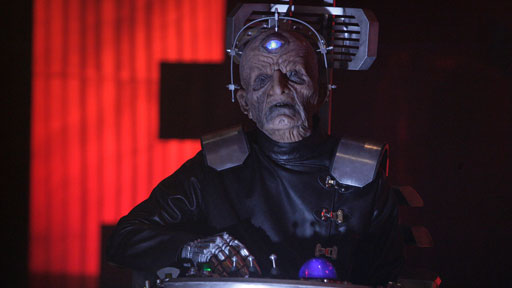
Longtime readers of this blog know of my antipathy for Russell T. Davies’s contributions to Doctor Who. So it was with no expectations whatsoever that I fired up “Journey’s End,” the season finale of Doctor Who, assuming that my intelligence and my emotions would be condescended to and that the fanwankery set into motion last week would be taken to new masturbatory heights. Yes, there was a gratuitous appearance from K-9. Yes, there was the Davros-Sarah Jane Smith showdown referencing “Genesis of the Daleks.” The less said about the phony resolution to last week’s cliffhanger, the better. And I could do without the ridiculous manner in which Earth was transported across the galaxy.
But despite these melodramatic flourishes, this episode worked for me. It was a fitting end to Davies’s tenure on the show, bringing in nearly all of his supporting characters and leaving the Doctor more or less where he started at the beginning. I enjoyed the Daleks floating above Nuremberg speaking German. (Alas, Davies’s German is not so good. He got the German verb for “Exterminate!” wrong. Nevertheless, I enjoyed the Nazi parallels.) I liked Davros questioning the Doctor’s motives, which not only echoed the lone Dalek from “Dalek,” but referenced similar talk of genocide from “Genesis of the Daleks.” Let’s not forget that in “Genesis,” the Doctor asked Davros whether he would let loose a virus that would destroy all forms of alien life. And this quiet reference to the show’s longtime continuity was a surprisingly restrained Davies moment that I have to give him props for.
The whisper into Rose’s ear, the heartening future of Sarah Jane Smith having a 14-year-old, and Donna’s fate suggested unspoken connections that called into question the notion of what it is to be a companion to the Doctor. Traveling with the Doctor, whether as a companion or a viewer, involves being at a specific time and place in one’s life. But Davies reminded us with this finale that no matter where one is at in the series, there’s always a thread one can pick up. So at the end of Davies’s run, I have to thank Davies for using his influence to revive Who, while remaining wary of his overall writing contributions during the past four years. Nevertheless, I have every faith that, in the hands of Steven Moffatt, Who will truly demonstrate its potential to capture our imagination. And I’m glad that Davies closed out the show with a rousing, if problematic denouement, without entirely taking the easy way out.
Having said all this, however, there’s a part of me that wonders if Moffatt will continue portraying Tennant’s Doctor as the amiable metrosexual we all know him to be. To some degree, Tennant is the Alan Alda Doctor. The geeky guy who knows how to order the best wine at an Italian restaurant, but who will probably get his ass kicked in a roadhouse if the cops don’t show up in time. There were a few reminders of the tough Eccleston Doctor in “Journey’s End,” and I believe Tennant is capable of inhabiting this emotional territory. But I certainly hope we begin to see more of the Doctor’s dark side over the next few years. If Moffatt wimps out, I’ll be one of the first to lock his writing contributiosn in my crosshairs.
[RELATED: Worrisome io9 speculation that Moffatt is overrated.]
© 2008, Edward Champion. All rights reserved.
I had a similar reaction but then, I don’t think I could hate anything more than “Last of the Time Lords.” I was annoyed that, lost in the miasma of cameos (even RTD got overloaded and had to dispose of Gwen and Ianto for the majority of the episode) and cheap laughs were some really great moments. Annoyed because if the whole episode had been at the level of that two minute scene where Davros confronted the Doctor with what his past companions had become, it would have been a spectacular finale. I sometimes suspect him of bringing in someone else to write those bits. He’s certainly the most inconsistent writer I’m familiar with.
I won’t miss his penchant for setting unbreakable absolutes (Every last Dalek has been destroyed…oh wait, they’re back. Rose can never, ever, ever return to our world…oh, wait, she’s back) and then negating them, thinking it will provide a huge emotional pay-off. But he brought DW back and made it popular again. So, cheers for that.
As for concerns about Moffat: well, he’s not perfect. “Blink,” my favorite episode of all time, is flawed but it’s still head and shoulders over most anything else in the series. If I have a concern, it’s this: when you contribute just 1-2 episodes per season, you can aim all your skills into crafting something really special. Is it possible to keep that level of quality when you’re now responsible for more than half of the season’s content? That may be where Davies faltered. Perhaps if he’d had fewer things to write, he could have crafted some solid stories. Of course, that’s assuming Moffat will continue that tradition (prior to Davies, there wasn’t much history of Who being primarily written by its show runner) and that’s also assuming he’ll keep the idea of having overarching themes and “catch phrases” for each season. Still, I’m not worried. I’ll take my chances if it means pitting his flaws as a writer against Davies’.
The io9 article overstates the case, in my opinion, but there’s no denying that Moffat has some truly skeevy gender issues. They were there in his Who episodes, and in Coupling and in Jekyll, and I have no doubt that they’ll color his version of the series once he takes over. It remains to be seen whether his strengths as a writer are enough to compensate for this very real flaw.
The io9 article is ludicrous, suggesting that Moffatt is the Dave Sim of British science fiction. Moffatt is not a misogynist. Further, it’s the kind of self-righteous, politically correct bullshit that suggests that women can ONLY be portrayed a particular way. I have not seen JEKYLL, but Moffatt’s COUPLING and WHO contributions, which you are viewing through the prism of that Scotsman interview that he gave four years ago (does he feel the same way today?), don’t suggest to me that Moffatt views ALL of men and women that way. And it’s not as if Moffatt is suggesting that ALL women need to marry, reproduce, and spend their lives in the kitchen. If he did, I’d be the first to tear him a new asshole. (Honestly, I thought there was quite a bit going on with River Song. Nivair at io9 seems to have confused enigma with smugness.) You may as well attack Davies for making Donna “just a temp,” and always in need of a man (either to marry or to travel in space with). Just as much of a generalization when you come right down to it, and it’s only Catherine Tate’s great performance that hides these character problems.
At least we can be grateful that the companions aren’t mere screamers who are only there to ask questions.
Furthermore, we’re talking about the fucking Scotsman here — the newspaper that infamously forced Samantha Power to resign (a smart woman; hmm, is the Scotsman sexist?) because they wouldn’t permit her to clarify her point. Do you honestly believe, Abigail, that the Scotsman was reporting the WHOLE quote that Moffatt uttered here? Or that this was one of those quotes adjusted to sell newspapers?
And where are you on Russell T. Davies’s constant assaults on fat people?
He liked it! He really liked it!
I have to confess, I was wondering about why the Daleks had a “blow up the Daleks” button lying around. They must be really, really into exterminating.
The io9 article is off the rails. Sally Sparrow had no personality? Song had no personality?? What??? And I think the Scottsman thing was blown out of proportion. It sounded like an off-the-cuff remark made by someone who’d been writing Coupling for too many years.
I’m not familiar with that interview, Ed. My conclusions stem from having watched a not insubstantial amount of Moffat’s work and noticed some recurring elements. I hope I don’t need to be told that a man who creates a character who is first gorgeous but dumb, then brilliant but ugly, and because of that ugliness unloved, and finally, in her perfect afterlife, beautiful again, a man who thinks a good afterlife for an adventurer like River Song would be playing mommy to a couple of imaginary kids she’s never met before, a man who sees nothing wrong with someone as awesome as Sally Sparrow ending up with a schlub like Larry Nightingale, has some issues that I might want to keep a wary eye on.
As I said, I find the io9 article overstated, and I strongly disagree with its assertion that Sally Sparrow and River Song are poorly conceived characters (I have a few problems with Reinnette, though, who struck me from the first as something of a wish-fulfillment girlfriend). Moffat writes strong, interesting, clever, independent women. But he’s interested in those women only inasmuch as they fill traditional roles, and often it seems that he can’t get past the male gaze – not just in his Who episodes, in which the one-off nature of his characters might justify this, but in his own work as well.
There’s no denying that Davies has his weaknesses, and he’s by no means perfect when it comes to portraying women (or people of color), and certainly Moffat brings a lot of strengths to the table (though I will never be as sanguine about his ability to plot as I was before watching the disastrous Jekyll), but it makes no sense to ignore his very real flaws.