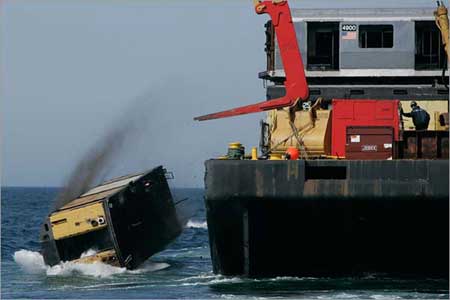
Ever wonder what happens to abandoned subway cars? Well, apparently, retired subway cars have proven to be quite helpful to the fish population just off coast of Delaware. Cars are dumped into the water, and the subway car’s roomy confines has resulted in fish taking to the cars like, well, water. (There have been other efforts to dump aircraft, automobiles, and other vehicles into the ocean to create these reefs. But the fish seem to like the subway cars the best.) Red Bird Reef, named after the famed Redbird cars being used for this experiment, has seen a 400-fold increase in marine food per square inch over the past seven years.
Red Bird Reef is not without controversy. The American Littoral Society has expressed concern that the small levels of asbestos within the glue used to affix floor panels and the like might prove damaging to the environment. And since there are only so many retired subway cars to go around, other states are trying to compete for the subway cars. (New York provides these subway cars for free.)
So is this a waste of manmade resources? A sullying of the environment? Or is it very possible that, given the declining fish populations in the Atlantic, it takes this extraordinary manmade reef to generate a sustainable fish population again?

The Call by Yannick Murphy: The always interesting author of Here They Come and Signed, Mata Hari returns with a novel that whips up a worldview from a rather quirky set of limitations: namely, the call logs that a veterinarian maintains as his son is unexpectedly put into a coma and an unforgiving economy denies him work. What emerges is a surprisingly optimistic, often funny, and very moving account on how one family uses acceptance and forgiveness as a way to atone for hard knocks. (
Birds of Paradise by Diana Abu-Jaber: Forget Franzen and Eugenides. If you're looking for a social novel that counts, Diana Abu-Jaber is the author you're looking for. Building from the free-form exploration of consciousness and identity in Crescent and the gripping procedural structure of Origin, Abu-Jaber's latest novel is her finest, equally fluent with gutterpunk culture and smarmy real estate men. It has been suggested by The Washington Post's Ron Charles that you will likely gain some pounds while reading this novel. This is certainly true. Abu-Jaber's description of food is so precise that it often made me want to do more cooking. But I very much admired the way in which Abu-Jaber presents all her characters as unwitting victims of rough capitalism, which permits them some dignity even as they perform terrible acts.
The Last of the Live Nude Girls by Sheila McClear: This memoir isn't so much about the decline of the Times Square peepshow, as it is about one young woman's efforts to pull herself up by by her bootstraps when presented with few economic options. Filled with self-introspective candor and a quiet dignity, McClear's story is one that might befall any of us in these volatile times. While McClear does get back on her feet, her book leads one contemplating the terrible fates of other young women now moving to New York and falling into deadlier vocations. (