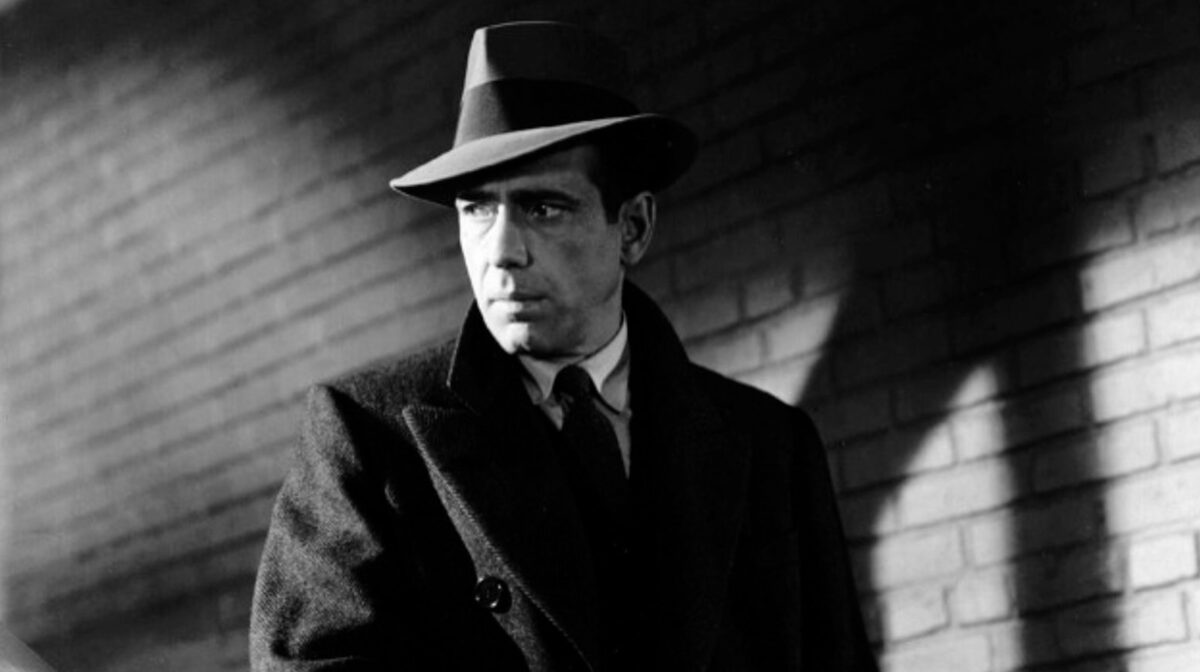
(This is the forty-fifth entry in The Modern Library Reading Challenge, an ambitious project to read the entire Modern Library from #100 to #1. Previous entry: Parade’s End.)

I have never frowned upon mysteries and I’ve always been a huge film noir nerd. During the waning days of the 20th century in which I came of age, I was deeply smitten with Raymond Chandler (Farewell, My Lovely‘s “He looked about as inconspicuous as a tarantula on a slice of angel food cake” remains one of my favorite similes of all time), James M. Cain (see my 2011 essay on The Postman Always Rings Twice), Jim Thompson, Donald E. Westlake (especially Richard Stark and the excellent Parker series, which I reread last year in a crazed white heat of excitement!), David Goodis, Dorothy B. Hughes, Patricia Highsmith, Chester Himes, Cornell Woolrich, Ian Rankin, Charles Willeford (will I ever get a chance to read Grimhaven?), Gregory Mcdonald’s Fletch books (especially the early ones; incidentally, a huge influence on filmmaker Kevin Smith’s dialogue), Rex Stout’s Nero Wolfe series (Archie Goodwin was a wiseacre after my own heart), Sara Paretsky’s V.I. Warshawski series, and Walter Mosley’s Easy Rawlins books (a significantly underappreciated multivolume anthropological study of Black Los Angeles). I scarfed down all these books like some unrestrained college kid overcooked on edibles just discovering the stockpile of snacks in the pantry.
And then there’s Dashiell Hammett, one of the vital godfathers of detective fiction (although let’s not discount Poe’s “The Murders in the Rue Morgue” — the detective story is a purely American invention!). I’ve always admired him, but I’ve never entirely loved him. This has caused certain detective fiction aficionados, the ones who assign godhood status to Hammett much in the same way that Star Wars nerds can’t not deify George Lucas, to look upon me as if I am some vulgarian or arriviste inexplicably invited to the opening night of Stravinsky’s Les Noces in 1923. The guests encourage Jean Cocteau to throw a flute of champagne in my face and Picasso to paint me in a hideous cubist caricature (actually, that latter act of outrage against my putative lack of taste would be really cool!). But, nope, I’m sticking with my guns here.
My instinctive Hammett resistance is somewhere between borderline anhedonia and reluctant ennui. Because I do recognize that the man had chops. He was unquestionably a master of smooth hardboiled prose, with much of the concise shoe leather reporting he picked up as a Pinkerton detective translating into impressive streams of sparse nouns and no-frills modifiers. Nearly every tidy storytelling move Hammett served up was economical, rarely wasted. (Indeed, few authors would be able to pull off The Maltese Falcon‘s masterful denouement within Sam Spade’s cramped apartment, complete with a betrayal and Wilmer Cook, probably my favorite supporting character in the book, becoming more unhinged.) But unlike other hardboiled practitioners, I’ve never felt that infectious frisson with Hammett.
The fault is likely mine. I possess too much of an exuberant theatrical personality and I have hit an age in which Hammett’s moribund tone now hits me differently than my first escapades with Dashiell as a younger man. I am too old now to seek out models for manhood in fiction. I am now more thrilled with expressive novelty and deep life than chronic detachment. (This is also probably why Kubrick’s films, veritable catnap for a young man like me who wore a lot of black T-shirts and blasted loud and depressing industrial music, matter less to me now and Altman’s films now epitomize everything that I love and value in art and that I definitely didn’t fully appreciate in my youthful folly.) In rereading all of Hammett this year — including all the Continental Op stories — I discovered Red Harvest was a far richer political novel than I had recalled, that The Dain Curse, despite drugs and a wild cult serving as the crux of the tale, was, to me, now more of a lumbering and largely unpleasant millstone, and that The Thin Man was a significantly accomplished comic novel, with rich chemistry between Nick and Nora, the “lanky brunette with the wicked jaw.”
And then there’s The Maltese Falcon, the subject of this Modern Library installment. Is it great? Yes. Does it land with me? Not as much as I would like it to. The novel contains a rich tapestry of memorable characters (the ever patient Effie Perine (who can’t feel for her with that devastating ending? how many times has Spade done this to her?), the sinister Lieutenant Dundy, the “young boy” Wilmer Cook played by the brilliant character actor Elisha Cook in John Huston’s excellent movie, a baroque plot about a missing bird worth a great deal of money, the perfect serving size of murders (believed by some scholars to be Hammett’s response to criticism of the Continental Op stories being too violent), a wide variety of policemen occupying many points on the corruption spectrum, a double cross, some brilliant depictions of methodical detective work, and Sam Spade’s geometrical presence (from the opening line) looming large throughout.
Yes, Hammett indisputably paved the way for mysteries to be taken seriously as literature. And every mystery writer owes Hammett that. Why then have I always felt half-hearted about him? I say this even as I fully recognize that Edmund Wilson’s infamous 1945 essay “Who Cares Who Killed Roger Ackroyd?” is less about a principled man upholding critical standards and more about a humorless snob sneering down at readers (“a meagerness of imagination,” “ranks somewhere between smoking and crossword puzzles”) who enjoy and recognize the prima facie adrenaline rush (and even the imaginative possibilities) of a crime-driven pageturner. (Wilson also misread Chandler’s “The Simple Art of Murder,” falsely claiming that Chandler had seen Hammett as his father when Chandler himself was observing something altogether different.) Well, let’s hear from Raymond himself:
How original a writer Hammett really was it isn’t easy to decide now, even if it mattered. He was one of a group—the only one who achieved critical recognition—who wrote or tried to write realistic mystery fiction. All literary movements are like this; some one individual is picked out to represent the whole movement; he is usually the culmination of the movement. Hammett was the ace performer, but there is nothing in his work that is not implicit in the early novels and short stories of Hemingway.
Verisimilitude is an invaluable tool for storytelling. And Falcon has plenty of it. Biographer Sally Cline wisely noted that the number of American police doubled between 1910 and 1930 — and with that came aggressive scumbags like Lieutenant Dundy and, to some degree, the scheming district attorney Bryan. (At one point, Sam Spade quips of Bryan, “He’s more interested in how his record will look on paper than anything else. He’d rather drop a doubtful case than try it and have it go against him.”).
Chandler also rightly commended Hammett on being “spare, frugal, hard-boiled” and writing “scenes that seemed never to have been written before.” And whenever I revisit Hammett with a modest internal whisper of inexplicable resistance, I have to keep reminding myself that his taut prose — with its .45 Thompson spray of crisp adjectives and tough guy mannerisms (although it is genuinely surprising to encounter the word “swell” so ubiquitously; the adjective seems veritably cornball during the year that I write this and reminds me of many conversations I had as a kid with my late great grandmother) — was very much ahead of its time. I admire the manner in which Hammett revitalizes the “monkey wrench into the works” cliche by having Spade declare, “My way of learning is to heave a wild and unpredictable monkey-wrench into the machinery.” That crucial “heave” reloads the tonal balance onto the verb. The integral phrase “wild and unpredictable” is a confident remixing of “my way of learning.” Even today, the “lathy youth with salient ears” who escorts Spade into Bryan’s office is a sui generis touch for a walk-on character. And then there is this great description of Gutman:
The fat man was flabbily fat with bulbous pink cheeks and lips and chins and neck, with a great soft egg of a belly that was all his torso, and pendant cones for arms and legs. As he advanced to meet Spade all his bulbs rose and shook and fell separately with each step, in the manner of clustered soap-bubbles not yet released from the pipe through which they had been blown. His eyes, made small by fat puffs around them, were dark and sleek. Dark ringlets thinly covered his broad scalp. He wore a black cutaway coat, black vest, black satin Ascot tie holding a pinkish pearl, striped grey worsted trousers, and patent-leather shoes.
This is the closest Hammett comes to the type of writing that excites me. You can imagine Chandler reading and rereading the clustered soap-bubbles line and, upon devising an entirely new and beautifully wild metaphor on his latest novel, quietly saying to himself, “Yo, Dash, hold my beer.”
And yet I still resist Dashiell even as I confidently defend his position on the Modern Library list! What is wrong with me?
Many of the later crime fiction practitioners I have named took the Hammett storytelling approach and made it their own by adding a more stylized voice. I suspect that the excellent hardboiled films noir that emerged later with their endearing 1940s patois and scene-stealing character actors, were also leaning into the same fount of inspiration. But it wasn’t just tone. The Hammett style immortalized in Falcon emerged from an ideal grounded in real-world experience:
Spade had no original. He is a dream man in the sense that he is what most of the private detectives I worked with would like to have been and what quite a few of them in their cockier moments thought they approached. For your private detective does not — or did not ten years ago when he was still my colleague — want to be an erudite solver of riddles in the Sherlock Holmes manner; he wants to be a hard and shifty fellow, able to take care of himself in any situation, able to get the best of anybody he comes in contact with, whether criminal, innocent by-stander, or client. — Dashiell Hammett’s introduction to the 1934 Modern Library edition, also contained in the handsome Library of America volume edited by Steven Marcus.
This may very well be Hammett’s most important contribution to literature and, given the fact that Hammett signed his letters “Sam” when he reenlisted to the Army in 1942, it may have been extremely personal. Hammett innovated by presenting detectives, namely the Continental Op, who were working stiffs rather than flashy and eminent. But Sam Spade was resourceful rather than honorable. And despite the savage ways in which Spade betrays the people around him (the brutal stripping of Brigid O’Shaughnessy for the missing one thousand dollar bill in the bathroom, the affair he carries on with Iva (his partner Miles’s wife), the way in which he leads poor Effie on), he does have a baseline code of honor in the way he (initially) cares for Brigid, quietly brewing coffee and making beds. Or perhaps, more accurately, a sullied (and often sullen) slate of ethics. Because he’s also happy to sneak into apartments, pilfer keys, and search through everything with a skilled clandestine hand, not unlike the crooks he’s paid to catch. Spade, unlike the Op, is a dashing romantic figure — a veritable “blond Satan” defined by devilish Vs. He’s not some fugly schlub pursuing leads. He is his own man, reporting to no one.
I love unlikable Mephistophelian protagonists in fiction. But I can’t say that I liked spending time with Spade. Even though I am clearly adept at recognizing why Hammett is widely recognized as a mack daddy.
The inspirations for Falcon are quite fascinating: Henry James’s The Wings of the Dove, as well as Hammett lightly cannibalizing a few of his previous stories: “Laughing Masks” (a detective rescuing a dame from a dicey villain), “The Whosis Kid” (the shady seducer), “The House in Turk Street” (the man with the “drawling British voice” is an early version of Fat Man Gutman), and “The Girl with the Silver Eyes” (an early version of Brigid — “She was a thing to start crazy thoughts even in the head of an unimaginative middle-aged thief-catcher”).
Hammett told his editor Harry Block that, even though he was in desperate need of money, he refused to shed “the to-bed and the homosexual parts” and was also adamant about sustaining the careful sentence structure that gives Falcon its lively momentum. So you can’t accuse Hammett of not having artistic integrity. (Hell, the man’s brave stance against Joseph McCarthy and his refusal to name names demonstrates that Dashiell Hammett had more integrity than most people!)
So why can’t I boogie with all my heart to all this? The poor bastard who started this Reddit thread is very much in the same boat as me. Like me, he’s a huge fan of Chandler. Like me, he would rather love Hammett than admire him. I think Jim Clair is actually closer to describing this conundrum when he compares Hammett to Chuck Berry and Chandler to AC/DC. He’s right. Goddammit, that explains it! I’m more likely to blast “If You Want Blood (You’ve Got It)” or “Thunderstruck” than “Maybellene.” But I also have to express gratitude to Clair for another of his observations. Unlike Hammett, Chandler was classically educated. As such, Philip Marlowe is more of a Homeric figure than Sam Spade. Does this mean my literary tastes are more traditional? Not necessarily. Every year, I look at the Deep Vellum and Dalkey Archive catalogs and order the longest and most experimental titles they have. I’m very much enjoying China Mieville’s groundbreaking 1,200 page epic, The Rouse, right now and strongly recommend it. And I am greatly looking forward to reading William T. Vollmann’s A Table for Fortune when this tetralogy of doorstoppers arrives in a few weeks. Not exactly the reading diet of a normie!
It could very well be that Dashiell Hammett, despite revolutionizing detective fiction, didn’t especially care about any continuity to earlier schools of fiction or even where his work resided in the canon. The fact that he never published any additional fiction in the last three decades of his life — the result of being ravaged by political persecution, alcoholism, and the poor health that dogged him all his life (and ironically made him a writer) — represents one of the great tragedies of 20th century literature. Perhaps if Hammett had written more, his greatness might have grown ever larger, securing the endorsement of a hapless Redditor and this wacky bald man in Brooklyn.
Next Up! Jack Kerouac’s On the Road!