Charlie Kaufman recently appeared on The Bat Segundo Show #243. Kaufman is most recently the writer-director of Synecdoche, New York, now playing in limited theaters.
Condition of Mr. Segundo: Lost in the endless ebb and flow of emotional and cerebral ideas.
Guest: Charlie Kaufman
Subjects Discussed: Mr. Kaufman confronting more energy than he is accustomed to, whether or not Mr. Kaufman is an idea man, Mr. Kaufman’s slow conceptual process, exploring the possibilities of an idea peer review process for Mr. Kaufman, whether an idea can be emotional, what Mr. Kaufman has to do to impress our interviewer and the audience, how Mr. Kaufman changes, the issues that arise from Mr. Kaufman’s experiences, coming closer to a complete resolution of the world, shots of clocks in Synecdoche, New York, misunderstandings from Hollywood journalists, initial assemblies, how time seems to speed up as Mr. Kaufman gets older, walking by a clock that was a piece of graffiti on the wall, Caden and his colors, how Mr. Kaufman talks with the costume designer, whether or not clothes are comfortable on Philip Seymour Hoffman, Beckett’s Act Without Words, Mr. Kaufman trying to get closer to who he is, trying to avoid copying presentations of relationships from movies, Death of a Salesman, The Trial, literary influences, Equus, Proust, near literalisms, writing the Harold Pinter scene when revising the screenplay, and verifying real world headlines through the act of writing.
EXCERPT FROM SHOW:
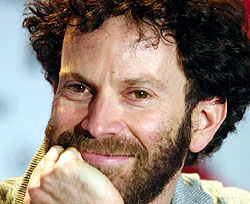 Correspondent: It’s safe to say that you are an idea man. So I must ask you: to what degree do you worry about an idea? Does your mind brim with more ideas — even correct ideas — than you can possibly use? Are you thinking of ideas right now? Is there a slight sense of panic with any idea? What is your idea of ideas?
Kaufman: Well, this whole question is based on the premise that I am an idea man, which I’m not sure that I agree with.
Correspondent: Oh.
Kaufman: So I’m trying to break down what you asked me. And I don’t know. How am I an idea man? To turn this around. On you, Ed.
Correspondent: Well, I would argue that this film is laced with endless ideas meshing against each other.
Kaufman: Yes, it has a lot of ideas. But the ideas came over a two-year period, as I wrote the script. It’s not that I was furiously — like you or your girlfriend — furiously writing 700 pages in two days so that you could read it two days later. I mean, it’s slow. And sometimes it doesn’t happen at all for long periods of time.
Correspondent: So it’s the impression, I suppose, of being an idea man based on the final output here.
Kaufman: It’s not like it happens in real time. It’s not like there’s a two-hour movie and I wrote it in two hours.
Correspondent: Okay, well then let’s turn that…
Kaufman: I mean, I think you thought that before.
Correspondent: Oh certainly!
Kaufman: But it’s not true.
Correspondent: Let’s talk about it.
Kaufman: Let’s turn it around.
Correspondent: Okay. What is the actual ratio of you coming up with an idea? Is it one idea every 2.2 days? What’s the deal?
Kaufman: I would say that…(to himself) you figure two years….maybe it’s an idea a week.
Correspondent: And you have to determine whether…
Kaufman: And this is terribly disappointing for you.
Correspondent: Oh no! It’s actually quite interesting! I’m wondering. Do you have a certain….? Over the course of a week, do you determine whether that idea is correct in association with another idea? Is there kind of an idea peer review process that you run across in your mind? I mean, what’s the situation here?
Kaufman: There is no correct for ideas. Ideas are ideas. And if they’re interesting to me, they’re interesting to me. You know, I don’t know what an idea is actually. I think I think more in terms of emotions than ideas, although there are conceptual things that I utilize. Conceptual things that are devices or that are interesting to me. But the meat of the work for me is the emotional aspect of it. And I don’t know if you would consider those ideas or…
Correspondent: I think an emotional idea is nevertheless an idea.
Kaufman: Okay, then I…
Correspondent: You’re assuming that an idea is based entirely on cerebral terms. And I don’t think that’s necessarily the case.
Kaufman: Well, it may just be more the way that you’re presenting it. It feels….when you talk about ideas, and how many ideas you come up with, blah blah blah.
Correspondent: We’re presenting it in statistical data, yeah. (laughs)
Kaufman: It feels very cerebral.
Correspondent: Okay.
Kaufman: And scientific. And so yes, I have emotional ideas.
BSS #243: Charlie Kaufman (Download MP3)
© 2008 – 2011, Edward Champion. All rights reserved.
Listen: Play in new window | Download
Ahhhh, may Kaufman’s funny little jokes be the death of masturbatory over-analysis.
Except, of course, when the funny little jokes are the cause of masturbatory overindulgence? Did you see Anthony Lane’s interesting take on the film? I read this long after conducting the interview, but he seemed to observe many of the same things that I brought up in this interview.
http://www.newyorker.com/arts/critics/cinema/2008/11/03/081103crci_cinema_lane
repasted from the comments section of BatSegundo.com:
Ed, some (I hope constructive) criticism: it seems like there is a repetitive theme in these interviews of you asking the interview subjects very long questions regarding recurring symbols, possible references to obscure prior works, and other hidden meanings in the works under discussion, and the authors responding almost uniformly that they create their work intuitively and weren’t aware of what you are talking about, and haven’t intentionally placed these symbols in their work and thus they cannot comment on the patterns of repeating symbols which you you have found.
It just seems to me at this point that after this many replies of this sort that this line of questioning should be de-emphasized, as it is dominating the time alotted for your interviews and turning opportunities for discussion into semi- (and sometimes fully) adversarial confrontations wherein the interview subjects have to repeatedly tell you that what you believe you have observed in the subtexts and semiotics of their work was not intended, and doesn’t seem to them related to what they were intending with the work.
It seems to me that perhaps if you tried some new avenues of questioning that it might open up your interviews to more productive and illuminating themes of discussion, rather than these repetitive confrontations which seem to focus the interviews more on your own interpretations of what the authors have created than on what the authors themselves have to say. I don’t believe this is intentional, but it is getting sort of annoying, particularly in examples such as the recent Mike Leigh clusterfuck and most of this Kaufman interview, which was a frustrating listening experience, as it felt like a real missed opportunity for two intelligent fellas to find common ground, but instead turned into you attempting one failed analysis of the film after another while Kaufman exasperatedly attempted to steer you off of your serial wild goose chases.
I think you’re a skilled interviewer and intelligent guy, just wanted to speak up on this as it feels like it’s getting in the way of what your show is when it’s at its best.
What’s a limited theater? Do they not sell popcorn? 😉 Just ribbin’ ya. Take care.
Yes, but, on the other hand, Kaufman goes on to admit to the “clock” idea, for example; saying “it’s just stuff I stuck in there”, later in the interview, is a pretty disingenuous way of referring to some interesting, and funny, ideas in a shooting script that didn’t just function as a box for random “stuff” to pile up in, in a random order.
If Kaufman isn’t an “idea man”, which screen writer is? Whether or not his rate of idea creation is “slow”, as he says, there are more *new* ideas (or subversions of old ones) per page in a Kaufman script than any Hollywood scriptwriter’s work (of the past thirty years, including the Coens) I can think of. That’s why I *still* laugh my brains out whenever I watch “Adaptation”: the acting and cinematography are fine but it’s all those fresh *ideas* that make the movie a gem.
Just because Kaufman chooses not to see himself as an Idea Man (or chooses to be difficult) doesn’t mean that it’s not a fair question. The only quibble I have with Ed’s half of this interview is his tendency to throw the interviewees into the deep end with the first question of the interview, whereas a little stealth might work a lot better. Ie, warm them up (and win them over) with genial chitchat and a few softballs first, possibly (you can edit these out later-laugh). If you spot a telltale hair on the tweed, for example, Ed, ask if they’re cat fanciers…
The first thing Kaufman says is, “This was a lot more energy than I expected” and that was probably more of a warning than a winking quip. Disagreeing with Ed’s premise was, perhaps, Kaufman’s instinctive way of putting the emergency brake on Ed’s Peterbilt.
[…] Charlie Kaufman over thinks […]