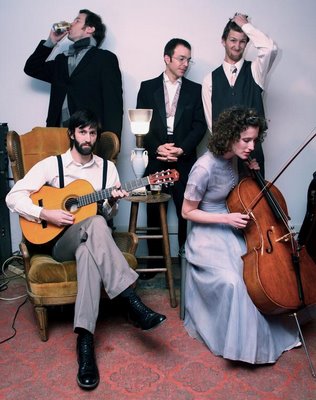
Pale Young Gentlemen appeared on The Bat Segundo Show #242. The band is currently touring across the United States, and has just released its second album, Black Forest (tra la la).
Condition of Mr. Segundo: Contending with unexpected discrimination during the economic crisis.
Guest: Michael Reisenauer (of Pale Young Gentlemen)
Subjects Discussed: [List forthcoming]
EXCERPT FROM SHOW:
 Reisenauer: We’ll actually write through entire songs and entire arrangements, and then cast them away and then start over.
Correspondent: Really?
Reisenauer: That happened a lot with this album. As the songs started fitting together, certain things didn’t work at all anymore, didn’t work for the mood of the entire album anymore. So we had to change the arrangement so it fit better. Drums are one of the things that I have absolutely no knowledge about.
Correspondent: So you defer to Matt.
Reisenauer: I can’t play them. So he’ll play things. And he’ll do things. “Don’t do that anymore.” “That’s bad.” “That’s great.” Or “do that again.” You know, that kind of stuff.
Correspondent: I’m curious. Do you have any input on specific sounds? Or is that all Matthew? I note, for example, there’s that sound during “The Crook of My Good Arm,” where you have something that sounds between a cowbell and a gas station bell.
Reisenauer: Yeah, I can tell you what that is. I was having trouble with that song, and so I decided I’d just demo it in my apartment on an eight-track. So I just had the guitar line. And I was just messing around. And I was headed at a table. And at the table was a Pottery Barn-like fruit bowl. And so I just took the end of a handle on some scissors and banged on the inside of it.
Correspondent: Really?
Reisenauer: We used that on the record too. We brought that bowl into the studio.
Correspondent: It was that bowl.
Reisenauer: With the back of the scissors.
Correspondent: Did you try any other bowls out?
Reisenauer: No! It was the perfect sound right away.
Correspondent: It was one bowl and it worked out.
Reisenauer: Yeah, we didn’t mess with it at all.
Correspondent: Are there any other percussive scenarios like that? Where you banged on something and it turned out to be just that particular one? A divine act of serendipity?
Reisenauer: (laughs) Nothing like that on the album. We tried other various things. Matt had an idea for a song using a wrench. A ratchet wrench going KWHLEKT. Like that. That kind of stuff. But it didn’t end up fitting well for the album.
BSS #242: Pale Young Gentlemen (Download MP3)
© 2008, Edward Champion. All rights reserved.
Listen: Play in new window | Download
Great interview with one of Madison’s best and brightest. Thanks, Bat!