China Mieville recently appeared on The Bat Segundo Show #298.
China Mieville is most recently the author of The City & The City. He previously appeared on The Bat Segundo Show #105.
Condition of Mr. Segundo: Searching for the Mieville and the Mieville.
Author: China Mieville
Subjects Discussed: When The City & The City was written, speculating on the novel’s setting, ratty technology and shambolic modern cities, passenger policy, comparisons between The City & The City and “Reports of Certain Events in London,” subconscious intent and conceptual framework, police procedural dialogue vs. melodramatic dialogue, whether an author’s voice is “reigned in” because of genre, the myths of genre constraints, steps taken in advance to alter voice, the dangers of reading while writing, maintaining two sets of momentum while writing two different books, the enabling qualities of thematics, multiculturalism in Canada, satire and political engagement within fiction, resisting critical labels within a cultural framework, Jacques Lacan, metaphors in fiction, Mieville’s frustrations with perceived author endorsements, readers who cling to rigid interpretation, disappointing mystery novels, designing endings as moral dilemmas, circumstances in which you can exonerate the author, Mary Doria Russell’s The Sparrow, uneasy books, the dangers of unease as an abstract concept, not distinguishing between aesthetic and emotive qualities within text, resisting post-structuralism, seeing text as part of social totality, and keeping people turning pages.
VIDEO EXCERPT:
EXCERPT FROM SHOW:
 Mieville: Fundamentally, what this is about is taking the logic of everyday borders — the logic of political boundaries — and extrapolating them just a little tiny bit. But the logic is the same. It’s an exaggeration, but it’s not a radical break. So in terms of the rules of physics and all that sort of stuff, it is at least 96% sure that they are the same as in this world here. This is not a magical realm in that sense. That’s not how this works. And that’s quite a big difference. Because that short story [“Reports of Certain Events in London”] was very much about the kind of implicit dream logic of the psychogeography of London, and literalizing that metaphor and the city as an uneasy beast. This is slightly different. In some ways, this is much more to do with a genuine juridical legal reality of the world. As I said, it’s extrapolated. But to that extent, it’s very realistic. The logic of the strangeness is actually a logic that exists in the real world. It’s a little bit exaggerated, but that’s all. So to me, they feel quite different. But that’s not to invalidate your point. Because like I say, it has much to do with reception and subconscious stuff. But at a conscious level, they felt different to me.
Correspondent: Yeah. But you’re also dealing with a conceptual framework here with the two cities. And this leads me to wonder — since, of course, the last time we talked, you talked repeatedly about your notion of monsters and the way your imagination works — if this is very much extending into creating this giant world. Here you have a situation in which on a dialogue standpoint — just on that alone — you are now dealing with procedural dialogue, as opposed to what we have seen in your previous books, in which you have dialogue that is very intense and dramatic. Because, of course, there are giant monsters that are terrorizing the landscape and ripping things up. And, of course, people are going to want to get other people’s attention in this. But I’m curious if going to this procedural dialogue was a bit of a challenge — because you had to possibly restrain the natural inventiveness that definitely crops up in the dialogue as well as the narrative — or if the conceptual framework was just enough to even things out. Or if there any difficulties in the procedural dialogue whatsoever.
Mieville: Well, it didn’t feel difficult. Now that’s not to say it’s done well. I mean, I’m not the right person to judge. It’s up to readers. They might be saying, “Well, of course, it didn’t feel difficult. Because you totally fucked it up.” You know, I don’t know. I mean, for me — can I swear? Sorry.
Correspondent: Oh yeah. You can say whatever the hell you want here.
Mieville: Alright. Okay. But, no, in the writing, it didn’t feel difficult. Because for me, it’s always a question of trying to get into the voice at the start. So it wasn’t a question. Like I don’t think I have a default voice as people possibly think. Because the Bas-Lag books have a baroque meandering voice. So that’s obviously what I’m known for. And I understand that. But I think it’s more that each of the voices was got into as part of the project. So, for this, because this was always a book that was conceived of as a noir — as a noir set in what is, brackets, very, very nearly, close brackets, the real world, it felt completely different from the word go. And so people ask the same question of Un Lun Dun. Did it feel difficult to get into a slightly more playful child-friendly voice? No. Because that’s the mode you’re in when you’re starting the writing. I was reading a lot of noir. I was reading a lot of crime. I was thinking in terms of telling a story to my mum, who read a lot of books like that. So that was the voice that that demanded. So, no, it wasn’t a question of reigning yourself in. It was a question of indulging the voice that you had got into for this job. If that makes sense.
Correspondent: But still, you are dealing with limitations here in a way that you’re not in any of your other books. Because you don’t have those giant monsters. Literal monsters. Metaphorically speaking, we can go into that too. But you have to reign yourself in. Because even though, as you argued in your Scalzi piece, you don’t believe mystery novels to represent any kind of realism, there is nevertheless a verisimilitudinous plane that you have to meet with this. It’s a little bit different.
Mieville: They pretend to be realist.
Correspondent: Yeah, exactly. Exactly.
Mieville: Yeah, that’s true. There is a limitation. But there’s a limitation in all forms. Genres are both constraining and enabling. Now one of the things I wanted to do when I was writing this book — it was very important to me that this was a book that was faithful to crime. That somebody who was interested in crime, who read a crime novel, would not feel that this is some outsider who doesn’t get the rules, who doesn’t play fair. I wanted to be completely respectful and have total fidelity to that paradigm. So you’re quite right. I can’t magic them out of a difficult situation. You don’t have the recourse to that sort of thing. But at the same time, you have other things that are potentialities. Like I know a lot of readers with the best will in the world, without any snobbery, who simply cannot proceed with a book once they’ve had too much of a strong eruption of the fantastic.
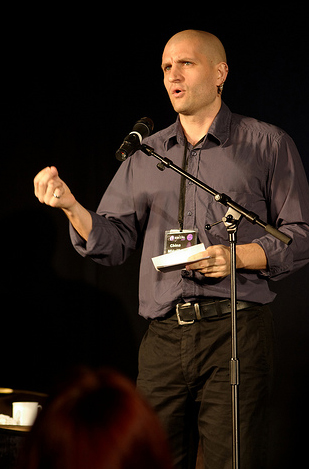
(Photo: Mattia V)
BSS #298: China Mieville II (Download MP3)
© 2009, Edward Champion. All rights reserved.
Listen: Play in new window | Download
Ed,
Didn’t know you liked BBQ. Read a great review of Virgil’s on Chowhound, I think…something hound. They gave it 5 Cuirasses! The only negatives were that the Pulled Pork Po Boy was pugilistic going down and the Mustard Slaw a tad acidactylic. But they loved the Herradura Gold Sunrises and said it would be a crime to miss the Deep Dish Apple Pie.
The Virgil’s backdrop came about by accident. We wanted to shoot the video so that China and I would be blown out by the cityscape — similar to the book. And, lo and behold, a perfectly wonderful Aeneid reference, and not altogether inapplicable to the book under discussion.
[…] with 6 comments China Mieville on Bat Segundo […]