Mark Kurlansky recently appeared on The Bat Segundo Show #292.
Mark Kurlansky is most recently the translator of Emile Zola’s The Belly of Paris and the editor of The Food of a Younger Land. He previously appeared on The Bat Segundo Show #220.
Condition of Mr. Segundo: Pushing past the patois of a forgotten linguistic formation.
Author: Mark Kurlansky
Subjects Discussed: Wanting to be Zola as a kid, thorough food research, the difficulties imposed by lawyers, racist patois, Don Dolan’s failure to understand the burrito, why so many unqualified people got jobs with the Federal Writers Project, Nelson Algren, Richard Wright, manuscripts that were never intended for publication become published thanks to Kurlansky, investigative anthropologists, Coca-Cola parties, lost culinary rituals, Brunswick stew and the original recipe involving squirrel, Kurlansky’s obsession with recipes involving beaver tail, Vermont maple trees, “Nebraskans Eat the Weiners,” corroborating dishes and rituals that made it into the present day, the Nebraskan Popcorn Queen, trying to whittle down Library of Congress material for a book, food conflicts, regional gaps in the America Eats project, Kenneth Rexroth, Basque inaccuracies, Claire Warner Churchill’s extraordinary fury concerning mashed potatoes, World War II’s effect on the WPA, editorial oversight with the Federal Writers Project, geoducks, rarefied cuisine, drying meat over an open fire, hoecakes, low-class and slave forms of cornbread, an altogether different notion of Texas chuck wagon, sheriff’s barbeque, and the mint julep controversy.
EXCERPT FROM SHOW:
 Correspondent: First off, just a general question to tie in Zola with the Federal Writers Project book. In an introduction to The Belly of Paris, you confess that, in fact, you wanted to be Zola when you grow up. And this is very interesting because Zola, of course, was a serious investigator. And, of course, going through the endnotes of The Belly of Paris, I see all these references to sausage and meat, and simultaneously I’m thinking in terms of the investigations in this book, The Food of a Younger Land. I’m curious if you think that investigation of that particular time is comparable with Zola and the Federal Writers Project and whether you think perhaps that there’s something that is missing from that type of investigation today. What are your thoughts on all this? Just to start off here.
Kurlansky: Well, Zola was — especially as fiction writers go — a very thorough researcher. This book takes place in the Les Halles market. And he spends a lot of time in the Les Halles market and actually followed wagons from the entry of Paris to the Les Halles market. And when he did Germinal, he spent weeks and weeks in the mines with the miners. I don’t know how much writers do that now. I certainly do. And I think other writers must. Of course, there’s a lot of things where it’s getting more difficult in America to do these things. Because lawyers won’t let you.
Correspondent: (laughs) Yeah.
Kurlansky: There are all these legal issues if it’s a dangerous workplace.
Correspondent: Is this why the time of the past is better then?
Kurlansky: (laughs)
Correspondent: Because you have the statute of limitations.
Correspondent: (laughs)
Kurlansky: I mean, part of the reason I admired Zola, outside of the fact that he was such a great writer, was that he had deep political commitments. And those commitments can be found in his writing. But his writing never descends into political diatribe. He always had it very clear in his mind that art was above that kind of thing. That in art, you could show society with all its faults, but you couldn’t rant about it. And, in fact, in The Belly of Paris, he has characters who he probably very much agreed with who he makes look ridiculous. Because they go into these rants all the time.
Correspondent: But in terms of this level of investigation, also in the anthropological folklore component of many of the Federal Writers Project’s writers, I mean, there is something interesting in reading an entry or an article in a particular dialect and essentially listening on the page to someone essentially listening a recipe. The question though is whether this is entirely accurate of the patois at the particular time or whether there are problems. I mean, you allude to a lot of racism that you uncovered and that you didn’t put into the book.
Kurlansky: Yeah, well, some I did. My original reaction was not to put any of it in. But since my whole idea of doing Food of a Younger Land was that I wanted to give readers the experience that I had when I looked through these boxes and accidentally falling into another time into 1940 America, and how different it was, and different in a lot of positive ways. And why cover up the negative ways? This was pre-civil rights South. Black people were referred to by their first name, comma “a Negro.” And a lot of the dialogue sounds like master and slave. And the black dialect is stretched to absurdity. To a point where it’s clearly racist.
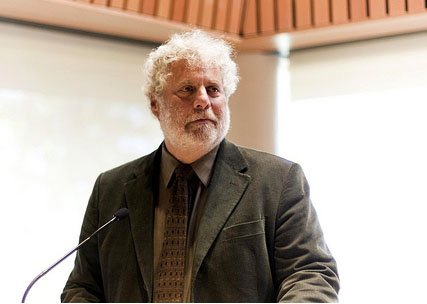
(Photo: Lawrence Sumulong)
BSS #292: Mark Kurlansky II (Download MP3)
© 2009, Edward Champion. All rights reserved.
Listen: Play in new window | Download