Neal Stephenson appeared on The Bat Segundo Show #245. Stephenson is most recently the author of Anathem. It is not known whether or not he “likes cake a lot.”
Condition of Mr. Segundo: He likes cake a lot.
Author: Neal Stephenson
Subjects Discussed: Seven as the ideal number of guests for dinner, William Gibson, the shift from the near future to the past, Cryptonomicon and the Baroque Cycle, science fiction about the alternative present, the various manners in which one interprets information as forms of discipline, Kurt Godel’s life at the Institute for Advanced Study, Platonism, Edmund Husserl, the Kantian influence in Anathem, units of measurement, Gene Wolfe, the use of “runcible,” using very old words to avoid the high tech feel, “aut” and auto-da-fe, devising quasi-Latin lingo, Riddley Walker, learning new words as an essential part of the experience of literature, considering the general reader, devising a script that went through the entire text to determine how many words were invented, concocting an intuitive vernacular, cognitive philosophy concerning the fly, the bat, and the worm inspired by Husserl, reader accessibility, My Dinner with Andre, the danger of getting caught up in an invented world, the snowscape journey as a side quest, finding humor in unexpected places, Ras as the anti-Enoch Root, Robert Heinlein’s YA novels, Ras’s perception of music, music and mathematics, literal and figurative meanings, Max Tegmark’s The Mathematical Universe, creating a metaverse and happy accidents, being “family-based” and types of relationships within the Avout, Laura Miller’s suggestion that Anathem is “a campus novel,” use of the first-person, narrative constraints, criticism about women as nurturers, female characters, and the risk of writing books about ideas.
EXCERPT FROM SHOW:
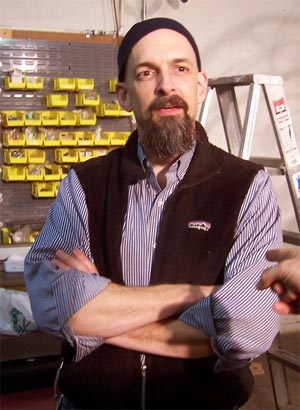 Correspondent: Going back to the idea of the general reader, or the common reader — whatever we want to call the audience here — the philosophical proposition involving the fly, the bat, and the worm expressing basic cognitive abilities, and how cognitive abilities come together so that humans are a higher form of animal than other animals, this was a very clear way of expressing this particular concept of individual senses. And I’m wondering if this was something that you concocted. Or that you took from Kant. Because I actually tried to find a philosophical precedent for this as well.
Stephenson: It’s more from [Edmund] Husserl. So Husserl was an amazing guy who could just sit in his office and look at a copper ashtray, and then write at great length about all of the processes that went on in his mind when he was perceiving that ashtray, and recognizing it from one moment to the next as being the same object. And so he’s got a number of lengthy books about this, which, as you can imagine, are pretty hard to read. So the content of the dialogue, or the parable you mention — the fly, the bat, and the worm — really comes from him. But it’s me trying to write a somewhat more accessible version of similar ideas.
Correspondent: So you really wanted to be accessible in some sense, it seems to me.
Stephenson: In some sense, yeah.
Correspondent: Well, what sense exactly?
Stephenson: (laughs) Well…
Correspondent: If the reader doesn’t matter and, at the same time, there’s this accessibility here, it seems…what’s the real story? (laughs)
Stephenson: Oh no. The reader matters. The criterion is very simple. It’s got to be a good yarn. If it’s not a good yarn, then the whole enterprise fails. So I think that to have a good yarn, you’ve got to have characters that people are interested in. And they’ve got to get into situations that make for a good story. It’s okay to stop the action and have them sit down and have an interesting conversation. You know, for some reason, I always go back to the movie, My Dinner with Andre, which is a long movie consisting of two guys just sitting there talking with each other. But it’s a completely engaging and fascinating movie. That’s kind of an existence proof that you can build a good yarn that consists largely of people just having conversations. And so that was kind of my guiding — that was my guideline, I guess you could say, for trying to work that material in.
BSS #245: Neal Stephenson (Download MP3)
© 2008 – 2011, Edward Champion. All rights reserved.
Listen: Play in new window | Download
SF Tidbits for 11/1/08…
Free Fiction [courtesy of QuasarDragon]:Andy Remic’s War Machine is being serialized as a free audiobook.@MindFlights: “Worlds Apart” by J.L. Gadberry.@Afterburn SF: “The Legend of Sleepy Hollow” by Washington Irving.@The League of Reluctant Adul…