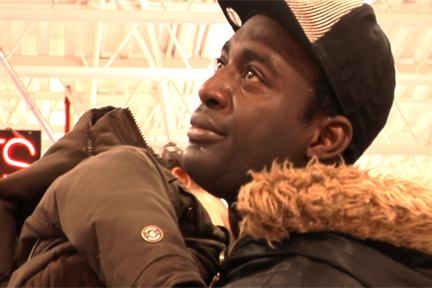
Sean Baker, Darren Dean, and Adam Langer all appeared on The Bat Segundo Show #354.
Sean Baker is the director and co-writer (among other things) of Prince of Broadway. Darren Dean is the producer and co-writer of that same film.
Adam Langer is most recently the author of Thieves of Manhattan. He previously appeared on The Bat Segundo Show #175.
Listen: Play in new window | Download
Condition of Mr. Segundo: Searching for princes and publishing insiders.
Guests: Sean Baker and Darren Dean, and Adam Langer
Subjects Discussed: [List forthcoming]
EXCERPTS FROM SHOW:
Correspondent: Because this was a low-budget operation, I have to say that there had to be at least one moment where it was guerrilla shooting.
Baker: Oh yeah.
Correspondent: Could you talk about this? I mean, how much of this was sneaked….
Baker: Do you want to talk about it?
Correspondent: Can you talk about it?
Baker: I don’t know if we can talk about this.
Dean: (laughs)
Correspondent: You can hint at it.
Baker: The fight scene.
Dean: Yeah, we can talk about it.
Baker: I think so.
Dean: We had permits for everything. Which fight scene? The first fight scene or the second fight scene?
Baker: No, the second fight scene.
Dean: We had permits for everything. And we just ran up against the wall. And at the very, very end, we were like, “Oh my god! We forgot this fight scene!”
Baker: Yeah.
Dean: But we shot in the parking lot. We got up that day and we said, “Well, we need to shoot this scene.” Our permits were gone.
Baker: We ran out of insurance that morning.
Correspondent: Wow.
Dean: Everything was gone. This was the last scene we had to shoot or one of the last scenes we had to shoot. And we got up. We went to Prince. And we said, “Here’s $10. Or $15. For each guy you can find. Tell them we need them for twenty minutes. There’s going to be a fight. And meet us at that garage over there.” I went over to the gate of the garage, talked to the guy who was working the garage. I gave him twenty bucks. I said, “We’re going to be here shooting for fifteen minutes and then we’re out.” Shot the scene and literally took off. And that was it.
Baker: That was the one point where we just had to resort to that. Because we were running out of money. We ran out of insurance. And to get the film completed, it took those drastic measures.
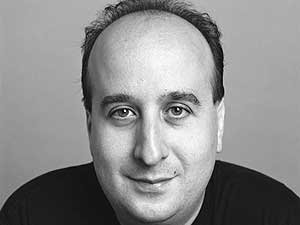 Correspondent: John McNally at the San Francisco Chronicle called you a “publishing insider.”
Langer: Oh yeah.
Correspondent: And I’m wondering why he thought this. This is a book, after all, that has the rather implausible idea of US News & World Report having a books editor. I thought that was rather absurd, I have to say. If you’re a “publishing insider,” that should have been the big tipoff.
Langer: Yeah, I know US News & World Report. But that’s also from the perspective of someone who doesn’t know a hell of a lot about the book industry. The guy who identifies himself as a US News & World Report guy. But publishing insider? I mean, I don’t know. I write books. So I’m inside publishing that way. I’ve never had a job in publishing. I worked as an editor for a book magazine. I don’t know. If you’re a sportswriter, are you inside the sports world? Maybe. I don’t know.
Correspondent: It could very well be that the literary world, or the publishing world, has only so many cliches or is so diaphanous in its subject matter that anyone could, by way of delving into it, could become a publishing insider.
Langer: Yes. Guilty as charged. But I never really thought of myself that way. And I wish I had a few more editorial jobs to give myself a little more streetcred in that regard.
Correspondent: Well, going back to the names of people you brought up, did you have to go through Legal to get permission in house? Was anything considered to be defamatory in any capacity?
Langer: No. Not everything is defamatory in the book necessarily. I mean, I really didn’t want to slag individual people in the book. But at the same time, I wanted it to be taking place in the real publishing world. So I didn’t want anything in there fictional. I mean, if someone’s at a party, I wanted people who would be at these parties intermingling with fictional characters. In the same way I like to talk about how you have Bob Hoskins in Who Framed Roger Rabbit? But you also have Jessica Rabbit running around. So I like the intermingling of cartoonish and reality. But I had no desire or interest in ragging on anybody specific in publishing. And anyone who is libeled in the book is fictional, I would say.
The Bat Segundo Show #354: Prince of Broadway & Adam Langer II (Download MP3)
© 2010 – 2012, Edward Champion. All rights reserved.
Lions and tigers and bears, oh my!
Didn’t immediately get why these two cake-eating works were paired—but then I watched the trailers.“Look ma, no insurance!” “Look ma, I’m pretending to bite the hand that feeds me!” Exploitation, capitulation, cowardice, putting the gloss on pathology by avoiding asking that really important question–just who exactly is the bastard here? Or maybe kinda/sorta asking it and resoundingly answering, “none of the above.”
Congrats on an ingenious juxtaposition of these “risky” business-as-usual content providers. What can I say, Ed? Makes one yearn for a little cow dung on the madonna. At least you couldn’t see that one coming a million miles away. Did you catch the fine print disclaimer at the end of Prince of Broadway? I think it said: “No Louis Vuitton bags, faux or otherwise, were sacrificed in the making of this movie.” That’s a forkin’ relief.
Apropos of nothing, Mrs. (no name) Langer wasn’t vacationing in Durham, England circa 1966/67, was she? Just curious.
.