Ross Raisin appeared on The Bat Segundo Show #229. Raisin is the author of God’s Own Country (UK title)/Out Backward (US title).
(Please note: This discussion deals at length with many of the Yorkshire terms that Mr. Raisin uses within his novel. Please consult this lexicon if you’d like to know more.)
Condition of Mr. Segundo: Abdicating to a helium-impaired fill-in host.
Author: Ross Raisin
Subjects Discussed: Schizophrenia, designing a particular voice and the relationship to environment, talking in a peculiar way, reference books, snickets, the relationship between topography, reference books, and reality, looking through books, cookbooks, foreshadowing, talking with animals, verbs transferred to nouns, subconscious immersion into language, the third-person origins of God’s Own Country, the rhythmic origins of the lexical voice, “gleg” vs. “gawp,” the frequency of words for specific meaning, the Yorkshire vernacular, working as a waiter vs. working as a writer, nouns from specific regions in England, trunklements, the etymology of “bogtrotter,” crammocky creel, jarp and Easter, Nobbut a Lad, ferntickles, “upskittled” and ninepins, nouns transferred to verbs, “normaltimes,” “gleg,” and “chuntering” — the most frequent words in the book, snitter, references to Dracula, the concern for backsides within the book, The Butcher Boy, literary attempts to understand the monster, being ransacked by Raisin, Iain Banks’s The Wasp Factory, separation between style and content, tankards and chalices, the historical cycle of gentrification within bars and restaurants, and stools vs. metal buffets.
EXCERPT FROM SHOW:
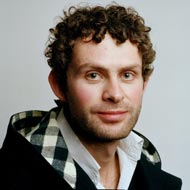 Correspondent: There are a number of Yorkshire terms in which you take a verb meaning and you transfer it into a noun. And so everything is inverted. Even his communicative methods with the animals, as well as his particular idiosyncratic way of talking to the reader, which is presumably the only person he has to talk with aside from his parents and the like. And how this notion of inversion essentially announced itself. Was this more of a subconscious immersion in language on your part? Or a conscious decision to take a verb and transfer it to noun form and the like?
Raisin: The whole thing with the language being in that peculiar idiomatic language didn’t come about immediately. It came about as a result of thinking about character and wanting to think about a character who was very much inside their own strange little world. And one of the main ways you can achieve that is through language. And so I started experimenting with different ways of working with language. And that’s how it turned into a first-person book. Actually, it was initially third-person. Okay, some of the language in it. Most of it is a real Yorkshire language. Sort of a different melange of different parts of Yorkshire, to be honest. And a lot of it is invented. It actually came more out of rhythm — it began with rhythm — more than actual lexicon. And so I got a real feel for this rhythm of the landscape, and the way that transposed into the voice. And then through the second draft, I suppose, I started inserting all these words. And a lot of them are verbs actually. Like glegging and blathering and all these kind of blunt Yorkshire, quite masculinized words that he peppers his language with.
Correspondent: But “gleg” comes from the Scottish noun. Alert and quick to respond.
Raisin: Is that right?
Correspondent: That’s at least what I discovered. And I’m wondering where you transformed it into more of a verb. And also the difference between “gleg” and “gawp” as well. Because he gawps at some points and glegs at others.
Raisin: Well, a gleg is more of a brief look. It’s more of a glance, I suppose. And a gawp is a more of staring. But that’s quite an interesting point actually. Because when you’re writing the book, you become so observed with it. And I’m convinced that these words that I’ve researched, they’re Yorkshire words. And I hold them very preciously. They’re Yorkshire words. And then you tell them to somebody else, and they say, “Oh yeah. We use that word.”
© 2008, Edward Champion. All rights reserved.
Listen: Play in new window | Download