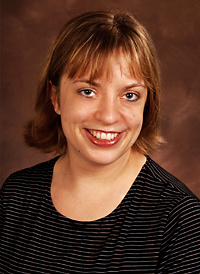
Jenny Davidson appeared on The Bat Segundo Show #230. Davidson is most recently the author of The Explosionist.
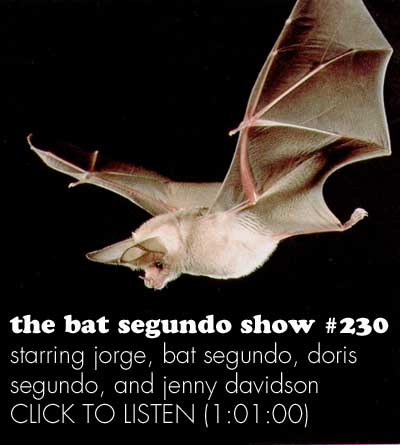
Condition of Mr. Segundo: Investigating the veracity of explosions.
Author: Jenny Davidson
Subjects Discussed: Coincidental run-ins, the necessity of war, Edmund Burke, philosophical asides, a novelist’s use of argument, Agatha Christie novels, John Buchan, ending chapters on cliffhangers, early 20th century British adventure fiction, alternate universes, Tolstoy as theologian, research undertaken years in advance of writing a novel, forgetting things one makes up, world-building as you go along, Michael Moorcock’s Hawkmoon, thought experiments, rationality vs. emotions, historical plausibility exemplified by electric kitchens, junk science, lie detectors, spiritualism vs. organized religion, Arthur Conan Doyle, Herbert Sidgewick, radios talking to ghosts, post-9/11 sensibility, danger of terroristic attacks in public places, narrative serving the needs of the world, novels as problem-solving exercises, tradeoff between security and civil liberties, fiction as a means of addressing political issues, productive forgetting, contemplation hindering the creative process, the internal responsibility to finish a trilogy, Margo Rabb, YA and genre categorization, voracious and eclectic reading, the difficulties of writing a good book, John Banville, cynical motivations for writing genre novels, freedom afforded by academic institutions, meaningful distinctions between YA and adult fiction, Philip Pullman, Garth Nix, whether authors should worry about book marketing, leaving publishing concerns to the experts, Rebecca West’s The Fountain Overflows, James Baldwin’s Just Above My Head, Sigmund Freud broadcasting via pirate radio, possible references to The Man in the High Castle and Brave New World, suicide booth trope in Golden Age SF novels, inventions by Alfred Nobel’s father, seals trained to drag bombs on ships, Dr. Jekyll and Mr. Hyde and Sherlock Holmes, exclamation marks, italicized words, exclamations as metaphor for genre writing, cockamamie explanations in the exposition, nostalgia for British children’s literature, ratio for invention and ambiguity, classroom scenes as an acceptable setting for fiction, reclusiveness, the enthusiasm and passion of boy characters, tension between female school roommates, Muriel Spark as a “great novelist of a small group”, sociological interest in dynamics of schools and boarding houses, Scottish dialect, peculiarities of diction, willful delving into uncomfortable territory, standing by sentences, emotional ethical questions about truthfulness, relationship between style and ethics, when writing is “too showy”, Thomas Paine, self-pity as antithesis to good writing, blindness to self-justifying elements of prose, Kate Atkinson’s Jackson Brodie novels, Ernest Hemingway’s style, David Foster Wallace as self-parody, David Copperfield, the purity of the unwritten sentence.
EXCERPT FROM SHOW:
 Correspondent: Well, going back to one of the many questions that I just asked you about the idea of concocting this alternative universe, was it a matter of working within a loose world here? I mean, in a way, this book reminded me very much of a Michael Moorcock alternative history, like the Hawkmoon books that he wrote, which have only a few existing elements which suggest what may have happened. But it’s largely an excuse. This particular book gave Moorcock the freedom to explore this notion of ideas that have spun off into other terribly mutated forms. And I wanted to ask how this idea of worldbuilding relates to this idea of exploring ideologies, of which I plan to ask you more about.
Davidson: I think that’s a really fair description. And I find in my academic writing, as well as in my fiction writing, I’m strongly right now in a counterfactual mode, where it’s the thought experiment appeal. If this was different, and the thing that you make different — like, in this case, what if 1930s Scotland was still really being run in a way that was consistent with the ideals of the Scottish Enlightenment. No swerve into the 19th century and these different snails of thought. What if we really went back to those core ideas of rationality and the emotions? That was my most fundamental counterfactual for this novel. The set of questions that came up around that. And what if you were a teenage girl growing up in a country that was being run along those principles? That was at the core of my interest in the topic and what made me want to write the book. So the other stuff is for fun, and the stuff that comes up around that once you start thinking that way. But I guess in a sense, I’m not so much writing alternate history as a novel of ideas type thing. Where the premise of altering something in the past allows me to get a clear grip on some idea like that. I mean, I don’t know. I don’t know how we categorize these different genres anyway.
Correspondent: So you’re saying in the end that where it’s set, or when it’s set, really does not matter because it is a novel of ideas? Is that what you’re suggesting here? And that the world, or the alternative universe, is more of a fun component towards entering the story?
Davidson: Well, I think the sense that you get — at least I hope the sense that you get — I’m clearly a writer who is in love with densely realized and realistic particulars that are historically plausible in some sense. So that, for instance, the storeroom with the electric kitchens, and all the sense that electricity is transformative and the way of future — that’s very realistic. I mean, that was a real feature. And a lot of the things in the novel that seem slightly fantastical, I drew from historical sources. I don’t mean so much to say that it’s a novel of ideas, as I mean to say it’s more like regular historical fiction than alternate history. Because, in fact, in very many particulars, the world of Sophie’s 1938 Scotland is like the world of real 1938 Scotland.
© 2008, Edward Champion. All rights reserved.
Listen: Play in new window | Download
[…] Jenny Davidson on “Bat Segundo” […]