ITEM: September 1, 2009. A YouTube video surfaces. In the video, Van Jones calls Congressional Republicans “assholes.” The video is from an event in February 11, 2009. Jones was appointed by President Obama in March 2009. After considerable outcry from conservatives, Jones resigns from his White House position as Special Advisor for Green Jobs.
ITEM: September 8, 2009. President Obama delivers a speech before Congress. Rep. Joe Wilson (R – SC) shouts “You lie!” in the middle of the speech. Wilson apologizes, but the matter isn’t dropped. There are countless efforts to find ways to respond to Wilson’s words (is it racism as Jimmy Carter suggests a week later?). There is endless chatter by liberals and conservatives alike. More than a week later, Joe Wilson remains in the news.
ITEM: September 13, 2009. Serena Williams goes ballistic at the US Open. She is fined $10,000 for delivering a tirade at a judge. (She is also docked $500 for racket abuse. It was a tough racket.)
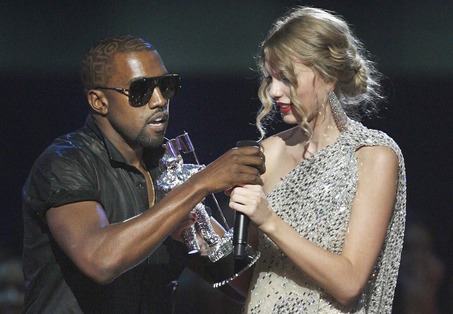
ITEM: September 13, 2009. Taylor Swift wins a Video Music Award. In the middle of her acceptance, Kanye West grabs the microphone out of Swift’s hands and shouts, “I’m sorry, but Beyoncé had one of the best videos of all time.”
ITEM: September 13, 2009. President Obama is asked about Kanye West and Obama calls West a “jackass.” Efforts to prevent the tweet, the audio clip, and the video clip from disseminating around the Internet fail. Most side with the President.
One could probably include many other visceral explosions in recent history. Sherman Alexie, Alain de Botton, Alice Hoffman, Michael Richards, Christian Bale, or Don Imus all come to mind. But the above items all went down this month. We still have about two weeks to go before September’s over. It appears very likely that more public figures will erupt (or interrupt) with a subtlety worthy of Vesuvius.
But what do these reactions mean? And what is the appeal? It would be superficial to blame it all on the media, although the media is going out of its way to perpetuate these stories. (Arguably, as a questionable media source, I am going out of my way to perpetuate these stories, although I am trying to ruminate on it all instead of getting away from it.) Could it be that the tendency to fixate on these incidents involves some desire to make sense of these reactions? Maybe. I doubt that any of us could have predicted that POTUS would have managed to mix himself up in a Kanye West tirade, particularly when more pressing concerns like unemployment and health care are burning up national peat. But politics is now just as vital to the celebrity-industrial complex as sports, movies, and music. (It could hardly have been an accident that the FOX Network timed its announcement of Ellen DeGeneres as new American Idol judge to coincide with the President’s speech.)
Instead of trying to understand these visceral impulses, it has become the duty of every cultural observer to perpetuate the shallow headlines rather than plunge deeper. Are two words or two sentences really enough to denounce someone? Is this not continuing the soundbite culture? (No accident that Twitter, itself a bedrock of textual soundbites, was one of the major conduits through which these stories spread.) Should we not judge these people on a more complete impression? What resides beneath the comments?
Van Jones’s “assholes” admonishment came when the assembled group was trying to understand how bipartisanship could be an option when the Republicans remained obdurate. That’s a fairly interesting question, but it’s too bad that sensitive ears and Penn Ave propriety weeded Jones out.
Joe Wilson, as inappropriate as his actions were, was trying to express his passion. And isn’t understanding that passion, as unsettling as the motivations may be, the more important concern here? If we calmly listened to people, as Al Franken patiently did, wouldn’t this cut down on conservatives showing up at town meetings packing heat? Why not ask questions? Or see where people are coming from? Why did Wilson think that Obama was lying? And why aren’t we discussing the more interesting facts?
The Nation‘s Dave Zern observed that Roger Federer had a tantrum two days after Serena Williams, but Federer wasn’t upbraided in the press as severely as Williams. Is there a double standard? Does Federer get a free pass because he isn’t African-American and he isn’t a woman? Maybe it has more to do with celebrity figures fulfilling our expectations. After all, Federer is known more for his calm demeanor on the court. Williams, on the other hand, is known for her temper. Shouldn’t Federer’s incongruous reaction (“I don’t give a shit what he said” uttered on national TV) be rejoined with greater severity? And shouldn’t we praise Serena Williams for handling a future game with calm professionalism? Are we not just as guilty with our predictable responses? Are we true to our nature?
Kanye West acted like a jackass (a subjective view), but he never called Taylor Swift a jackass (the objective quote). He told Swift that he was “very happy” for her before turning his back and denying her moment. And yet President Obama, who used an ad hominem remark to respond to the whole mess, has neither given an apology nor been asked for an apology. (Contrast this with the Cambridge Police Department demanding an apology from Obama in late July, after Obama declared that the police had “acted stupidly” in the Henry Louis Gates arrest. Obama didn’t apologize, but there was a beer summit.)
Since the President has become involved in these public disputes with greater frequency, and he reserves the right to tell people that they “acted stupidly” or call someone a “jackass,” then perhaps he should start setting a better example for rational bipartisan discourse. Or perhaps he should abandon his “civilized” remarks and call people “jackass” from time to time. (Nixon was hardly a President to be proud of, but it’s worth noting that he had no problem using the word “cocksucker.”)
Maybe there’s something else at work here pertaining to executive privilege. The New York Times reported that New York City’s unemployment rate hit 10.3% in August, a 16-year-old high. The national unemployment rate still holds at just under 10% — the highest unemployment rate since 1983. As of April, two million jobs were lost in 2009. In tough times, when those who are fortunate enough to remain employed have a strong desire to stay mum and keep their jobs, and when millions of unemployed people can’t take any chances, it makes intuitive sense to look vicariously towards those who have this executive privilege of emotional expression.
But if emotional expression is so atavistic, shouldn’t it be predicated on egalitarianism? Is it not a double standard for Van Jones to be dismissed while Obama keeps his job? Subjectively, I happen to think that Obama was correct in both instances. But why can’t somebody who isn’t the President make such statements and not have to go through the endless rigmarole of apologizing over the course of multiple interviews? Why can’t we just accept someone’s apology and move on? If we don’t, then the purpose of an apology is useless or the apology doesn’t fit the apparent punishment for the crime. And if we don’t accept other people, which includes listening to their heightened emotional expression, then this runs counterintuitive to eclectic discourse.
If emotional expression is reserved only for those at the top, then should we really be surprised by the people who show up at tea parties? Should we really be surprised that Glenn Beck’s popularity has risen dramatically during the Obama Administration?
Perhaps these people are expressing extraordinary emotions like this because society has established unspoken prohibitions in the manner by which they communicate. As I type this sentence, I happen to believe that Salman Rushdie is a cunt. I could tell you why if you asked me. And if Rushdie were to explain himself, I would be happy to listen. If he had a reasonable explanation for his cunt-like behavior, I might change my mind. But because I have stated that “Salman Rushdie is a cunt,” people will see this and possibly believe me to be an asshole. But should such a sentence discount all the thoughtful and positive sentences I have ever uttered? And is my opinion of Rushdie so inflexible? By our present emotional expressive standards, this would certainly be the case if I had, by some lark, achieved the fame of Serena Williams.
But let’s approach this issue from another sideways shuffle. It is very possible that you, dear reader, harbor a feeling, however permanent or temporary, that someone that you know is a cunt. If that sentiment is permanent, and if it is not subject to change, then you may not be a civilized person. (Or, in Joe Wilson’s words, you lie!) But if you accept the follies of your emotional expression and you remain flexible enough to change it or to embrace it, then it is very probable that you are a civilized person, assuming that you aren’t a sociopath.
And now that I’ve thought about it, I don’t think that I believe that Salman Rushdie is a cunt. I believed it just now, but after thinking about it, it seems ridiculous to place a writer who has written a novel as great as Midnight’s Children into the same milieu as Hitler, Nixon, and Genghis Khan (to name only a few rotten apples, but, to give Hitler that cliched benefit of the doubt, he treated his dogs well). I have not thought to strike the sentence from this essay. But if this were published somewhere, I’m certain that very few editors would print the phrase “Salman Rushdie is a cunt.”
Is it reasonable to prohibit ad hominem or emotional expression? Or to dwell on it, as it crops up from time to time, as if it something to be skimmed over and over like a four-second tape loop? Only if you believe that humans — or, with the second rhetorical question, a select civilized elite — are capable of nothing more than profound enlightenment. Humans certainly do great things, don’t they? But if you’re naive enough to believe that they contribute nothing but thoughtful contributions, then I urge you to acquaint yourself with the many psychopaths who have chewed up the scenery over the course of human history.)
But let’s say that we accept emotional expression and slow down with these knee-jerk responses. We therefore give those who practice this perfectly normal tendency an opportunity to explain or atone. The eccentric contributors come out of the closet. Innovators who have held their tongues are permitted to communicate wild ideas and become part of the process. And we expand the repertoire of human behavior. There will probably be ugliness, but ugliness can be rectified without forcing horses to drink the water. Asking people to constantly apologize — often before a camera — is the action of an autocratic enforcer who has no faith in humankind. But when two people listen to each other without instantaneous judgment, you can plant seeds instead of chopping down trees.
© 2009, Edward Champion. All rights reserved.
Ed, the reason this entry of yours is good is because you have been known as rather extemporaneous and spur of the moment with your opinions, which makes for liveliness but also a bit of backtracking at times, where you further explain your pov. In other words, I feel you are an expert on the topic of eruption of opinion, who has traveled the mean streets of honest expression and not flinched in the face of challenges to your integrity and veracity. (Although where straight opinion is concerned, I am sometimes not in your corner.)
I don’t believe in being “the devil’s advocate” anymore. If one can’t even be one’s own advocate I don’t want my time wasted by some imaginary position or straw man. All over the Internet there are those of limited interests and knowing, who venture into realms basically out of their experience. They waste all our time. For those covering lit online or elsewhere it is interesting when they run off-leash and interact with other areas of culture, but only insofar as they have some valuable information to impart. The gossipy, kissing-up-to types always looking for quid pro quo can disappear into the black hole of 404/Not Found for all I care. You handle multiple venues (film, music, lit) well, but there are others in the blogosphere who for some reason believe that the world is their oyster even as they waste their time trying to produce some ever-elusive pearl of wisdom. What we get from them is noise, not even the somewhat degraded form of communication that is emotional outburst. What does this have to do with your post? Well, if no one is listening one must make more and more noise until attention must be paid. Perhaps what we’re witnessing is Anti-Willie Loman Syndrome Syndrome.
JDF: Thanks very much for your comment and for your very interesting thoughts on being the devil’s advocate. Perhaps a solution to this dilemma has to do with trusted middlemen — that is, particular voices that certain sectors can trust. Not diplomats, per se, but skillful transpositionists working with each other to accurately represent the viewpoints of the unmapped or the disenfranchised. I agree with you that if one is not constantly shifting territory, then a certain calcification can kick in. This was, after all, what attracted everybody to blogs in the first place. And those days are gone. But if the “alternative” has calcified and it’s all about superficial gossip or who one knows, then one must remain suspicious of the emotional prohibition that the “alternative” champions. One does not have to agree with the person shooting off straightforward opinion. Assumption is not the goal and groupthink is never healthy. But if we’re in the business of uniting a spectrum of viewpoints, and I think to a large degree that we are, then any discourse we maintain must facilitate voices anathema to our own. Maybe that’s a half-sufficient alternative to being a devil’s advocate.
I enjoyed reading this, and you make some very provocative points, but the “asshole” remark by Van Jones had almost nothing to do with his undoing. It made for a nice soundbite, but his associations with Marxism and a 9/11 truther group (as well as being singled out by Glenn Beck) were the reasons for his ousting.
Also, I don’t see how Obama’s opinion of Kanye was ad hominem. West acted a certain way and this act was considered by most to be that of a jackass. Character is the only thing to judge (unless you truly feel Beyonce made one of the best videos of all time).
Again, I like a lot of what you have to say, but some of your connections seem a tad dubious.
Rushdie is, as you suggest, a complete cunt. Most writers are but he is one of the biggest cunts since Aristotle and a poor writer, Midnight’s Children was crap, it just fooled a few dimwits like you, you cunt….