My review of The Reel Stuff, an anthology of horror and speculative tales turned into Hollywood films edited by Brian Thomsen and Martin H. Greenberg, appears in today’s Los Angeles Times. In addition to the reading (in most cases, rereading) I had to do for the review, I watched many films: hence, the crazed kudos for Candyman posted at some ungodly hour not long ago.
Johnny Mnemonic had the consolation of some unintentionally hilarious moments and Screamers was a hoot, complete with a distinguished Canadian actor licking a knife and scowling, “It’s never sharp enough.”
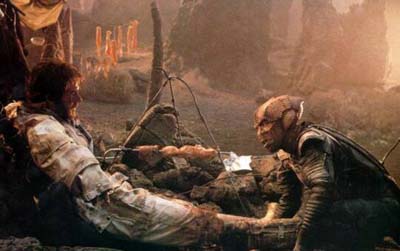
But the worst film of the bunch was Enemy Mine. I hadn’t seen the film in almost two decades, but time had not been kind. Its failure, however, had less to do with its sweeping production value (even with the visible matte lines) and more to do with its almost total bastardization of Barry Longyear’s Hugo and Award-winning novella. Aside from changing the book’s ending to include a literal mine (did they really think the audiences were that dumb?), screenwriter Edward Khmara and director Wolfgang Petersen placed less emphasis on Davidge’s unexpected role as surrogate father, introduced over-the-top meteor showers, and otherwise muted the novella’s themes of war and camaraderie. There is even a terrible moment in which Pepsi product placement gets Dennis Quaid excited.
Longyear’s novella was collected in a handsome book put out by White Wolf called The Enemy Papers, which also featured two other stories, “The Last Enemy” and “The Tomorrow Testament,” set in the same universe. But this went out of print. Thankfully, the book is also available through Back in Print. Longyear also has a website and an interesting history.

The Call by Yannick Murphy: The always interesting author of Here They Come and Signed, Mata Hari returns with a novel that whips up a worldview from a rather quirky set of limitations: namely, the call logs that a veterinarian maintains as his son is unexpectedly put into a coma and an unforgiving economy denies him work. What emerges is a surprisingly optimistic, often funny, and very moving account on how one family uses acceptance and forgiveness as a way to atone for hard knocks. (
Birds of Paradise by Diana Abu-Jaber: Forget Franzen and Eugenides. If you're looking for a social novel that counts, Diana Abu-Jaber is the author you're looking for. Building from the free-form exploration of consciousness and identity in Crescent and the gripping procedural structure of Origin, Abu-Jaber's latest novel is her finest, equally fluent with gutterpunk culture and smarmy real estate men. It has been suggested by The Washington Post's Ron Charles that you will likely gain some pounds while reading this novel. This is certainly true. Abu-Jaber's description of food is so precise that it often made me want to do more cooking. But I very much admired the way in which Abu-Jaber presents all her characters as unwitting victims of rough capitalism, which permits them some dignity even as they perform terrible acts.
The Last of the Live Nude Girls by Sheila McClear: This memoir isn't so much about the decline of the Times Square peepshow, as it is about one young woman's efforts to pull herself up by by her bootstraps when presented with few economic options. Filled with self-introspective candor and a quiet dignity, McClear's story is one that might befall any of us in these volatile times. While McClear does get back on her feet, her book leads one contemplating the terrible fates of other young women now moving to New York and falling into deadlier vocations. (
Enemy Mine is very derivative of the film Robinson Crusoe on Mars.