The litblogging team had an early lead. But when our team fumbled an answer, PEN America took control of the literary trivia smackdown. We knew every answer that they did. But they had the opportunity to respond first. And in most cases, we didn’t know every answer that they didn’t know. You could sense some common polarity here. And it wasn’t too long before they jumped ahead of us by a good ten points.
 It looked for a while that we wouldn’t stand a chance in hell of making a comeback. And then a bit of magic happened. We then took control of the questions, and inched our way to within striking distance. PEN America needed sixteen points to win. And we clawed our way up the mountain to a 15-13 shortfall. I urged Eric Rosenfield not to get too cocky about this, but the man was dripping boatloads of saliva. Had my hand not rested upon his right shoulder, he would have bolted out of his chair and performed like a spastic mascot before the PEN America team.
That’s when Levi Asher and I betrayed the litbloggers. The question was simple: What award-winning playwright wrote the script for the Marilyn Monroe film, The Misfits? Now I’ve seen the film and I knew the answer. It’s not a great film by any means. But somehow my brain misfired. I’m confident that our collective mistake had something to do with the spoons I brought. I played the spoons during every correct answer to ensure that there was a certain harmony in the air. Some pleasant syncopation that would get the audience on our side. Something that could turn this imposing smackdown into the living embodiment of a John G. Avildsen film.
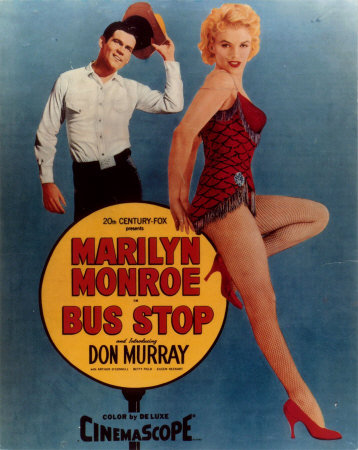
But somehow Levi and I had blocked Arthur Miller’s name — the name we knew — from our noggins. By some mnemonic phenomenon, the two of us thought simultaneously of Bus Stop, a film adaptation that had indeed originated from a William Inge play (although George Axelrod wrote the screenplay).
“That’s Inge!” I cried.
“William Inge! Yeah!” Levi agreed. “Go for it.”
We remain convinced that PEN America, as amicable as they were, had placed some kind of hex upon our heads. Something to perplex us. Something that might cause us to declare more income on our tax returns.
Sarah Weinman, of course, knew the correct answer. But the two of us were too fast, too caught up in our enthusiasm, and the two words were uttered into the mike.
“Wrong,” said Tim Brown, who was clad in a spiffy tuxedo that could outclass Bill Cullen’s sartorial oeuvre.
We couldn’t backpedal from this mistake. Arthur Miller had once been the president of PEN America. We were fucked. And we had fucked ourselves. Making it a doublefuck, or possibly the kind of strange gymnastics that only great geographers like Artemidorus can identify.
And so PEN America, an organization that we proudly salute, smacked us down during the literary smackdown. But everyone played a very good game, offering strange answers when we didn’t know the correct ones, and we made some people smile.
The most important thing to take away from this friendly competition is that just about every literary person has the same interests and enthusiasms. The print and online people don’t have to drink from different fountains. And it’s too bad that the New York Review of Books wasn’t there to share the magic.
[UPDATE: WNYC has an audio report of the smackdown.]
© 2008, Edward Champion. All rights reserved.
Well Ed, you should have watched out for that PEN bunch. Obviously it’s a case of give ’em an Inge and they’ll take a Miller.
If I understand this correctly, and as I was not there I rely upon your account, you blame the loss on 1) the inappropriate use of eating utensils, 2) the supernatural, 3)impulse control issues, and 4) not sufficiently tuning in to the wise women in your immediate sphere. 3 and 4 just might be lessons worth meditating on.
[…] has posted an audio report of the literary smackdown. However, they get one key fact wrong. The litbloggers have lost just once, not twice. Thanks to […]
This proves, beyond question, that lit bloggers lack the credentials to meaningfully contribute to serious literary discussion!
[…] that’s only because our teammate Catherine Lacey knew her stuff. If I learned anything from the last time bloggers went up against an opposing team, it’s that men really don’t know anything, even when they think they do, and that they […]