- The New York Times turns into Salon. Love! Valour! Lack of innovation! Go team!
- Daniel Green reviews Gilbert Sorrentino’s latest.
- Reading Middlemarch is still very much active.
- I didn’t realize that Mark Sarvas actually authored Home Land (you’d think that the Morning News people would double-check the text), but it’s still a brave and interesting win for the Tournament of Books.
- Black Swan Green‘s inspiration: The Mona Lisa, of all things.
- Sven Birkets on the Walter Kirn serial. (via MAO)
- Vikram Doctor on Rushdie’s Bombay. (via Kitabkhana)
- Who the fuck is Maddox?
- Apparently, Newsday didn’t get the memo that McGahern kicked the bucket. Granted, there’s an editor’s note near the end. But would it have killed the folks there to edit the article a bit? The headline “Talking with John McGahren” reads as if the journalist were channeling McGahren’s spirit from beyond the grave or something.
- The Age talks with Helen Dale, the J.T. Leroy of Australia.
- Time finally recognizes Peter Carey — in all likelihood because Lev Grossman, confessing to his editor that “there were too many big words,” didn’t write the article.
- George Saunders’ “Nostalgia.”
- Tod Goldberg gives a jejune Parade article far more deconstruction than it’s worth.
- Yo, Teachout, go easy on yourself or I’m going to come to NYC and kick your ass.
- Fantasybookspot talks with Jeff VanderMeer. I’ve been greatly enjoying City of Saints and Madmen (think Mieville/Peake meets Jack Benny, with a bit of J. Conrad and Borges thrown in; fun shit, yo) and I can’t wait to sink my teeth into Shriek.
- And this is just plain goofy.
- One other thing: I owe many of you emails. I’m hoping I can catch up in a few days. If you’ve sent me something in the past two weeks, I apologize. It’s been hectic to say the least.
Month / April 2006
NPR or the 700 Club?
This NPR segment is appalling journalism and comes damn close to outright propaganda. Not once does the journalist ponder whether faith-based initiative programs are the right way to combat poverty. Not once does the journalist consider the creepy hold that one of the described programs has on the local economy. Not once does the journalist call into question the notion that a man “believing in Jesus” can be trusted.
The “Too Soon” Mentality
It seems that every time a book or a film dealing with September 11th comes out, someone cries out the words, “Too soon!” It happened recently with Jay McInerney’s The Good Life, when Norman Mailer told McInerney that McInerney should wait ten years before attempting a novel about it. It happened with Jonathan Safran Foer’s Extremely Loud and Incredibly Close, where people declared it was “too soon” for a novelist to write about 9/11. And now it’s happening again with United 93. The trailer was released to theatres and people reacted negatively. The result? An AMC Loews theatre in the Upper West Side pulled the trailer.
It’s been more than five years since September 11th. And with all due respect to the victims, I’m wondering why today’s artists are so timid with respect to the subject. Is it standard operating procedure to take no chances for fear of offending? I hate to invoke Godwin, but the current silence reminds me of the situation chronicled in the 2004 documentary Imaginary Witness: Hollywood and the Holocaust, which I was lucky to see last year. The film offers a convincing argument that Hollywood adamantly refused to come to terms with the full reality of the Holocaust until years later and points out that later movies, such as the excellent film The Pawnbroker, were coping mechanisms that may have come too late.
This popular notion of repressing or, more accurately, self-censoring dramatizations of recent history hasn’t gone away. Talk of 9/11 and deal with its explicit details, and you are declared insensitive or tasteless. But what better way might our nation come to terms with that terrible day then to expose its explicit details through film, literature, music, painting, sculptures, theatre, opera, ballet or countless other forms of art? What do we gain when our culture reflects the notion that September 11th didn’t happen or shouldn’t be talked about? Piece of mind, perhaps. But limitations which might beget other limitations.
So people are crying and feeling uncomfortable when seeing this trailer. Well isn’t it art’s purpose to do this? And don’t such emotions allow a certain catharsis?
Too soon? If not now, then when?
Sam Tanenhaus: “More Chicks” to Write Book Reviews
 New York Times Book Review editor Sam Tanenhaus announced that “more chicks” will be contributing book reviws on a weekly basis. The decision came when Tanenhaus grew disgusted at Norman Mailer’s boorish behavior at a recent cocktail party.
Tanenhaus promised, “Women won’t just be reviewing poetry or women’s fiction. I’ll be assigning them science and history books too!” There’s no firm word yet on whether the NYTBR will cover fiction in any pertinent way in the future, much less translated fiction or obscure titles.
John Updike to Author Books About Regular People
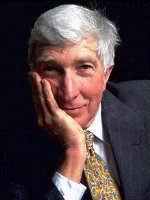 John Updike, author of the Rabbit Angstrom books, has decided that writing about upper-class adulterers simply “isn’t fun” anymore and has decided that writing about impoverished characters will be “a welcome change.” The New Yorker doyen will be penning a new series of books featuring Joe Angstrom, a down-and-out man from the skids. “He’s the Angstrom the rest of the family doesn’t want to talk about,” said Updike. “And get this: he’s black!”
Literary critics remain skeptical. An early draft of It All Happened in East L.A. has made the rounds and some have felt Updike’s references to OutKast and the Notorious BIG to be sadly dated. Tom Wolfe, in particular, is watching from the sidelines. “Let’s see if the old boy who called my novels ‘entertainment, not literature’ has the stuff to do the kind of backbreaking research I did for Charlotte Simmons,” said Wolfe, whose own take on college life has been called into question.