Rachel the Hack: Post-Apartheid Fiction

rachelhack.jpg

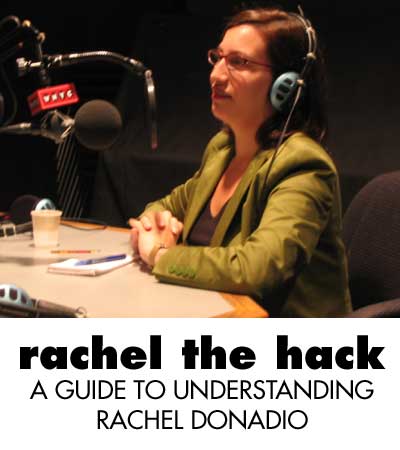
It’s time for a new installment of Rachel the Hack, an essential guide to understanding Ms. Donadio’s warblings. This week, Donadio can be found in the New York Times Magazine section for a piece on post-apartheid fiction. Donadio begins by telling us that author Niq Mhlongo is “one of the most high-spirited and irreverent new voices of South Africa’s post-apartheid literary scene,” but it takes Donadio three more paragraphs to provide a paragraph that corresponds to this topic sentence. We learn that Mhlongo writes “with verve and candor about the anxieties of his demographic.” But is Mhlongo really writing for a demographic? And is “demographic” really a word one should use in relation to rugged fiction? Maybe this applies if you’re a marketing manager without a sense of compassion, but it’s certainly not a noun that applies if you truly give a damn about literature.

But let’s consider this taxonomic measure. If I were hard-pressed to cite a demographic for Donadio’s work, it would probably be marketing managers, perhaps those who cite liberalism as a CV-enhancing “interest.” If this is the case, then it’s a telling sign that Donadio focuses on Mhlongo’s BlackBerry as opposed to the animated way he answers Donadio’s questions. Or that South Africa’s tourist-friendly landmarks (bed-and-breakfasts, KFC, Johannesurg’s shopping malls, et al.) are prioritized over those cute and cuddly brown-skinned people known to pen a noble book or two in a post-apartheid environment.

To be fair, Donadio does chronicle corruption early on and does yield a few observations on post-apartheid racism and how Mhlongo’s book deals with it. But who knew that the 1996 Constitution was capable of vocal communication? (The correct verb when dealing with the printed word is “state,” not “say.” And Donadio’s the one who insists we’re sub-literary.)

Donadio also notes that, presently, few books “create a national conversation” in South Africa. But then one can argue that this is also the case here in the States. And yet this apparent “conversation” has shifted “toward the search for the great black South African novelist.” Wait a minute. I thought the conversation wasn’t really happening. So how is Donadio gauging this? Well, apparently, it’s about “the national and international spotlight.” But where is this Kleig light coming from exactly? Typical of Donadio, you’ll be hard-pressed to find any information which tracks this waning and waxing conversation. But since Donadio hasn’t even bothered to reveal how resistance to apartheid served as a literary muse through such awards as the Amstel Playwright of the Year award, which encouraged anti-apartheid playwrights through 1994, and the many poets who responded through verse, the article relies too much on general quotes that stop short of examining this fascinating issue.

At least Donadio reveals, through a citation from Shaun de Waal, that the South African literati has grown tired of hearing the question of where the black writers are. But it’s a shame that her own article strikes this same nauseous note.

Donadio also suggests that the emerging generation of South African writers are “no longer fueled by rage.” Really? An economic and racial divide replacing an apartheid one, the implied gentrification in the article’s early paragraphs, and the possible lack of national conversation (on this point, we cannot be sure), and there’s absolutely nothing to be enraged about? It’s certainly telling that this lovely little generalization comes without a single supporting quote, but it’s even more telling how this reveals Donadio’s naivete about social and political developments. Obviously Donadio hasn’t read Antjie Krog’s Country of My Skull or Desmond Tutu’s No Future Without Forgiveness.

Donadio does score minor points for revealing Zakes Mda’s frustrations about fiction’s inability to discuss all the issues occurring in South Africa and Norman Rush’s failure to parse this in a review of Mda’s book. But she doesn’t investigate this issue any thoroughly beyond Mda’s resentment, particularly when he brings up the critical double-standard which applies to Coetzee.

Donadio’s article is a slipshod primer that misses many opportunities to investigate many angles of a fascinating topic. It is designed to be clipped to a refrigerator rather than leave you thinking.

Let’s Hope It Isn’t Anything Like the Environment Depicted in Eisenstein’s Stachka

Any interview that begins with the answer “I’m waiting to find out whether we go on strike or not. How are you doing today?” is certainly worth your time. The Kenyon Review offers its first part of an interview with Philly Inquirer books editor Frank Wilson, who may or may not be exiled depending on how things develop. The interview yields an interesting glimpse inside the book reviewing world. Frank Wilson is one of the most forward-thinking and hardest working books editors in the business.

Superman II: Donner Cut vs. Lester Cut

supermanii.jpg

I don’t believe Richard Donner’s cut of Superman II (recently released on DVD) is necessarily better than the 1981 theatrical cut directed by Richard Lester, but it is still fascinating on its own terms. When Donner helmed the first Superman, he actually shot a good deal of footage for Superman II, much of it (including all of the Lex Luthor scenes) contained within the theatrical version that was subsequently released. Donner was kicked off the project midway through the film because of cost overruns, replaced by Richard Lester. Fans, tantalized by the footage that appeared in various ABC airings of the film in the 1980s, have long hoped for Donner’s vision to be reinstated. Warner listened and tracked down some six tons of film, restored all of it, and re-edited Superman II to reflect this what-if scenario.

This cinematic experiment certainly demonstrates what Donner would have effected, had he been left alone to finish the film. But it also indicates that Richard Lester’s contributions weren’t nearly as bad as Donner makes them out to be. (Donner’s commentary track is a veritable shitting contest. But Donner has produced many cinematic dogs himself. Exhibit A: Assassins.)

Donner’s version moves faster, with an opening sequence that dovetails Superman II‘s story into the first film quite nicely. (It is the missile aimed at Hackensack that causes the three supervillains to be released, not the nuclear bomb at the Eiffel Tower. Lester’s Eiffel Tower sequence has been removed.) Donner’s version takes more chances with the characters, particularly in an exciting early scene where Lois Lane throws herself out the window of the Daily Planet to test whether Clark Kent is actually Superman. Susannah York’s Lara has been replaced by Brando’s authoritarian Jor-El at the Fortress of Solitude. While these scenes play up the father-son dynamic, Brando is just as stiff as he was in the first film.

Donner’s panache for action sequences works well in the first hour, but I found myself missing Lester’s light touch, particularly with General Zod and company’s appearance on Earth. The two small town cops arguing about the restaurant (“They have a fine selection.”) are now one-dimensional characters for Zod, Ursa and Non to fuck with. Lester’s humor also worked effectively as the three supervillains let loose a gust of wind just as the people of Metropolis attempted a lynching (“Superman is dead! Let’s get him!”). The scenes of cars flying through the air and colliding into each other had a certain gravitas when edited against Lester’s slapstick contributions (ice cream flying from a cone onto another’s face, the guy still talking on the phone even after the booth has been knocked over).

The musical cues have also been seriously marred. In the Lester cut, when Superman flies into Niagra Falls to save a boy from falling into the waters, he was accompanied by a reprise of John Williams’ main theme. The Donner cut has opted for a more diluted theme and it makes Superman’s rescue of the boy nowhere nearly as dramatic as it was in the original. (A similar change has been made when Superman rescues the large antenna from falling onto a mother and her stroller.) Also greatly missed is John Williams’ menacing series of percussive quintets, which lent Zod’s takeover of the planet Houston a sense of dread. I’ve long considered Williams’ contributions to the Superman films to be among his best as a composer, but the Donner cut reveals just how naked the Superman films are without the score: a telling sign of its own.

But perhaps my biggest objection (aside from Donner’s bitterness) is that Superman’s sacrifice of his powers for Lois Lane feels more solipsistic in Donner’s hands. In the Lester cut, Superman sleeps with Lois Lane only after he loses his powers. But in the Donner cut, he gets bedtime action before. While it’s nice to see a postcoital Lois Lane observe Superman’s conversation with Jor-El dressed only in his shirt, Reeves’ conversation with his father (instead of his mother) is now laced with selfish import (“I deserve this!”) as opposed to a bona-fide declaration of his love for Lane (“Mother, I love her.”). Because of this, one views the diner scene that comes after, in which a powerless Kent is beaten to a pulp by a truck driving bully, in a new light. Clark Kent’s request to step outside is now guided more by hubris, rather than a desperate need to figure out where he stands and how to defend himself as a human.

Donner’s contributions were certainly essential to the Superman films. His camerawork was better. His action sequences were better. But I suspect he sometimes took Superman too seriously, considering him to be an almost Christ-like figure. I’d argue that Lester understood that Superman II was an entertainment and injected just the right amount of comedy into Superman II, giving it a more humanistic feel. It’s regrettable that Lester’s equally essential contributions are being pooh-poohed by the fanboys.

On Human Weight

It is true that many good citizens are concerned with weight. Few fellows ruminate upon pounds gained deliberately, for this is the territory of compulsive overeaters, Method actors angling for an Oscar, and those hoping to teach Manuel Uribe Garza a lesson.

weight-loss-scale.gif.jpgBut it is a point of fact that pounds are gained and, therefore, must be lost: sometimes due to peer pressure, sometimes due to careful study of celebrity photos and associated guilt, sometimes for no reason at all other than unimaginative (or perhaps creatively blocked) people who hope to enforce an all-too-easy New Year’s resolution. Even before that fateful turn of the year, when resolutions are hastily decided upon after too much drink, weight must be lost, even when one is then in the process of gaining it. (If one has imbibed three vodka martinis over the course of the evening, this works out to approximately 600 calories, enough to inspire a severe headache and a brisk morning run.)

But if one loses weight, where does it go? Is it not possible that the weight is actually misplaced instead of lost? Is it not also possible that a sentient mammal simply cannot lose weight if he is feeding himself three square meals a day, taking in the nutrients, and allowing the waste to expunge unceremoniously through his anus?[1]

We have established that human weight is by no means as constant as we believe it to be. Thus, “losing” the weight, which suggests a type of loss similar to “losing” one’s keys[2], is a misnomer. Humans will always lose weight, whether they are in the process of gaining it or losing it. Human chemistry might be compared to a kind of two-lane highway, where the “weight loser” is hoping like hell that there isn’t traffic coming the other way. To take this metaphor further, presumably when one burns calories the slowest, one can be said to be stuck in the chemical equivalent of rush hour traffic. Which I suppose is a bit of a bummer, unless of course you’re currently fasting, thus securing that traffic does not pass you on your left side.

The problem then isn’t just the terminology we use, but precisely how we gauge this constantly shifting value of weight. Humans, you see, burn a number calories every hour, thus shedding a small but vaguely discernible amount of mass (with the rate of shedding depending upon the activity). Are we to consider those 100 calories we lose each hour sitting at a desk trivial? Absolutely not! I’m certain that I am not alone in applauding this pedantic achievement in nutritional chemistry. Even when a human is lazy, his natural chemistry is actively trying to burn calories. They may not be enough calories, but at least it’s something.

The United States of America has settled upon the pound as its unit of measure for human weight. This noun stands rather puckishly against the metric system. This unit of measure, a revolutionary as Ameican as guns and apple pie, is equivalent to 16 ounces or about 453.59 grams. (I hope that we can agree that a hundredth gram is suitably miniscule when discussing the elastic nature of human weight as a whole, but I take no umbrage if readers desire to rip me a new one. One can never measure things too small.)

But is the pound a close enough measure? If I tell you that I am just over 200 pounds (which I am), is it noble of me to sit at a desk for an hour? Is this sufficient enough for me or you? Or must I burn calories whenever I can because you view my just-over-200 pounds weight as an ignoble and paunchy hindrance? Who sets the standards here exactly? Do I not have the right to live comfortably at this weight? I’m not hurting you, nor am I cooking a starving child over a spigot for dinner.

gymladies.jpgEnter the gymnasium, with its resident “nutritional experts” and “personal trainers” employed, often at stupendous cost, by the management, who are in turn paid quite handsomely by those who frequent these grand halls of machines, body odor, sweat and (sometimes) tears. If it can be truly believed, one actually pays for the privilege of having someone tell you how fast you should be traveling down the calorie highway. And while this results in our default weight value being reset, one might view this human weight development as a bit of a cheat.

If our bodies were set a specific weight when we came out into the world, is it not the world’s duty to ensure that one person’s weight remains at a more or less constant (but by no means inconstant) level? I’m wondering then if we have so corrupted the world with fast food restaurants, ice cream sundaes and (perhaps) those New Year’s vodka martinis that the great promise of early humans foraging in the wilderness, eating just enough food to get by, has gone unfulfilled.

Thus, I must raise my martini glass to our savage forefathers. They may have been primitive hunters and berry gatherers, but at least they kept their weight relatively constant. Of course, this came at the expense of life expectancy and a full set of teeth. And they certainly didn’t have two-lane highways. So I must ponder upon why this virtue of constant weight must be labored at in our age, perhaps more than any other.

[1] And why is there no ceremony in a bowel movement? Seeing as how a human is prone to visit many restrooms over the course of his existence, why do we associate this with filth? It is true that fecal matter is neither pleasant in color, odor, or taste (although I have no personal experience on the latter qualifier). But if some humans can become accustomed to cleaning septic tanks and if humans regularly defecate, is this not, outside of diarrhea and constipation, a magical experience?

[2] It is a telling sign that some people, searching for a more civilized verb, often substitute “misplaced” for “lost,” in relation to personal possessions that they cannot find. Perhaps there is a sense of shame to “lost” things, particularly when one locates the seemingly “lost” item (e.g., keys) after tearing apart what was once an orderly room and beating themselves up over how foolish it was to declare the item lost in the first place. If only they had looked in that one spot! Insert your elegy of choice.