Prospect Magazine: “Groups used to tour, often at a loss, to stimulate sales of their latest album. Now it’s the other way around. Hence the widely reported decision earlier this year by the Crimea, a band previously signed to Warner Bros, to release their new album as a free download. The band explained this not as an anarcho-hippie gesture in support of the principle that music ought to be free, but as a sensible promotional tactic. Their hope is that by disseminating their music online, they will expand their fan base and increase their returns from touring. Having seen the small size of the cheques they got from Warner, they know where not to look for their future income.”
Month / August 2007
Sam Tanenhaus: The Architect of Decay
This week’s New York Times Book Review includes a potentially promising meditation on ideology by Stephen Metcalf, who writes about a recent essay anthology, Why I Turned Right: Leading Baby Boom Conservatives Chronicle Their Political Journey. Ensconced within this essay is Metcalf attempting to come to terms with his personal ideology, with a surprisingly uncharacteristic use of the first-person — surprisingly uncharacteristic, at least, for the Tanenhaus crew, who have continually operated as if writing in first-person was akin to shaking hands with a leper or eating an entree with a salad fork. But I must agree with Levi that Metcalf misses a significant opportunity with this revelation:
In short, I am white, privileged, middle-aged and boring. But one thing I am not, and never will be, is a conservative.
Never will be? Countless individuals have written statements like this over human history, only to live against the promise. While I commend Metcalf for copping to his alleged “privileged” and “boring” status (would Rachel Donadio ever confess anything like this?), it is a great misstep to remain so convinced that one will not change over the course of time — particularly in unexpected ways — while also closely examining a collection with contributors likely to adopt a similar position from the other side (“I own a home. I make good money. I never will be a liberal.”). This could have been a more compelling essay if Metcalf had stopped to examine the plausibilities of conservatism influencing him and others, the rhetorical similarities behind any ideology left or right, or if he had kept up his daring personal perspective throughout the piece’s entirety. Instead, we get this overly tidy generalization:
Because these conservatives were, by and large, low-status males (or the feminism-disdaining women who loved them) in high school and college, they know instinctively how to connect with the culturally dispossessed.
Whether this specific sentence came during the writing or the editing process is difficult to say, but it does fit in with the NYTBR‘s current m.o. Never let the audience contemplate a position outside of a rigid dichotomy. Ironically, this is the very position that Metcalf objects to in the anthology.
I have enjoyed some of Metcalf’s work for Slate, which often has him adopting the contrarian position, only to gradually work against this initial summation over the course of a piece. (See, for example, this essay on Bruce Springsteen.) It’s a nice approach that allows Metcalf to drift eventually to the more interesting gray areas. But I’m wondering if the NYTBR‘s rigid orthodoxy allows Metcalf to take the same intellectual liberties.
Chuck Nevius: The Cancer of the San Francisco Chronicle
Forget the horrors of The Family Circus. Do you really think your biggest concern when reading the daily paper is yawning over a comics section that takes no chances?
Frankly, if you’re a newspaper devoting column inches to a far from magnificent man in his flying machine, a far greater danger is that you, your child, or your pets will somehow believe in the xenophobic and thoughtless doggerel that the op-ed columnist in question considers a well-informed take by a responsible citizen for responsible citizens. Step off the paths into ruminative territory, and you’ll have less knee-jerk views on a highly complex situation that won’t go away anytime soon.
I’m not suggesting that the homeless situation shouldn’t be looked at through a critical prism, with criticisms extending to the homeless and municipal failings alike.
But, on a recent Sunday afternoon, I examined the newspaper in my former hometown and found — without trying too hard — a heartless and complacent yuppie writing very much in the thoughtless and vacant manner I used to find in that reactionary cad of a columnist, Ken Garcia. I saw the smiling visage of a man cast lovingly in a blue-toned circle — a smug and self-satisfied man who probably wouldn’t last twenty seconds in a bar brawl, and who certainly wouldn’t attempt to understand those people who were “beneath” him, who were possibly “more common,” and who didn’t sign their columns or their checks with pretentious initials like “C.W.” (If Chuck Nevius thinks he’s some kind of bullshit aristocrat with this preposterous handle, then I’m a small rhesus with a commodious shard of banana up his sphincter.)
Here was a man who was entirely uninterested in coming to terms with the homeless in Golden Gate Park for his piece. (Note how Nevius, like a well-trained corporate bitch, weighs the quotes of city officials and residents over the people who camp in the park.) I saw a man who witnessed needles and ran away and didn’t stop to think that maybe one of the guys he talked to, Christopher Ash, was troubled and didn’t have another place to go. I saw a “journalist” who didn’t have the balls to ask hard questions about where the homeless in San Francisco will sleep or how they will be fed or how they will be cared for. These were questions I asked myself when I lived on the edge of the Park and when I tried to pass along food and a few bucks and when I went out of my way to talk with people and understand a horrible problem. In this wicked web, these were uncertain questions with no immediate answers that sometimes brought tears to my eyes. San Francisco was, in many ways, very cruel in the manner that they threw the homeless to the wolves — now, the coyotes apparently — and in the manner in which they denied organizations like Food Not Bombs the means to disseminate food or help those in need.
With this column, I saw a “journalist” who was more concerned with banging out a piece instead of examining these harder issues, who described “the jewel of a public park” but didn’t consider that the people who slept there simply had no other spot and were just as human as the upper middle-class people who this journalist likewise spoke to.
Inevitably when we write a story like this, there are complaints that we are unsympathetic to the homeless. But this isn’t a homeless issue.
Is Nevius really this fucking daft? Here is a story that involves people camping out in the park and shooting up. If that isn’t a homeless issue, then tell me what is. An unexpected conflagration taking out the many expensive homes above Lake Street and causing San Francisco’s precious aristocrats to check into a hotel? (“Oh dear! I’ve become homeless! Thank goodness I have my driver and valet!”)
In the Nevius world, bravery is attached not to the everyday people who are trying to find a new place to sleep every night and live with their drug addictions, but to those volunteers who work to clean up the neighborhood and who pay $8,500 a year in property taxes. And if Nevius is gullible enough to think that Central Park is devoid of the homeless, he might want to consider this Wall Street Journal item from last month that reported how New York City was undercounting the homeless. Just because Gavin Newsom didn’t see them doesn’t mean that they aren’t there.
Consider Nevius’s nonsense when compared against the Chron‘s detailed series of articles in February that examined the homeless problem in depth, hitting it from numerous angles. In writing this sham of a column, Chuck Nevius has demonstrated that he is a hack who defames journalism and who defames what is, for the most part, a pretty good paper.
I may have had my quibbles with William T. Vollmann’s Poor People, but if you want real journalism, you’ll find more honesty on this subject in one highly reflective chapter that begins with the line “I am sometimes afraid of poor people,” and that proceeds to explore the problem of maintaining a neighborhood while contending with the equally necessary quality of human compassion.
Walking Person & Upraised Hand, Part One
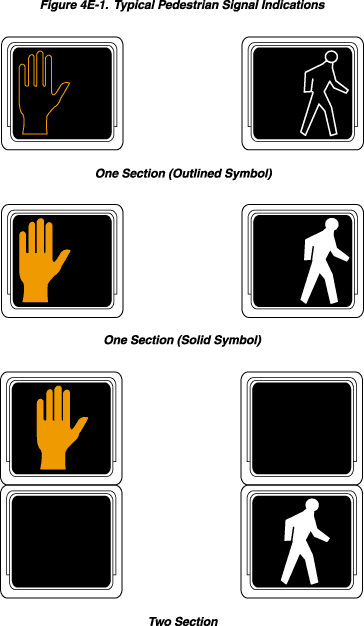 I’ve long wondered why the hand and man symbols — resembling some vaguely international semiotics — replaced the WALK and DON’T WALK blinking signs on crosswalks. This 2003 New Yorker article by Nick Paumgarten covers the switch — at least, as it went down in New York. At some point around 2000, it was decreed that all 85,000 signs — at the cost of $28.2 million — would be replaced. And while Section 4A.02 of the Manual on Uniform Traffic Control Devices outlines the specifics, nobody has thought to ask why the bright red hand (known officially as the UPRAISED HAND) and the white man (known officially as the WALKING PERSON) were settled upon. Were there boardroom battles? Were there numerous drafts? Were there competing designs? Was there one brave revolutionary who defied the pencilnecks in the Federal Highway Administration and had greater ideas than the hand and the man?
Here’s why I’m so obsessed by what we now all accept as real. This morning, while walking home from breakfast, I examined the white pixels located where the WALKING PERSON’s elbows should be. Even accounting for the optical liberties of pointillism, there was no elbow!
Now you may find this to be somewhat pedantic. But when most people walk, they generally use their elbows in some sense, because of this crazy little thing called gravity. And this WALKING PERSON — presumably named PERSON to avoid any controversies on the gender front — that I observed did not — repeat, not — appear to have any discernible elbows! Thus, if the PERSON was truly WALKING, would it not be strutting in representative form like a dutiful mack daddy, thus conveying to pedestrians that now was the time to get down and perambulate against the traffic?
Given that the UPRAISED HAND is a strong visual approximation of what a hand looks like, one wonders why Brooklyn thought that it should skimp out on the WALKING PERSON component of a universally mandated symbol.
But observe the diagram on the right. We see a clear elbow! And not only that, but observe the notable gap between the ring finger and the pinkie in the UPRAISED HAND! This graphic was culled from an Oklahoma site which freely disseminates an HTML version of the Manual on Uniform Traffic Control Devices, 2003 Edition with Revision No. 1 Incorporated.
So the question becomes far more compelling — predicated perhaps on a battle between city and state and federal government. Can the federal government live with the non-deployment of the gap or the non-deployment of the elbow? And why, in turn, does it bother me that the gap and the lack of elbow does not grace Brooklyn pedestrian signals? Does this mean that I am secretly some conformist pencilneck? Should I be the strapping young bureaucrat who demands better than a flashing red hand? Or does my visceral reaction come from being pushed around for so long by a government that purports to represent us? None of us certainly had any say when the Manual on Uniform Traffic Control Devices was concocted. Was there some period of public comment when the WALKING PERSON and the UPRAISED HAND were unveiled?
Let it not be said, however, that the MUTCD is entirely without leeway. Did you know, for example, that the UPRAISED HAND can be flashed at a rate of no less than 50 and no more than 60 times per minute? I can imagine city supervisors getting into fierce arguments. “Dwayne, you heartless bastard! At this intersection, we’re going to need a greater sense of urgency! 59 or 60 times a minute! Not a flash less!”
Even more interesting, there’s this option:
An animated eyes symbol may be added to a pedestrian signal head in order to prompt pedestrians to look for vehicles in the intersection during the time that the WALK signal indication is displayed.
I have not, as of yet, seen these mysterious eyes. But there may, however, be a reason why the animated eyes remains underused:
If used, the animated eyes symbol shall consist of an outline of a pair of white steadily-illuminated eyes with white eyeballs that scan from side to side at a rate of approximately once per second. The animated eyes symbol shall be at least 300 mm (12 in) wide with each eye having a width of at least 125 mm (5 in) and a height of at least 62 mm (2.5 in). The animated eyes symbol shall be illuminated at the start of the walk interval and shall terminate at the end of the walk interval.
Of course, none of this gets to the main point I was trying to uncover. Why the UPRAISED HAND and the WALKING PERSON? Sure, accessibility and rampant illiteracy may have forced cities and counties to swap four-letter words for symbols. But how did they settle upon these two symbols?
This, alas, is a complicated answer that will require a zealot-like determination. And I hope to fully unravel this mystery in the near future.
Rupert Thomson Appearances in Boston, San Francisco, and Seattle
As Megan notes, New York isn’t the only East Coast venue for Rupert Thomson . He’ll also be appearing at the Harvard Book Store in Boston the night before — on Thursday, August 16, 2007 at 7:00 PM. At my old stomping grounds in the Bay Area, Thomson will also be appearing at Black Oak Books on August 13, 2007. There are also two appearances planned in the Seattle area.