BSS #108: Ken Alder

segundo108.jpg

Condition of Mr. Segundo: Puzzled by polygraphs.

Author: Ken Alder

Subjects Discussed: The connection between polygraphs and Northwestern University, the United States’ fascination with lie detectors and cultural connections, why allied nations use junk science, polygraph tests and employment, the lie detector as coercive device, the CIA, Aldrich Ames, John Larson and William Keeler, Leonarde Keeler, the lie detector vs. due process, waterboarding, August Vollmer, paranoid personal lives of the polygraph progenitors, the subjugation of women, criminal technology and the white male, the polygraph showdown between Ken Alder and Fred Hunter, reliable confessions, American loyalty, detective fiction and tabloid journalism’s role in promulgating the lie detector, polygraphs and movie studios, advertising, Erle Stanley Gardner, asking Doug Moe’s question to Alder, the placebo effect and crime statistics, Alberto Gonzales and contemporary coercion, and the dream of psychological certainty.

EXCERPT FROM SHOW:

Alder: You know, it’s such a bizarre claim. There are different kinds of historians of science, and some historians of science go after the people who have the really big ideas and figure out these great novel ideas like Darwin and Einstein transform the world. And I do the opposite almost. I’m interested in history of the banal — those things that are so ubiquitous, as almost to be invisible. We don’t even notice them anymore. And lie detectors in this country are just part of the landscape and yet we’re the only country in the world that uses them.

BSS #107: Arlene Goldbard

segundo107.jpg

Condition of Mr. Segundo: Feeling that the community misunderstands him.

Author: Arlene Goldbard

Subjects Discussed: Artistic individuality vs. creative community, the benefits of 20th century funding for the arts, the WPA, community murals, public plays, happenings, the political agenda of “creative community,” collective absolutism, the Forum Theatre and “spectactors,” collaborations between professional and amateur artists, the Great Wall of Los Angeles, the dangers of constant artistic modifications, impoverished people and art, art and fame, reality TV, Stalinism, the Ukiah Players Theatre, and government artistic subsidization.

EXCERPT FROM SHOW:

Goldbard: Marx had this favorite saying: Stadtlyft mach frei. City air makes you free. Which the sense being, in a place of anonymity, you are free to completely express your individual essence and characteristics in a way that you may not be. You may be constrained in the small town you came from. Because people know your name and your face. And you can fool them once, but your probably can’t fool them twice. So there’s a truth that a certain degree of anonymity creates a certain degree of social freedom. And people want that to some extent. You don’t want to be surrounded by gossip. You don’t want people looking over your shoulder all the time. But the kind of community that I aspire to is one in which there’s tremendous permission to be different.

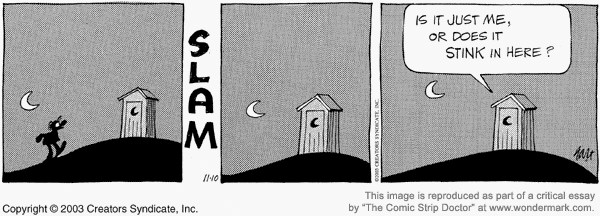
Johnny Hart, 1931-2007

bc1.gif

Jewish Journal: “In the days leading up to its publication, the Easter Sunday strip, which featured quotations from the New Testament juxtaposed against images of a burning, seven-branched menorah that transforms into a crucifix, became the object of concern among Jewish watchdog agencies. The 71-year-old Hart has written and drawn ‘B.C.’ since 1958, which appears in roughly 1,300 newspapers, reaching millions of families around the world. Hart, a devout Christian, has increasingly presented strips with explicit religious overtones.”

BSS #106: Ellen Klages

segundo106.jpg

Condition of Mr. Segundo: Affirming his miserable status.

Author: Ellen Klages

Subjects Discussed: On being approached by Sharon November at a convention to write a children’s book, writing fiction from a child’s perspective vs. an adult’s perspective, conducting research for a story, the 1950s, how characters kick-start stories, realism and fantastical elements, libraries, the gender divide in science, the label of “science fiction,” comfort food, Stephen King, missing words in sentences, the advantages of a late start, becoming a writer by hanging out with professional writers, writing “Portable Childhoods” with two meanings, word choice, and assembling a short story collection after many years.

EXCERPT FROM SHOW:

Klages: I write about the point of view of children for a couple of reasons. One of them is because I think I remember being a child better than I really understand being a grown-up a lot of the time. It’s a much simpler mind set. And I don’t really do a lot of politics and, oh I don’t know, insurance claims. And that sort of thing. That if you have a grown-up character, they might have to worry about and it just goes right over children’s heads. Especially in short fiction. You can streamline the world a little bit if you’re telling it from the point of view of a kid.

BSS #105: China Miéville

segundo105.jpg

Condition of Mr. Segundo: One might say quite “un”-well.

Author: China Miéville

Subjects Discussed: World-building, building a world with an urban center, being a “city animal,” the imagination-per-page ratio, a creative license to put in anything, C.S. Lewis, ideology and YA books, Marxism, terrorism, the 1952 London smog, London bus drivers, politics and fiction, inventing monsters, environmentalism, the pleasure and joy of the grotesque, Miéville’s creative veto process, Un Lun Dun as a creative experiment, having to lay off arcane words in a YA book, the nature of spoilers, the underrated virtues of sidekicks, narrative surprises, the journey vs. the destination, rigid plotting, the two types of people who respond to “fridge man,” and how literal puns transform into monsters.

EXCERPT FROM SHOW:

Miéville: There are different ways of world-building. When we say “world-building,” we tend to think of that D&D-esque kind, which is not a diss incidentally. It’s just a description. It’s sort of a consolidation between the geography and the history and the culture and so on before writing the story. At that’s one way of doing it. But then there are others, which are less rigid, less to do with internal coherence, in the same way. So in terms of something like Un Lun Dun or some of the short stories or even King Rat, and the book I’m working on the moment as well, it’s less to do with having a coherent back-narrative and more to do with having a coherent moral and emotional feeling. I know the whole question of world-building is quite controversial at the moment, because M. John Harrison just wrote his blistering attack on the idea. Which I thought was, characteristically for his stuff, was a brilliant provocation and full of a certain kind of angry integrity. I don’t agree with him exactly, but I think it would be a fool who dismissed his criticisms out of hand.