(This is the fifth entry in the The Modern Library Reading Challenge, an ambitious project to read the entire Modern Library from #100 to #1. Previous entry: The Sheltering Sky)
 In Alexandra Styron’s forthcoming book, Reading My Father, she describes liberating a galley of Sophie’s Choice, a presale unit freshly arrived at the family home, at the age of twelve. It was the spring of 1979. Her plan was to read the mint green paperback between classes. She felt it incumbent “to somehow validate the rumors of his greatness.” Young Alexandra discovers that the novel bores the tears out of her. “The difficult vocabulary and historical references kept eluding me,” she writes, “until finally I began to let them sail by, unchallenged.” Further, upon encountering her father’s libidinous passages, she then becomes embarrassed, wincing “at the liberal sprinkling of words like fucking and horny and lust.” (Here’s the full tally according to Amazon’s Look Inside! feature: “fucking” — 29 counts; “horny” — 4 counts; and “lust” — 20 counts. I am also informed that readers in need of steady doses of the mildly profane are likely to find a good deal more “fuck” and “fucking” in Philip Roth’s Zuckerman books. Miles Davis’s autobiography, published a decade after Sophie’s Choice, contains 672 uses of the word “fuck.” I think it’s safe to say that Styron was pushing the “fucking” boundaries no more and no less than any other writer around the time. Perhaps his striking tone says something about his ability to alarm.)
A good thirty-one years later, The Millions‘s Lydia Kiesling posted a Modern Library Revue installment on Sophie’s Choice. Kiesling, fourteen years older than Alexandra Styron when she first read Sophie’s Choice, wrote, “I’m not a prude; I think there should be sex in novels. However, while I’m not certain how it is best achieved on the page, I feel quite certain that ‘mossy cunt’ and ‘undulant swamp’ are not the ideal epithets. I mean, Jesus. Also, it’s just so cheesy — the release of her secrets, the release of his orgasms.” To be fair to Styron, he actually writes about “her moist mossy cunt’s undulant swamp.” Say what you like about Styron, but it takes a rare writer willing to go the distance like this. (Incidentally, “release” gets five counts in Sophie’s Choice according to Amazon and in neither explicit usage that Kiesling claims. In fact, at one point, “release” in the orgasmic context is declared “an odious word” by young Stingo, of whose randiness more anon, in one of his notebooks.) This prompted Emma Barton (not the actress who played Honey Mitchell on EastEnders) to leave a spirited comment in response: “You must have noticed there’s a new generation of us younger feminists coming up who don’t get our panties in such a twist over guys talking about their sexual thoughts, since we’re pretty open about our own sexual thoughts too.”
If Styron’s sexual effrontery is a matter to be settled by the old guard feminists, then we’re in luck. In her essay “Night Thoughts of a Media Watcher,” Gloria Steinem was to offer stronger sentiments. For Steinem, Sophie’s Choice was “like reading a case history by Freud in which he stoutly maintains a woman patient was not really raped by her father as a child, but just made up this story because she had hoped it would happen.” To put it mildly, I don’t think this gets at the complexity that Styron was attempting. But let’s carry on. Shortly after Steinem concedes the possibility that “Styron knew what he was doing,” she writes, “My first hope is that there was no real Sophie, that Styron just made her up completely. Like Freud’s women patients, however, she is just real and believable enough to break your heart; all the more so because she is recorded by someone who describes her but never understands her.” While it is true that Styron has drawn heavily from his personal experience for Stingo (especially for Sophie’s Choice‘s enthralling opening chapter), Steinem’s diagnosis presupposes that Styron wasn’t remarking in some way upon Stingo’s own (and Styron’s own) failure to understand her. Styron alludes to a real-life Sophie in a 1983 interview with Stephen Lewis, but not for the reasons that Steinem imputes:
It summed up the absolute totalitarian nature of this evil, which we really had not seen, certainly in civilized society, since history began to be recorded. It seized me so poignantly that I was compelled to write a book about it. I also connected it with something that had happened to me: I went to Brooklyn, in the late 1940s, and met a young — older than I was, but nonetheless young — woman who had been a survivor of Auschwitz, and who had a tattoo on her arm. Her name was Sophie.
So if absolute evil was Styron’s primary focus, how did we get from 29 uses of “fucking” to nebulous Freudian speculation to bright spirits duking it out in the comments at one of the Web’s best literary sites? Whatever it was that Styron was doing, in 2002, it was enough to get the California-based Norwalk-La Mirada High School District to remove Sophie’s Choice from its libraries after a single complaint. The objection? You guessed it. The sexual content. The ACLU intervened after students protested the distinct possibility that their very own First Amendment rights were being violated. The book was eventually returned to the stacks.
I think it’s remarkable that a brick-thick book from 1979 has continued to get so many people hot and bothered — especially since most novels written in the last decade don’t possess this power. (One cannot imagine people getting this worked up about Jonathan Franzen in 2043.) But now that I’ve finally read Styron’s masterpiece, I’m bewildered by much of the ballyhoo. The objections over the book’s sexual passages would suggest that all this exists independently from the book’s take on the Holocaust. It is almost as if the book’s opponents are incapable of reconciling the two strands, a grave oversight in light of the book’s presentation of tragic relativism, which I’ll get to in a bit. Of the four objections cited above, only Steinem makes a tenuous connection. And even then, she falls into the cliche of accusing Styron of some psychosexual fantasy — as if every impulse an author sets down involves unzipping the pants of the mind.
To get the hot stuff out of the way first, it cannot be stressed enough that we are dealing with Stingo, a young man who isn’t getting any during the postwar epoch, which comes a few decades before American culture has at long last grasped and permitted the reality of teenagers losing their virginity. As Stingo himself explains:
A lot in this way of bilious remembrance has been written about sex survivors of the fifties, much of it a legitimate lament. But the forties were really far worse, a particularly ghastly time for Eros, shakily bridging as they did the time between the puritanism of our forefathers and the arrival of public pornography. Sex itself was coming out of the closet, but there was universal distress over how to deal with it.
Here is a young man so lonely that we see him, in the book’s extraordinary opening chapter, fantasizing about “the Winston Hunnicutts, this vivid and gregarious young couple,” whom Stingo sees from his window in the rotting University Residence Club on West Eleventh Street. Yes, Stingo offers us extraordinary fantasies about the wife, using romantic language (“My lust was incredible…priapic, ravenous, yet under hair-trigger control”). But it is clear that Stingo’s fantasies also revolve around the Hunnicutts’ “enormous good fortune to inhabit a world populated by writers and poets and critics and other literary types.” To some degree, Styron’s fusion of sex with literary aspirations anticipates Roberto Bolaño’s The Savage Detectives. And yet because Bolaño’s book carries the heft of multiple testimonies to sustain its illusion and Styron confines his interests to a singular first-person perspective, the former is permitted his posthumous genius while the latter is seen as a late middle-aged creep (also dead, by the way) getting his jollies through a young man’s perspective.
Never mind that Styron has taken care to include excerpts from Stingo’s notebooks, which contain prototypical revelations about Stingo’s life, along with wry commentary after these italicized passages: “I am a little mortified to discover that almost none of the above was apparently written with the faintest trace of irony (I actually was capable of ‘somewhat slightly’!”)”
If such provisos aren’t enough. Stingo, who is very aware of his prose style, is fond of embellishing his life story — even decades later — with seemingly robust, manly sentences. One such sentence reads: “I got up and made my way to the men’s room, weaving slightly, aglow at the edges of my skin with a penumbra of Rheingold, the jolly, astringent beer served at the Maple Court on draught.” Taken out of context, some of the phrasing (“aglow at the edges of my skin with a penumbra”) might be construed as awkward, yet Styron’s “edges of my skin” anticipates how the out-of-practice, out-of-time romantic phrase is no longer used among male writers today. Indeed, in recent years, “edges of my skin” has been used by such highly readable writers as Stephenie Meyer, Alice Sebold (in Lucky, no less), Aimee Bender, Lorrie Moore, and Justine Larbalestier. Indeed, it is difficult to imagine a single male writer born after 1970 using such a phrase in contemporary fiction.
Stingo’s revelations serve purposes beyond the ostensibly tawdry. Styron is telegraphing a dying language, revealing modernist modes misconstrued today as overly melodramatic. Yet if they are so over-the-top, why then is Styron so willing to have Stingo explain himself? As Stingo notes late in the book, once he has at long last accomplished his effervescent goal (I have blanked out the name to avoid spoilers):
The varieties of sexual experience are, I suppose, so multifarious that it would be an exaggeration to say that _____ and I did that night everything that it is possible to do. But I’ll swear we came close, and one thing forever imprinted on our brain was our mutual inexhaustibility. I was inexhaustible because I was twenty-two, and a virgin, and was clasping in my arms at long last the goddess of my unending fantasies….For me it was less an initiation than a complete, well-rounded apprenticeship, or more, and _____, my loving instructess, never ceased whispering encouragement into my ear. It was as if through a living tableau, in which I myself was a participant, there were being acted out all the answers to the questions with which I had half maddened myself ever since I began secretly reading marriage manuals and sweated over the pages of Havelock Ellis and other sexual savants.
Speaking as a man who was once twenty-two and sexually frustrated (as nearly every kid at that age is), I can assure all parties that Styron accurately describes what it means to sow one’s young oats.
If Sophie’s Choice were merely an itemization of Stingo’s sexual fantasies, then it would not have rightly earned its place in the Modern Library canon. I haven’t even brought up the indelible Nathan Landau, Sophie’s wildly exuberant and psychologically troubled Jewish paramour. He is inarguably worse than Stingo, prone to rages and boasting about cures for cancer, and abusive of Sophie and Stingo. Yet he shares much of Stingo’s autodidacticism. Indeed, it is Nathan’s curious amalgamation of knowledge (one might very well use the 21st century term “mashup”) that is the allure:
His range was astonishing and I had constantly to remind myself that I was talking to a scientist, a biologist (I kept thinking of a prodigy like Julian Huxley, whose essays I had read in college) — this man who possessed so many literary references and allusions, both classical and modern, and who within the space of an hour could, with no gratuitous strain, weave together Lytton Strachey, Alice in Wonderland, Martin Luther’s early celibacy, A Midsummer Night’s Dream and the mating habits of the Sumatran orangutan into a little jewel box of a beguiling lecture which facetiously but with a serious overtone explored the intertwined nature of sexual voyeurism and exhibitionism.
What’s especially interesting is how close this self-taught ideal mimics Stingo’s own narrative voice. The key tell here is “the intertwined nature of sexual voyeurism and exhibitionism,” which serves in parallel to Stingo’s own sexual exhibitionism. This is unconsummated for the most part, with even “a remarkably beautiful, sexually liberated, twenty-two-year-old Jewish Madonna lily named Leslie Lapidus” (later revealed to be involved in orgone therapy; Wilhelm Reich, of course, being one of the twentieth century’s great charlatans) just outside his grasp.
DG Myers has put forth the idea that Sophie’s Choice owes its historical importance not because of its literary quality, but as “a pioneering dissent on the Holocaust.” (While Myers’s 10,000 word essay is well worth reading, especially because Myers offers a very helpful overview of Styron’s developing thoughts on the Holocaust, Myers is curiously prudish about the novel’s sexuality.) I think he is right to observe that Sophie’s Choice is about “the ideological representation of the Holocaust,” with the origins of these thoughts to be found in Styron’s essay, “Auschwitz” (contained in This Quiet Dust). But Myers is wrong to suggest that Styron’s views on Jewish exclusivism — with the non-Jewish Sophie serving as Styron’s ecumenical exemplar — are invalidated by what Myers perceives to be a historical error. Myers cites Styron writing that Sophie “had suffered as much as any Jew,” but there is also this parenthetical (after Stingo has made efforts to reconcile Sophie’s life with George Steiner’s Language and Silence):
(It is surpassingly difficult for many Jews to see beyond the consecrated nature of the Nazis’ genocidal fury, and thus it seems to me less a flaw than a pardonable void in the moving meditation of Steiner, a Jew, that he makes only fleeting reference to the vast multitudes of non-Jews — the myriad Slavs and the Gypsies — who were swallowed up in the apparatus of the camps, perishing just as surely as the Jews, though sometimes only less methodically.)
Here, Styron dares to enter into the tricky realm of genocidal relativism by inclusion. Yet if Styron is going to quibble with Steiner, we must quibble with Styron by his own rules. Stingo has left out the pink triangles, the political prisoners, and numerous other laborers who perished in the camps. If Styron hopes to “sum up the absolute totalitarian nature of this evil,” it is quite possible that no book can truly contain it. On the other hand, when Styron writes of Stingo’s whereabouts on April 1, 1943, he is clearly showing the foolish nature of the comparative enterprise:
I was able to come up with the absurd fact that on that afternoon, as Sophie first set foot on the railroad platform in Auschwitz, it was a lovely spring day in Raleigh, North Carolina, where I was gorging myself on bananas.
Stingo is gorging himself on bananas because he needs three more pounds to meet the minimum weight requirement to join the Marines. And yet, at the time, Stingo
had not heard of Auschwitz, nor of any concentration camp, nor of the mass destruction of the European Jews, nor even much about the Nazis. For me the enemy in that global war was the Japanese, and my ignorance of the anguish hovering like a noxious gray smog over places with names like Auschwitz, Treblinka, Bergen-Belsen was complete. But wasn’t this true for most Americans, indeed most human beings who dwelt beyond the perimeter of the Nazi horror?
In condemning Styron for his “historical error,” Myers correctly observes that none of the books and records that Stingo quotes is a firsthand source. And yet while Myers is right to point out that Sophie’s testimony to Stingo “secures the narrative authority of Sophie’s Choice,” he fails to observe that even Styron’s fictional firsthand source is suspect, suggesting that “the novel’s case against the Jewish interpretation of the Holocaust depends upon the claim that Jews are ignorant of the historical reality.” But if Stingo himself starts from a blank slate of ignorance, is not the purported case against predicated on an interpretation built atop gentile ignorance? The details here are as much about the lies and the omissions as they are about what is stated and filtered through Stingo. Of one of Sophie’s accounts, Stingo notes, “Her brief observation on the function of Auschwitz-Birkenau….is basically an accurate one, and she neither exaggerated nor underestimated the nature of her various diseases….Why, then, did she leave out certain elements and details that anyone might reasonably have expected her to include?” Later in the novel, Stingo declares, “Would I not forgive her, she said, now that I saw both the truth and her necessity for telling the lie?” Still later, a highly inebriated Sophie exclaims, “Jews! God, how I hate them! Oh, the lies I have told you, Stingo. Everything I told you about Cracow was a lie. All my childhood, all my life I really hated Jews. They deserved it, this hate, I hate them, dirty Jewish cochons!”
This is distressing and prejudicial language. And it certainly points to one interesting takeaway that Myers promulgates: “The only respect in which [the novel’s Jewish characters] remain Jewish at all is in their exclusivist response to the Holocaust.” But can Stingo as narrator be entirely trusted? Is not Sophie’s anti-Semitic outburst, the fissures widened by self-medicating swigs of rye, not pointing to the inherent ugliness within the Enlightenment liberal position?
Sophie’s Choice is many things, but the thrust here may be more emotional than intellectual. Cannot the Holocaust be both ecumenical, as Styron once proposed, and exclusively Jewish? If one is not Jewish, and one feels deep sadness and great contrition for these tremendous atrocities, then Jewish exclusivity presents no other option other than conversion. Thus, Stingo’s romantic language, tailored for crass sexuality, may very well be upholding the folly buried within.
Since Myers was too timorous to consider this angle, I’m going to suggest that Stingo’s sexual longings represent some wishful reconciliation between Jewish exclusivity and universal understanding. For the gentile denied exclusivity, there is the commingling of guilt with passion, even carnal passion. Yet as Leslie Fiedler observed in his take on Sophie’s Choice, “Even when Stingo manages to participate in the action, he proves incapable of influencing its outcome.” So if Myers believes that Styron “fails to understand the sense in which the Holocaust calls into question the left-liberal distaste for Jewish exclusivism,” it would appear that he did not read the following reflective passage near novel’s end, when Stingo is attempting to balance his youthful journal with his adult self:
Someday I will understand Auschwitz. This was a brave statement but innocently absurd. No one will understand Auschwitz. What I might have set down with more accuracy would have been: Someday I will write about Sophie’s life and death, and thereby help demonstrate how absolute evil is never extinguished from the world. Auschwitz itself remains inexplicable. The most profound statement yet made about Auschwitz was not a statement at all, but a response.
Next: Iris Murdoch’s Under the Net!
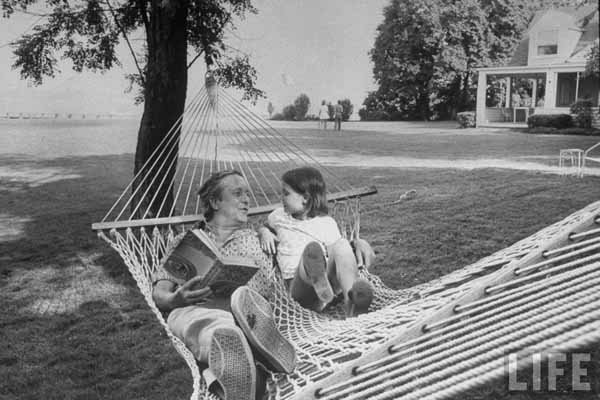
(Image: Alfred Eisenstaedt)