New Directors/New Films: Curling (2010)

[This is the fourth in a series of dispatches relating to the New Directors/New Films series, running between March 23, 2011 and April 3, 2011 at MOMA and the Film Society of Lincoln Center.]

If Kingpin and The Big Lebowski (or, heck, even Dreamer – a silly movie starring Tim Matheson as a bowler from 1979 that nobody remembers) portrayed the bowling experience from the bowler’s vantage point (natch, given that this is the way most of us comprehend that lengthy lane with the nine pins we hope to topple down in half-drunken triumph), then Curling dares to see it from the middle-aged folks toiling in bowling alleys. This may be because writer-director Denis Côté was born in New Brunswick. In fact, what you may not realize is that five pin bowling, which is quite popular in much of Canada, isn’t nearly as much of a draw in Quebec, New Brunswick, and Nova Scotia. And that is because in some of the French-speaking territories, petite quilles (or duckpin bowling, which is ten pin bowling with fat little bastards replacing the slim pins most of us know in the States; perhaps this is why the obesity epidemic is writ larger south of the 49th parallel) is more the order of the day.

I didn’t intend to write a silly essay about the many variants of bowling, although they certainly excite me. (In fact, my discovery of candlepin bowling upon moving to the East Coast made me both very surprised and very happy.) I am, after all, supposed to tell you about this movie, Curling. What I can say is that Denis Côté isn’t terribly interested in the bowling alley’s culinary offerings, which you’d figure that anyone who speaks French or who enjoys chilli cheese fries (does Côté?) would be keen on investigating. However, as the film’s title suggests, the film itself isn’t about bowling. It also involves a pastime that is insufficiently defined by Wikipedia as “a sport in which players slide stone across a sheet of ice towards a target area.” I don’t wish to come across as overly querulous, but this clinical sentence certainly doesn’t insinuate what makes curling a draw. Having not curled in any meaningful capacity outside of the boudoir, I can safely report that Curling‘s curling moments did fill me with the sense that I had missed something – even if most of the curlers were advanced in years and looked as if they had taken up curling to alleviate the gloomy boredom awaiting them outdoors. Since the Will Farrell comedy Dodgeball is held in high acclaim, I would not be surprised if some crass Hollywood crew appropriated this sport too. After all, like golf, curling did originate in Scotland.

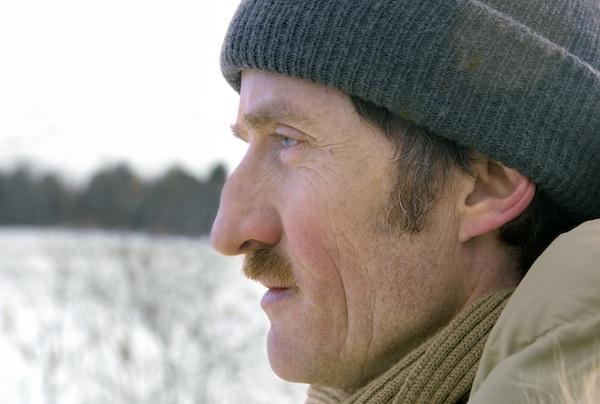
For one unsmiling man with a mustache, Jean-Francois (played by Emmanuel Blidodeau), bowling isn’t so much a joy, as it is a low-paying part-time job in which he sometimes loses bets with his co-workers to clean the bathroom or dress up in preposterous costumes. Jean-Francois’s other gig involves cleaning a motel and, one morning when he discovers a bloody mess in Room 9, he is informed by the owner that his services are no longer required. Of course, it isn’t Jean-Francois’s fault, nor even the fault of the “big Accordion trucker” who stayed the night before who either killed somebody or died bleeding in the wilderness. The owner had planned on closing down the motel anyway. “I don’t have the energy,” says the owner. Well, who can blame the owner when the guests die like this?

Did I mention the fact that some tiger is running loose and that various people are being mauled down in the wintry wilderness? Did I also mention that Jean-Francois is a single dad home-schooling his daughter Julyvonne because it’s so dangerous outside? Jean-Francois takes care of Julyvonne because his partner is locked up in a mental institution. “If you touch a hair on her head,” she shrieks, “I’ll rip your fucking heart out.” Such is the promise of domestic tranquility in this family’s universe, but, in Côté’s defense, I should point out that I grew up in an environment in which such lines were shouted around the dinner table. In fact, the situation here is so bleak that Julyvonne begs her father to play Stacey Q’s “Two of Hearts” through a crappy stereo so that she can dance in a vague manner as Jean-Francois sits on the couch in a moribund manner.

And you thought some of your nights were pathetic. In seeing these scenes, I wondered if the film was set sometime around 1989. Later in the film, when there was talk of cell phones and video games, I felt a genuine sense of shock that this time capsule of a town in the middle of nowhere could be penetrated.

These cinematic results, depending upon your temperament, are either relentlessly bleak or mostly depressing with occasional bright and quietly hilarious spots. At times, Curling made me feel like I wanted to kill myself. And yet I can recommend this mumblecore opus from Quebec. Because the melancholy often functions in a peculiar comic mode. Any film featuring a man dressed up in a bowling pin costume, hassled by a ten year old kid who wants to wear the top portion and who then reveals rudimentary erudition that eludes Julyvonne, can’t be entirely humorless. And any film featuring a fetching employee who has a new hair dye color for every fresh screen appearance is probably suggesting that iridescence can be located in a bleak landscape if you know how to change your stripes. (In fact, chances are that maintaining a silly moustache may be part of the problem.) Then again, this is also a film in which Julyvonne, precluded from painting the town red, humbly requests that her dad paint the bathroom red. Jean-Francois insists that green would be a better shade. Julyvonne is later briefly abandoned because, in Jean-Francois’s view, this contributes to the possibility of him going insane like his partner.

What I enjoyed so much about Curling is that it doesn’t give up its mysteries. We never quite learn why the mother has gone insane. For all I know, it could be a rite of passage in this village. I mentioned earlier that a large cluster of the local population seems to be getting killed or mauled. It could be the tiger. It could be the truck driver. It could be what some folks call cabin fever. I don’t believe the Quebec community is this violent in real life, although I don’t have any fresh crime statistics at my side. Curling presents enough ambiguities to make you wonder whether its village represents some parallel universe occupying Côté’s inventive mind or some part of Québécoise equipoise that just isn’t talked about. It is the rare film that is both a downer and a winner.

The Bat Segundo Show: TC Boyle IV

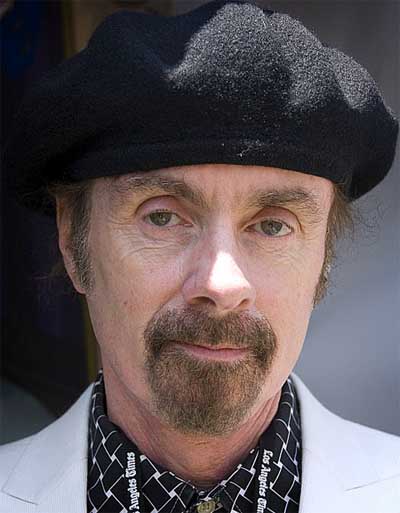
TC Boyle appeared on The Bat Segundo Show #385. He is most recently the author of When the Killing’s Done. This is his fourth appearance on the program. He has previously appeared on The Bat Segundo #273, The Bat Segundo Show #70, and The Bat Segundo Show #10.

Condition of Mr. Segundo: Considering a savage swim to the Channel Islands.

Author: T. Coraghessan Boyle

Subjects Discussed: Whether one can look dapper while being under the weather, Boyle’s powerful immune system, connections between Wild Child‘s stories and When the Killing’s Done, fishing expeditions gone awry, early subconscious efforts to hone the narrative framework, the short story “Anacapa,” “Question 62,” who has the ethical result to control all creatures, details on the next novel San Miguel, the Channel Islands, the bleak winds of San Miguel, straightforward historical narrative vs. exuberant adventure, Boyle’s prodigious description of hair, folk singers and massive hair, writing about women, Ruth Dershowitz in East is East and Dana in Talk Talk, basing When the Killing’s Done on news accounts without meeting anybody involved, Dave LaJoy and megalomaniacs, readers who take hard sides in response to the book, whether the portrayal of an exuberant megalomaniac causes an unintended ideological tilt, sympathizing with an animal rights activist, not being able to look at the PETA slaughterhouse videos, Diane Johnson’s essay in the New York Review of Books, whether Boyle’s sense of the ridiculous overcomes moments of gravity, the role of literature within Killing, Madame Bovary “in the Jean Renoir original,” Island of the Blue Dolphins, Boyle’s pessimism, being thrust into the lap of the existentialists, Jeffrey Dahmer, the comforts of irrelevance, Flannery O’Connor’s “A Good Man is Hard to Find,” spirituality, feeling the pulse of nature and being humbled by it, Boyle’s pilgrimages, blocking out terrible news, the role of art in a nihilistic viewpoint, the geography of Santa Cruz and Anacapa, Boyle’s mother-in-law, the degree of geographical exploration required for Drop City and When the Killing’s Done, the Judas pig, Tom Wolfe’s journalistic approach to novel writing, passages written by “Boyle the historian,” being in the clear when using real people for fiction, when fiction is more real than reality, riffing on history, Home Depot as “the loneliest place in the world,” not having material goods, and escaping to the mountain.

EXCERPTS FROM SHOW:

Correspondent: I wanted to remark upon a recent essay by Diane Johnson in The New York Review of Books. I’m sure you’ve probably seen it by now.

Boyle: Yes, I have.

Correspondent: She wrote something that I happen to agree with. “Because his sense of the ridiculous usually overcomes his moments of gravity, he rarely departs from a comic mode that precludes tears even in the most tragic circumstances.” I think that this is a fair point, especially in this book. But if your book is informed with this sense of the ridiculousness, I’m wondering if this is going to impede upon writing in more serious or greater turf.

Boyle: It might. Which is precisely why I’m doing a non-comic straightforward historical narrative right now. Just to see how that might be and what might happen. Don’t forget. I’m the guy who wrote Water Music as my first novel, which turned the historical novel on its head and subverted and pulled the rug out and nudged you constantly about the unreliability of fiction and of history too. Now I am trying to write something without any irony or any comedy. Straightforward drama. Straightforward realism. Just because I’ve never done it before. I’ve done it in short stories. But I’ve never done it at length. And I found this wonderful story, a historical story, which I’m telling as best I can. We shall see what the results are. In fact, if we’re very lucky, you and I will be sitting here in three years discussing that one. And we’ll find out. (laughs)

Correspondent: Well, maybe we will. But I want to see if we can get to When the Killing’s Done and this problem of adopting the comic exuberant tone. I think this book does really present some very important issues, which we were getting to earlier, about how does humanity play god in the animal kingdom. I mean, this is a very serious topic. And the comedy is almost a mask over something which is — well, if you think about it from either side — really depressing. So I’m wondering if, in not permitting us to share tears (as Diane Johnson believes), it almost trivializes the issue to some degree. Does it present a problem? Or is your strategy more laying a few comic exuberant bombs to blow up in the reader’s head in about a week or so?

Boyle: Wow. Neither of the above. I’ll go for Choice C. I don’t see this as necessarily a comic novel. Certainly there are many varieties of comedy, of course. And I’ve used every possible mode I can think of. This has its moments, of course. And I think it allows the reader to stand back at times and view the characters with some kind of ironic detachment perhaps. But I don’t see this as essentially a comic novel. I see this as a dramatic novel. And further — and we’ve talked about this in the past — I often find that using the comic mode can be more emotionally wrenching then writing a straightforward drama. Because it subverts your expectations. And in this one. Well, look at the ending to this book. It should punch you right in the heart. I hope it does.

Correspondent: But I don’t know. From my standpoint, it read very much like a comic novel. To me. Particularly every time LaJoy came up. I mean, this guy is such a hilarious…

Boyle: Because he’s exaggerated to a degree. And yet, and yet, he’s also real. And I wouldn’t want to say, as I said earlier, that he represents a large part of me. But certainly that part is there. And certainly, Ed, we are both of us pretty much perfect and beautifully emotionally adjusted. But a lot of people out there are not. There are a lot of people out thee who make LaJoy look calm.

* * *

Correspondent: Do you have anything that you feel optimistic or joyful about?

Boyle: No.

Correspondent: No? Nothing optimistic?

Boyle: No. Since I discovered death at a very young age, it has obsessed me. And the whole purpose of our endeavors obsesses me. And in a larger scale, of course, our human endeavors on the planet, which will of course be burned to a cinder in there and a half billion years anyway. So what does anything matter? Etcetera. As I probably have said to you before, you know, I went from a Roman Catholic boy with god and his heaven and Santa Claus at the age of eleven or twelve or whatever, realizing that it’s all completely phony and it’s just some myth that we’ve been fed to prevent us from committing suicide at a young age. And within three or four years of that, I was thrust into the lap of the existentialists. And I’ve never come back.

Correspondent: Then is work really the only way, the only reason to stay alive?

Boyle: All work is irrelevant. Everything is irrelevant. Our conversation is irrelevant. Literature is irrelevant. Films, love, everything is utterly irrelevant in the face of utter meaninglessness and death. That’s what we live with. Everybody lives with every minute of every day. On the other hand, if you’re not going to shoot yourself tonight, do what satisfies you. What satisfies me is making literature and then sitting here with you talking about it. And also I have honor. I really believe in the power of literature and I like to promote it. I’ve never cheated anybody or hurt anybody — you know, that sort of thing. And that’s simply because that’s my own code. It doesn’t make me any worse than Jeffrey Dahmer, for instance.

Correspondent: Who’s dead.

Boyle: It’s just my point of existence.

(Image: Mark Coggins)

The Bat Segundo Show #385: TC Boyle IV (Download MP3)

This text will be replaced

Review: Win Win (2011)

Can a woman seeking a $1,500/month guardian stipend truly afford to stay at a New Jersey motel for several weeks? (The Quality Inn in Toms River, New Jersey has kindly informed me that they rent rooms at $39.95/night. Discounting tax, that’s $279.65/week. At three weeks, that’s $838.95.) I suppose she could put it on her credit card, even though she’s just spent a considerable amount of her money in rehab and doesn’t appear to be gainfully employed. But can this same woman also afford to retain an attorney who makes at least three public appearances?

If a pack of cigarettes cost about eight bucks in Jersey, and you are a spendthrift like Mike Flaherty (played by Paul Giamatti), does it make any sense to buy a fresh pack, throw the other nineteen cancer sticks into a dumpster, and then smoke the remainder whenever you need to relieve stress? (For that matter, why are you spending your money on mid-grade scotch you keep in the office? And if your cigarette intake is that why aren’t you relieving stress that way?)

Such story problems emerge up with troubling frequency during Win Win, which isn’t just a subpar mainstream comedy, but a fallacious fantasy. The vastly overrated writer-director Thomas McCarthy (not to be confused with the very smart British novelist Tom McCarthy, who gave us Remainder and C) hasn’t bothered to ask or answer these basic questions. Perhaps it’s because McCarthy lives in a privileged bubble which prevents him from researching or investigating the very people he wishes to depict.

If we are to (rightly) condemn the Tea Party for perpetuating the view that some mythical age of prosperity occurred under Reagan, then we should also (rightly) condemn any huckster who wishes to perpetuate a roseate view of the middle-class instead of one that accurately presents its ongoing erosion (yet still manages to get us to walk away with some faith in humankind: Stewart O’Nan’s novels or Mike Leigh’s films come very much to mind). Because of these problems, Win Win is more feel-good propaganda than respectable entertainment. It’s the kind of movie that a clueless centrist, the type who doesn’t know how to live and who arrogantly claims comprehension of the hoi polloi without actually talking with them, will enjoy without question. I know this, because the film’s generic and gutless humor (1980s rock stars, games called Secret Apprentice, signs on ceilings that read “If you can read this, you’re pinned”) caused the middle-class types I was sitting with to laugh at the carefully engineered, preprogrammed moments.

The problem here may be that Win Win is actually two movies awkwardly sandwiched into one. Does it want to be a film about how Mike Flaherty survives in an increasingly unforgiving economy as a sole practitioner who takes up the causes of the elderly and as a part-time wrestling coach? Or a film about how a man who cannot relax finds a new cause to take up with Kyle (Alex Shaffer)? Kyle, a troubled boy, reveals himself to be a very capable wrestler who can shake the wrestling team from its losing streak. (Some hint of Kyle’s troubled past is seen late in the film, where Kyle’s violence shows signs of surfacing to the edge. Between this, and one joke that has Mike hitting Kyle in the face just before a wrestling match, there’s the possibility of a richer film buried beneath the crowd-pleasing claptrap. Alas, McCarthy would prefer to collect the check.) He’s landed into Mike’s life not long after Mike has taken the aforementioned $1,500 monthly guardian stipend from Kyle’s grandfather to help keep his family afloat.

Because the film’s story is so overstuffed, supporting characters who should matter aren’t given the chance to breathe. Amy Ryan, for instance, plays Jackie, Mike’s wife, revealed to be nothing less than a former Jersey girl (with a JBJ tattoo on her ankle: JBJ, of course, being shorthand for Jon Bon Jovi, a shorthand that also condescends to the audience) who now nurtures. The Flaherty family may be having financial difficulties, but why doesn’t the family chip into pick up the slack. Why doesn’t the film give Jackie a chance to get a part-time job? Or even offer us a dramatic moment in which Mike finally cops to Jackie about his inability to make ends meet? Surely, a woman who has observed her husband cheaping out (not fixing the creaky pipes in the office, not sending in the health insurance check on time, not hiring a tree surgeon to cut down the diseased tree) would notice. Even Mike’s office assistant, a woman confident enough to announce her hangovers and carefully tallying the expenses, would probably have some modest clue that the arithmetic doesn’t add up. Presumably, these women don’t confront Mike with these financial issues because they are aware of Mike’s health (he hyperventillates after too much stress). But if Mike has the time to work two jobs, and he’s spending nearly all of his spare time playing Wii tennis and bullshitting with his somewhat loutish friend Terry (Bobby Cannavale), surely he should take some personal responsibility or would at least be called (gently perhaps) on the way he evades what he needs to do. I mentioned a woman earlier who also cannot do the financial numbers. That woman is Kyle’s mother. So that’s three women McCarthy offers who are incapable of understanding basic personal finance. In a world in which The New York Times claims gang rapists to be the victims, I don’t think it’s hyperbolic to call Thomas McCarthy a sexist pig.

New Directors/New Films: At Ellen’s Age (2010)

[This is the third in a series of dispatches relating to the New Directors/New Films series, running between March 23, 2011 and April 3, 2011 at MOMA and the Film Society of Lincoln Center.]

Last August, JetBlue flight attendant Steven Slater decided to quit his job after a passenger refused to sit down. “I’ve been in the business 20 years,” he was alleged to have said. “And that’s it. I’m done.” He grabbed two Blue Moon beers, told the passengers to go fuck themselves, inflated the emergency slide, and walked away from the plane. A few hours later, he was arrested at his Queens home.

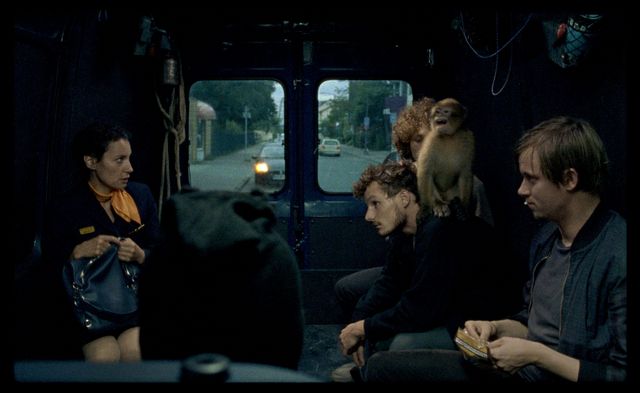
It’s doubtful that Pia Marais’s At Ellen’s Age – which played the Locarno Film Festival slightly before the JetBlue ballyhoo – was inspired by the Slater story. But there are a few interesting similarities. Ellen (Jeanne Balibar) is a flight attendant over forty who learns that her partner Florian (Georg Friedrich) has knocked up another woman. One day, with the camera tight on Ellen as she’s demonstrating emergency procedures and with only one boy craning his head around the edge of the seat to observe her, Ellen decides to exit the plane. Later, when the airline lets her go, Ellen’s boss explains that the lost profits and the security breach makes her continued employment with the airline untenable. Ellen, like Slater, defends her twenty years in the business. She then begins a journey of aimless wandering and inhabiting, not unlike Lost in Translation‘s Bob Harris (but without the wealth or the fame). She kicks around in random hotel rooms, hitting listless parties and often hiding in bed after everyone has left. She becomes an unexpected surprise for room service and for the next guest checking into the room. Through a series of odd run-ins, Ellen finds herself chasing a taxi that contains her luggage while inside a van containing animal rights activists. She ends up living with these activists, still wearing her flight attendant uniform as if it’s a skin that she can’t seem to shed.

The interesting juxtaposition of Ellen against animal rights activists suggests that Ellen herself might be a type of human animal. (And before she flees her job, it’s probably worth pointing out that she observes the surreal prospect of a cheetah walking down the runway and setting his haunches close to the plane’s wheels, causing a delay.) When the news outlets depicted the Slater tale, they invented a detail about Slater being in bed with his partner when the police arrested him. They were content to see Slater as a lurid animal to fit into their narrative cage. But the media isn’t terribly interested in Slater now and it never meaningfully examined why Slater did what millions of Americans wanted to do but couldn’t. When one aspect of our stability is threatened or removed, and we decide to roam the landscape that contains us, are we any more responsible in our actions than some grotty kid rightfully directing her energies towards capitalism’s many abuses, while failing to comprehend the exigencies of living with this shady social contract? There’s one moment in the film when Ellen finds herself protesting alongside her intrepid protesters. They strip their clothes off and spray something resembling blood on their bodies and wrap themselves in cellophane like meat. Is the protest here less about sticking up for animals and more about consumerism? Is not the chant MEAT IS MURDER a marketing cliché which might sit comfortably alongside JUST DO IT? Is not the decision to abandon one’s job as much of a capitalistic choice as sticking it out with the drudgery? These are interesting questions the film seems capable of, but that, frustratingly, aren’t buttressed by a cogent framework.

Yet Jeanne Balibar’s performance is to be commended here. As she gets further away from her ironically rooted career as a flight attendant, she almost lopes on-screen, like some animal released from captivity. She still resorts to the smile that she’s used for twenty years when taking in a young man named Karl (Stefan Stern) who thinks he can seduce her, but one gets the sense that this smile is hiding an additional layer of savagery. When Florian discovers just how thoroughly Ellen has rejected her former life, he is genuinely surprised. And so are we. But once the film has thrown Ellen so exquisitely into the wild, with Ellen even walking down a dark highway with liberated lab rats, At Ellen’s Age doesn’t quite have the philosophical heft to enter Levinas territory and raise vital questions about society’s responsibility for an impromptu Other like Ellen. That’s too bad. Because Balibar certainly has what it takes to go the distance.

New Directors/New Films: Happy, Happy (2010)

[This is the second in a series of dispatches relating to the New Directors/New Films series, running between March 23, 2011 and April 3, 2011 at MOMA and the Film Society of Lincoln Center.]

The best thing about Anne Sewitsky’s comedy, Happy, Happy, is Agnes Kittelsen, whose bright eyes bounce around with so much life that you figure she’s angling to become Norway’s answer to Amy Adams. Kittelsen plays Kaja, a thirtysomething teacher who lives in the middle of a snowy nowhere with Eirik (Joachim Rafaelsen), a laconic man who likes to leave for a week and go hunting (“go hunting,” we learn later, is a pretense and a euphemism), and Theodor (Oskar Hernaes Brandso), their son. When Theodor meets an Ethopian child his age, he initiates a game of “Slave” with him.

Based on that description, it probably seems that Kaja and Eirik are white supremacists. And based on the fact that a happy quartet of white men pops into the film every fifteen minutes to sing famous blues standards (This reminded me, for some reason, of Alan Price’s band in O Lucky Man! Let’s have more of these happy musical intrusions in cinema.), I cannot deny that I felt that the film was embracing some bizarre yet slight shadow of white privilege. My slight discomfort, however, was assuaged by the pic’s good-natured tone, which is more committed to trying out any number of comical quirks, however messy.

There are strong indications that Eirik is a closeted gay man. He hasn’t banged his wife in a year, which makes no sense, seeing as how she’s quite happy to offer him blowjobs and she’s very happy in general – even when snobby people speak down to her. Are Theodor’s casually racist reenactments the result of closeted emotions? It’s probably worth pointing out that Eirik and Theodor enjoy staring at Kaja, without saying anything, over breakfast. They continue this dreadful staring contest, against Kaja’s protests, until Kaja flees. With men this boorish around, who needs traditional family? It isn’t much of a surprise when Kaja takes an impromptu step to break this stability.

The Ethiopian child, Noa (Ram Shihab Ebedy), doesn’t talk much and, rather strangely, isn’t terribly aware of his own heritage. (It’s especially strange because Noa appears to be very fond of books. Nevertheless, the game of “Slave” does eventually encourage Noa to examine his own closeted heritage.) Noa is the adopted son of Sigve (Henrik Rafaelsen) and a fairly chilly attorney named Elisabeth (Maibritt Saerens), who have moved into the spare house across the way. Sigve and Elisabeth have vacated from the big city because Elisabeth had an affair. The two hope to rekindle their marriage. However, as I pointed out before, Kaja is fond of blowjobs. It doesn’t take a lot of know how to predict what happens next.

What does make Sewitsky’s film very interesting for a long stretch is how behavioral collision often forces perverse exuberance to emerge in this wintry wilderness. When the two couples play Norway’s answer to Cranium, during a drawing round, Eirik attempts to illustrate AIDS by drawing an incomprehensible backdrop of planes hitting buildings and two stick figures. “Two gay guys in New York,” he explains.

I enjoyed Happy, Happy quite a lot when it embraced these uncomfortable moments, which, oddly enough, emerged quite frequently when the four main characters were playing board games. When the two couples meet to play the Couples Game (a bit like The Newlywed Game, where couples demonstrate how well they know each other through questions), Sigve and Elisabeth seem to know each other very well, while Eirik and Kaja don’t. The latter couple can’t even answer the question, “What did you first love about your partner?” But Sewitsky is skillful enough to play against this expectation later in the film. Very often, Sewitsky suggests, it’s the couples who know each other too well who end up breaking their covenant.

Unfortunately, Sewitsky is less adept in portraying the aftermath. After affairs are consummated and the truth is revealed, she’s not quite sure what to do with her characters. Having crossed the threshold of what they must do to serve the narrative, these characters are left, quite literaly, to sing to the audience – however badly. Perhaps Sewitsky is asking us to remember that euphoric residue remains after a domestic cataclysm. As a cautious optimist, that’s certainly a message I can get behind. But I don’t believe this to be entirely fair to her characters.