Posts by Edward Champion

Edward Champion is the Managing Editor of Reluctant Habits.

Those Who Resist the End of Racial Profiling

It didn’t take long for the gutless Washington Post writer Neely Tucker to chicken out on the Henry Louis Gates, Jr. arrest. Beginning his article with the lame certainty of a Duck and Cover film, Tucker wasted no time suggesting that the conformist maxim “Don’t Mess With Cops” was “one of the common-sense rules of life.” Tell that to the 320 people who complained of racial profiling in 2007 to the Los Angeles Police Department, only for the LAPD to report back in April 2008 that not a single case had merit. Tell that to Zakariya Reed, a Gulf War veteran in Toledo who retired from the U.S. National Guard after twenty years of service, and who, like many Muslims and Arab Americans, was interrogated at the Canadian border because he had converted to Islam and because he had changed his name.

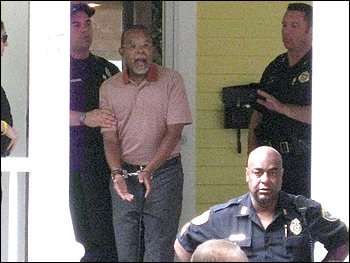
henrylouisgatesarrestThere are more truths to be found in this eye-opening ACLU report released last month, which demonstrates that racial profiling is alive and well in the United States. And you’d have to be more sheltered than a stray Samoyed hoping to woo an owner before getting the gas not to know that the color of one’s skin often remains more suspicious to a police officer than hard evidence.

But if you’re Neely Tucker and you’re a privileged white guy living in “a predominantly white neighborhood” and you cleave to the naive notion that even the bad cops can have their corrupt actions halted by a next-door neighbor, and if you’re “thrilled” to have the police search your entire house without considering that they might be overstepping their authority, then I must ask in all sincerity just how vanilla your understanding of human nature really is. I must ask whether you even have a basic understanding of American history.

The Fourth Amendment’s beginnings, as Leonard Williams Levy’s Origins of the Bill of Rights helpfully informs us, emerged by linking the right to privacy in one’s home with the Magna Carta maxim that a man’s home is his castle. In 1589, a clerk by the name of Robert Beale asked why agents could “enter into mens houses, break of their chests and chambers” and carry off any evidence that they felt like taking home. Beale was the first figure to suggest that the sanctity of a man’s castle applied to everyone. And over the next two centuries, the English propensity for warrantless searches would draw numerous protests.

Here in the colonies, in 1766, the writ of issuance would face protests from Daniel Malcolm, who allowed customs officials to search all parts of his film save a locked cellar and defiantly responded to these efforts with a set of pistols and the threat, “Try it and I’ll blow your head off.” (A crowd had formed. The officials abandoned their quest. Malcolm and the crowd shared the cask of smuggled wine that he had, after al, hidden in the locked room.)

But the writs of assistance, which gave tax collectors a remarkable degree of powers to violate Beale’s egalitarian link between privacy and the sanctity of home, restricted free speech with the case of John Wilkes and were famously derided in a blistering five hour defense by James Otis. The seeds for the Fourth Amendment were sown. But the fledgling federal government wasn’t exactly upholding its principles. To cite one of many abuses that came in the United States’s first decade, in 1777, six Quaker homes were violently violated, with numerous papers confiscated. Legislation, such as Frisbie v. Butler (1787), was enacted to limit any search which there was reason to suspect. This set down the flagstones for “the right of the people to be secured in their persons, houses, papers, and effects,” and the Fourth Amendment’s ratification.

These incidents created an ongoing dialogue — helpful in an emerging nation that valued vital rights and liberties — about what searches and seizures were acceptable. But incidents like Henry Louis Gates’s needless arrest outside of his own home, in which the arrest is motivated by race, the abuse of police power, and police reaction that is incommensurate with the incident being investigated, must likewise cause the dialogue to continue. Gates was fortunate to have the charges dropped, but how many others in this nation don’t have such a luxury?

The complicity of knee-jerk authoritarians like Neely Tucker, who are better suited devoting their limited talents to writing about forgettable two-part TV movies, is part of the problem. It is part of what Martin Luther King once identified as the “almost universal quest for easy answers and half-baked solutions.” Progress begins by identifying a different form of resistance — namely, those who perpetuate grave injustices by endorsing them with their silence. There once was a time when people drank from different fountains or were forced to sit at the back of the bus. And there will eventually be a time in which people will scratch their heads, wondering why the police went around arresting people for irrational reasons.

(Image: Demotix Images)

Regretting the Error

Early this morning, a piece appeared on these pages that took to task Neely Tucker’s article in the Washington Post. I used a historical example from 1766, but neglected to point out one minor but pivotal detail — indeed, one that I had forgotten, until two readers pointed it out to me — that pretty much destroyed my thesis. Therefore, I have removed the piece from these pages and apologize for my error. I thank the readers for pointing out this indiscretion and I will endeavor to pay closer attention to prevent such mishaps in the future.

[UPDATE: Due to popular demand, I will find some time later today to rewrite and revive the post.]

[UPDATE 2: The article has been revived.]

Understanding the General Audience

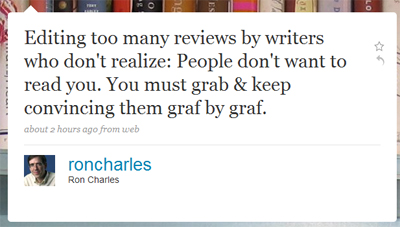
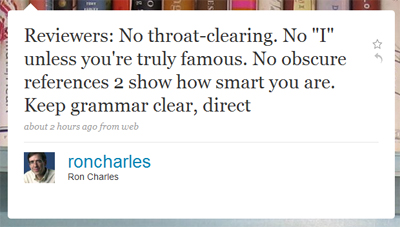
On the morning of July 21, 2009, Washington Post books editor Ron Charles expressed some concerns about book reviewers on Twitter:

roncharlestweet1

roncharlestweet2

At the risk of clearing my own throat (and with all due respect to Mr. Charles), I’m wondering if the 2008 winner of the Balakian Citation for Excellence in Reviewing really has a handle on the type of writing that is likely to attract readers to his newspaper section.

Mr. Charles’s editorial sensibilities call for clear and direct writing. But his other entreaties are problematic. He asks that a first-person perspective or a sense of playfulness through reference — vital variables that might permit readers to get excited, interested, or enthused about a book — be omitted from the equation. Mr. Charles cannot seem to corral the idea of grabbing an audience with each graf with the possibility that readers may be interested with what a particular voice has to say (see, for example, the rise of litblogs over the past six years). Indeed, if Mr. Charles is desirous of a more objective journalistic approach, should not the ideal reviewer be someone who permits a reader to make up her own mind? Mr. Charles’s sentiments appear to reflect a newspaper culture in which personality or perspective — those indelible human traits that make us interested in people on so many levels — don’t get a hot seat at the formal table. Unless, of course, the reviewer is “truly famous,” which connotes a troubling elitism that runs counter to Mr. Charles’s seemingly egalitarian-minded agenda.

We should probably ask ourselves whether there is even a “general audience” for books. I think a case can certainly be made, provided you keep in mind that a “general audience” doesn’t just consume the type of pretentious literary fiction involving suburban asshats and cricket bats. We have seen millions of people get excited over the Harry Potter books (and their cinematic counterparts; see the box office bonanza in the past week). As I discussed with Sarah Wendell and Candy Tan in a recent podcast interview about the romance genre, over 64 million people claimed to read a romance novel in 2004. If Mr. Charles is genuinely committed to a “general audience,” surely he would open up his books section to more romance coverage. (Certainly, Mr. Charles’s coverage of Nora Roberts is a start.) And if the Washington Post is sincerely devoted to attracting a “general audience,” they may wish to do away with the annoying and obtrusive registration prompts that pester us for personal information.

But let’s examine a typical lede for a Washington Post review. Let’s take, simply at random, the first fiction review on today’s Washington Post books page: Mke Reed on Colum McCann’s Let the Great World Spin. Here’s the lede:

As the narrator of Colum McCann’s new novel sees it, Philippe Petit’s tightrope walk between the World Trade Center towers in 1974 triggered a quietude generally unknown to New Yorkers.

We can do away with the superfluous opening clause. There’s no need to inform the reader that this is a review about Colum McCann’s latest book. We already know this. So this leaves us with:

Philippe Petit’s tightrope walk between the World Trade Center towers in 1974 triggered a quietude generally unknown to New Yorkers.

Okay, we have a few interesting concepts to play with here. There’s the exciting prospect of Philippe Petit’s tightrope walk, which is rendered remarkably cold and objective through the bland reportorial phrasing. There’s the more intriguing concept of “triggered a quietude generally unknown.” That phrasing is clumsy, hardly as “clear” and “direct” as Mr. Charles demands. (Is the “triggering” a reference to 9/11? Were New Yorkers really quietly in awe for the first time in 1974?) But there’s some poetic potential here. Perhaps if we take the metaphor and front-load it at the beginning of the sentence, we might have a more compelling lede:

His high wire walk between the twin towers triggered an explosive awe among New Yorkers.

Okay, this isn’t perfect, but it’s an improvement. If the reader is unfamiliar with Petit (or familiar with the 2008 Petit documentary Man on Wire), she’ll be compelled to move onto the next sentence. By switching “tightrope” to “high wire,” we not only provide cultural context for a reader (“Hey, isn’t that the Man on Wire documentary?”) who soaks up art more from cinema than from books, but we also neatly foreshadow the “explosive trigger” metaphor later in the sentence. (Do you cut the red wire or the green wire?) By removing the subjective “generally unknown” assumption about New Yorkers, we do away with a superfluous aside that has little to do with the paragraph’s main purpose here.

With a few modest editorial changes, not only do we have a lede that is more of interest to a general audience, but we also don’t insult the audience’s intelligence by littering their attentive bin with the detritus of clinical phrasing.

Of course, one can avoid these disastrous results by daring to write in the first-person. Ernest Hemingway once wrote an essay about writing in the first-person — which can be found in A Moveable Feast — in which he suggested, “When you first start writing stories in the first person, if the stories are made so real that people believe them, the people reading them nearly always think the stories really happened to you.” Hemingway was referring primarily to fiction, but the advice nevertheless points to one primary deficiency among the newspapers — namely, an ability to give the reader a sense that he is a colleague, not some peon to be dictated to, and that literature is something to be experienced rather than cheerlessly discussed over tea and scones.

Critical Ass

From the latest National Book Critics Circle newsletter:

Eric Banks then spoke about the blogging committee. Our blog visitor numbers, he said, are down sharply. We’re getting only 10,000 visits per month, with an average of 250-500 each day. One of the problems is that Google is misdirecting people to the old blog which is no longer forwarding reliably to the new one. It was suggested that we create a wikiprofile and Jane Ciabattari underlined the importance of blog visits when it comes to our application for NEA funding. Everyone, Eric Banks urged, needs to help by thinking of ideas for new posts, even if they are only a few sentences long. One idea in the works is a series of interviews with editors about the move toward on-line reviewing. Laurie Muchnick suggested a sort of six-question template for editors, the answers to which we could post periodically.

How do I put this delicately? Perhaps the numbers are down because the content put up isn’t exactly scintillating. Perhaps the failure to link and include other bloggers, whether NBCC or non-NBCC, might be one of the reasons why nobody cares to visit the site. Perhaps nobody really cares about what stuffy and humorless book critics have to say about $27 hardcovers that regular people can’t afford to read because the unemployment rate is rising and the job market now sees 200 people applying for a busboy job and there are pedantic matters such as figuring out which relative you can ask to loan you the money to pay the rent and keep food on the table. Assuming you are even that lucky.

There are endless possibilities here. And it’s certainly not going to be remedied by a six-question template for editors or a wikiprofile. I don’t believe that James Wood has ever required a six-question template for editors or a wikiprofile. But if decent blog stats can get you NEA money to survive, just where in the hell is the bailout money for the bloggers?