Posts by Edward Champion

Edward Champion is the Managing Editor of Reluctant Habits.

The Zombie Adulthood Ideal of A.O. Scott

There is certainly a case to be made against the increasing hostility to anything remotely “difficult” in American culture. Rebecca Mead rightly called out Ira Glass after the This American Life host tweeted “Shakespeare sucks” and opined that the Bard was “not relatable, unemotional.” Last month, the Washington Post published an op-ed written by a dullard named Justin Moyer that was indistinguishable from a small child banging out a spastic screed before his daily Ritalin shot. It began with the sentences, “Jazz is boring. Jazz is overrated. Jazz is washed up.” There is a legitimate sickness in our culture when sitcom experts complain about poptimism and this dreadful neologism is offered as a “cure” for book criticism. Calling someone with highbrow tastes a “snob” is no different from calling some undiscerning underground hip-hop listener a “backpacker” or suggesting that someone should be embarrassed for reading YA. But in shoehorning these problems into some vaguely expressed notion of “adulthood” in The New York Times, A.O. Scott has revealed himself as a flailing prescriptive type who would rather wolf down the few canapés remaining on the plate rather than share what’s left. If you don’t share his vulpine approach, you’re a “child.”

Adulthood, for Scott, means an embittered white male existence where an older woman who wears plastic butterfly barrettes in her hair is an unacceptable cancer to be sneered at and eradicated. He suggests that the adults we now see within culture are “symbolic figure[s] in someone else’s coming-of-age story” and he limits acceptable comic protagonists to people who have “something to fight for, a moral or political impulse underlying their postures of revolt.” (Never mind that Chaplin’s Tramp and Keaton’s Stoneface were essentially hard-on-their-luck guys who acted “morally” or “politically” in their narratives only on occasion and largely by accident.) Scott’s notion of adulthood is a concessional ideal, one that does not wish to learn from the work that gets through to people.

Scott fears that the “perpetual freedom and delight” of reading YA fiction means squeezing out the more “serious” titles and living a relentlessly juvenile life devoted to nothing more than slavish fandom. But this is an especially condescending way of looking at readers. Facebook recently compiled the results of a meme where users tagged each other, listing the “ten books that stayed with you in some way.” Both YA and “serious” titles left memorable impressions on readers. J.K. Rowling’s Harry Potter series took the top position. J.R.R. Tolkien, Suzanne Collins, Madeleine L’Engle, and C.S. Lewis snagged six slots in the top twenty. But readers still care very much about Shakespeare, Anne Frank, Elie Wiesel, Margaret Atwood, F. Scott Fitzgerald, Gabriel Garcia Marquez, Victor Hugo, Sylvia Plath, Cormac McCarthy, Fyodor Dostoevsky, Leo Tolstoy, Jack London, and Mark Twain. And they’ll continue to care about great literature as long as we continue to remain passionate about it. It is rather sad and delimiting that Scott cannot fathom a reader who likes both YA and books, much less the possibility of getting readers into YA hooked onto other forms of literature.

To some degree, I sympathize with Scott. When the distinguished indie publisher Coffee House Press spearheaded a Kickstarter campaign for an essay compilation on cat videos, I was skeptical. How could the same house that published J.M. Ledgard’s Submergence, Ben Lerner’s Leaving the Atocha Station, or Eimear McBride’s A Girl is a Half-formed Thing devote itself to such a superficial and ostensibly juvenile exercise? But then I remembered that I had edited and uploaded two cat videos — one that was a Keyboard Cat response to Spock’s melodramatic breakdown in “The Naked Time” and a Nyan Cat video that was in answer to a preposterous Herman Cain commercial. Both exercises were goofy attempts to understand the style of these then popular memes. I wanted to know why something got through to an audience by reverse-engineering it. So who was I to stand in the way of potential cat video scholarship, especially when an essay outlining the rise and popularity of the YouTube genre could lead readers to other thoughtful valleys?

My initial dismay originated from the kind of myopic view that Scott proffers in his essay. I worried that people who wanted to read about cat videos would not have opinions or interest in reading about Syria, ISIS, developments in Gaza, the recent fast food strike, income inequality, drones, journalistic ethics, the history of American imperialism, militarized police and the needless murders of unarmed men, racism, sexism, game theory, #gamergate and the increasing abuse towards women who speak their minds, and any number of important subjects that I can’t stop obsessing over as a thinking adult. On the other hand, if I want other people to care even a soupçon about issues I consider important, then it would be foolish of me not to examine what does get people excited. This is why I have read at least one volume of Harry Potter and Hunger Games. It is why I have played all three Bioshock games. It is why I listened to a One Direction album in full (never again). It is why I tuned into Beyoncé’s performance on the MTV Video Music Awards. Of course, it’s also important for me to read, watch, and listen to the art that people aren’t paying attention to. But if I want to be culturally fluent and communicate with people, then I need to get some baseline on what’s happening. I don’t have to like it. (Indeed, in many cases, I don’t.) But if I despise it, I can always go back to James Joyce, Shakespeare, Maria Bamford’s comedy, Ronna & Beverly, Westlake’s Parker novels, Iris Murdoch, the Marx Brothers, Mark Twain, The Shaggs, Fawlty Towers, The Prisoner, Alison Bechdel, Nina Simone, Charles Mingus, the hilariously misunderstood movie Shoot ‘Em Up, or any of the countless pleasures that keep me happy and inspired. I really don’t care what brow the art is supposed to rest on. Culture is omnifarious. It just has to be good.

Now when a scummy anti-intellectual jackanape proclaims that there is only one type of art to appreciate — whether it be Dan Kois employing his ADD and ample idiocy to protest high art he deems “cultural vegetables” or Ruth Graham telling Slate readers that they need to be ashamed of reading YA (a charge adeptly parried by the Washington Post‘s Alyssa Rosenberg) — it gets in the way of the natural all-encompassing pursuit. It creates a needless lie that something entertaining cannot be found in art or that something artful cannot be found in entertainment. It is precisely the kind of two-tiered, hypocritical approach to cultural engagement that Leslie A. Fiedler, who Scott glowingly quotes from, nailed in his essay, “The Middle Against Both Ends”:

There is no count of sadism and brutality which could not be equally proven against Hemingway or Faulkner or Paul Bowles — or, for that matter, Edgar Allen Poe. There are certain more literate critics who are victims of their own confusion in this regard, and who will condemn a Class B movie for its images of flagellation or bloodshed only to praise in the next breath such an orgy of highminded sadism as Le Salarie de la Peur. The politics of the French picture may be preferable, or its photography; but this cannot redeem the scene in which a mud- and oil-soaked truckdriver crawls from a pit of sludge to reveal the protruding white bones of a multiple fracture of the thigh. This is as much horror-pornography as Scarface or Little Caesear. You cannot condemn Superman for the exploitation of violence, and praise the existentialist-homosexual-sadist shockers of Paul Bowles. It is possible to murmur by way of explanation something vague about art or catharsis; but no one is ready to advocate the suppression of anything merely because it is aesthetically bad. In this age of conflicting standards, we would all soon suppress each other.

Scott can claim import in three notable deaths in Mad Men while avoiding any comparable speculation into the notable deaths in The Twilight Saga: Breaking Dawn — Part 2. He can bring up the death of television patriarchs, essentially the “adulthood” he covets in culture, but backpedal from articulating it (“this is not really an argument I want to have right now”). He can commend Walter White on Breaking Bad as a seductive monster, but not examine Olivia Pope’s comparable qualities on Scandal. (Scandal‘s last season finale racked up 10.5 million viewers. That’s a tad more than the 10.28 million people who watched “Felina,” the Breaking Bad finale.) Olivia Pope is arguably a “grown-up” character. Is it not fruitful to examine how Shonda Rhimes depicts adulthood in our culture? Or is Scott simply incapable of looking at the world through the eyes of anyone who isn’t a white person? What of the adulthood in Orange is the New Black? Key & Peele? The Bridge? (All of these shows, including Scandal, won the distinguished Peabody Award last year. All of these shows contain adult perspectives that are not presented from the white male side. None of these shows were mentioned by Scott in his essay.)

This dishonest notion of unvoiced Cacuasian privilege recalls Scott’s hostility to Spike Lee earlier this year, which resulted in an appropriately blistering response by Lee. It is not so much “the cultivation of franchises…that advance an essentially juvenile vision of the world” that Scott condemns. It is his timidity in confronting his myopia. He will wave a scolding finger at those who don’t fulfill his limited ideal of art as he trashes the “glass brownstone” of anyone trying to depict minorities and subcultures while making art. He cannot seem to value any perspective straying outside “the monument valley of the dying patriarchs.”

A.O. Scott is little more than a reactionary bore holding up a zombie ideal of “traditional adulthood” that involves being a Veblenian consumer too self-respecting “to be idiotic, selfish, and immature as well as sexually adventurous and emotionally reckless.” His essay rightly signals “a crisis of authority,” but it’s too bad he doesn’t have the guts to leave his lawn. He’d probably have a much better time, maybe discovering a few new ways to be adult along the way.

Giving the Upscale Types the Graphic Novels That They Want

SHOPLIFTER
by Michael Cho
Pantheon, 96 pages

In a recent interview, Michael Cho claimed that his crisp illustrative style developed from reading adventure comic strips from the 1930s and the 1940s. While one sees something of Noel Sickles’s thick shadows fringing his subjects and Roy Crane’s tidy closeup panels in Cho’s work (superbly featured in Back Alleys and Urban Landscapes, a gritty collection of still life illustrations), there remains a fundamental quality missing in Shoplifter: namely, the resounding thump of a human heart.

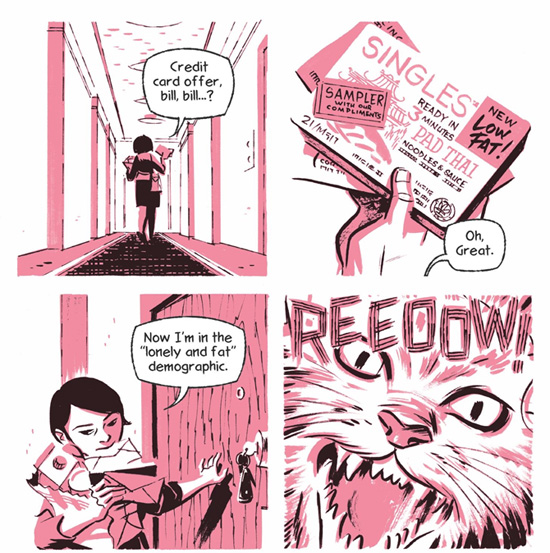
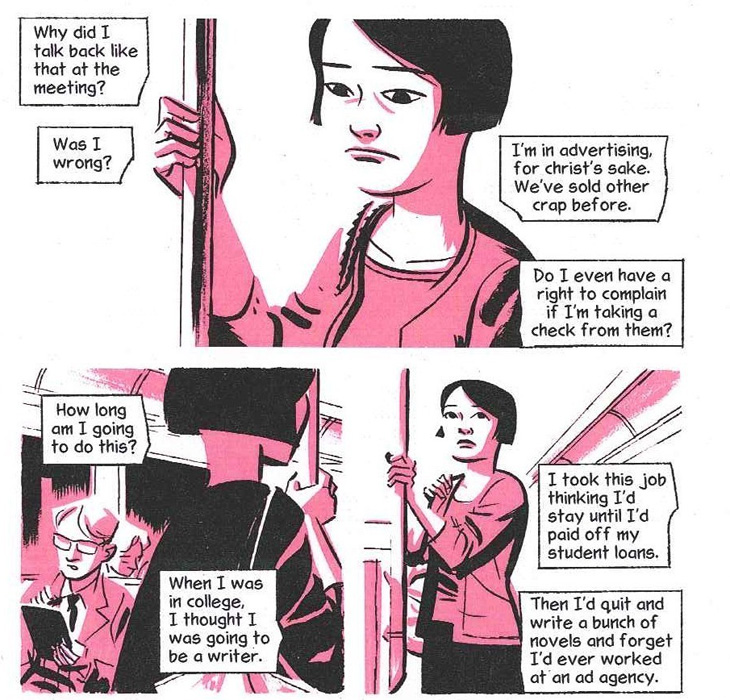
michaelchoshoplifterThis graphic novel tells the story of Corrina Park, a young woman who works in an advertising agency. There is nothing interesting or unusual about her, unless you believe the occasional pilfering of a magazine from a convenience store to be jaw-dropping criminal mayhem. She complains about an unfulfilled creative life. She spends her evenings in a spacious apartment guzzling down wine and watching television. She listens to her boss quote Khalil Gibran while he steeples his fingers in the hackneyed manner of a corporate stooge smuggled from behind the arras at the last minute. While I was very fond of Corrina’s hissing cat (and what does it say that the only real character with any personality in this dull and pandering volume is an animal?), I could not find any open nook in my warm and expansive heart for this extraordinary listless protagonist. Corrina is no different from millions of young bourgie aspirants whinging throughout North America. If I wanted this kind of vanilla and unadventurous narrative, I’d spend two insufferable hours being barraged by other people’s First World problems at the Whole Foods overlooking the Gowanus Canal.

Cho certainly has the chops to transpose his observations onto the page. A hip bestubbled specimen named Ben offers a perfectly complacent and beery look when he says, “Yeah, you too, Corrina,” at a party. When Cho populates his frames with strangers, especially on subways and at the party, there is a feral yet controlled quality to his illustrations. I also appreciated the deliberately cramped framing at the convenience store, almost as if we are witnessing the action through an impossibly placed surveillance camera. But it’s maddening that his characters lack the dimension to match the artwork.

Michael Cho is a man who does not court danger in any way. Even Shoplifter‘s denouement plays out like a didactic game of Whac-A-Mole, with its shopworn trope of a shopkeeper with a heart of gold. Yet at least one middlebrow hack wheezing in Los Angeles has risibly suggested that Cho is “operating out of a tradition,” without remembering the degree to which 20th century artists were persecuted for their “unwholesome” tales. As astutely documented in David Hajdu’s The Ten-Cent Plague, comic book artists faced professional and criminal punishment, as well as charges of contributing to “juvenile delinquency,” simply because they had the effrontery to tell visual stories that were odd or weirdly imaginative. It’s bad enough that the contemporary fiction market has become saturated with mediocre narratives of privileged people blogging or vacationing in Europe, but do we have to flood the comics market with this gutless junk as well?

Now that comics have become widely accepted, with unscrupulous sharks in suits sauntering through San Diego’s relentless cacophony to snatch up any young pup who can make them a few easy bucks, I’m wondering why someone as talented as Michael Cho has willfully ignored the fiercer tradition that made comics fun in the first place.

Battling the Digital Babysitter: The Case for Reading and Curiosity

BORN READING
by Jason Boog
Touchstone, 336 pages

On November 27, 1960, only a few months after Green Eggs and Ham was published, Dr. Seuss called for a movement more modest than the Ham and Eggs pension drive. Seuss argued that “children’s reading and children’s thinking are the rock bottom base upon which this country will rise. Or not rise.” He was deeply concerned about the increasing junk being published under the guise of juvenile fiction and he rightly pointed out how children were “eagerly welcoming the good writers who talk, not down to them as kiddies, but talk to them clearly and honestly as equals.” (In the same manifesto, the good Theodore Geisel also promulgated the fanciful claim that he was “mayor of La Jolla,” but this hardly detracts from his salient points.)

Eight years before this, Seuss had written another essay on how people laughed less as they grew older, with the fun “getting hemmed in by a world of regulations.” Yet even Seuss’s imagination could not have foreseen our world of digital devices, with the horrifying 2011 video of a one-year-old baby flipping through a physical magazine, her hand squeezing on fixed text and hoping to push it across a malleable vortex, and with her little fingers, yearning for any toy, trying to flip a photo because she believes that the page is a tablet. The parent, with the toxic cruise control bravado of a privileged Google Bus commuter who refuses to see the world beyond his soy vanilla latte and gluten-free muffin, offers the smug, self-congratulatory, and ire-inducing caption, “For my 1 year old daughter, a magazine is an iPad that does not work. It will remain so for her whole life. Steve Jobs has coded a part of her OS.”

With tablets and smartphones increasingly replacing television as the screen-based babysitter of choice for the overtaxed parent, we have very little knowledge on what this will mean for the next generation of readers and thinkers. With Common Core literary standards introducing preposterously dogmatic regulations (“Retell stories, including key details, and demonstrate understanding of their central message or lesson” reads one such farcical instruction) into classrooms with the same blindly faithful haste as the digital devices, any reliable advocate for imagination and salutary tomfoolery is left to wonder if we are preparing a generation that will surrender its wonder and humor earlier, without the pull of palpable paper to trigger some potential to raise this broken nation.

As a childless man often on call for friends with kids who demand yet another vivacious in-home performance of my free-form vaudeville show, I didn’t realize how much I cared about any of this until I read Jason Boog’s thoughtful Born Reading. (I also recommend Boog’s recent appearance on Colin Marshall’s excellent podcast, Notebooks on Cities and Culture, which discusses many of the issues in the book.) Boog harbors no illusion that we can go back to the analog ways, but he has gone out of his way to document his reading experiments with his daughter, Olive. He recognizes the overcrowded field of parenting handbooks, pointing out in the book’s early pages that he won’t be offended if the time-challenged parent doesn’t read beyond the introduction. But even with the book’s self-help thrust with sections devoted to a “Born Reading Playbook,” Boog’s volume is worth considering as a whole. Boog is candid enough to cop to enjoying Don Ho’s kitschy ditty “Tiny Bubbles,” but he also recognizes the nefarious ways that diabolical software developers sneak hypnotic advertisements into apps that are ostensibly intended to “educate.” We often forget this Faustian bargain, if we even bother to remember it at all.

The smartphone is only seven years old and the iPad, at the age of four, is only a year away from entering kindergarten. How are these new and ubiquitous technological tools shaping our real and decidedly more irreplaceable children? Boog rightfully points out, through the statements of Lisa Guernsey, that the conversations that adults have with their children before the age of two are more valuable than any interactive bauble. If a parent is too beleaguered, perhaps she can find a bedtime solution with the physical book, with its promise of enticing worlds beyond the real, its firm hold requiring neither wi-fi nor batteries, and its manifold possibilities for acting out stories. Last year, in a well-publicized report, the American Academy of Pediatrics recommended that parents discourage media exposure for children under the age of two. The AAP also suggested that children over that age should never spend more than two hours in front of a screen. Yet there remains the ineluctable lure of the digital babysitter. Put your kid in front of a screen playing mindless entertainment and, voila, even you too can get a few household chores done! But because the new screens are portable and more regularly used, even bright children such as Olive are tempted to imitate their parents, often resulting in workaround mimicry to postpone the inevitable moment when real digital devices will be as close to them as Barbie dolls and Matchbox cars:

Even before she turned two years old, Olive would mimic my cell phone cradle with various phone-shaped objects. I designed a pretend computer out of a cardboard box and an abandoned computer mouse, and Olive would dutifully plug in the mouse and press imaginary buttons on the box just like daddy.

Boog is extremely diligent in limiting his daughter’s digital usage, yet smartphones and tablets also offer undeniable value in summoning an immediate response to a child’s question. Boog describes calling up several images of Brahams after Olive asks what the famous composer looks like. In the analog days, parents offered approximate and often quite wrong answers to a child’s endless string of whys. But now that the highly specific answer has become commonplace thanks to Google, there remains the more troubling problem of how to encourage imagination and curiosity when nobody can be leisurely wrong anymore. Maybe the key for healthy digital implementation among toddlers resides in only using digital devices to promote curiosity. It is certainly an ethos that Boog subscribes to:

Reading for discovery can change the course of your child’s life. You can help him or her maintain a natural curiosity throughout school. This precious flame of scientific wonder can be snuffed so easily. Don’t let your child lose that sense of wonder. Follow up science books and apps with zoo visits or natural science museum trips. Make sure that part of your home library is dedicated to science, gross or scary as it may be.

Providing a toddler with limitless words and endless options for discovery can mean the difference between a child armed the tools to succeed and one who gives up in a tougher world of standardized education. Betty Hart and Todd Risley conducted a famous study revealing a thirty million word gap between low and high income kids. This disparity revealed lasting effects later in life. But with enough active parental participation, it is possible to make a book stick. Boog describes repeatedly reading Dick and Jane and Vampires to Olive, often acting out the story with gusto. The book became such a fixture that Olive demanded the book at all hours.

For cash-strapped parents who don’t have the resources to fill their child’s bedroom with books, there is also the public library. Judy Blume’s oft-quoted suggestion that children should be allowed to read whatever they want holds true even in this hallowed space, which is not merely a secular temple for books, but a place for many kids and parents to come together. If Boog’s book ends on an appropriately grim note when considering the draconian Common Core standards, very much at odds with unhindered reading and free-flowing curiosity, it is nevertheless a welcome reminder that merely asking children to regurgitate knowledge is a recipe for chaos as the gap between the rich and the poor grows to its highest level since 1928. If we want to lift our nation beyond this crippling inequality, then it is vital for us to reject any measure that prevents parents and educators from talking with children as equals. The Seussian ideal will allow the next generation to embrace and challenge knowledge rather than have facts drilled into their heads with all the delicacy of a bureaucrat fumbling around with a jackhammer.

(Image: mbeo)

Darren Wilson Named as Michael Brown Shooter; Photos and Text of Police Report

At a Friday morning press conference, Darren Wilson was named as the police officer who killed Michael Brown in Ferguson, Missouri on August 9, 2014.

Ferguson Police Chief Tom Jackson, who was visibly nervous and refused to answer questions from reporters, uttered the name, along with a few sketchy details about Brown being stopped because he was a robbery suspect. Jackson had arrived late, with CNN reporting that he had consulted with legal counsel beforehand. Newsweek‘s Alexander Nazaryan noted that no reason had been offered to reporters for Jackson’s delay. On a FOX 2 raw feed, Jackson was reported hiding behind a van before approaching the mike. And when the time came for the Ferguson Police to distribute the appropriate packets to press, there were not enough to go around. The Ferguson Police Department distributed the first copies to reporters who had filed Sunshine requests. But the police did not provide an online link to the heavily redacted police report.

When Jackson fled from the microphone, several angry voices could be heard over the FOX 2 raw feed, with one unidentified man shouting, “There goes the trust again!”

Huffington Post Justice Reporter Ryan J. Reilly was good enough to take pictures of the press packet on Twitter. I have transcribed the two pages of the heavily redacted report that Reilly uploaded, along with the page of surveillance photos which the police have used to justify the charges against Michael Brown.

Here are the surveillance photos:

michaelbrownpictures

* * *

Here is the first page of the police report that Reilly scanned (and my transcription):

fergusonpolicereport-pageone

Ferguson Police Department
222 S Florissant Road, Ferguson, MO 63135

Officer/Incident Report

Report Date:
08/09/2014 11:51

Type of Incident
ROBBERY (F)
2ND—STRONGARM–CONVENINECE STO

Complaint No.
I4-12388

Case Status:
EXCEPTIONALLY
CLEARED

Supplemental Report:

Supp No.
0001

Date/Time:
8/11/2014 11:31 AM

ID
[Redacted]

Officer Name
[Redacted]

SUPPLEMENT

Pursuant to the original report, the following information is pertinent. On Monday 08/11/2014 @ 0900hrs, I was assigned the investigation.

_________ had come out of the restroom and returned to the counter where she observed Brown tell ____________________, that he (Brown) wanted several boxers of cigars. As ______________ was placing the boxes on the counter, Brown grabbed a box of Swisher Sweet cigars and handed them to Johnson who was standing behind Brown. ________________ witnessed ______________ tell Brown that he had to pay for those cigars first. That is when Brown reached across the counter and grabbed numerous packs of Swisher Sweets and turned to leave the store. ________________ then calls “911”. Meanwhile, ______________ comes out from behind the counter and attempts to stop Brown from leaving. According to _________________, _______________ was trying to lock the door until Brown returned the merchandise to him. That is when Brown grabbed _____________ by the shirt and forcefully pushed him back in a display rack. _________________ backed away and Brown and Johnson exited the store with the cigars.

(Cover Pages Only)

Printed 08/14/2014 1419

* * *

Here is the second page of the police report that Reilly scanned (and my transcription):

fergusonpolicereport-pagetwo

Ferguson Police Department
222 S Florissant Road, Ferguson, MO 63135

Officer/Incident Report

Report Date:
08/09/2014 11:51

Type of Incident
ROBBERY (F)
2ND—STRONGARM–CONVENINECE STO

Complaint No.
I4-12388

Case Status:
EXCEPTIONALLY
CLEARED

I then had the opportunity to review a copy of the video surveillance footage which captured the following events. The date and time stamps correspond to the video footage provided. The entire incident takes place on Saturday, 08/09/2014 between 11:52:58 hrs and 11:54:00 hrs.

Camera 3 – Exterior camera mounted on southwest corner of building, pointed east to record side of building and parking lot.

Camera 6 – Interior camera mounted on ceiling to record entry/exit doors.

Camera 7 – Interior camera mounted on ceiling to record counter/register.

The video reveals Brown enter the store followed by Jackson. Brown approaches the register with Johnson standing behind him. ___________________ can be seen in the background walking from the restroom to behind the counter. Brown hands a box of Swisher Sweets to Johnson. An apparent struggle or confrontation seems to take place with Brown, however it is obscured by a display case on the counter. Meanwhile, Johnson sets the box he was handed back on the counter. Brown turns away from the counter with another box of Swisher Sweet cigars and walks towards the exit door. ____________ then comes out from behind the counter, with what appears to be a set of keys in his hands. ______________ then stands between Brown and the exit door. Brown, still holding a box Swisher Sweets in his right hand, grabs _______________ by his shirt with his left hand. Brown aggressively pulls ________________ in close to him and then immediately pushes him back in to a display rack. Johnson continues out the door and out of camera frame. ______________, no longer between Brown and the door, stops and watches Brown as he walks towards the exit door. Brown then abruptly turns back around and advances on ________________. Brown towers over ______________ appearing to intimidate him. Brown then backs around and walks out of camera view.

It is worth mentioning that this incident is related to another incident detailed under Ferguson Police Report # 2014-12391 as well as St. Louis Police Report # 2014-43984. In that incident, Brown was fatally wounded involving an officer of this department. I responded to that scene and observed Brown. After viewing Brown and reviewing this video, I was able to confirm that Brown is the primary suspect in this incident. A second person, also at that scene, identified himself as being with Brown. That person was later identified as Dorian Johnson. After observing Johnson and reviewing the video I confirmed he is the second suspect in this incident.

A disc containing the 911 call made by ___________________ was obtained from Police Communications.

Reporting Officer

Approving Officer ( I )

[UPDATE: CNN has a PDF of the full police report.]

On Ferguson, Michael Brown, and Sanctioned Murder in America

Michael Brown was murdered by the Ferguson Police Department. There is no other word that can sufficiently describe killing an unarmed man, especially one who didn’t have a criminal record. Witness Dorian Johnson stated that an officer whom the Ferguson Police refuses to identify pointed a gun at Brown’s head instead of containing the situation with a cool head. Brown was executed. The civilians rightfully protested. Now the police fire upon everyone with rubber bullets and tear gas.

The only detail that the police has revealed about the unidentified officer is that he was treated for swelling on the side of his face, but this is a woefully insufficient explanation. Just as instituting a no-fly zone “TO PROVIDE A SAFE ENVIRONMENT FOR LAW ENFORCEMENT ACTIVITIES” is a betrayal of the essential trust needed between police and citizens during a volatile time. Just as the Department of Defense’s militarization of police departments turns jurisdictional resources into a cruel cartoonish joke. Just as police muzzling and arresting veteran reporters like The Washington Post‘s Wesley Lowery as he was trying to piece together the maelstrom, with the preposterous rap of “resisting arrest” applied to a fair and innocent journalist holding his hands up high and terrified, is a desecration of civility, understanding, and free expression.

Murder. There is no other word to describe what happened to Michael Brown and what is now happening to our essential liberties. Just as there is no other word for what the New York Police Department did to Eric Garner in July; homicide was, after all, what the New York medical examiner concluded.

We wouldn’t have to use the word “murder” if these purported upholders of the law were responsible enough to own up to their mistakes or if our elected officials displayed swift and peremptory leadership. But they can’t. President Obama issues hollow statements. Governor Jay Nixon has displayed gutlessness and incompetence with his unfathomable silence. (Nixon broke his Marcel Marceau routine on late Wednesday night, asking for calm and urging “law enforcement to respect residents & press,” well after the time for conduction had passed.) The baleful mess in Ferguson, Missouri, especially harrowing in this YouTube video showing excessive force on peaceful protesters, has demonstrated that the American system is broken, that we are a nation that refuses to learn from its mistakes and that prefers to remain in denial about its deadliest problems.

We are now at a crucial point in history — one just as important as the epoch before Miranda rights were established — where we must understand that we have the power to say no, to not accept further abuse of police power, and to demand accountability and responsibility from callous ruffians who believe they can get away with sanctioned murder under the “serve and protect” lie. Because if we do not, we will come to take on yet another barbaric regularity of American life, one that an entire generation could grow up accepting without ever knowing another way.

[8/14/14 UPDATE: On Thursday afternoon, Governor Nixon pulled the St. Louis Police Department from Ferguson, replacing them with the Missouri Highway Patrol. MHP Captain Ronald Johnson has been overseeing operations with a cool head. Lowery reported that Johnson marched in the largely peaceful protest, with Johnson saying that he will tolerate neither looting nor “citizens not having ability to speak their minds” or having their rights violated. This is a much-needed and exemplary step in the right direction. The question now is whether the bad cops who attacked journalists and protesters will be named and brought to the appropriate justice.]