Babble: “Like surprisingly many people, I have always held a vague abhorrence for Neal Pollack. Could it be his claim to be the ‘Greatest Living American Writer’? His penchant for putting his name in his book titles? Or his jokey, sexist piggishness — supposedly the ironic mantle of a true feminist, but I really have my doubts? I think it’s just him.”
Author / Edward Champion

BSS #91: Valerie Trueblood & Anne Fernald

Condition of Mr. Segundo: Fleeing from disco.
Guests: Anne Fernald and Valerie Trueblood
Subjects Discussed: Weaknesses for beautiful books, life as “structured anarchy,” the definition of plot, David Markson, narrative flow, cause and effect in narrative, unexpected events, Seven Loves‘ “eventless” perception, on being “anti-plot,” the beginnings of May Nilsson, family characteristics, the relationship between unpredictable life and fiction, compartmentalized American novels vs. compartmentalized British novels, Edward P. Jones, MFA workshops, the short story form, the paucity of older protagonists in fiction and how older people are underestimated, Faulkner and race, Sidney Thompson, verboten perspectives, underlying nuances beneath sentences, Trueblood’s unintentional wisdom, two-inch items in newspapers, “quiet” vs. melodramatic reader perceptions, people who disappear, and being an apocalyptic person.
(A co-production of the LBC, Pinky’s Paperhaus and The Bat Segundo Show)
EXCERPT FROM SHOW:
Trueblood: Narrative seems to me to be something that sort of flows in many currents through us and carries us through life, but is not — I guess what I mean by plot and why I’m sort of anti-plot is the sort of contained arc: the beginning, the complication and the resolution. Novels like that, I just don’t believe. It’s hard for me to see that things could really ever be tied up with a resolution.
Listen: Play in new window | Download
BSS #90: Richard Ford
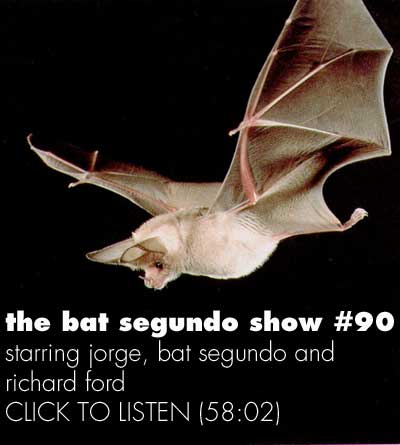
Condition of Mr. Segundo: Trying to get the lay of the land.
Author: Richard Ford
Subjects Discussed: Bill Buford’s “dirty realism,” inland vs. coastal territory in the Frank Bascombe books, nautical motifs, Joshua Slocum’s Sailing Alone Around the World, the development of Haddam, recurring supporting characters, crafting long, information-heavy sentences, Ford’s dismissal of cyclical metaphors as “a bunch of baloney,” religion and irony, the politics of the Bascombe books, arranging Frank Bascombe’s days, Ford’s violent reactions to reviews, Colson Whitehead, Bascombe’s culinary habits, quotidian details, street names, evading the influence of other writers, the Permanent Period, self-help books, Sally’s letter vs. Frank Bascombe’s voice, roomy novels, writing short stories vs. novels, dyslexia, research and real estate terminology, William Gaddis’s A Frolic of His Own, Frank’s Great Speeches book, making trips to New Jersey, Haddam vs. Updike’s Brewer, memory and perspective, the relationship between Ford and his readers, on pissing the right people off, responding to the “fool” Christopher Lehman, and character conventions.
EXCERPT FROM SHOW:
Ford: I don’t think of [Haddam] as a character. I think of it as just the backdrop of what the real characters, which is to say the human beings in the book, do in the foreground. Setting for me is always just the context that makes what people do more plausible. And I invented Haddam out of what experience I have had and continue having in central New Jersey. And so for me it was an amalgamation of a bunch of different places that I sort of organized under the name Haddam. And it never really was intended to be more than that, except as these books began to develop to be more about American cultural life and American spiritual life in the suburbs, it sort of rose to become a bit of a touchstone subject in and of itself. Because in describing a town’s housing stock, in describing moratoriums, in describing sprawl outwards from these little towns, that became for me a subject I never intended to find but did find and then did use.
Listen: Play in new window | Download
Who Wrote This?
“The President is merely the most important among a large number of public servants. He should be supported or opposed exactly to the degree which is warranted by his good conduct or bad conduct, his efficiency or inefficiency in rendering loyal, able, and disinterested service to the Nation as a whole. Therefore it is absolutely necessary that there should be full liberty to tell the truth about his acts, and this means that it is exactly necessary to blame him when he does wrong as to praise him when he does right. Any other attitude in an American citizen is both base and servile. To announce that there must be no criticism of the President, or that we are to stand by the President, right or wrong, is not only unpatriotic and servile, but is morally treasonable to the American public. Nothing but the truth should be spoken about him or any one else. But it is even more important to tell the truth, pleasant or unpleasant, about him than about any one else.”
So who wrote this?
Glenn Greenwald? Paul Krugman? Bob Woodward?
Think again. You may be surprised by the answer.
If By “Save Marriages,” You Mean “Avoid Speaking to Spouse for Long Periods of Time,” Sure!
Arianna Huffington: “Why not experiment? I think Second Life will save marriages.”