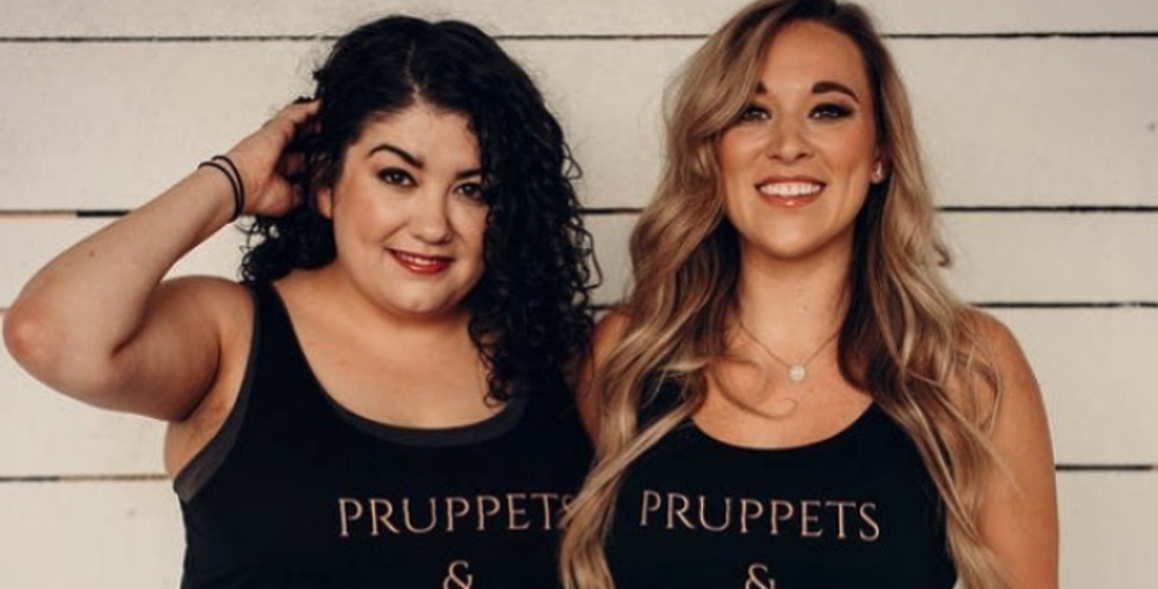
Ashley Flowers was an Indiana native with big dreams, slick sales savvy, and a fierce determination to be number one. She was in her late twenties. She’d earned a bachelor’s degree at Arizona State University. She’d studied genetics at the University of Norte Dame. But in September 2016, the world wasn’t bending the way she thought it would. Ashley’s biotech background couldn’t land her a steady paycheck. So she worked as a software sales exec and made the best of it. Instead of squinting at genomes, she was poring over revenue reports.
She kept the tech gig because the place was dog-friendly. She could toil while Charlie wagged his tail just next to her. A playful pooch with a big bark. Proudly featured on the company’s Instagram feed. An important part of her life. The first taste of working on her own terms.
She wanted more.
She found some hope in what she had. The Crime Stoppers of Central Indiana, where she volunteered and eventually served on the Board of Directors. An important figure. A respected position. A childhood friend named Brit Prawat who shared the same birthday. A brother named David who knew how to edit or who could, theoretically at least, figure out how to. Important connections. The fond memory of watching “geriatric” mystery shows with her mother. An important formative experience. A weekly morning radio segment on Radio NOW 100.9 called Murder Monday, where she’d get up very early and be at the microphone by 7:30 and join Joe and Alex and talk about murders and missing people and creeps lurking in the night and maybe get a little attention. Important attention.
And she liked that. Both the attention and being on the radio.
But why couldn’t she be bigger? And why couldn’t the segments be longer? And why shouldn’t she make money at this? Ashley figured she could pack away some dough and beat them all her way. By working harder than anyone else. Three hours before work. Late into the night after work. She’d listened to true crime podcasts. All of them. Or so she told everybody. Why couldn’t she do it?
And so she did. The program was Crime Junkie and it had a winning formula. Two friends gossiping over a cold case or a grisly homicide as if they were discussing the right apricot chutney to serve with the duck breasts. But somehow it worked. Brit playing the bewildered pal muttering many wows as Ashley told her the crime story. No ad libbing. All of it tightly scripted. Or as scripted as she could make it. There were only so many hours each day. With David cutting it all together. A family affair. Two childhood friends together on the podcast, even though they were separated by a two and a half hour drive between West Lafayette and South Bend and they only seemed to see each other when they made promotional appearances.
She put up a new thirty minute podcast every Monday. Longer than her radio spots. On her own terms. And it blew up. With cards placed in women’s restrooms. Loads of cards. And marketing. Paid marketing, as Ashley was to tell two Italian dudes who ran a podcast in her hometown. What kind of paid marketing? Well, some have speculated. The numerous five star iTunes reviews — with their repeat use of “love this podcast,” double exclamation marks, and “obsessed” — were fishy, as were the questionable user names, which included such improbable identification choices as “Addyjeannnewcomb1234” and “vgifddssetivdyiogfdgjobvr.” The download stats were wonky. How does a show jump from nine million monthly downloads in March to sixteen million in July? What “paid marketing” cooked these numbers? Again, we can only speculate.
But who really cared? Ashley and Brit were a success. The United Talent Agency came calling. For the right price, you too could blow the entirety of your quarterly budget to have Ashley Flowers fly out and speak to you on one singular but vitally important topic: “A Conversation with Ashley Flowers.” There was a TV deal. A second podcast series. An empire to build. What could go wrong? Ashley and Brit sold out every damn venue on their maiden live show tour. Every show. You can’t argue with results. Multitudinous meetups where the duo had charmed crowds. It is estimated that Crime Junkie now earns somewhere between six figures and seven figures each year. This buys, as the old saying goes, a lot of corn chowder.
There was just one problem. One very serious problem. A math problem. A time management problem. Those twenty-five to thirty hours that Ashley spent each week to write and research the show simply weren’t enough. Ashley had to cut corners. Somewhere. The money was important. The attention was important. The adulation from her fans was important. She squashed any comment that wasn’t a fawning compliment on the Facebook forum like a bug zapper sizzling a pesky insect. Because successful people have to stay successful people. And if they believe in success, then other people will still believe they are successful.
Even when they break the rules.
And so Ashley Flowers decided to become a serial plagiarist. Sometime around the twenty-fifth episode. Continuing to this day. (Crime Junkie has released 95 episodes to date, with a June 24, 2019 episode devoted to Amanda Cope pulled after Flowers got many details wrong. Flowers released a new Episode 87 dedicated to the Sumter County Does on July 1, 2019.) Because it was her show, she had no one to answer to.
 Ashley read the words — verbatim sentences or lifted syntax with willowy asides to disguise the outright theft — from Wikipedia, from passionate podcasters who put in unpaid hours doing their own research and who formed their own conclusions, from journalists who spent the day sifting through public records and who toiled for months getting their sources to trust them. Crime journalism is not a field for the timid. But Ashley was not a journalist. Still, the ends justified the means. At least that’s what Ashley kept telling herself.
But then came two vital whistleblowers: (1) The journalist Cathy Frye left a comment on Ashley’s Facebook page on the evening of August 11, 2019, pointing out how her four part series on the 2002 murder of 13-year-old Kacie Woody, “Caught in the Web,” had been severely cannibalized for “entertainment.” Frye noted that she had “spent months” working on the series and that the details that Ashley relied on could only have emerged from her exclusive time-consuming work (as BuzzFeed‘s Stephanie McNeal would report four days later, the project had “sucked a big part of [Frye’s] soul,” with Frye taking months to get Kacie Woody’s father to talk). (To get a full sense of the scale here, this document points out just how thoroughly Frye’s work has been scraped and repurposed without credit.) (2) A cheerful true crime fan by the name of Millicent Tirk who could no longer stand to see the work of her friends stolen and who, on August 13, 2019, called out Crime Junkie on Facebook. The failure to credit hard work and the subsequent outrage whipped up the true crime community, with many unsubscribing from Crime Junkie as articles in Variety and The Week started bubbling up the news feed.
When it finally started to go south for Ashley, when the many shocked listeners discovered more than one hundred instances of plagiarism and who knows how many more (all carefully collected on a Google spreadsheet generated during the course of this investigation and, most glaringly documented on YouTube by Trace Evidence‘s Steven Pacheco), the thefts were appearing nearly every week. But Ashley didn’t care. She would never acknowledge her wrongdoing, a series of transgressions comparable to those that derailed Janet Cooke (forced to return her Pulitzer), Jonah Lehrer, and a magazine that lifted recipes. She deleted episodes that had contained vast swaths of cutting and pasting and reciting, as if the words had emerged wholly from Ashley Flowers herself. Episodes revived from digital extinction with the help of three anonymous listeners — when it became necessary to create a mirror of the entire Crime Junkie archive just in case Ashley decided to delete additional episodes — revealed the plagiarism in glaring detail. When Ashley and Brit released Episode 94 on August 19, 2019, the week after the plagiarism news hit and stunned many, the two did not acknowledge the behavioral pattern that had been exposed the previous week. But there were four bright new lifts from Wikipedia. Ashley and Brit were making money. They had won fame. All Ashley had to do was pluck the work of others and claim it as hers and keep on doing this. Surely nobody would care. And because the numbers hadn’t dipped that much, she believed she could keep this ruse going.
But many previously loyal fans — such as a Reddit user named @spoilersinabox — feel betrayed by Flowers’s failure to acknowledge her wrongdoing. Spoilers, a 27-year-old teacher in the DC area who requested anonymity, became aware of Crime Junkie while awaiting a seven hour flight thanks to an Apple recommendation — a recommendation fueled by the numerous five star reviews — and quickly became a fan. “It was just the tone that Ashley and Brit had as they were talking. There’s something about a soothing voice. I said, ‘I can get behind this.’ It sounded as if they had really researched the crime.” Spoilers wanted to support Flowers in her research. She attended the first live Crime Junkie show in DC. She told her friends and family about it. She then became a Patreon regular, pledging $20 a month, believing that her money was going into “the tools and time to do research.” Spoilers cited a second podcast that initially appeared on the Crime Junkie Patreon page before disappearing without explanation.
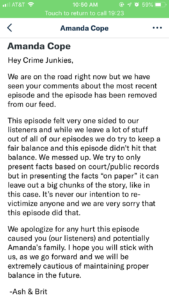 When Ashley and Brit issued a statement (pictured right) about the pulled Amanda Cope episode (the original Episode 87), Spoilers respected the thoughtful and “mature response” and was willing to give the two hosts the benefit of the doubt. When I asked Spoilers if she could forgive the two hosts for their plagiarism if they owned up now, she said, “On Thursday and Friday, I might have. At this point, I can’t.” She said that she felt guilt. “My time and my money should have gone to the people who told these stories first.” She remains angered that so many people have not comprehended the full scale of Flowers’s plagiarism. “Kudos to them,” said Spoilers. “They’ve pulled off a really good scam.”
Two other former fans, both of whom requested anonymity because they feared repercussions from the show’s fan base, told me over the phone that they had similar feelings — that they had been initially inclined to extend contrition to Flowers. But like Spoilers, they felt that Flowers’s silence spoke for itself. The moment had sadly passed.
As of this writing, Flowers and Prawat are gearing up to begin a second tour — this time, involving seventeen live shows, all reportedly based on the murder of six-year-old Isabel Celis, with ten of the shows presently sold out. This tour represents a sizable haul for the Crime Junkie crew, but fans who purchased tickets before the plagiarism controversy and who feel uncomfortable about supporting a program that steals content verbatim may not realize that there is no refund or exchange policy for these shows. A representative from the Parker Playhouse in Fort Lauderdale, Florida informed me that the January 17, 2020 show was still on. NO REFUNDS OR EXCHANGES. Indianapolis. Show on. NO REFUNDS OR EXCHANGES. Orlando. Show on. NO REFUNDS OR EXCHANGES. Atlanta. Show on. But you can only refund your ticket if you purchased it at the box office. And most people didn’t. NO REFUNDS if you purchased it online. Austin. Show on. No refunds. “The only thing we can do is give the tickets to someone else.” The average seating capacity for these venues is around 800. The ticket prices range from a $31.50 balcony ticket at San Diego’s Balboa Theatre to a VIP Meet & Greet package at $103 at the Chicago Athenaeum Main Stage. If we assume that the average ticket price is $50 and the average seating capacity, this adds up to $680,000 if the shows all sell out. If Flowers and Prawat take home 25% of this, then that’s $170,000. More corn chowder to buy.
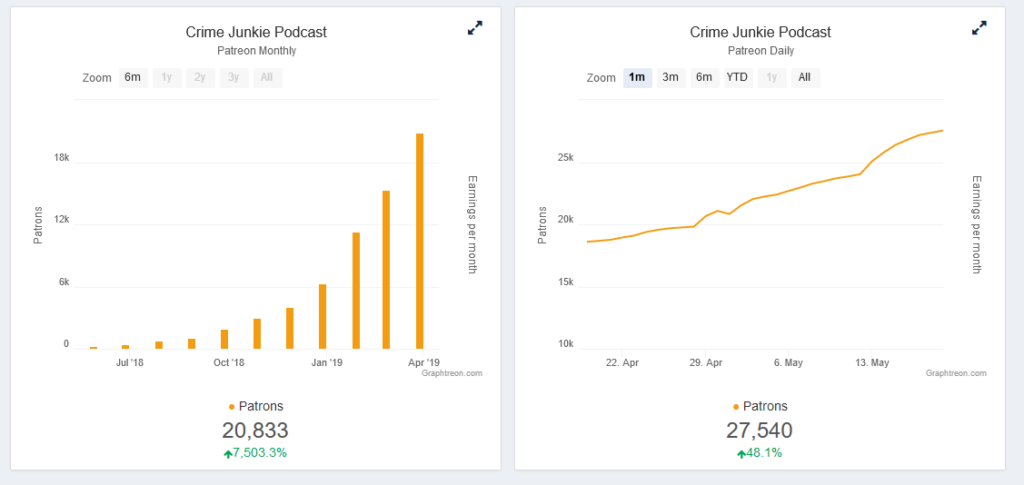
Because Crime Junkie has continued to plagiarize in its most recent episode, one must naturally ask whether it will continue to profit greatly from the hard work of others. I looked into the sources of revenue that keeps the show going. I put in calls to AdSense, which provides ads for Crime Junkie, asking what their position was on financing sponsoring content that had been lifted verbatim elsewhere. The firm declined to comment. Presumably, Crime Junkie will hold onto many of the estimated 27,540 fans who support their show (the exact number has been hidden on Patreon) — with varying tier donations of $5 to $20 each month. (At $5/month, this works out to $137,700 per month or $1.6 million each year.) While some have publicly announced that they would no longer be supporting the show on Patreon, Reddit users noticed on Monday that Ashley and Brit may have recently changed the tier rewards without informing their listenership. (Attempts to confirm this through Web Archive proved inconclusive.)
There’s also the question of whether a podcast that cribs content from other people is a legitimate journalistic outlet. Should Crime Junkie be granted exclusive access to vital police records, as is now the case with the duo’s planned second podcast? Flowers’s influence and coziness with local law enforcement led Chris Davis, producer of the 3C Podcast, to be barred from examining records pertaining to the November 17, 1978 Burger Chef murders — an unsolved Indiana case for which he has produced fifteen episodes. Davis told me that Sheriff Bill Dalton of the Indiana State Police declined both his unofficial and official requests to look at the files. (Dalton, who was in the middle of an investigation, was unavailable for comment. But I did speak with someone at the ISP who had worked closely with Dalton and who had been there for thirty years. This person informed me, “We have a tight lane around here. So we don’t allow a lot of people here.” This makes Flowers’s access even more uncommon and more surprising.) The official request took five months to elicit a response. In both cases, Davis was denied because of an investigatory records exemption. But the prohibition also arose because Flowers had cut an exclusive access deal, where the police would have complete control of the finished product. This was a decidedly sketchy journalistic arrangement.
“She was granted access and I have no qualms about her getting access,” said Davis. “At the end of the day, I want this case solved. We started our journey the same way.”
When I asked Davis if he would consider collaborating with Flowers or asking her if he could take a look at the records for his own investigation, he said no. He pointed to an incident in which Flowers posted a picture on social media of the old Burger Chef building with the tagline, “Guess what case I’m working on?” He replied with friendly humor, “Oh, I think I know.” Davis was swiftly blocked by Flowers on all social media immediately after.
While working on this story, I made every effort to contact Ashley Flowers. I really wanted to listen to her and understand why someone would do all this. Because one cannot deny the allure of hearing about a murder in a soothing voice. It’s one of the reasons why I love the podcast Criminal so much. As I listened to multiple Crime Junkie episodes, examining them for plagiarism, I felt increasingly sad and sorry for Ashley Flowers. Because she really was onto something with her format. Take away the speculation about automated iTunes reviews or even the profit and power motives or the errors she has sometimes made and the sonic aesthetic of two besties getting together to discuss crime possesses tremendous appeal. But here’s the thing: Flowers is even more fun and charming when she speaks in her own voice and expresses her own thoughts, as this interview with Espresso clearly reveals. Anyone who reaches people like this deserves great success, but it must be a success predicated upon her own work and her own voice.
Flowers did not return my calls, my emails, and my direct messages through social media. She’s still saying silent. A veritable content outlaw hiding in plain sight. I’ve learned that The New York Times is also working on a Crime Junkie plagiarism story. Will she say no to them?
But that’s not even the important question about Ashley’s serial plagiarism. The real question, the question often put forth to any addict before she admits that she has a problem, is whether Ashley can even stop.
[8/23/2019 UPDATE: The New York Times has reported on the Crime Junkie plagiarism. The only new information here is (a) some quotes from those were plagiarized, (b) Flowers did not responded to the Times (except through the same statement issued to Variety) and (c) Pacheco approached Flowers with a lawyer, sending along transcripts with time marks for seven episodes. As a result of Pacheco’s efforts, Crime Junkie pulled a few episodes.]


 Markham, Page 15: “The machine measured their breathing, the sweat on their palms, their blood pressure and pulse, and it knew whether they had stolen money from the government, submitted to homosexual advances, been doubled by the opposition, committed adultery. The test was called the ‘flutter.'”