The above film, “The Most Important Absence,” is the first one I’ve made in 2010. And I intend to put together several more of them. All clips were taken from public domain sources — mostly stag and burlesque films from the first half of the 20th century. The title is taken from a very influential essay about image, which I leave viewers to seek out. But the content contained within the film will probably reveal its source. Different viewers will come away with different interpretations, but the onus falls upon the viewer to determine what the juxtaposition means and where the absence really lies. The film has been expressly designed to offer several possibilities. There is no uniform interpretation.
Author / Edward Champion

I’m Feeling Plucky
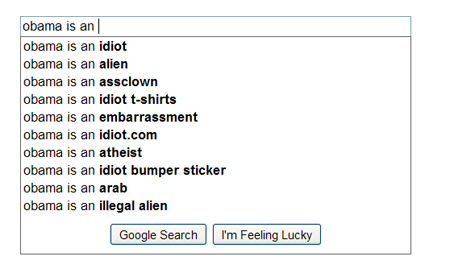
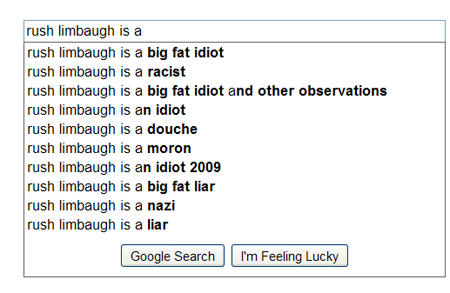
Inspired by recent experiments conducted by Predictably Irrational, whereby Dan Ariely typed in certain terms into the Google search bar and Google preceded to suggest possibly queries, I took the liberty of typing in a few words, obtaining these results:


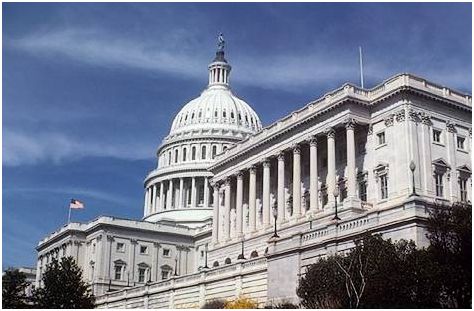
The Racist Senate of the United States
Here is a listing of racist incidents involving United States Senators presently in office:
On March 13, 1998, during investigations pertaining to the 1996 Presidential Campaign, Sen. Bennett remarked, “I stepped in and said, `No. I have owned a business in Asia. I have done business in Asia. Charlie Trie’s actions are the typical actions of an Asian businessman.'” (CSPAN — video and transcript)
On July 16, 2009, at an Environment and Public Works Committee hearing, Sen. Boxer was speaking to Harry Alford, president and CEO of the National Black Chamber of Commerce (an organization that Boxer confused with the NAACP), when the following exchange occured:
Boxer: Then we’re going to put the NAACP resolution that passed saying this: The NAACP approved a historic resolution addressing climate change legislation for the first time in the organization’s history.
Alford: What does that mean?
Boxer: Sir, we’re gonna put that in the record, and you can read it cuz I don’t have the time, but I’ll read the rest-
Alford: What does that mean though? I mean, the NAACP has a resolution. What does that mean?
Boxer: Sir, they could say the same thing about what do you mean? I’m just telling you they passed it-
Alford: I’ve got documentation!
Boxer: Sir, they passed it. Now, also, if that isn’t interesting to you, we’ll quote John Grant who is the CEO of A Hundred Black Men of Atlanta. Quote: Clean energy is the key that will unlock millions of jobs, and the NAACP’s support is vital to ensuring that those jobs help to rebuild urban areas. So clearly there is a diversity of opinion.
Alford: Madame Chair-
Boxer: If I can-
Alford: -that is condescending to me.
Boxer: Well-
Alford: I’m the National Black Chamber of Commerce-
Boxer: If this- if this-
Alford: -and you’re trying to put up some other black group up to pit against me.
Boxer: If this gentleman- if this gentleman were here, he would be proud that he was being quoted. Just as-
Alford: He should have been invited.
Boxer: Just as- He would be proud-
Alford: It is condescending to me.
Boxer: Just as so- Just so you know, he would be proud that you were here. He is proud I am sure-
Alford: Proud, proud (bitterly and contemptuously).
Boxer: -that I am quoting him.
Alford: All that’s condescending-
Boxer: Well, Sir.
Alford: -and I don’t like it. It’s racial.
Boxer: What’s racial?
Alford: I don’t like it.
Boxer: Excuse me, Sir.
Alford: I take offense to it.
Boxer: Ok.
Alford: As an African-American and a veteran of this country, I take offense to that.
Boxer: Offense at the fact that I would quote-
Alford: You’re quoting some other black man. Why don’t you quote some other-
Boxer: No.
Alford: Asian? Or some other-
Boxer: Well, lemme-
Alford: I mean- what- You are being racial here.
(Transcript and YouTube clip)
On July 10, 1997, when questioning a witness about a reward from Asian-Americans that Democratic fundraiser John Huang was to receive, Sen. Brownback remarked, “No raise money, no get bonus.” (USA Today, Seattle Times)
At a March 20, 2004 Republican event, Jim Bunning stated that his opponent, Sen. Daniel Mongiardo, looked like one of Saddam Hussein’s sons. (USA Today, Associated Press)
“Senator Byrd quit the Klan in the 1940s and has renounced it since. On the other hand, his history is worth revisiting, since it’s something Democrats have been willing to tolerate, despite Lott-like remarks that would have ended a Republican’s career. Only last year Mr. Byrd told Fox News that ‘there are white niggers. I’ve seen a lot of white niggers in my time, if you want to use that word. But we all–we all–we just need to work together to make our country a better country and I–I’d just as soon quit talking about it so much.'” (Wall Street Journal)
During the July hearings for Supreme Court Justice Sonia Sotomayor, Sen. Coburn impersonated Ricky Ricardo from I Love Lucy, saying, “You have lots of ‘splaining to do!” (YouTube clip and The New York Times)
During his 2006 campaign, Sen. Corker used fears of interracial relationships and stereotypes against his opponent, Harold Ford, who was African-American. “Harold Ford looks nice,” says one African-American woman, “isn’t that enough?” “I met Harold at the Playboy party,” says a scantily clad white woman. (Truthdig with video clip)
During the health care debates, Sen. Graham argued the following: “I have 12 percent unemployment in South Carolina. My state’s on its knees. I have 31 percent African-American population in South Carolina.” Later in the speech, Sen. Graham said, “My state, with 30 percent African-American citizens, a lot of low income people in South Carolina is going to cost my state a billion dollars, that’s the same old stuff that I object to. That’s not change we can believe in. That’s sleazy.” Rachel Maddow concluded, “The argument here appears to be that Sen. Graham believes it is sleazy to expect a state with lots of black people in it, to have health reform.” (Rachel Maddow video and Raw Story)
During the 2000 campaign, Sen. McCain told reporters, “I hated the gooks. I will hate them as long as I live.” (Seattle Post-Intelligencer, March 2, 2000)
In 1983, as a young congressman, Sen. McCain voted against the recognition of Martin Luther King Day. (ABC News)
In an August 1, 2008 post, Capitol Hill Blue’s Doug Thompson noted additional anecdotal examples of racism. (Capitol Hill Blue)
In John Heilemann and Mark Halperin’s new book, Game Change Harry Reid stated that Barack Obama could become the first African-American President because he was “light-skinned” and because he did not speak with a “Negro dialect, unless he wanted to have one.” (New York Times)
In 1986, Sen. Sessions was rejected from an Alabama judiciary seat by the Senate Judiciary Committee seat. In previous remarks, Sessions had claimed that the NAACP was “un-American,” calling an African-American aide “boy,” and describing a white civil rights attorney as “a disgrace to his race.” Sessions also claimed that Klansmen were “O.K.” until he learned that a few of them smoked pot. (Numerous articles through Meet Jeff Sessions. See also The New Republic.)
Before he switched parties from Republican to Democrat, Sen. Arlen Specter spoke at a November 1, 2008 pro-McCain rally, where he noted “a couple of hidden factors” in the 2008 presidential election: “The first is that people answer pollsters one way, but in the secrecy of the ballot booth, vote the other way.” (Salon)
In October 2009, an interracial couple was denied marriage by justice of the peace Keith Bardwell. Sen. Mary Landrieu and Gov. Bobby Jindall both called for Bardwell’s firing. But Sen. Vitter was the only senior official who refused to comment, running away when asked by a guy with a video camera. He also refused to comment when asked three times by MSNBC. (YouTube video, Talking Points Memo)
I Wanna Droid You Tender
For Comparative Purposes: Armi & Danny’s “I Wanna Love You Tender”

Review: Daybreakers (2010)
The vampire film has needed a kick in the ass for quite some time. Popular audiences have endured the emo complacency of the Twilight films, suffered through the soporific bastardization of Bram Stoker with 2004’s Van Helsing, and settled for the mediocre Underworld trilogy — all relying on tired and tedious tropes that have made recent vampire movies about as desperate as a burned out bookkeeper flipping through a community college catalog for a new hobby.
But Daybreakers is a vampire flick with a brain: a fresh and much-needed corrective to the past decade’s measly offerings. It may be the best American vampire film (courtesy of Australia) since the original Blade. The film manages to deliver on its premise, set ten years from now, largely because it has taken the time to consider the social implications of a world populated mostly by vampires. Cars are equipped with a Daytime Driving Mode, with tinted windows permitting vampires to drive during the day. City buildings are denuded of windows, modified to include corridors high in the sky. A Subwalk has emerged as an adjunct to the subway, which permits vampires to amble beneath an urban world, protected from daylight. Homeless vampires hold cardboard signs reading STARVING NEED BLOOD and bare their fangs at the rich. Cafes now offer coffee tinged with blood, and self-important yuppie vampires still berate baristas. There are even gated suburban communities, whereby those who provide the blood are rewarded with secure enclaves.
But when 95% of the population relies on human blood to survive, and humans are being increasingly munched on, there’s bound to be problems. As one vampire puts it, “Life’s a bitch and you don’t die.” Daybreakers presents blood as a commodity that is just as exhaustible as oil, offering a subtly creepy Hubbert’s Peak analogy that aligns nicely with the distressing prospect of human genocide. But when any commodity declines, the poor will be the first to suffer. And it isn’t too long before those vampires who cannot afford blood are transformed into wretched winged monsters and chained “traitors” are led in daylight before an assembled shaded audience to demonstrate the consequences of questioning big business.
This premise is buttressed considerably by Sam Neill camping it up as a sleazy industrialist and by Ethan Hawke (playing a vampire researching a surrogate for the diminishing blood supply) approaching this material as if he has been cast in an Ibsen play. Michael and Peter Spierig — the writer-directors behind this fun little flick — wisely understand that any good vampire movie requires these varying levels of performance. They’ve even managed to recruit Willem Dafoe as a former vampire turned human vigilante, who brandishes a crossbow and proudly announces, “My friends call my Elvis.” I can’t really complain much about the process that turns Elvis human. It’s about as plausible as the semi-cheesy procedure offered near the end of Kathryn Bigelow’s great flick, Near Dark.
The Spierig brothers give this film a suitable fluorescent look, where each individual vampire carries the combined pallor of twenty Peter Murphy acolytes. They don’t hesitate to depict starving vampires hungrily licking walls, and that desperate hunger reinforces the narrative stakes. The filmmakers flounder somewhat near the end, largely because their characters can’t always match the conceptual complexity. One can level the same minor complaint against District 9, which replaced its interesting take on race with fights and explosions. But then one expects this sort of thing from a movie of this type.
But Daybreakers must be lauded. It is a rare vampire movie that comes layered with so many intriguing ideas. The 2012-boosting Roger Ebert has dismissed it, because of “fierce fights and bloodshed.” But if you cannot accept a vampire movie with “fierce fights and bloodshed,” particularly with so many socioeconomic factors at stake, that’s too bad. For Daybreakers has thought out its setting with more alacrity than much of its duller non-genre counterparts.