I used to write in longhand all the time, filling up five-subject notebooks with the predictable angst of a young man in his early twenties and several early starts on stories, plays, and screenplays that I would revise or abandon. Taking notes was once the thing to do. Back in the nineties, when I wrote film reviews, half the critics took notes. And I learned to write in the dark by taking up large sections of the paper, noting a sentence and then sliding my pen downward to another sector. I felt that it was important to be true and accurate to any crazed thoughts or feelings, even the half-assed ones that I could dredge up in a pinch. Today, thanks to reduced column inches (and reduced journalistic expectations), very few critics, aside from those still writing reviews longer than 600 words, take copious notes anymore, whereas I still obstinately scribble without looking down at the pen. I suppose it’s the writer’s equivalent of learning how to assemble a weapon while blindfolded.
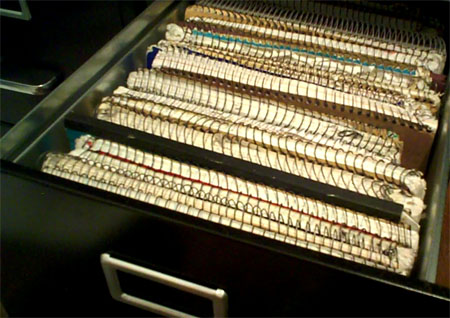
 The result of all this scribbling has involved quite a few notebooks, most of which I have kept in two file drawers. I’ve just pulled one out at random and I see a drawing of a floor plan for a San Francisco streetcar. Flipping the pages, I see lists of interesting words I’ve noted in novels, such as “contrapposto” and “ephemeron.” There’s an awkward poem that begins with the line “Pigeon pecking pieces from discarded pizza boxes / Whopper wrappers flayed upon a health nut in detox.” I see a hasty budget I’ve drafted for a film shoot, noting the costs of renting fresnels, Tota kits, flex-fills, and C stands. Another page offers this curious list:
- Party Animal
- Collector
- Amateur Sleuth (Sam)
- Femme Fatale
And I instantly recall the moment in Java Beach when I wrote this all down, along with the research I did for a short film I wrote, but never saw through to production, called “The Collector.” Then there is this section from an entry titled “Observations in the Mission”:
At Muddy Waters, two ladies talk. One is more short-haired than the other and is enamored with such words as “never,” “layoff,” and “responsibility.” She keeps her left hand locked on the table, perpendicular to the surface. Her thumb sticks up. There is almost a butterfly-like spread, ever so slight. Perhaps the modest gust from the door can be felt this way. Her companion listens. “You are a robot,” says the angry friend.
These are curious details to observe. And I chide my younger self for not being more careful to observe the specific hairstyles of the time, which would perhaps be of greater value to me in reconstructing the moment. I am also needlessly zealous about the hand gestures. But I do remember being particularly interested in body language. Still am.
But sometime around the year 2000, I cut down on notebooks. I figured that anything that I could observe would be permanently captured on my hard drive. But I’ve had a number of hard drives die on me and I haven’t always been able to revive the files. A friend of mine just lost her thesis this way. We get so caught up in the act of writing that we forget that our tools are sometimes more fickle. And even if we do manage to backup our data, there’s always the possibility that it might be accidentally deleted or lost within a baroque directory structure.
Not so with notebooks. Like analog books, one flips through any notebook and finds a diagram or an abandoned idea. This is rather similar to the unexpected book you find in a library or a bookstore that just happens to be situated close to where you’re standing. Many of the discoveries are useless, but some are surprising. Some fresh idea you think you possess now was actually in some primitive gestation a decade ago. Even some phrases are similar. Your voice is yours, even when you didn’t quite know how to express it in early days. Ten years from now, will we be able to do the same with our blog posts and tweets?
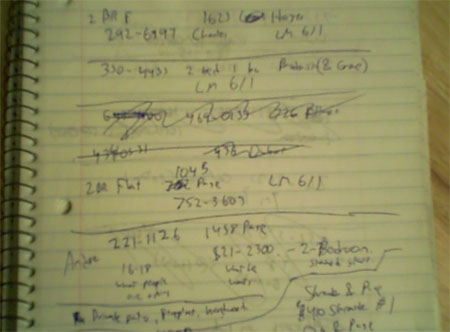
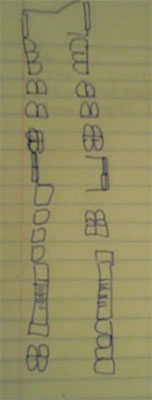
That picture above is from an apartment hunt. I can adduce from the squiggles the apartments that didn’t pan out. And I can track the specific order in which I located an apartment by looking at this page vertically. I have the price ranges of apartments in San Francisco at a specific time. I also see that with this particular quest, I had my eye on the Haight Ashbury neighborhood (which I didn’t end up moving to, but eventually did later).
Since I’ve been less prolific with notebooks in the past nine years, I wonder how many ideas or thoughts or unintentional chronicles (such as the above) that I’ve lost. Smartphones may permit us to text our friends or send an email on the fly, but don’t we have some obligation to preserve our online thoughts? We call an Apple laptop a “notebook,” but is it really a proper notebook’s equal? Our pens do not have delete keys. We cannot take back a written thought, except by scratching it out or burning it. I wrote about linkrot and the problems with online permanence back in August. And it occurs to me that we may be driven to confess our most private details to Facebook — little thinking of the manner in which the social network giant is profiting — because we perceive it to be the new notebook.
But looking through even this one notebook, I can’t imagine a more foolproof technology. And I’m wondering if I should use notebooks more. Computers have produced interesting blogs, wondrous photos on Flickr, and a culture that is more documented than ever before (at least so long as the technology holds). But what about the subconscious buried within us? If we are prohibited from expressing unpopular or strange ideas on social networks because of what others might say or think, then is Twitter so reliable a tool? Could Kafka have written “The Metamorphosis” if commenters were constantly heckling him about his silly bug story? (Conversely, if Kafka couldn’t count on Max Brod to burn his papers, would he have succeeded in closing his online accounts? Or would the cache images live on forever?) If you’re at a party tweeting the names of people arriving into your BlackBerry, are you really being social?
I’m not against technology or e-books. The Internet has given us many great things. But I do feel it’s important to always contemplate the purpose and usage of any new development. If 90% of the reading public prefers analog books over digital, then now is not the time to declare a revolution or to suggest that the days of printed books are over. Moving forward and adopting tools is great, but maybe there’s more life in the dead tree technologies than some of us are willing to admit. Hell, maybe there’s even a good deal on an apartment vacant for years.