
Night at the Boxcar

This was roughly the view you received if you had the privilege of attending the Boxcar Lounge on Wednesday night. The venue was indeed shaped like a boxcar and it was SRO for those souls, like Levi and me, who had arrived from McNally Robinson. (Of that counterprogramming, while John Freeman made a valiant attempt to ask questions of Lee Siegel that would cause him to think instead of fulminate more on his puerile anti-Internet views, the two of us left after twenty minutes. Siegel, as a speaker, has the voice of a semi-squeaky plush toy that still has a bit of air left, but hasn’t yet figured out that the tots have moved on to newer baubles. I had seen this kind of arrogant and opinionated blather before when the speaker had referred to itself as Andrew Keen. So there was no need to subject myself to it again. To offer a small sample: According to Siegel, the Internet is apparently composed of 80% porn. And while it’s absolutely diabolical for people to leave anonymous and hateful comments (as they did for Siegel’s posts at the New Republic), apparently it’s perfectly peachy keen for Siegel to impersonate “sprezzatura” because there is nothing forbidding such a cheap impersonation under journalistic rules. Never mind that Siegel’s shenanigans were hardly transparent and had to be ferreted out by top brass at the New Republic. I took notes, but I felt like I was transcribing a kindergarter’s efforts to discuss Kant’s Critique of Pure Reason based on a one-sentence summary. As such, my notes are not worth reproducing or summarizing.)
You couldn’t get a seat at the Boxcar Lounge. Unless you were one of the smart ones, like Maud and her friend, who arrived early to get a seat. There were many bloggers in the crowd, including Jason, Levi, Marydell, Lauren, and Sarah. It was also a pleasure to talk with Michael Orbach, Jami Attenberg, and a number of other people who I will no doubt remember after I hit the “Publish” button. I’m sorry.
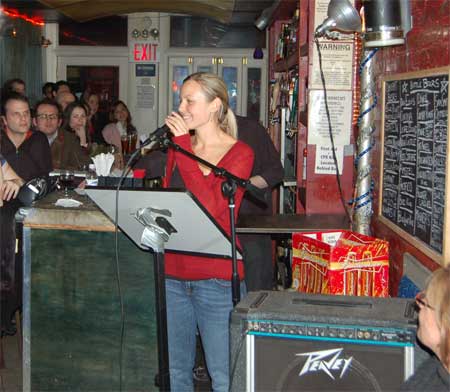
Besides, who needed Siegel when there was another installment of Jami Attenberg’s Class of 2008 Reading Series going down? This one featured Michael Dahlie reading from A Gentleman’s Guide to Graceful Living, Lynn Lurie reading from Corner of the Dead, and (pictured above) Ceridwen Dovey reading from Blood Kin. Dovey was one of the evening’s standouts. Her reading was quietly intense and suitably genteel, and I am now most curious about her novel.
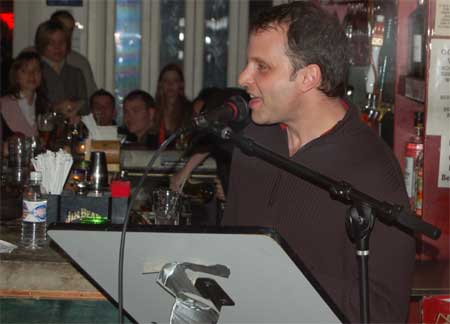
And then there was Mr. Sarvas himself, who read from a chapter of his forthcoming novel, Harry, Revised: the infamous incident in the bookstore. The chapter contains a disparaging reference to David Foster Wallace and I felt compelled to cry out a “Yea!” in DFW’s defense. Mark likewise felt compelled to point to me during this moment.
Is Harry, Revised any good? I was a bit hesitant to approach it, as my candor compels me to tell even my closest friends when their work is not up to snuff. But I have read the whole of Harry, Revised and I can recommend it. Mark has ventured down a somewhat unexpected path here, unafraid to have his protagonist enter into uncomfortable territory. The book’s style displays Mark’s clear love for Fitzgerald and there is something of a French farcical feel that permits material that should not work to be executed with a crazed grace.
I am sorry to report, however, that there remains one passage that will almost certainly be nominated for The Bad Sex Award. But you’ll have to wait for a forthcoming installment of The Bat Segundo Show to find out precisely what it is.

Sprezzatura the Maligned
It’s been more than a year since the manboy cultural critic Lee Siegel was temporarily suspended from The New Republic for allegedly posting anonymous comments on its blog, under the name “sprezzatura.” And while Boris Kachka has interviewed Lee Siegel, Filthy Habits recently received an email from an individual claiming to be “sprezzatura.” He wished to set the matter straight. Sprezzatura’s email, which contained three mysterious JPEG attachments (among them, a picture of an alpaca in a compromising yet family-friendly position), claimed that he had been misrepresented, that Siegel was not “brave, brilliant, and wittier than [Jon] Stewart,” and demanded immediate reinstatement to the New Republic message boards. It remains a mystery to me why sprezzatura thought I had the keys to the New Republic castle. But this was a desperate email written in a desperate time.
“It is there where my shallow invective flowed best,” wrote sprezzatura of the New Republic website. He offered to send me $100 if I would interview him. I declined on moral principle. Then sprezzatura demanded an interview with me gratis by email because “Kachka had proved to be a wuss with his softball questions.” And I agreed, only because I had no wish to receive an email from sprezzatura ever again. I have been unable to confirm whether this “sprezzatura” is the same “sprezzatura” unleashed on Siegel’s blog. Indeed, I do not how many “sprezzaturas” there are. But I suppose it’s pedantic mysteries like this that have many of us wasting long hours on the Internet.
Why don’t you just get a blog?
Because that would be too easy! And if I had devoted a blog just to clarifying my identity, I would have been thought a kook!
Actually, most bloggers are cranks. I speak with some expertise on the subject. But I don’t see how you’re making a case here, Lee.
Do not address me with that name! Those days are far behind me! We must forget that regrettable episode!
So you are Lee Siegel.
If you’ll pardon a metaphorical leap, Lee Siegel is a tuna melt poorly prepared with half-melted cheese. John Battelle never responded to any of my thoughtful queries. Therefore, he is an imbecile who cannot recognize my genius. David Brooks rested his argument on the flimsiest of premises. I do not need to inform you what these premises are. Just trust me. They’re flimsy. And when Cox wanted to draw attention to herself, she used the word “cunt” to make a point. Plus, she made more money than I did. And she’s a woman two decades younger than I am. It’s not fair!
Lots of invective there, sprezza baby. But can you cite any specific examples? Some might argue that you are using “cunt” to make….well, not exactly a point, but to stand out with an irrational Dale Peck-style explanation.
It doesn’t matter! Malcolm Gladwell’s hair was adopted for television as American Idol. I have tried to stop them from supplying him with shampoo, but they keep arresting me!
Lee, step away from the Internet and get some fresh air. We’ve had some unseasonably warm weather in January. Go for a walk.
I love the Internet, I’m on it all the time. I couldn’t have written my book so quickly without it. Thanks to the Internet, I didn’t have to think. I could just cut and paste some boilerplate, bang out a book and make a quick book and show those New Republic bastards exactly who mattered. I don’t think it’s making more people connected than they were before, not at all.
It didn’t have to be this way, Lee.
I react very badly when mediocrity is associated with my name.
Well then, write well!
That is hard when you are “sprezzatura” and you have been banned from your own magazine’s message board. Will you give me a hug?
Only if you stop using the moniker “sprezzatura.”
Beyond Heaving Bosoms by Sarah Wendell and Candy Tan. The famed writers behind
Alice Fantastic by Maggie Estep. This wild and highly enjoyable narrative involves two sisters (presumably, the third one was still being rented out by Chekhov), a hippie ex-junkie mother who lives with seventeen dogs, a murder, gambling, and libidinous Hollywood actresses who live in Woodstock. But this is the wonderful Maggie Estep we're talking here. And what seems at first like a quirky yarn becomes something unexpectedly moving about connectivity. What I love about Estep's work is the way that she'll juxtapose an extremely astute observation (now that you mention it, why do cab drivers always have somebody to talk with on the phone past midnight?) with an often outrageous story development.
Generosity by Richard Powers. It doesn't come out until September 29th, but Richard Powers's latest will have anyone committed to books reconsidering their literary fervor. I foresee some animosity from the vanilla critics hostile to idea-driven novels, but book bloggers, YouTube chroniclers, and MFAs would do well to plunge into this chance-taking narrative, which introduces vital questions about what the reader's relationship is with media, scientific dissection, and "creative nonfiction." Are we rats fleeing to happy cities? Or can we find the humanism within the purported plague?
Pieces for the Left Hand by J. Robert Lennon. Lennon is one of the most underrated fiction writers working today. Much as On the Night Plain proved that Lennon had a lot more in the toolbox than heartfelt (and often very funny) suburban satire, this slim but fascinating volume juxtaposes 100 small-town anecdotes -- arranged by category -- in a manner that reads, at times, like Nicholson Baker's passions for minutiae and, at other times, Stewart O'Nan's concern for psychological detail. The result is fiction that makes us wonder about whether one person's subjective view of particulars can entirely be trusted. This book never found a publisher in 2005. But thankfully, Graywolf has released it in the United States, along with Lennon's latest novel, The Castle.
Wonderful World by Javier Calvo. This wonderfully raucous volume has been completely ignored by the Washington Post, the New York Times, and the Los Angeles Times. But it's probably one of the most delightful reading experiences I've had this year. Calvo cavalierly mashes up multiple genres and manages to mix up familial subtext with larger-than-life, almost cartoonish characters. (Indeed, one might argue that one mobster's penis is a character of its own in this sprawling novel.). This is not an easy thing to pull off, but Calvo makes it work. And it's helped immeasurably by Mara Faye Lethem's idiom-specific translation. (
The Means of Reproduction, Michelle Goldberg This thoughtful book tackles the complicated (and little discussed) subject of reproductive rights from numerous angles, which includes a number of unpleasant but necessary ones. The upshot is that there isn't a quick fix solution for declining birth rates and fundamentalist abuses. Just about every political faction has contributed to the friction. But you'll want to read this book anyway to refamiliarize yourself with the topic, but also to understand just what's occurred during the past several decades to get us where we are today. (