The Structure of Scientific Revolutions (Modern Library Nonfiction #69)

(This is the thirty-second entry in The Modern Library Nonfiction Challenge, an ambitious project to read and write about the Modern Library Nonfiction books from #100 to #1. There is also The Modern Library Reading Challenge, a fiction-based counterpart to this list. Previous entry: The Strange Career of Jim Crow.)

When I was a child in the 1980s, I observed many men in early middle age (i.e., my mother’s dates) using the word “paradigm” in everyday conversation.  At the time, my freshly budding mind associated the word “paradigm” with a specific series of television commercials known to frighten small animals that were then airing ubiquitously on UHF stations. These ads featured an exploding volcano and kept referencing something called “Dianetics” — an alleged “spiritual ideology” that had been devised by some guy named L. Ron Hubbard. 

Even in my younger days, I possessed enough critical thinking skills to detect that all this igneous noise between reruns of What’s Happening!! and Star Trek represented a business venture more than a religion. Years later, when I learned all about L. Ron’s grand scam, I realized that I hadn’t been far off.  Much like the man who had told my mother “There’s something of the devil in that boy” when I blossomed into a young atheist and started poking holes in the Bible during Sunday school after I was dragged against my will to church. This is probably why I took a shine to history and felt closest to “heretics” like Socrates, Joan of Arc, Oscar Wilde, and Galileo before I had even started fourth grade.

The commercials all featured a yammering synthesizer intended to suggest Vangelis-style import, with accompanying title cards citing allegedly seminal questions from the book.  But this manufactured cacophony only succeeded in giving me a throbbing headache.

I asked many of these men what “paradigm” and “Dianetics” were. They all told me that I was far too young to be positing such questions and proceeded to guzzle down more beer in one sitting than the weekly limit established by the National Institute on Alcohol Abuse and Alcoholism.

Nearly all of these men were balding and many of them had extremely thick mustaches. Now millennial hipsters can boast all they like about the soi-disant “lumberjack” movement in Williamsburg in the early 2010s or even the “slutty little mustache” that was popular for a while in dive bars.  But they had nothing on the thirtysomething and fortysomething men of that era. You see, after the sideburns craze of the 1970s, men who suffered from male pattern baldness had an overwhelming desire to grow hair in places where it could still grow — in large part because there was still an inexplicable shame in being bald.  (When I decided to go bald in my thirties after the curls above my forehead receded to a threadbare thatch that resembled a malfunctioning Chia pet, I eschewed mustaches.  Every time I tried to grow one, I looked like some gay porn star who had been flown in from Düsseldorf. And while I won’t gainsay that there were certain lovers who appreciated this aesthetic, particularly when my swiftly grown and objectively preposterous mustache was accompanied by my fairly accurate “bam-chikka-chikka” impression of period detail porn music in the boudoir, my great respect for the admirable mustache growers of the 1980s (along with my desire to eliminate the possibility of terrorizing strangers) curtails any need to sprout hair above my upper lip.)

You might say that the mustache trend among balding men in the 1980s was its own paradigm waiting for the likes of Sean Connery and Patrick Stewart (both not Americans) to demonstrate that it was okay to be bald and only grow facial hair if your face could pull it off.  But at the time, none of the men (even the ones without mustaches) could explain to me why they grew mustaches or even what a “paradigm” was. So I came to associate “paradigm” with cockamamie get-rich-quick schemes. Given that many used car salesmen during the Reagan era had mustaches (a detail that Robin Williams picked up in Cadillac Man), it all made sense within my young free associative mind.

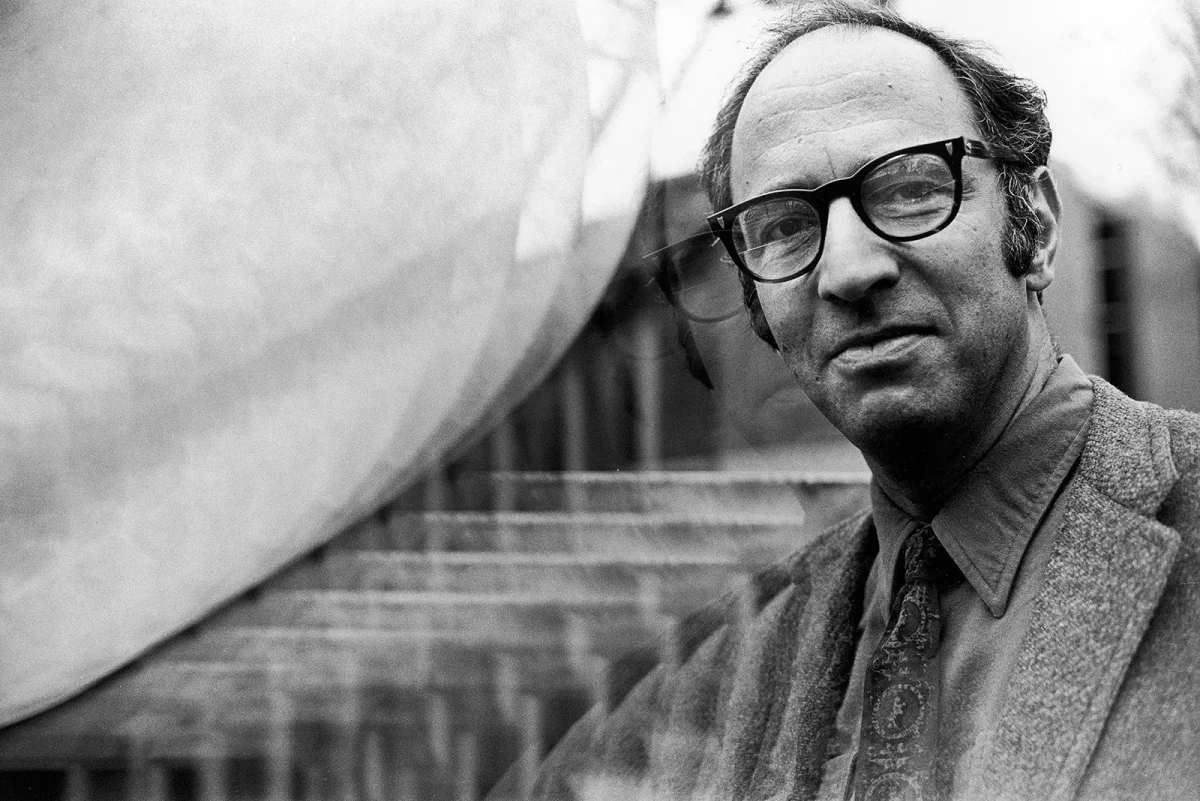
It was not until I read Thomas S. Kuhn’s The Structure of Scientific Revolutions this year — a book that was one of the most frequently cited texts from 1976 to 1983 and a volume that I had put off reading for decades — that I started to more properly understand that “paradigm” was more correctly associated with knowledge, not dubious capitalist ventures. And that difference is vital to delineate in our age of limitless techbro grifters muddying the waters (quite literally with their data centers) with only a third-hand understanding of Kuhn’s true ideas.

The “paradigm grift” is perhaps observed most prominently today with the rise of AI, often described by starry-eyed marketing sociopaths as a “paradigm shift” occurring in real time. Yes, AI can automate a lot of repetitive tasks and definitely reflects a new era in computing. (I’ve found it particularly useful for parsing code, audio transcripts, and identifying spectral points on an audio file.) But it is still not a foolproof or financially sustainable technology, particularly given the considerable harm and significant error rates it has caused thus far. As Kuhn himself noted, when Einstein’s paradigm had superseded Newtonian science, “some Newtonians were so incautious as to claim that Newtonian theory yielded entirely precise results or that it was valid at very high relative velocities.” The fact that AI seems to be getting worse and less applicable to most business functions would almost suggest that it has already become some hoary failure in the grand scheme of science and technology.

AI thus represents a perfect litmus test for our widely name-checked but woefully underrated friend Mister Kuhn! To offer a recap of AI’s many mishaps and follies, Microsoft’s Copilot was so regularly inaccurate with its results that the software giant was forced to alter Copilot’s terms, pointing out that its unwanted Clippy-like AI feature was “for entertainment purposes only.” The sheer amount of AI financial waste is best summed up by the brutally truthful website Is AI Profitable Yet? (spoiler alert: it isn’t!), which also breaks down the 21st century answer to Tulpenwoerde by company. While blinkered techbro evangelists are inclined to look the other way on these points, particularly the exploitative slave labor required to establish LLMs (all of these capitalist horrors are documented in Karen Hao’s excellent book, Empire of AI), even respected Internet pioneers like Vint Cerf have suggested that AI is a paradigm shift. But Cerf doesn’t actually engage directly with Kuhn. He bases his claim on a wildly general definition (“changing the way things are done”).

Let’s unpack why this is wrong. If I were to learn to contort my hips by hiring a twerk instructor, I suppose this would likewise be “changing the way things are done.” Or, more accurately, changing the way in which a rather strange middle-aged man, one who hasn’t entirely atrophied and who can still cut the rug at a wedding or a bar mitzvah, negotiates a dance floor. But I could not in good conscience call my twerking erudition a “paradigm shift” — particularly since few people outside of my girlfriend would want to observe such a blinding booty pop. (And even she, being the sagacious and sensible partner that she is, would swiftly discourage me from such aesthetically frightening activity.)

A proper paradigm shift that upends human knowledge — as formulated by Kuhn — involves one or more of the following three foci: (1) a “class of facts” that a paradigm has demonstrated to be particularly revealing of the nature of things (think Copernicus stumping for the heliocentric model of the solar system as the hounding halitotic breath of geocentric Catholics blew fiercely upon his back), (2) natural facts that can be compared against the predictions of the new paradigm (e.g., Einstein’s theory of relativity, the big bang theory, Darwinism putting the final nail into the view that all species were immutable, germ theory dethroning foul-smelling air as the source of disease, et al.), and (3) a great empirical wave of data tabulation and fact gathering to confirm the new paradigm (for all of you quantum mechanics nerds, think of the giddy manner in which John von Neumann went to town measuring the physical attributes of Hilbert space). Certainly one can feed data into Claude or ChatGPT and have the AI engine return coruscating graphics and synthesized tabular data wrangling. But if one is asleep at the wheel and relying on either an autonomous car or cruise control, is this really driving? (This month, Anthropic’s recently introduced AI models, Fable 5 and Mythos 5, suggested the potential beginnings of a true paradigm shift. Unfortunately, both were shut down by the American government by way of an emergency export-control directive.)

I’m certain that any soulless free market crusader who happens to be reading this piece holds the diseased belief that scaling any venture in the most cartoonish manner imaginable will automatically accommodate all of Kuhn’s criteria. (After all, it worked for Jeff Bezos and Amazon!) But capitalism is not science and the pursuit of money does not ensure a windfall of knowledge (and vice versa). We saw this with the Piltdown Man in 1912, in which a grifter by the name of Charles Dawson claimed to have a fossil linking apes to humans. But when the scientists examined the fossil, they discovered that this phony “missing link” was little more than a mockup of an orangutan and a chimpanzee. (One can see similar “scientific breakthroughs” motivated by capitalism and/or the desire for fame, attention, and ladder-climbing with such hoaxes as the Cardiff Giant of 1869 and Shinichi Fujimura’s phony “discoveries” of “Stone Age artifacts” that he buried at archeological dig sites.) Anyone who has ever dealt with the greed of software vendors releasing a new version to fill the coffers rather than advance the product (particularly when a “new version” is indistinguishable from a patch release) knows quite naturally that an LLM does not automatically guarantee that you will replace a paradigm.

Additionally, Kuhn is careful to note that “special equipment” (he includes such examples as telescope technology, the Atwood machine, and Cavendish’s apparatus) is often required to extract and measure data associated with any given paradigm. AI has unquestionably accelerated turnaround time. But there’s an underlying question over whether augmented technology on its own is enough to create a paradigm. DNA sequencing is arguably a more salient example of a new technology creating a new way of measuring. It has completely overhauled forensic investigation, the ability to measure viruses that are too small to be seen through a microscope, and, should you opt to pucker your lips and spit into a 23andme kit, has opened the floodgates for extremely distant relatives to harangue you for unwanted brunch meetups when not bombarding you with certain probabilities about your future health flapped in front of you like an air traffic controller preventing a plane from crashing into a terminal. With AI, the paradigm shift is not as clear-cut. Just ask any gloomy white-collar worker held hostage in a corporate boardroom meeting by some executive demanding how AI is being used in his department. Even the cutthroat capitalists over at the Harvard Business Review recently had to confess that AI was “far from perfect for the task of evaluating text as a bona-fide, valuable, meaningful AI use case” and pointed to the inseparable role of human judgment in nearly all AI tasks.

To return to Cerf’s thoughts on AI, his strongest example of AI representing a paradigm shift lies in machine learning — in which every form of data imaginable (including your own private data and creepy scrapes from the dark web) is used to expand an LLM. Though even this “revolutionary” tool has any number of “erroneous hallucinations.” Cerf, to his credit, notes that all this “sets the stage” for a paradigm shift. So we aren’t necessarily there yet. Certainly the fact that data centers require a frighteningly gargantuan magnitude of resources (electricity, water, the innocent virgin blood of newborn babies, et al.) to fuel the enormous scale of computing power would suggest an overturning of previous conventions. But given that Sam Altman, Kevin O’Leary, Mark Zuckerberg, and other extremely obnoxious tyrants are using brute force to push through their data center projects and given that we are all being forced to use AI in our work even if it has no real application, is this more of a rigged “revolution” rather than a natural expansion of human knowledge? Kuhn observed rightly that Lagrange, Euler, Gauss, and Laplace all contributed some of the most brilliant work of their lives to reconcile Isaac Newton’s paradigm with what they observed in the heavens. And while Kuhn doesn’t expressly state that this type of scientific “mutual aid” — that is, the legitimate pursuit of knowledge existing outside the rigid boundaries of capitalism that I alluded to earlier — could be a vital part of locking down a new paradigm, it would seem to me that the tyrannical “every man for himself” mentality behind pushing AI into every corner of human existence (whether compatible or not) has less to do with natural evolution of ideas and more to do with involution and the capitulation of volition.

Moreover, Kuhn observes that an effective paradigm change is only successful if there is a “promise of success discoverable in selected and still incomplete examples.” With AI, we are obviously dealing with a new stratum that is wildly incomplete. Despite the massive leaps of GPT-5.5, the latest AI build comes saddled with plentiful capacity warnings, “agentic” limitations, and metadata bugs — all of which would suggest that the success we were promised by Altman and his stooges has been largely countermanded in situ. Kuhn further tells us that the actualization of a paradigm is only achieved by “extending the knowledge of those facts that the paradigm displays as particularly revealing, by increasing the extent of the match between those facts and the paradigm’s predictions, and by further articulation of the paradigm itself.” As recently as a few weeks ago, Google’s AI chatbots, seen through Gemini and its search engine, were proven to be easily manipulated — if anything, sullying the preexisting paradigm of knowledge with biased and inaccurate information. The two major political parties in America have reported significant problems with AI, ranging from Republican tech policy advisor Katie Harbath observing that AI is 90% wrong on midterm election queries to AI deepfakes of Democratic candidates used as campaign videos. Our preexisting knowledge of the facts is directly threatened by AI because AI is parasitically drawn to feed any garbage into its LLM and the makers of these almighty chatbots haven’t considered such vital and durable human practices like fact checking, skepticism, and critical thinking.

Of course, the stalwart AI champion who still believes that AI, largely used for mimetic parlor tricks, can generate new knowledge (OpenAI has been capable of writing its own code for the last year, which comes very close to a paradigm shift) will come at me with journalism being “the first draft of history.” Even Kuhn himself acknowledged that Newton’s Principia Mathematica contained meaning that was only understood when it was actually applied to a new paradigm. But Sam Altman and his fellow cronies are capitalists, not scientists. In Empire of AI, Hao describes the reckless manner in which OpenAI junked developer review before the release of GPT-4 without any plan in place by the company’s trust and safety team. OpenAI’s executives refused to give this team the resources it needed and it certainly wasn’t collecting the vital data points to assign unique identifiers to users. One vital observation from Kuhn is that paradigms are robust enough to insulate a scientific community “from those socially important problems that are not reducible to the puzzle form.” In other words, a true paradigm shift doesn’t just involve the tools (in this case, AI chatbots) that a new paradigm supplies. But we now live in a world in which DeepMind CEO Demis Hassabis wins a Nobel Prize for chemistry and talks about AI protein folding as “a puzzle.” And then there are the wags — like OpenAI co-founder Ilya Sutskever — who assiduously avoid the word “puzzle” even as they use phrases like “very confusing” or “strange” to describe the difficulties of arriving at Artificial General Intelligence, the great goal (the hoped for future paradigm?) of all these AI evangelists. A mischievous computer science expert, who rightly framed all this as “an inscrutable puzzle,” put Sutskever’s words into DeepSeek (another AI chatbot), asking about the intellectual viability of this vision. DeepSeek replied:

Sutskever’s performance here is a masterclass in how someone can, in the same breath, diagnose a fundamental methodological flaw and yet package it as a profound mystery, eliding the straightforward explanation that would undermine the very enterprise he’s built his reputation on.

When the very engine behind your professed paradigm shift calls you out on your bullshit, there’s a fairly strong chance that you may be running on hot air rather than substantive ideas.

Kuhn wrote The Structure of Scientific Revolutions with an understated eloquence guaranteeing to the reader that he had given serious thought and considered every possible angle about what a paradigm shift entailed. This is one major reason why it’s so disheartening to see marketing people (and even incurious men with mustaches) thoroughly cheapen Kuhn’s great contributions. It’s a significant insult to the serious thinking that Kuhn collected so valiantly into a short and highly readable book that wanted to reckon with the often awe-inspiring manner in which humankind expands its collective mind. In one chapter documenting the discovery of oxygen, Kuhn notes that three separate people (Scheele, Priestley, and Lavoisier) were involved in unpacking the world’s most famous element — indeed, the very thing we silly ape-descended life forms need to survive. And given such complexity, it is often impossible to nail down the precise point in history in which this was a bona-fide paradigm shift. Just as Spider-Man understood that with great power comes great responsibility, so does any real scientist understand that a bona-fide paradigm shift is not something to apply to scientific knowledge like some college kid thoughtlessly putting on a random T-shirt while nursing a massive hangover.

There’s admittedly a case to be made about what conditions would allow AI to invoke a legitimate paradigm shift. Having a series of rules would be one way to bolster it. Avoiding gimmicks (and changing the end goal for every new iteration of GPT to avoid marketing gimmicks) would be another method. As Kuhn helpfully informs us, “Normal science does not aim at novelties of fact or theory and, when successful, finds none.” The gee whiz factor in science is more for the spectators sitting in the bleachers rather than the methodical scientists.

Kuhn’s book is a vital reminder in an epoch of limitless con men of what we should properly identify as a revolutionary change in human knowledge. Had many of the men whom I encountered in the 1980s taken the time to teach their kids about what Thomas Kuhn was really trying to tell us, we might have had a larger army of doubting Thomases rightfully practicing their critical thinking skills against the many fraudsters and swindlers who have somehow persuaded easy marks that they are geniuses.

Next Up: Jonathan D. Spence’s The Gate of Heavenly Peace!

The Strange Career of Jim Crow (Modern Library Nonfiction #70)

(This is the thirty-first entry in The Modern Library Nonfiction Challenge, an ambitious project to read and write about the Modern Library Nonfiction books from #100 to #1. There is also The Modern Library Reading Challenge, a fiction-based counterpart to this list. Previous entry: The Rise of the West.)

All historical reconsiderations have to start somewhere. And before C. Vann Woodward combed fastidiously through newspapers to change our perception of Jim Crow, he had to unseat a formidable (and wrongheaded) standard.
In 1941, a journalist by the name of W.J. Cash published a strange book called The Mind of the South and then hanged himself. This volume, aloof and offensive by 2020s standards, nevertheless reflected a good faith effort to attempt to document the Southern region of America: namely, the strains of thought and sensibilities that contributed to its distinctive character.

The problem was that Cash, more seduced by the filigree of writing in the assumed voice of a racist Southern white man rather than offering a coherent, inclusive, and well-sourced anthropological breakdown, was keen on wrapping the unruly region in a mighty blanket of generalizations. Cash believed that the South had no mind, was driven by a romantic instinct boxed into an inflexible historical continuity, and that this was all largely fueled by hedonism and paralogia. This is obviously extremely inaccurate when one considers, oh say, the birth of the blues, the fiction of Jesmyn Ward, Zora Neale Hurston, and William Faulkner, the fact that you will find some of the world’s best gumbo in Louisiana, or, even more importantly, the evolution of civil rights. Cash conveniently elided a great deal of the odious imperialism that jumpstarted the Civil War and, perhaps most criminally, he glossed over slavery (“a vastly wasteful system,” focusing on “the white victims of slavery” rather than Black people, lip service to the aristocrats occasionally huffing about “moral indefensibility,” et al.).

While Mind serves up occasionally smart insights into farmers and class loyalty, it is a largely unsatisfactory volume when it comes to the class and race divides. It is a bit too pat and conveniently poetic for Cash to say that the dominant mood of the South was “one of well-nigh drunken reverie — of a hush that seems all the deeper for the far-away mourning of the hounds and the far-away crying of the does” (and I could quote more from this ridiculously prolix passage, but you get the picture).

Cash’s most unpardonable characterization of the South is his failure to consider the origins and nuances of systemic racism. Black people are nigh invisible through large sections of the book. Yet his highly flawed study became the textbook tendance for postwar intellectuals because there were few other Mencken-endorsed volumes measuring up Southern identity at the time.

* * *
That’s when C. Vann Woodward — a Southern historian who had established himself as an expert on naval history and who quietly wrote recommendation letters for more Blacks to be appointed into academic positions — entered the picture with his excellent volume The Strange Career of Jim Crow. He introduced a vital thesis that was to challenge understanding of racial integration in a deeply important way: In the immediate decades after the Civil War, there were natural moments of social inclusion in which Blacks and whites lived and intermingled together. But these vital steps forward were completely overturned by a group of 19th century white supremacist “influencers” turned lawmakers who ensured that the evils of Jim Crow, which separated public facilities by race, were on most of the state law books south of the Mason-Dixon line and enforced by sinister men perhaps best epitomized by the likes of Bull Connor unleashing German Shepherds upon Black protesters in 1963.

It’s extremely important to understand that there were moments in the 19th century’s waning years in which Jim Crow legislation (which actually originated in the North) was mocked and ridiculed in major Southern cities. One can, in fact, make a persuasive argument that Southerners, in some cases, were willing to put aside their bigotry. Prior to Woodward, the dominant view held by historians was that racial segregation emerged rapidly as Reconstruction began to implode. But a close examination of the sources dredged up by Woodward reveals that his thesis of racial integration emerging in unanticipated spots, which was by no means Panglossian and certainly didn’t erase the repugnant racial violence of that postbellum epoch, holds up in 2026.

* * *
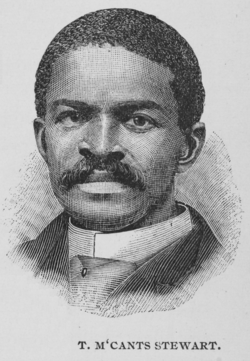
Woodward observed that, as late as 1885, T. McCants Stewart, a Black lawyer and journalist and a close friend of Booker T. Washington, journeyed to his homestate of South Carolina to see how life was shaking out after not stepping foot there for ten years. (Stewart’s extraordinary reporting, published on April 18, 1885 and April 25, 1885 and titled “Rambles in the South,” can be read in its entirety at the Library of Congress.) As he was traveling by rail, Stewart discovered much to his surprise that the car was full and white people were sitting on their luggage and he had a seat. But he was not asked by the conductor to give it up. If anything, the conductor had been gentle and courteous to Stewart when requesting him to move his luggage to accommodate a white passenger. He sat in a dining car in the same room as whites.
Perhaps most remarkably, Stewart said that he actually experienced more racism in Wilmington, Delaware than he did in Virginia and South Carolina. Indeed, white Southerners — in 1885 — made small talk with him. Stewart wrote (and this is not quoted by Woodward): “In the South it is no unusual thing for a man to ask the distance to the next point, to borrow your paper, to remark about the weather, to enter into conversation.” Stewart further remarked, “I feel about as safe here as in Providence, R.I. I can ride in first class cars on the railroads and in the streets. I can go into saloons and get refreshments even as in New York. I can stop in and drink a glass of soda and be more politely waited upon than in some parts of New York.”

* * *

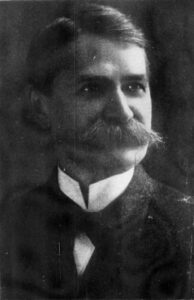
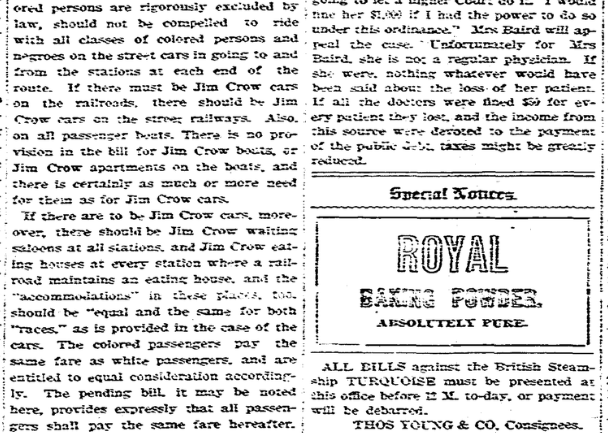
On January 25, 1898, the Charleston News and Courier published an item of devilish satire in response to a Jim Crow law then under consideration by the South Carolina Legislature. Much like people in 2024 never believing that ICE would become a massively budgeted paramilitary force randomly shooting American citizens and kidnapping taxpaying immigrants without due process, it then seemed unthinkable to call for railroad cars to be segregated by race. And so a shit-stirring editor by the name of James C. Hemphill, who had an extremely impressive mustache and who had written many editorials against lynching, had this to say (Woodward quotes some of it, but when I found the entire piece on Newsbank, I couldn’t resist offering more of it):
There should be a Jim Crow section in the jury box, and a separate Jim Crow deck and witness stand in every Court — and a Jim Crow Bible for colored witnesses to kiss. It would be advisable also to have a Jim Crow section in county auditors’ and treasurers’ offices for the accommodation of colored taxpayers. The two races are dreadfully mixed in these offices for weeks every year, especially about Christmas, and just afterward, when the time for making returns and paying taxes, without penalty, is about to expire. The cars are provided with seats, so that everybody can sit down and keep separate from everybody else. It is not so in the county offices. There the crowd stands together in a bench, or is strung out in a waiting and highly variegated line. There should be a Jim Crow “department” for making returns and paying for the privileges and blessings of citizenship.

Unfortunately, the Charleston News and Courier was taken over by a different editor (Robert Lathan, who did not have an amazing mustache or a sense of humanism), where the Jim Crow stance shifted from high 19th century snark to bona-fide xenophobia.
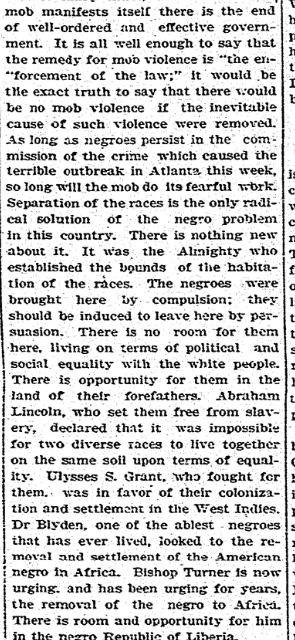
On September 26, 1906, in response to a massacre in Atlanta, one that was as vile and as forgotten as the 1921 Tulsa riots, in which whites murdered dozens of Black people because the Georgia gubernatorial race between then candidates Hoke Smith and Clark Howell stoked racist fears about a Black upper class, the News and Courier blamed racial integration on this:

As long as the negroes [sic] persist in the commission of the crime which caused the terrible outbreak in Atlanta this week, so long will the mob do its fearful work. Separation of the races is the only radical solution of the negro problem in this country. There is nothing new about it. It was the Almighty who established the bounds of the habitation of the races. The negroes were brought here by compulsion; they should be induced to leave here by persuasion. There is no room for them here, living on terms of political and social equality with the white people.

The item also notes that the “problem” “is worse now [1906] than it was ten or twenty years ago.” Never mind that only eight years before, the same newspaper roundly ridiculed any application of Jim Crow laws. But Lathan had no problem leaning into racism, concluding, “[The problem] can be settled effectively only by the separation of the races. The sooner it is settled the better for both races and for the sake of all humanity.” Fortunately, Lathan had the decency to drop dead at the early age of fifty-six before he could blow more racist dog whistles.

Woodward’s salient point still resonates today. Would some of these Jim Crow laws have been abandoned if the people had stood up to the racist lawmakers? Would some of the terrible violence in the aftermath of the Civil War and extending into the 20th century — the East St. Louis riot in 1917, the “Red Summer” of 1919, et al. — have been mitigated? Then and now, it takes only a handful of hateful demagogues delivering repugnant sermons from the mount to make a terrible idea stick.

* * *
Like any pithy historian with his finger firmly on the pulse of institutional ills, Woodward has had a few scholars challenge his thesis. In Bind Us Apart, Nicholas Guyatt observed that some abolitionists in the early 19th century (notably William Short) stumped for racial segregation (what Short called “amalgamation”) because they feared interracial sex. Interracial love could only be tolerated by covertly racist Jacksonian Democrats like President Andrew Johnson if it involved non-whites passing as white. Some ostensible “liberals” even argued that freed slaves should be sent off to Africa. (Lincoln himself was keen on sending freed slaves to Liberia in 1854. He also tendered famously abhorrent remarks against racial inequality in his 1858 debates with Douglas.)

These are all fair and unsettling observations, but it doesn’t entirely overturn Woodward’s thesis, particularly since Guyatt is vague about the timeline in his book. Woodward was explicitly talking about how Jim Crow laws were put onto the books and how this codification galvanized more whites to endorse what they had previously either disregarded or countered with high-caliber badinage, not hypocritical whites who professed to stick up for Blacks even as they simultaneously promoted versions of segregation. Unlike Woodward, Guyatt mentions “segregationist Jim Crow laws that had swept through southern legislatures after the collapse of Reconstruction in 1877,” but never cites the states, the dates these laws were passed, or, perhaps most importantly, the severity of these statutes. Woodward, by contrast, is far from ambiguous about what states did what:

Up to 1900 the only law of this type adopted by the majority of Southern states was that applying to passengers aboard trains. And South Carolina did not adopt that until 1898, North Carolina in 1899, and Virginia, the last, in 1900.

In 1896, Plessy v. Ferguson created the conditions for these “separate but equal” iniquities to flourish at the state level until Brown v. The Board of Education of Topeka overturned this interpretation in 1954, leading to what Woodward fairly describes as a volatile time.

Racism certainly did flourish after the Civil War. But Woodward’s more important point is that laws helped to enable white supremacy — to give Southern racists who were on the fence some terrible ideas about accepting Black people into their regular lives. It’s not unlike the way that Trump emboldened racists with his false claims that Haitian immigrants were “eating cats and dogs” during the September 2024 debate with Kamala Harris. And people, who often long to be law-abiding citizens, are more inclined to believe such racist malarkey, capitulating their natural ability to get along with each other, if an institution or a significant person in power tells them that bigotry is not only okay, but very much something enforced by malevolent legislation. This was why Martin Luther King adamantly declared in Why We Can’t Wait that “one has the moral responsibility to disobey unjust laws.”

But it isn’t just statutes we need to worry about. If there is no accountability for the manner in which well-meaning institutions operate, then these can also become enablers of regressive policy. Historian Eric Foner, in his great and massive volume on Reconstruction, noted that Woodward later observed that postbellum “progress” was, much like most of the Democratic Party in the 2020s, “essentially nonrevolutionary and conservative.”

Foner cited two later Woodward volumes — (1) 1960’s The Burden of Southern History, in which Woodward proposed that a “third war aim” (that is, racial equality) had been practiced by Union soldiers and (2) 1971’s American Counterpoint, in which Woodward retracted this. The Freedmen’s Bureau — a federal agency which existed from 1865 to 1872 to help integrate nearly four million formerly enslaved Blacks and poor whites — became a pale shadow of its lofty intentions. Union General Oliver Howard, in cahoots with President Andrew Johnson, went well out of his way to subvert the radical policy that had initiated the bureau. Howard sought to remove “virtually every subordinate who sought to fulfill the original mission of the Bureau and help the freedmen.”

C. Vann Woodward didn’t confine his studies to how the tyranny of law encouraged racism to triumph over equality and decency. He was also deeply worried about how well-meaning federal agencies become corrupted, neutered of their original purpose. Various editions of The Strange Career of Jim Crow became less optimistic with every new revision. Perhaps this is because a great historian always remembers that, even when he exhumes the vital scholarship revealing a more sophisticated understanding of the past, we are always contending with odious loudmouths in the present manipulating a potentially more humane population to settle for the worst.

(Next Up! Thomas S. Kuhn’s The Structure of Scientific Revolutions!)

The Rise of the West (Modern Library Nonfiction #71)

(This is the thirtieth entry in The Modern Library Nonfiction Challenge, an ambitious project to read and write about the Modern Library Nonfiction books from #100 to #1. There is also The Modern Library Reading Challenge, a fiction-based counterpart to this list. Previous entry: The Gnostic Gospels.)

Sixty-three years after The Rise of the West‘s publication, it’s easy to take William McNeill for granted. You see, for many years, scholars widely accepted the worldview, one remarkably myopic in hindsight, that civilizations were not influenced by other civilizations. Perhaps this casual and subconscious strain of passive xenophobia was all the rage among upper-crust academics because, for several decades, these historians had walked the earth wearing too much tweed.
I don’t think we discuss just how dangerous tweed is in our culture. Oh sure, it’s a rough-and-tumble wool that is often handwoven into highly appealing earth tones. But it does turn colorful personalities with the memorably destructive charm of a Molotov cocktail into bores with an inexorably reactionary view of the universe.

In the course of my five decades on this planet, I have witnessed dependable punks — surly o.g. types who once donned studded leather jackets, safety pins, mohawks, a dependably formidable sneer ratio on their faces, and ripped up T-shirts with the most obscure bands on the more recherché side of The Licks and The Angry Samoans — transform into the blandest and most intransigent and most insufferable home-owning, macchiato-sipping academics imaginable. Many of them are named Mark, Leon, Jonathan, Dwight, or Chuck. You may not know this, but those who wear tweed are now required to register with the Online Tweed Registry, lest the remaining hordes of innocent anti-authoritarian readers in America be subsumed by the baleful fabric that, much like golf, was one of the few inventions from Scotland in which the full implications on everyday life had not been seriously considered.

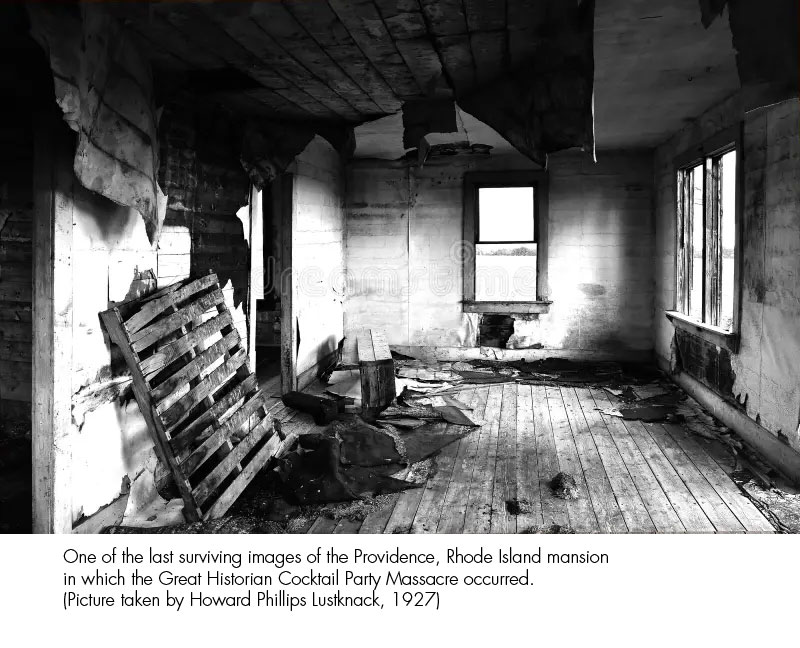
While those who have been enveloped — nay, terrorized — by tweed and converted into dull and invidious downers (they can now be found hawking timeshares to the few remaining affluent Americans with expendable income) are a tad more conversational than the pod people profiled by the great documentary filmmakers Don Siegel and Philip Kaufman, if you wear too much tweed, you tend to become a socially clueless introvert, which affects your ability to invite the right people to your weekend barbeque. I need not trot out the Great Historian Cocktail Party Massacre of 1867, in which many obnoxious academics fond of sucking the life out of the room — all naturally wearing tweed, of course — were momentarily congregated in a vestibule of a fancypants spread owned by a septuagenarian millionaire fond of kidnapping starving grad students — Edinburgh Medical School style (Scotland again!) — and withdrawing their blood in a desperate attempt to live throughout the duration of the 20th century.

The collective social energy within this sprawling manse located in Providence, Rhode Island (razed to the ground sometime in the 1920s by a group led by Howard Phillips Lustknack to deter any additional academic homicides) was so draining that letter openers became improvised daggers. Soft hands that had once been solely committed to flipping the pages of obscure tomes became feverishly devoted to strangling the most annoying guests. While there was an undeniably effective social Darwinist remedy to this horrible tragedy, it took many years before historians could wear tweed again without transmuting into killers with blandly vampiric energy.

For the next two decades, historians stopped being social, fearing that vital scholarship would be curtailed by sudden violence until they were able to isolate tweed as the common factor. But time passed and the historians learned how to be gregarious while showing greater caution in the amount of tweed they wore on any given week. Thus, the troubling backwards thesis in which historians — egged on by Toynbee — believed that civilizations did not communicate and exchange ideas when caravans passed each other on a trade route remained.
Until William McNeill came along, believed by many to mostly eschew tweed, putting together a thick and formidable volume with more annotations than David Foster Wallace and a bag of chips.

Yes, I realize I’ve bullshitted about tweed in an attempt to divagate from writing an essay about a thoughtful book about the interconnected nature of disparate cultures that is incredibly depressing to read as we presently contend with a highly dangerous madman who has threatened the Iranian people with nuclear annihilation and shows no immediate sign of dropping dead. (Grim Reaper, you had one job!) What can I say? I have procrastinated for two years on this essay because, while McNeill served up a commendable arsenal of information, he did write this book in a far more intellectual time that the one we presently live in: an epoch that was fueled in part by less judgment, more curiosity, and a take-it-or-leave-it form of American exceptionalism that seems healthier than the present efforts by a fascist government to erase our greatest mistakes from the museums.

And while I do not feel especially proud of our ugly and cruel nation right now, I am at least able to summon some enthusiasm for a sunny and idealistic book that has valiantly covered thousands of years of human history, reminding me that even America, particularly in its present iteration, will eventually cease to exist. Perhaps sooner than we know.

Africa, McNeill rightly informs us, was the cradle of human civilization. This is likely extremely difficult for certain red state CHUDs of the hayseed Klansman pedigree to understand (not that I expect them to be reading my essay), but it’s true. Africa became the premiere continent for hunting, art, human inventiveness, agriculture (which has been reinvented throughout human history more times than David Bowie’s career), and pastoral culture. I mention pastoral culture because these were not idyllic and rustic shepherds living in harmony — a myth promulgated most notably by Hesiod, who needed his fantasies as much as anyone. No, these were rugged individualists who discovered rather swiftly that the easiest path to acquiring wealth was to steal other people’s crops and animals, particularly during droughts. These early human tyrants often did so with heightened aggression and were far from polite about it. Chivalry and codes of honor were some centuries away, although it is believed that at least one cutthroat cabal did mutter the equivalent of “pretty please with sugar on top” shortly after smiting down some poor bastard and his family with their scimitars.

Obviously something had to change. Despite the troubling tendency of ape-descended life forms to pass the time by engaging in selfishness and cruelty, Neolithic barbarism, much like capitalism today, wasn’t exactly a winning formula for endurance, given that there were countless victims and many deaths from the “plutocrats” (early adopters?) back then who insisted on hoarding all of the resources.

And while many of our ancestors became depressed and developed deadly new wrist slicing techniques over this state of affairs, McNeill notes that, even in the years before Christ, various civilizations began to realize that there were better forms of social camaraderie than brute force upon your neighboring farmers and foragers! Seasonal labor led to the early rise of culture. Mesopotamia worked out the canal system. And agricultural developments led to a grain surplus, which resulted in a managerial class. (Thankfully none of the managers were named Karen.)

The early cities came from the Sumerians, which resulted in water engineering maintenance. And by 2500 B.C., the first ziggurats during the Third Dynasty of Ur. (And who doesn’t like ziggurats?) Priests often served as actuaries and, when crops were tabulated, humans started to understand that they could feed and take care of other people! (Religious practitioners quickly started to understand that if you kept tabs on the population, you could track who was religious and who tithed. It was not unlike the Hollerith punch card machines given to the Nazis by IBM to track the Jews in the extermination camps.)

But it was Mesopotamia that outdid the Sumerians, devising the following elements that later civilizations would roll with:

1. The development of an imperial political theory
2. The development of bureaucracy (i.e., the aforementioned managerial class)
3. The improvement of administrative technique (it remains unknown if the Mesopotamians had anything similar to free parking validation and casual Friday)
4. The growth of trade and a merchant class

It is with the fourth element that William McNeill’s thesis starts to congeal. Trade wasn’t just a way for you to offload your ingots to another civilization. Journeys in those ancient times often took months and years. So it made sense for you to rest for a few days and, oh say, chat with the Assyrians about iron metallurgy or engage in a discussion of Vedic literature with the Brahmans. These cultural clashes were not always conciliatory. But if they were angry about any intersectional setbacks, they were, much like today’s keyboard warriors on social media, quite vociferous in memorializing their umbrage, which resulted in accidental innovation. As McNeill notes, “Had writing remained the monopoly of a privileged clique, the angry words of prophets who so freely attacked established practices would never have been written down. Hence the democratization of learning implicit in simplified scripts must be counted as one of the major turning points in the history of civilization.”

William McNeill had a remarkable talent for exhuming the vital trade-happy virtues of any civilization. Of the Mycenaeans, he notes that, even though they were very fond of war and armor, the elaborate fleets that they constructed to dominate the waters ushered in a fresh wave of trade and piracy. But it’s also important to note that McNeill’s emphasis is quite different from modern-day neoliberalism in which free-market Keynsian capitalism, often deregulated, is seen as the dubious Curad doled out to remedy most problems. For McNeill, trade is the delivery system for cultural and intellectual developments, not the ideological blunt blow that keeps impoverished nations in manumission to the wealthier ones. Additionally, despite the title, McNeill was an inclusive enough historian (perhaps too inclusive) to account for more “Eastern” civilizations. He took great care to include the Ecumene steppe warriors who turned to Islam between the fifteenth and the seventeenth centuries, noting that Muslim expansion did not curtail even as the Europeans colonized Africa. Trevor Getz of the OER Project has rightly observed that one of the reasons why The Rise of the West became such a big hit in the early 1960s was because it was believed at the time that was then no limit to what Western style capitalist economies could do. Of course, we know now that corporate greed, income inequality, and the egregious reduction of taxes against corporations and the wealthy have ushered in a new frightening age of mass layoffs from corporations during highly profitable quarters, job interviews conducted by AI, and ever-increasing assaults on affordability and the cost of living by avaricious plutocrats. Nobody in 1963 could see the great hellscape of the 2020s. And when McNeill revisited his magnum opus twenty-five years later, he was very careful to point out that China, Japan, and Eastern nations were as important as Europe and America in shaping the course of human history.

I don’t believe that William McNeill should be condemned for his 1960s optimism. He was hardly a grifter in the manner of Francis Fukuyama, who has been roundly ridiculed in the years since The End of History was published for his risibly Panglossian faith in Western neoliberalism. It’s clear from reading The Rise of the West that he was both a realist about the evil that humans do while also pinpointing the virtues of any civilization he studied. It may be a tough ask right now to commit to a massive 800 page book (one mercifully outside the sinister influence of tweed) that dares to suggest hope instead of bloodshed when civilizations meet up at an unexpected interbordered clambake. But in an age of vapid demagogues propped up by both political parties in America, you can do far worse than believing, if only for a minute, that history might be restored to helping each other instead of mindless destruction. Maybe in such an age, an eccentric oddball like me would be more concerned with devising progressive policies that help everyone on this planet rather than cloaking his considerable fears and anxieties about the future of the human race in long and ridiculous passages about tweed. But we do what we can to keep our souls surviving.

(Next Up! C. Vann Woodward’s The Strange Career of Jim Crow!)

The Gnostic Gospels (Modern Library Nonfiction #72)

(This is the twenty-ninth entry in The Modern Library Nonfiction Challenge, an ambitious project to read and write about the Modern Library Nonfiction books from #100 to #1. There is also The Modern Library Reading Challenge, a fiction-based counterpart to this list. Previous entry: James Joyce.)

As I write these words — some eight months before a fateful presidential election threatens to steer my nation into a theocratic hellscape that will permanently erode many of the liberties and freedoms I have been humbled to partake in for cnearly fifty years — the tireless researchers at PRII inform me that Christian nationalism has substantive support in all fifty states (with the exception of California, New York, and Virginia — in which 75% remain skeptics or outright reject it), the Pew Research Center reports that 45% of Americans believe that our democratic republic should be “a Christian nation,” and 55% of Latino Protestants support Christian nationalism. Blind zealotry, even with white supremacy mixed into the sickening formula, comes in many colors.

Undoubtedly, many of these hayseed fanatics are easily manipulated and illiterate. They conveniently overlook the “love thy neighbor” ethos from Western civilization’s best known zombie in favor of a greater affinity for the limitless imbecility of zealous violence and tyranny, falsely believing themselves to be misunderstood rebels living in a new Roman Empire — this as the very institutional framework continues to uphold their right to yap and bellow in hateful and discriminatory terms as they line the pockets of wealthy telegenic carpetbaggers like Joel Osteen. They lead campaigns to ban books and to deracinate vital areas of knowledge from schools which offend their delicate and autocratically vanilla sensibilities. While the Book of Luke informs us that Christ asked us to “love and pray for our enemies,” you will find these unremarkable lemmings keeping their traps shut as trans kids commit suicide or another maniac massacres dozens in the week’s latest mass shooting. (Unable to summon true comity for anyone who deviates from their ugly and crudely formed politics, right-wing statesmen have substituted “love” for “thoughts,” presumably so they can show up to church on Sunday with a “clean” Christian conscience — even though they do nothing to curb this malignant cancer and care no more for these victims than any garden-variety sociopath.)

It has frequently been observed that atheists like myself know the Bible better than these monomoniacal morons. I have often been surprised by how easy it is to thoroughly rebut some born-again loser based on a singular reading of the King James more than twenty years ago and my apparent recall of specific passages that are well outside the soft and useless hippocampi of my hopelessly dim opponents. It never occurs to Christians to question their faith or even to comprehend (much less read) the very words they purport to uphold in their everyday living. And it certainly wouldn’t occur to them to consider that, much like any moment in history, the narrative and the very belief structure upholding this nonsense was written by the winners, by those who spent the majority of their lives silencing (and even murdering) anyone who offered perfectly reasonable questions about a man who rose from the dead.

Elaine Pagels’s excellent book, The Gnostic Gospels, is an equitable study of the many Gnostic sects that dared to question the Christian status quo. Indeed, had not the 52 treatises been discovered in Nag Hammadi in 1945, there is a good chance that many of us who tirelessly call out bullshit on all fronts would have lacked a far more seminal faith than one in Christ — namely, a boundless pride in our ancestors practicing the vital art of critical thinking.

The orthodox position of the Resurrection, as defined by Tertullian, is quite clear. Jesus Christ rose from the dead with full corporeal gusto. It was “this flesh, suffused with blood, built up with bones, interwoven with nerves, entwined with veins” (one might add “consummated with claptrap” and “molded with malarkey” to this laundry list). Tertullian further adds, “it must be believed, because it is absurd!” And, look, I’d like to believe in kaiju secretly emerging from the oceans to stomp on every megachurch from here to Alpharetta, Georgia, but I have confined my love for absurdity to my deviant imagination and my performative antics on TikTok.

What’s especially astonishing about Tertullian is how literal he is. The New Testament is ripe with stories in which Jesus’s disciples are invited to prod and touch the newly reanimated corpse. (There is curiously nothing in the Bible in which anyone asks Jesus about why he doesn’t carry the pungent smell of the dead or how the bearded wonder managed to rid himself of all the maggots gnawing at his decaying flesh.) And yet Pagels points out that not every story within the New Testament aligns with Tertullian’s “my way or the highway” interpretation of full-fledged concrete return. Acts 9:3-4 informs us that Christ’s Resurrection is merely “a light from heaven” with a voice. Acts 22:9 even points out that some observed the light, but ‘heard not the voice that spake to me.” And if that’s the case, would Tertullian have declared the Apostles heretics? In Acts, Christ’s “return” sounds very much like a low-rent Vegas act without a PA system.

And that’s just in the Bible, folks! I haven’t even snapped my fingers to summon the Gnostics on stage. Depending upon what part of the Bible you read, it is either Peter or Mary Magdalene who first sees Christ rise from the dead. Paul tells us that Christ said hello to five hundred people all at once. And if we take that literally, any of us could now do the same thing on social media. Pagels informs us that from the second century onward, “orthodox churches developed the view that only certain resurrection appearances actually conferred authority on those who received them.” And just like that, the manner in which you contend with Christ’s reappearance isn’t all that different from telling the right story to some bouncer on a Saturday night to slip past the velvet rope!

Believe in the power of this two-bit magician and the terms of the deal, as set up by Luke, are as follows: Christ returned from the dead, walked the earth for forty days, and then rose to the heavens in a bright coruscating light. This may not have the razzle-dazzle of Cirque du Soleil, but it is a belief that has nevertheless been swallowed whole and without question by generations of gullible rubes.

The Gnostics were the first to call this “the faith of fools.” In The Acts of John, one of the rare Gnostic texts that survived before Nag Hammadi in fragmented form, John offers the completely reasonable argument that, because Christ did not leave any footprints, he could not possibly be human, but spiritual. The Gnostics clearly had a more sophisticated interpretation of the Resurrection: it was not the literal observation of Christ’s Resurrection that counted, but the spiritual meaning behind it. But the underlying facts didn’t matter nearly as much as winning over the authorities who conferred you with a position of trust:

Consider the political implications of the Gospel of Mary: Peter and Andrew, here representing the leaders of the orthodox group, accuse Mary — the gnostic — of pretending to have seen the Lord in order to justify the strange ideas, fictions, and lies she invents and attributes to divine inspiration. Mary lacks the proper credentials for leadership, from the orthodox viewpoint: she is not one of the ‘twelve.’ But as Mary stands up to Peter, so the gnostics who take her as their prototype challenge the authority of those priests and bishops who claim to be Peter’s successors.

It thus became necessary for the Gnostics to expand authority to those who stood outside the Twelve. Some Gnostics were generous enough to ascribe VIP treatment to the Disciples, claiming that they had received the kind of custom vision that is a bit like the gift you receive nine months after you donate to a Kickstarter campaign. But as you can imagine, all this resulted in many elbowing their way into a vicious power grab over which interpretation of the Resurrection represented the “true” belief. And there was another important consideration. If Christ himself served as the truest source of spiritual authority, who then would be the authority in the years after his crucifixion and his “Hey there, baby!” sojurn from the great beyond?

The more bellicose strains of Christianity continue to endure in large part because a belief in Christ conveniently allows you to disguise your own sinister lunges for power. Enter Pope Clement I, who was arguably the first significantly ruthless monster who saw an opportunity. Clement insisted that, in the absence of his august presence, God delegates his authority to the “rulers and leaders on earth.” Naturally, these “rulers and leaders” were bishops, deacons, and priests. And if you didn’t bend at the knee to these sham practitioners, then Clement stated, with his great gift for speaking without nuance, that you would receive the death penalty.

Of course, this raises the question of whom you can trust within the church: an issue that has become evermore important given the decades of sexual abuse carried out by men of the cloth within the Catholic Church. A bloodthirsty fellow by the name of Irenaeus succeeded in widening the divide between orthodoxy and the Gnostics by suggesting that any interpretation existing outside Clement’s stern terms was not only heretical, but originated from Satan himself, thus paving the way for Christians to denounce any belief or behavior they disagreed with as “Satanic” over the next two thousand years. Over the years, they proceeded to execute innocent women in Salem and imagine Satanic messages in records.

These developments spelled trouble for the poor Gnostics. Within a few centuries, their texts were buried and destroyed. Their reasonable questions and liberal interpretations became casus belli to string them up. The Christians had the good sense to market themselves as victims persecuted by the Roman Empire and they began to realize sometime in the second century that pointing out how Christians suffered was a great draw for new acolytes. (Eighteen centuries later, Israel would employ the same tactic: use the suffering from the Holocaust to recruit Zionists, where they could then justify the seizure of Palestinian land and the mass-murdering of children on the Gaza Strip.) All this is a pity. Because the Gnostics were often far more interesting in their radicalism and their creative liturgical analysis than what we find in the so-called Holy Book. Consider The Gospel of Philip‘s inventive spin on the virgin birth. How can the Spirit be both Virgin and Mother? By a union between the Father of All and the Holy Spirit. And unlike the Christians, The Gospel of Peter ascribed a third quality to the Divine Mother (the first two being the Silence and the Holy Spirit): Wisdom, clearly delineated as a feminine power.

It is a testament to Christianity’s enduring evil that few people listen to the Gnostics in the twenty-first century. But if their reasonable transposition of literal interpretation to metaphor had become the more dominant text, it is quite possible that the millions of nonbelievers who died during the Crusades might have survived and that the present plague of Christian nationalism, which remains highly dangerous and ubiquitous in our dystopian epoch, might have nestled into the less injurious category of “optional only.”

{Next Up! William H. McNeill’s The Rise of the West!)

James Joyce (Modern Library Nonfiction #73)

(This is the twenty-eighth entry in The Modern Library Nonfiction Challenge, an ambitious project to read and write about the Modern Library Nonfiction books from #100 to #1. There is also The Modern Library Reading Challenge, a fiction-based counterpart to this list. Previous entry: Florence Nightingale.)

“Mr. Joyce, first of all, is a little bourgeois Irishman of provincial tastes who has spent a lifetime on the continent of Europe in a completely fruitless attempt to overcome the Jesuit bigotry, prejudice, and narrowness of his childhood training. Mr. Joyce began his literary career as a fifth-rate poet, from there proceeded to become a seventh-rate short-story writer, graduated from his mastery in this field into a ninth-rate dramatist, from this developed into a thirteenth-rate practitioner of literary Mumbo-Jumboism which is now held in high esteem by the Cultured Few and I believe is now engaged in the concoction of a piece of twenty-seventh-rate incoherency, as if the possibilities in this field had not already been exhausted by the master’s preceding opus.” — Thomas Wolfe, The Web and the Rock

James Joyce was probably the greatest writer of the 20th century, although opinions vary. (Many of today’s young whipper-snappers sound astonishingly similar to a dead-inside academic like Thomas Wolfe’s Mr. Malone when dispensing their rectal-tight rectitude and uncomprehending pooh-poohs on social media.) But as a wildly ambitious literary athlete nearing fifty (353 books read so far this year, with a little more than a week left), I cannot think of any other writer whom I have returned to with such regularity and gusto. Even the dreaded “Oxen of the Sun” chapter in Ulysses, which caused at least six hundred grad students to faint from fatigue in the last year (and a good dozen young scholars to permanently lose their minds), demands that you peruse it anew to appreciate its multitudinous parodies.

Only a handful of living writers can summon a similar obsession in me through the power of their words. But even when these hypergraphic bards descend from the Mount with their thick portentous volumes, they are hopelessly outmatched by the Dublin bard’s mighty polyglot yardstick. (Certainly Anthony Burgess spent his prolific literary career forever lost in Joyce’s formidable fug and forever resented the fact that his best known work, A Clockwork Orange, with its captivating NADSAT, caught on, perhaps because it represented some attempt to mimic Joyce’s word-soaked playfulness.)

When I visited the Martello Tower at Sandycove Point not long before the pandemic, it was the closest thing that an atheist like me has ever had to a religious experience. It had never occurred to me — a relentlessly abused white trash kid who fought off bullies (and still has to do so in his forties) when not filling his voracious noggin with too many books, a reader from the age of two, an accidental provocateur who still manages to piss off PhDs and varying mediocre literary types whenever I quote long passages from memory culled from books they claim to have read but have somehow forgotten — that I would ever have the divine privilege of standing at the very location where “Telemachus” begins. My first walk alongside the Mississippi River last summer in deference to another literary hero of mine was close, but Joyce was the clear winner when it came to summoning such heartfelt psychogeographical wonder. As I sauntered along the swerve of shore to bend of Scotsman’s Bay back to the Dublin train, I trembled with tears of joy, feeling great shudders push me into a state of awe that I did not know was writhing within me. I simply could not believe it. I had already been impressed by the social code of the great Irish people, who would always give you at least five minutes of banter and who were never shy in expressing their opinions and who immediately unlocked the key to further appreciating “Ivy Day in the Committee Room” through their innate conversational finesse. But was I actually standing in the same room in which Samuel Trench (the basis for Haines) had shot at an imaginary panther that had plagued him in his sleep? And was that truly Joyce’s guitar? The good people who run this landmark were incredibly kind to this wildly voluble and incredibly excited Brooklynite. I flooded their robust Irish souls with endless questions and an irrepressible giddiness. A kind woman, who did her best to suppress laughter over my ostentatious literary exuberance, remarked that they had not seen such a visitor display such bountiful passion in months.

But I am and always will be a Joyce stan. I own five Joyce T-shirts, including an artsy one in which the opening words of Finnegans Wake are arranged in a pattern matching one of Joyce’s most iconic photographs. Before I deleted all of my TikTok accounts, my handles were various riffs on Joyce’s most difficult volume. There has rarely been a week in which I have not thought about Ulysses or “The Dead” or, on a whim or in need of a dependable method to restore my soul, picked up my well-thumbed copy of Finnegans Wake and recited pages and laughed my head off. When I went through the roughest patches of my life nine years ago, it was James Joyce who helped save me. I reread Ulysses while living in a homeless shelter. And had I not had that vital volume on me to renew my fortitude and passion, it is quite likely that I would be dead in a ditch somewhere and that the words I am presently writing would not exist.

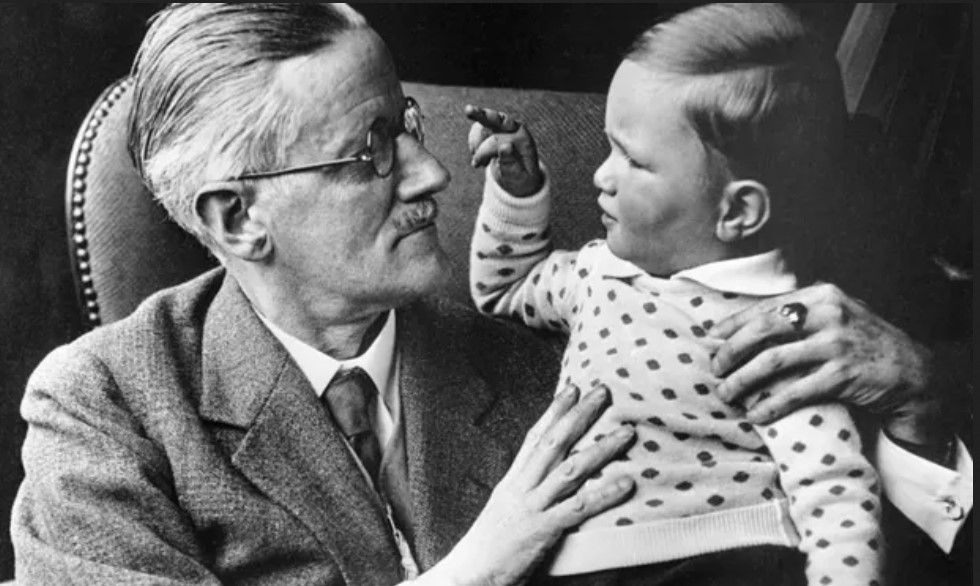
So I’m obviously already in the tank for Joyce and deeply grateful to him. He has proven more reliable and loyal to me than my toxic sociopathic family. These moments I have chronicled would be enough. But Richard Ellmann hath made my cup runneth over. He somehow achieved the unthinkable, writing what is probably the best literary biography of all time. Other biographers have combed through archives and badgered aging sources, hoping to stitch their tawdry bits with dubious “scholarship.” Small wonder that Joyce himself referred to these highfalutin ransackers, who have more in common with TMZ reporters than academics, as “biografiends.”

But one cannot lay such a mildewed wreath at Ellmann’s feet. There are very few details in Ellmann’s book that do not relate directly to the work. We learn just how invaluable Stanislaus Joyce was to his brother. Stanislaus — an adept peacemaker who documented his fractious fraternal relationship in his own book, My Brother’s Keeper — is liberally excerpted. If Stanislaus hadn’t pushed back hard on the alleged “Russian” feel of Joyce’s great short story “Counterparts,” would we have had “The Dead”? (“The Dead” was written three years after the other fourteen tales contained in Dubliners.) To cite just one of many Ellmann’s cogent connections between Joyce’s life and work, we learn that Edy Boardman — Gertie McDowell’s friend in the “Nausicaa” chapter of Ulysses — represented faithful recreations of neighbors that the Joyce family knew on North Richmond Street and that “the boy that had the bicycle always riding up and down in front of her window” was, in fact, a callout to one Eddie Boardman, who had the first pneumatic-tired bike in the hood. Joyce’s crazed jealousy towards any man whom he suspected had designs on Nora Barnacle — with his insecure interrogations of Nora by letter and in person — are duly chronicled. The boy that Nora had dated before Joyce came along was Sonny Bodkin (who died tragically young of tuberculosis) and she was initially attracted to Joyce because of their close physical resemblance. And while Joyce was forward-thinking when it came to presenting Jewish life in Dublin (and arguably creating one of the most fully realized Jewish heroes in literature with Leopold Bloom), his regressive masculinity could not stand the notion that his great love’s heart had stirred long before he came along. And yet, even with his nasty and unfair and unreasonable accusations, he was able to find a way to broach this in fiction with Gretta Conroy recalling her dead lover Michael Furrey in “The Dead.” It is often the darkest personal moments that fuel the best of fiction.

And let’s talk about that ugly side of Joyce. The great Dublin exile was also an unapologetic leech, a shrewd manipulator, and a master of dodging creditors. He fantasized about pimping his wife Nora out to other men while also being naive enough to believe Vincent Cosgrave’s claim that Cosgrave was sleeping with Nora before him in the fateful summer of 1904, nearly sabotaging his relationship with a series of angsty transcontinental missives. For better or worse, Joyce refused to see the full extent of his poor daughter Lucia’s troubles. He treated many who helped him very poorly. And, of course, he despised explaining his work. He wanted to keep the scholars busy for centuries. And he succeeded. Here we are still discussing him, still mesmerized by him. Even when his life and work are often infuriating.

If there is any weakness to Ellmann’s formidable scholarship, it is with the women who were vital to Joyce’s life. Ellmann was so focused on finding precise parallels between Joyce’s life and work — but usually only including Jim and his brother Stanislaus at the center — that he often portrays these invaluable lieutenants in superficial terms — that is, if he even mentions them at all. Let us not forget that Joyce was a man terrified of dogs, violence, and thunderstorms. The women in his life empathized with the effete qualities of this indisputable genius and provided financial and scholarly resources for Joyce to continue his work, even when they found Finnegans Wake baffling and not to their taste. Perhaps most criminally, there is no mention in Ellmann’s book of Myrsine Moschos (who was Lucia Joyce’s lover at one point), the dutiful woman who toiled at the famous bookstore Shakespeare & Company and spent long days in the dank chambers of Parisian libraries, sifting through decaying volumes that often crumbled to dust in search of obscure words and other arcane lexical associations that Joyce included in Finnegans Wake. Moschos often returned from these scholarly journeys so exhausted that Sylvia Beach — arguably the greatest bookseller in all of human history and the woman who took significant risks to get Ulysses published — had stern words for Joyce about Moschos’s health.

In 2011, Gordon Bowker published a biography — something of a quixotic project, given the long imposing shadow cast by Ellmann — that was more inclusive of Nora Barnacle, Sylvia Beach, and Harriet Shaw Weaver. But I do recommend Brenda Maddox’s Nora, Carol Loeb Schloss’s Lucia Joyce: To Dance in the Wake (with significant reservations), and Noel Riley Fitch’s Sylvia Beach and the Lost Generation as volumes that fill in these significant gaps that Ellmann, in his efforts to portray Joyce as his own master, often failed to address. (Even Jo Davidson, the sculptor who was instrumental in making the New York theatrical run of Joyce’s play Exiles happen, is merely afforded a footnote by Ellmann.)

Can one literary biography be the all-encompassing volume that captures a life? Even one that was as complicated as Joyce’s? Perhaps not. But Ellmann has certainly come closest. Now that Joyce’s famously hostile grandson Stephen has passed away and the copyright for much of Joyce’s work has at long last been released into the public domain, it’s possible that another biographer will be better situated to come closer to revealing the Joyce mystique without being strangled by the bitter hands of some unremarkable apple twice removed from the great tree. But I doubt that any future scholar will match Ellmann. For all of his modest limitations, he was the right man at the right time to capture a seminal literary life in perspicacious and tremendously helpful form.

(Next Up: Elaine Pagels’s The Gnostic Gospels!)