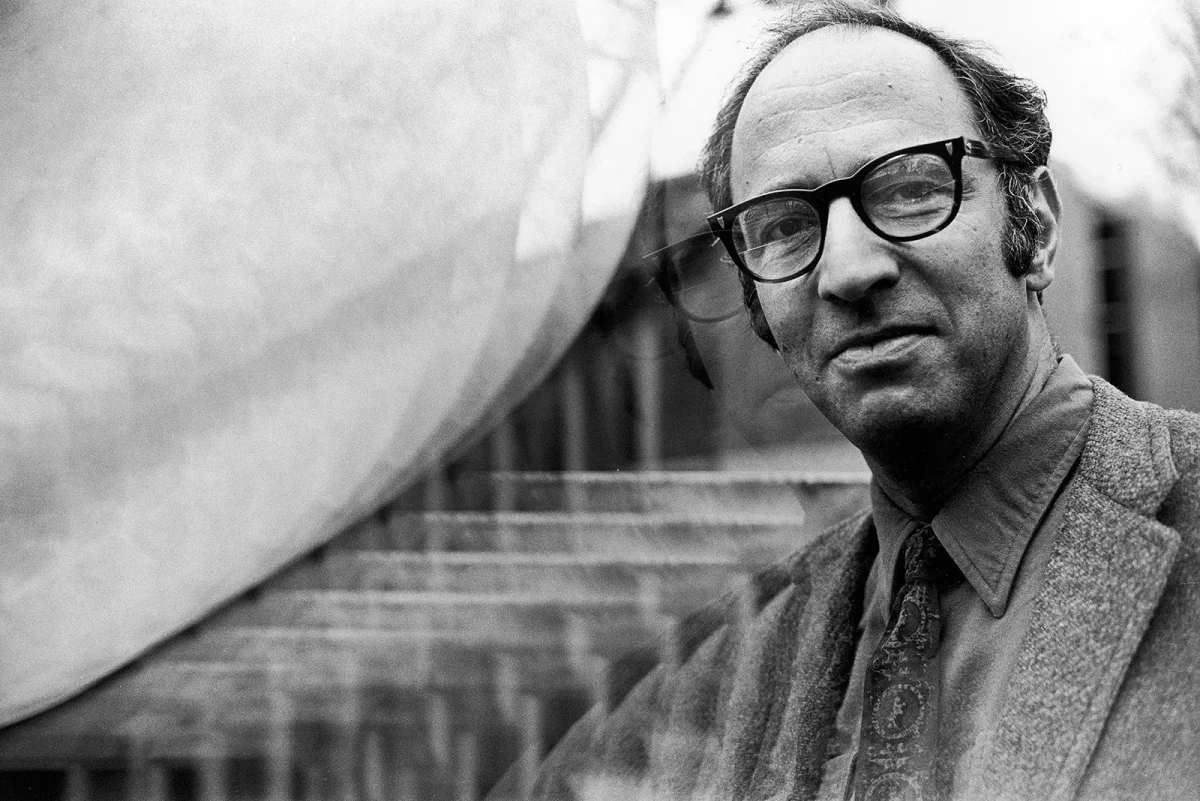
The Structure of Scientific Revolutions (Modern Library Nonfiction #69)

(This is the thirty-second entry in The Modern Library Nonfiction Challenge, an ambitious project to read and write about the Modern Library Nonfiction books from #100 to #1. There is also The Modern Library Reading Challenge, a fiction-based counterpart to this list. Previous entry: The Strange Career of Jim Crow.)

When I was a child in the 1980s, I observed many men in early middle age (i.e., my mother’s dates) using the word “paradigm” in everyday conversation.  At the time, my freshly budding mind associated the word “paradigm” with a specific series of television commercials known to frighten small animals that were then airing ubiquitously on UHF stations. These ads featured an exploding volcano and kept referencing something called “Dianetics” — an alleged “spiritual ideology” that had been devised by some guy named L. Ron Hubbard. 

Even in my younger days, I possessed enough critical thinking skills to detect that all this igneous noise between reruns of What’s Happening!! and Star Trek represented a business venture more than a religion. Years later, when I learned all about L. Ron’s grand scam, I realized that I hadn’t been far off.  Much like the man who had told my mother “There’s something of the devil in that boy” when I blossomed into a young atheist and started poking holes in the Bible during Sunday school after I was dragged against my will to church. This is probably why I took a shine to history and felt closest to “heretics” like Socrates, Joan of Arc, Oscar Wilde, and Galileo before I had even started fourth grade.

The commercials all featured a yammering synthesizer intended to suggest Vangelis-style import, with accompanying title cards citing allegedly seminal questions from the book.  But this manufactured cacophony only succeeded in giving me a throbbing headache.

I asked many of these men what “paradigm” and “Dianetics” were. They all told me that I was far too young to be positing such questions and proceeded to guzzle down more beer in one sitting than the weekly limit established by the National Institute on Alcohol Abuse and Alcoholism.

Nearly all of these men were balding and many of them had extremely thick mustaches. Now millennial hipsters can boast all they like about the soi-disant “lumberjack” movement in Williamsburg in the early 2010s or even the “slutty little mustache” that was popular for a while in dive bars.  But they had nothing on the thirtysomething and fortysomething men of that era. You see, after the sideburns craze of the 1970s, men who suffered from male pattern baldness had an overwhelming desire to grow hair in places where it could still grow — in large part because there was still an inexplicable shame in being bald.  (When I decided to go bald in my thirties after the curls above my forehead receded to a threadbare thatch that resembled a malfunctioning Chia pet, I eschewed mustaches.  Every time I tried to grow one, I looked like some gay porn star who had been flown in from Düsseldorf. And while I won’t gainsay that there were certain lovers who appreciated this aesthetic, particularly when my swiftly grown and objectively preposterous mustache was accompanied by my fairly accurate “bam-chikka-chikka” impression of period detail porn music in the boudoir, my great respect for the admirable mustache growers of the 1980s (along with my desire to eliminate the possibility of terrorizing strangers) curtails any need to sprout hair above my upper lip.)

You might say that the mustache trend among balding men in the 1980s was its own paradigm waiting for the likes of Sean Connery and Patrick Stewart (both not Americans) to demonstrate that it was okay to be bald and only grow facial hair if your face could pull it off.  But at the time, none of the men (even the ones without mustaches) could explain to me why they grew mustaches or even what a “paradigm” was. So I came to associate “paradigm” with cockamamie get-rich-quick schemes. Given that many used car salesmen during the Reagan era had mustaches (a detail that Robin Williams picked up in Cadillac Man), it all made sense within my young free associative mind.

It was not until I read Thomas S. Kuhn’s The Structure of Scientific Revolutions this year — a book that was one of the most frequently cited texts from 1976 to 1983 and a volume that I had put off reading for decades — that I started to more properly understand that “paradigm” was more correctly associated with knowledge, not dubious capitalist ventures. And that difference is vital to delineate in our age of limitless techbro grifters muddying the waters (quite literally with their data centers) with only a third-hand understanding of Kuhn’s true ideas.

The “paradigm grift” is perhaps observed most prominently today with the rise of AI, often described by starry-eyed marketing sociopaths as a “paradigm shift” occurring in real time. Yes, AI can automate a lot of repetitive tasks and definitely reflects a new era in computing. (I’ve found it particularly useful for parsing code, audio transcripts, and identifying spectral points on an audio file.) But it is still not a foolproof or financially sustainable technology, particularly given the considerable harm and significant error rates it has caused thus far. As Kuhn himself noted, when Einstein’s paradigm had superseded Newtonian science, “some Newtonians were so incautious as to claim that Newtonian theory yielded entirely precise results or that it was valid at very high relative velocities.” The fact that AI seems to be getting worse and less applicable to most business functions would almost suggest that it has already become some hoary failure in the grand scheme of science and technology.

AI thus represents a perfect litmus test for our widely name-checked but woefully underrated friend Mister Kuhn! To offer a recap of AI’s many mishaps and follies, Microsoft’s Copilot was so regularly inaccurate with its results that the software giant was forced to alter Copilot’s terms, pointing out that its unwanted Clippy-like AI feature was “for entertainment purposes only.” The sheer amount of AI financial waste is best summed up by the brutally truthful website Is AI Profitable Yet? (spoiler alert: it isn’t!), which also breaks down the 21st century answer to Tulpenwoerde by company. While blinkered techbro evangelists are inclined to look the other way on these points, particularly the exploitative slave labor required to establish LLMs (all of these capitalist horrors are documented in Karen Hao’s excellent book, Empire of AI), even respected Internet pioneers like Vint Cerf have suggested that AI is a paradigm shift. But Cerf doesn’t actually engage directly with Kuhn. He bases his claim on a wildly general definition (“changing the way things are done”).

Let’s unpack why this is wrong. If I were to learn to contort my hips by hiring a twerk instructor, I suppose this would likewise be “changing the way things are done.” Or, more accurately, changing the way in which a rather strange middle-aged man, one who hasn’t entirely atrophied and who can still cut the rug at a wedding or a bar mitzvah, negotiates a dance floor. But I could not in good conscience call my twerking erudition a “paradigm shift” — particularly since few people outside of my girlfriend would want to observe such a blinding booty pop. (And even she, being the sagacious and sensible partner that she is, would swiftly discourage me from such aesthetically frightening activity.)

A proper paradigm shift that upends human knowledge — as formulated by Kuhn — involves one or more of the following three foci: (1) a “class of facts” that a paradigm has demonstrated to be particularly revealing of the nature of things (think Copernicus stumping for the heliocentric model of the solar system as the hounding halitotic breath of geocentric Catholics blew fiercely upon his back), (2) natural facts that can be compared against the predictions of the new paradigm (e.g., Einstein’s theory of relativity, the big bang theory, Darwinism putting the final nail into the view that all species were immutable, germ theory dethroning foul-smelling air as the source of disease, et al.), and (3) a great empirical wave of data tabulation and fact gathering to confirm the new paradigm (for all of you quantum mechanics nerds, think of the giddy manner in which John von Neumann went to town measuring the physical attributes of Hilbert space). Certainly one can feed data into Claude or ChatGPT and have the AI engine return coruscating graphics and synthesized tabular data wrangling. But if one is asleep at the wheel and relying on either an autonomous car or cruise control, is this really driving? (This month, Anthropic’s recently introduced AI models, Fable 5 and Mythos 5, suggested the potential beginnings of a true paradigm shift. Unfortunately, both were shut down by the American government by way of an emergency export-control directive.)

I’m certain that any soulless free market crusader who happens to be reading this piece holds the diseased belief that scaling any venture in the most cartoonish manner imaginable will automatically accommodate all of Kuhn’s criteria. (After all, it worked for Jeff Bezos and Amazon!) But capitalism is not science and the pursuit of money does not ensure a windfall of knowledge (and vice versa). We saw this with the Piltdown Man in 1912, in which a grifter by the name of Charles Dawson claimed to have a fossil linking apes to humans. But when the scientists examined the fossil, they discovered that this phony “missing link” was little more than a mockup of an orangutan and a chimpanzee. (One can see similar “scientific breakthroughs” motivated by capitalism and/or the desire for fame, attention, and ladder-climbing with such hoaxes as the Cardiff Giant of 1869 and Shinichi Fujimura’s phony “discoveries” of “Stone Age artifacts” that he buried at archeological dig sites.) Anyone who has ever dealt with the greed of software vendors releasing a new version to fill the coffers rather than advance the product (particularly when a “new version” is indistinguishable from a patch release) knows quite naturally that an LLM does not automatically guarantee that you will replace a paradigm.

Additionally, Kuhn is careful to note that “special equipment” (he includes such examples as telescope technology, the Atwood machine, and Cavendish’s apparatus) is often required to extract and measure data associated with any given paradigm. AI has unquestionably accelerated turnaround time. But there’s an underlying question over whether augmented technology on its own is enough to create a paradigm. DNA sequencing is arguably a more salient example of a new technology creating a new way of measuring. It has completely overhauled forensic investigation, the ability to measure viruses that are too small to be seen through a microscope, and, should you opt to pucker your lips and spit into a 23andme kit, has opened the floodgates for extremely distant relatives to harangue you for unwanted brunch meetups when not bombarding you with certain probabilities about your future health flapped in front of you like an air traffic controller preventing a plane from crashing into a terminal. With AI, the paradigm shift is not as clear-cut. Just ask any gloomy white-collar worker held hostage in a corporate boardroom meeting by some executive demanding how AI is being used in his department. Even the cutthroat capitalists over at the Harvard Business Review recently had to confess that AI was “far from perfect for the task of evaluating text as a bona-fide, valuable, meaningful AI use case” and pointed to the inseparable role of human judgment in nearly all AI tasks.

To return to Cerf’s thoughts on AI, his strongest example of AI representing a paradigm shift lies in machine learning — in which every form of data imaginable (including your own private data and creepy scrapes from the dark web) is used to expand an LLM. Though even this “revolutionary” tool has any number of “erroneous hallucinations.” Cerf, to his credit, notes that all this “sets the stage” for a paradigm shift. So we aren’t necessarily there yet. Certainly the fact that data centers require a frighteningly gargantuan magnitude of resources (electricity, water, the innocent virgin blood of newborn babies, et al.) to fuel the enormous scale of computing power would suggest an overturning of previous conventions. But given that Sam Altman, Kevin O’Leary, Mark Zuckerberg, and other extremely obnoxious tyrants are using brute force to push through their data center projects and given that we are all being forced to use AI in our work even if it has no real application, is this more of a rigged “revolution” rather than a natural expansion of human knowledge? Kuhn observed rightly that Lagrange, Euler, Gauss, and Laplace all contributed some of the most brilliant work of their lives to reconcile Isaac Newton’s paradigm with what they observed in the heavens. And while Kuhn doesn’t expressly state that this type of scientific “mutual aid” — that is, the legitimate pursuit of knowledge existing outside the rigid boundaries of capitalism that I alluded to earlier — could be a vital part of locking down a new paradigm, it would seem to me that the tyrannical “every man for himself” mentality behind pushing AI into every corner of human existence (whether compatible or not) has less to do with natural evolution of ideas and more to do with involution and the capitulation of volition.

Moreover, Kuhn observes that an effective paradigm change is only successful if there is a “promise of success discoverable in selected and still incomplete examples.” With AI, we are obviously dealing with a new stratum that is wildly incomplete. Despite the massive leaps of GPT-5.5, the latest AI build comes saddled with plentiful capacity warnings, “agentic” limitations, and metadata bugs — all of which would suggest that the success we were promised by Altman and his stooges has been largely countermanded in situ. Kuhn further tells us that the actualization of a paradigm is only achieved by “extending the knowledge of those facts that the paradigm displays as particularly revealing, by increasing the extent of the match between those facts and the paradigm’s predictions, and by further articulation of the paradigm itself.” As recently as a few weeks ago, Google’s AI chatbots, seen through Gemini and its search engine, were proven to be easily manipulated — if anything, sullying the preexisting paradigm of knowledge with biased and inaccurate information. The two major political parties in America have reported significant problems with AI, ranging from Republican tech policy advisor Katie Harbath observing that AI is 90% wrong on midterm election queries to AI deepfakes of Democratic candidates used as campaign videos. Our preexisting knowledge of the facts is directly threatened by AI because AI is parasitically drawn to feed any garbage into its LLM and the makers of these almighty chatbots haven’t considered such vital and durable human practices like fact checking, skepticism, and critical thinking.

Of course, the stalwart AI champion who still believes that AI, largely used for mimetic parlor tricks, can generate new knowledge (OpenAI has been capable of writing its own code for the last year, which comes very close to a paradigm shift) will come at me with journalism being “the first draft of history.” Even Kuhn himself acknowledged that Newton’s Principia Mathematica contained meaning that was only understood when it was actually applied to a new paradigm. But Sam Altman and his fellow cronies are capitalists, not scientists. In Empire of AI, Hao describes the reckless manner in which OpenAI junked developer review before the release of GPT-4 without any plan in place by the company’s trust and safety team. OpenAI’s executives refused to give this team the resources it needed and it certainly wasn’t collecting the vital data points to assign unique identifiers to users. One vital observation from Kuhn is that paradigms are robust enough to insulate a scientific community “from those socially important problems that are not reducible to the puzzle form.” In other words, a true paradigm shift doesn’t just involve the tools (in this case, AI chatbots) that a new paradigm supplies. But we now live in a world in which DeepMind CEO Demis Hassabis wins a Nobel Prize for chemistry and talks about AI protein folding as “a puzzle.” And then there are the wags — like OpenAI co-founder Ilya Sutskever — who assiduously avoid the word “puzzle” even as they use phrases like “very confusing” or “strange” to describe the difficulties of arriving at Artificial General Intelligence, the great goal (the hoped for future paradigm?) of all these AI evangelists. A mischievous computer science expert, who rightly framed all this as “an inscrutable puzzle,” put Sutskever’s words into DeepSeek (another AI chatbot), asking about the intellectual viability of this vision. DeepSeek replied:

Sutskever’s performance here is a masterclass in how someone can, in the same breath, diagnose a fundamental methodological flaw and yet package it as a profound mystery, eliding the straightforward explanation that would undermine the very enterprise he’s built his reputation on.

When the very engine behind your professed paradigm shift calls you out on your bullshit, there’s a fairly strong chance that you may be running on hot air rather than substantive ideas.

Kuhn wrote The Structure of Scientific Revolutions with an understated eloquence guaranteeing to the reader that he had given serious thought and considered every possible angle about what a paradigm shift entailed. This is one major reason why it’s so disheartening to see marketing people (and even incurious men with mustaches) thoroughly cheapen Kuhn’s great contributions. It’s a significant insult to the serious thinking that Kuhn collected so valiantly into a short and highly readable book that wanted to reckon with the often awe-inspiring manner in which humankind expands its collective mind. In one chapter documenting the discovery of oxygen, Kuhn notes that three separate people (Scheele, Priestley, and Lavoisier) were involved in unpacking the world’s most famous element — indeed, the very thing we silly ape-descended life forms need to survive. And given such complexity, it is often impossible to nail down the precise point in history in which this was a bona-fide paradigm shift. Just as Spider-Man understood that with great power comes great responsibility, so does any real scientist understand that a bona-fide paradigm shift is not something to apply to scientific knowledge like some college kid thoughtlessly putting on a random T-shirt while nursing a massive hangover.

There’s admittedly a case to be made about what conditions would allow AI to invoke a legitimate paradigm shift. Having a series of rules would be one way to bolster it. Avoiding gimmicks (and changing the end goal for every new iteration of GPT to avoid marketing gimmicks) would be another method. As Kuhn helpfully informs us, “Normal science does not aim at novelties of fact or theory and, when successful, finds none.” The gee whiz factor in science is more for the spectators sitting in the bleachers rather than the methodical scientists.

Kuhn’s book is a vital reminder in an epoch of limitless con men of what we should properly identify as a revolutionary change in human knowledge. Had many of the men whom I encountered in the 1980s taken the time to teach their kids about what Thomas Kuhn was really trying to tell us, we might have had a larger army of doubting Thomases rightfully practicing their critical thinking skills against the many fraudsters and swindlers who have somehow persuaded easy marks that they are geniuses.

Next Up: Jonathan D. Spence’s The Gate of Heavenly Peace!

Lucy Ellmann and Galley Beggar Press Are Racists

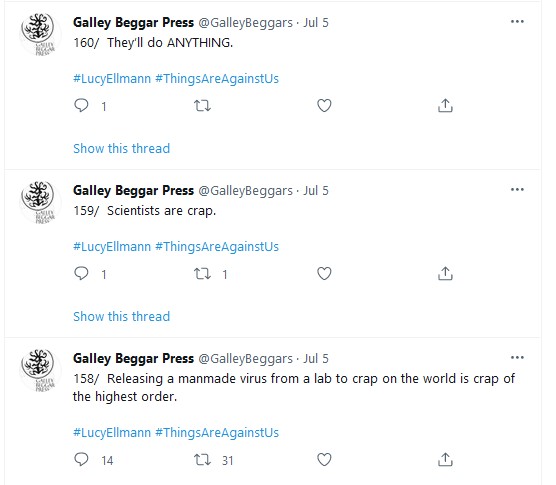
I’ve heard from three people — privately and confidentially — about what a narcissistic monster Lucy Ellmann is. I was crazy about her novel, Ducks, Newburyport — so much so that I even put together a list of all the music cues contained in the massive book. But the stories about her put me off. I was prepared to ignore Lucy Ellmann for the rest of my life, possibly reading future volumes of hers once my animus towards her had died down a bit or, ideally, after she herself had kicked the bucket (one should try to separate the art from the artist and, let’s face it, there’s no better time to untangle such a thorny moral predicament than one year after a repugnant author has died). But on Monday, some of Ellmann’s ugliness bubbled up to the surface in a vile, racist, and anti-intellectual 256 tweet vomit that she posted under the Galley Beggar Press Twitter feed.

The “essay” — if it can be called that — was unaccomplished penny-ante postmodernism, reading almost as if Lydia Davis had a lobotomy but was still somehow allowed to publish just after some opportunistic huckster (in this case, Sam Jordison) had learned that there was enough frontal lobe left in the old bag’s head to bang out a few words. The “essay” is an uninventive laundry list of things that Ellmann deems crap. Very obvious targets like Jeff Bezos, macaroons, terrorists, Boris Johnson, et al. In other words, the kind of hacky standup material that wouldn’t even fly on open mic night. Followed by more subjective objects of hate, such as Jeopardy!, Judy Garland, video games, and Tom Jones. At this point, the “satire” extends to nearly every state of existence (dying young, being a kid, being an adult) until it reaches a desperately racist and anti-intellectual crescendo here:

Hilarious! Genius!TM Good Christ, I’m pissing on every pair of pants I own right now!

Hardly. By cleaving to a racist conspiracy theory like this, even under the old hack’s parlor trick of using “satire” as a defense for vile sentiments, Ellmann is clearly siding against science and against intellectualism. The so-called “Wuhan lab leak” theory neatly aligns with other racist conspiracy theories such as the “great replacement” theory — a detestable strain of racism that has been used to justify Islamophobia. Moreover, the Wuhan lab leak theory has led to a rise in hate crimes against Asian Americans. Shall we talk about the man who stabbed three members of an Asian-American family (including two children younger than 6) because he believed that they were “Chinese and infecting people with the coronavirus”? Or how about the creep in Boston who followed a Chinese American doctor from a hospital and screamed, “Why are you Chinese people killing everyone? What is wrong with you? Why the fuck are you killing us?”

This is the virulent racism that Lucy Ellmann commits herself to.

Ellmann knew damn well that her bullshit would grab the attention of an audience. Her casual racism aligned neatly with Quentin Tarantino’s racist falsehoods against Bruce Lee. If this was comedy, well, it’s indistinguishable from the vituperative hate that one can finds in a soulless prop comic like Gallagher. The upshot is that Ellmann’s promotional strategy represents a book publicity problem we’re not talking about. White people can spout off anti-Asian sentiments to get attention and sell books. And Galley Beggar Press, being the true cynical fuckwits that they are, can bask in the glory, claiming that anybody who objects to the dissemination of an unproven racist lie in the name of “art” needs to lighten up.

But even if the tweetstorm had not contained the racism, it says quite a bit about Galley Beggar Press’s lack of editorial standards that they would honestly believe that such cartoonish nihilism was the stuff of “boundary-pushing literature.” This indie press is more of a religious cult where a “genius” author can do no wrong. I suppose Sam Jordison fancies himself a Barney Rosset of our time, but Lucy Ellmann is hardly on the level of Ioenesco, Beckett, Robbe-Grillet, Genet, or even de Sade. There is nothing artistically redeeming about what Lucy Ellmann published on Twitter. It isn’t doing anything innovative like Naked Lunch or Lady Chatterley’s Lover. It is simply the random spew of a 64-year-old loser who has nothing left in her vestibule of tricks other than cheap “provocative” vacuity.

A number of people pushed back against Galley Beggar on Twitter for publishing Ellmann’s racism. But something interesting happened along the way. Gallery Beggar began blocking critics of the Ellmann who were Asian (such as Bloomsbury marketing executive Wei Ming Kam), but refrained from blocking critics who weren’t Asian. In other words, Sam Jordison went well out of his way to target those of Asian descent and showed very much how he was an upholder of systemic racism.

I want to be clear that Ellmann and Galley Beggar Press should be free to publish whatever they want. But let’s stop rewarding any author who believes that anti-Asian hate is the best way to get attention. Anti-Asian hate crimes have risen 164% from last year. It seems to me that every writer has a duty to be more sensitive to this.

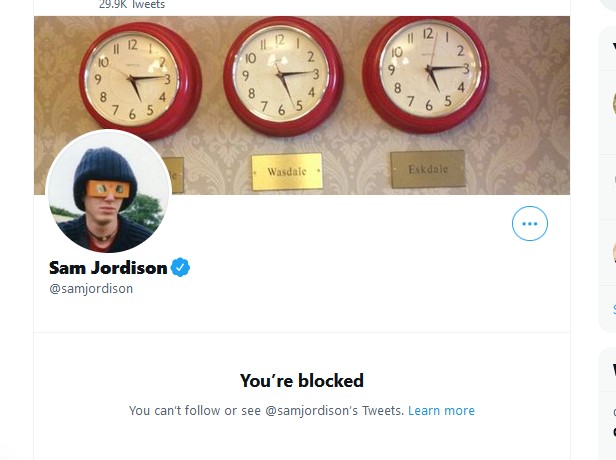
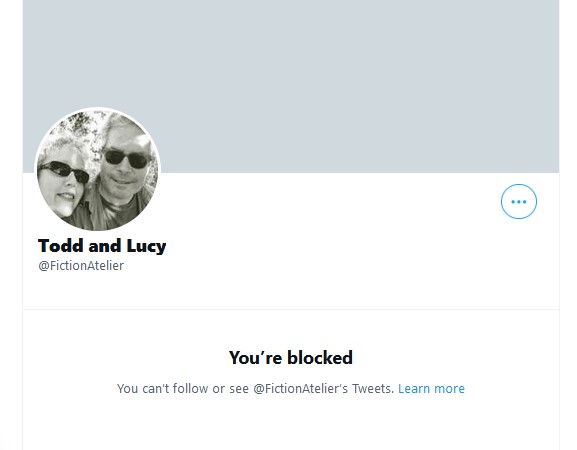
7/6/2021 1:15 PM UPDATE: Galley Beggar’s Sam Jordison and Lucy Ellmann have blocked me on Twitter, proving that they are both top-tier racists:

Crime Junkie: How the Most Popular True Crime Podcast Turned to Serial Plagiarism

Ashley Flowers was an Indiana native with big dreams, slick sales savvy, and a fierce determination to be number one. She was in her late twenties. She’d earned a bachelor’s degree at Arizona State University. She’d studied genetics at the University of Norte Dame. But in September 2016, the world wasn’t bending the way she thought it would. Ashley’s biotech background couldn’t land her a steady paycheck. So she worked as a software sales exec and made the best of it. Instead of squinting at genomes, she was poring over revenue reports.

She kept the tech gig because the place was dog-friendly. She could toil while Charlie wagged his tail just next to her. A playful pooch with a big bark. Proudly featured on the company’s Instagram feed. An important part of her life. The first taste of working on her own terms.

She wanted more.

She found some hope in what she had. The Crime Stoppers of Central Indiana, where she volunteered and eventually served on the Board of Directors. An important figure. A respected position. A childhood friend named Brit Prawat who shared the same birthday. A brother named David who knew how to edit or who could, theoretically at least, figure out how to. Important connections. The fond memory of watching “geriatric” mystery shows with her mother. An important formative experience. A weekly morning radio segment on Radio NOW 100.9 called Murder Monday, where she’d get up very early and be at the microphone by 7:30 and join Joe and Alex and talk about murders and missing people and creeps lurking in the night and maybe get a little attention. Important attention.

And she liked that. Both the attention and being on the radio.

But why couldn’t she be bigger? And why couldn’t the segments be longer? And why shouldn’t she make money at this? Ashley figured she could pack away some dough and beat them all her way. By working harder than anyone else. Three hours before work. Late into the night after work. She’d listened to true crime podcasts. All of them. Or so she told everybody. Why couldn’t she do it?

And so she did. The program was Crime Junkie and it had a winning formula. Two friends gossiping over a cold case or a grisly homicide as if they were discussing the right apricot chutney to serve with the duck breasts. But somehow it worked. Brit playing the bewildered pal muttering many wows as Ashley told her the crime story. No ad libbing. All of it tightly scripted. Or as scripted as she could make it. There were only so many hours each day. With David cutting it all together. A family affair. Two childhood friends together on the podcast, even though they were separated by a two and a half hour drive between West Lafayette and South Bend and they only seemed to see each other when they made promotional appearances.

She put up a new thirty minute podcast every Monday. Longer than her radio spots. On her own terms. And it blew up. With cards placed in women’s restrooms. Loads of cards. And marketing. Paid marketing, as Ashley was to tell two Italian dudes who ran a podcast in her hometown. What kind of paid marketing? Well, some have speculated. The numerous five star iTunes reviews — with their repeat use of “love this podcast,” double exclamation marks, and “obsessed” — were fishy, as were the questionable user names, which included such improbable identification choices as “Addyjeannnewcomb1234” and “vgifddssetivdyiogfdgjobvr.” The download stats were wonky. How does a show jump from nine million monthly downloads in March to sixteen million in July? What “paid marketing” cooked these numbers? Again, we can only speculate.

But who really cared? Ashley and Brit were a success. The United Talent Agency came calling. For the right price, you too could blow the entirety of your quarterly budget to have Ashley Flowers fly out and speak to you on one singular but vitally important topic: “A Conversation with Ashley Flowers.” There was a TV deal. A second podcast series. An empire to build. What could go wrong? Ashley and Brit sold out every damn venue on their maiden live show tour. Every show. You can’t argue with results. Multitudinous meetups where the duo had charmed crowds. It is estimated that Crime Junkie now earns somewhere between six figures and seven figures each year. This buys, as the old saying goes, a lot of corn chowder.

There was just one problem. One very serious problem. A math problem. A time management problem. Those twenty-five to thirty hours that Ashley spent each week to write and research the show simply weren’t enough. Ashley had to cut corners. Somewhere. The money was important. The attention was important. The adulation from her fans was important. She squashed any comment that wasn’t a fawning compliment on the Facebook forum like a bug zapper sizzling a pesky insect. Because successful people have to stay successful people. And if they believe in success, then other people will still believe they are successful.

Even when they break the rules.

And so Ashley Flowers decided to become a serial plagiarist. Sometime around the twenty-fifth episode. Continuing to this day. (Crime Junkie has released 95 episodes to date, with a June 24, 2019 episode devoted to Amanda Cope pulled after Flowers got many details wrong. Flowers released a new Episode 87 dedicated to the Sumter County Does on July 1, 2019.) Because it was her show, she had no one to answer to.

Ashley read the words — verbatim sentences or lifted syntax with willowy asides to disguise the outright theft — from Wikipedia, from passionate podcasters who put in unpaid hours doing their own research and who formed their own conclusions, from journalists who spent the day sifting through public records and who toiled for months getting their sources to trust them. Crime journalism is not a field for the timid. But Ashley was not a journalist. Still, the ends justified the means. At least that’s what Ashley kept telling herself.
But then came two vital whistleblowers: (1) The journalist Cathy Frye left a comment on Ashley’s Facebook page on the evening of August 11, 2019, pointing out how her four part series on the 2002 murder of 13-year-old Kacie Woody, “Caught in the Web,” had been severely cannibalized for “entertainment.” Frye noted that she had “spent months” working on the series and that the details that Ashley relied on could only have emerged from her exclusive time-consuming work (as BuzzFeed‘s Stephanie McNeal would report four days later, the project had “sucked a big part of [Frye’s] soul,” with Frye taking months to get Kacie Woody’s father to talk). (To get a full sense of the scale here, this document points out just how thoroughly Frye’s work has been scraped and repurposed without credit.) (2) A cheerful true crime fan by the name of Millicent Tirk who could no longer stand to see the work of her friends stolen and who, on August 13, 2019, called out Crime Junkie on Facebook. The failure to credit hard work and the subsequent outrage whipped up the true crime community, with many unsubscribing from Crime Junkie as articles in Variety and The Week started bubbling up the news feed.

When it finally started to go south for Ashley, when the many shocked listeners discovered more than one hundred instances of plagiarism and who knows how many more (all carefully collected on a Google spreadsheet generated during the course of this investigation and, most glaringly documented on YouTube by Trace Evidence‘s Steven Pacheco), the thefts were appearing nearly every week. But Ashley didn’t care. She would never acknowledge her wrongdoing, a series of transgressions comparable to those that derailed Janet Cooke (forced to return her Pulitzer), Jonah Lehrer, and a magazine that lifted recipes. She deleted episodes that had contained vast swaths of cutting and pasting and reciting, as if the words had emerged wholly from Ashley Flowers herself. Episodes revived from digital extinction with the help of three anonymous listeners — when it became necessary to create a mirror of the entire Crime Junkie archive just in case Ashley decided to delete additional episodes — revealed the plagiarism in glaring detail. When Ashley and Brit released Episode 94 on August 19, 2019, the week after the plagiarism news hit and stunned many, the two did not acknowledge the behavioral pattern that had been exposed the previous week. But there were four bright new lifts from Wikipedia. Ashley and Brit were making money. They had won fame. All Ashley had to do was pluck the work of others and claim it as hers and keep on doing this. Surely nobody would care. And because the numbers hadn’t dipped that much, she believed she could keep this ruse going.

But many previously loyal fans — such as a Reddit user named @spoilersinabox — feel betrayed by Flowers’s failure to acknowledge her wrongdoing. Spoilers, a 27-year-old teacher in the DC area who requested anonymity, became aware of Crime Junkie while awaiting a seven hour flight thanks to an Apple recommendation — a recommendation fueled by the numerous five star reviews — and quickly became a fan. “It was just the tone that Ashley and Brit had as they were talking. There’s something about a soothing voice. I said, ‘I can get behind this.’ It sounded as if they had really researched the crime.” Spoilers wanted to support Flowers in her research. She attended the first live Crime Junkie show in DC. She told her friends and family about it. She then became a Patreon regular, pledging $20 a month, believing that her money was going into “the tools and time to do research.” Spoilers cited a second podcast that initially appeared on the Crime Junkie Patreon page before disappearing without explanation.

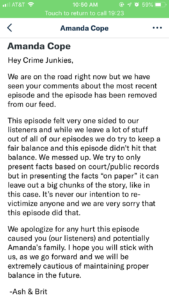
When Ashley and Brit issued a statement (pictured right) about the pulled Amanda Cope episode (the original Episode 87), Spoilers respected the thoughtful and “mature response” and was willing to give the two hosts the benefit of the doubt. When I asked Spoilers if she could forgive the two hosts for their plagiarism if they owned up now, she said, “On Thursday and Friday, I might have. At this point, I can’t.” She said that she felt guilt. “My time and my money should have gone to the people who told these stories first.” She remains angered that so many people have not comprehended the full scale of Flowers’s plagiarism. “Kudos to them,” said Spoilers. “They’ve pulled off a really good scam.”

Two other former fans, both of whom requested anonymity because they feared repercussions from the show’s fan base, told me over the phone that they had similar feelings — that they had been initially inclined to extend contrition to Flowers. But like Spoilers, they felt that Flowers’s silence spoke for itself. The moment had sadly passed.

As of this writing, Flowers and Prawat are gearing up to begin a second tour — this time, involving seventeen live shows, all reportedly based on the murder of six-year-old Isabel Celis, with ten of the shows presently sold out. This tour represents a sizable haul for the Crime Junkie crew, but fans who purchased tickets before the plagiarism controversy and who feel uncomfortable about supporting a program that steals content verbatim may not realize that there is no refund or exchange policy for these shows. A representative from the Parker Playhouse in Fort Lauderdale, Florida informed me that the January 17, 2020 show was still on. NO REFUNDS OR EXCHANGES. Indianapolis. Show on. NO REFUNDS OR EXCHANGES. Orlando. Show on. NO REFUNDS OR EXCHANGES. Atlanta. Show on. But you can only refund your ticket if you purchased it at the box office. And most people didn’t. NO REFUNDS if you purchased it online. Austin. Show on. No refunds. “The only thing we can do is give the tickets to someone else.” The average seating capacity for these venues is around 800. The ticket prices range from a $31.50 balcony ticket at San Diego’s Balboa Theatre to a VIP Meet & Greet package at $103 at the Chicago Athenaeum Main Stage. If we assume that the average ticket price is $50 and the average seating capacity, this adds up to $680,000 if the shows all sell out. If Flowers and Prawat take home 25% of this, then that’s $170,000. More corn chowder to buy.

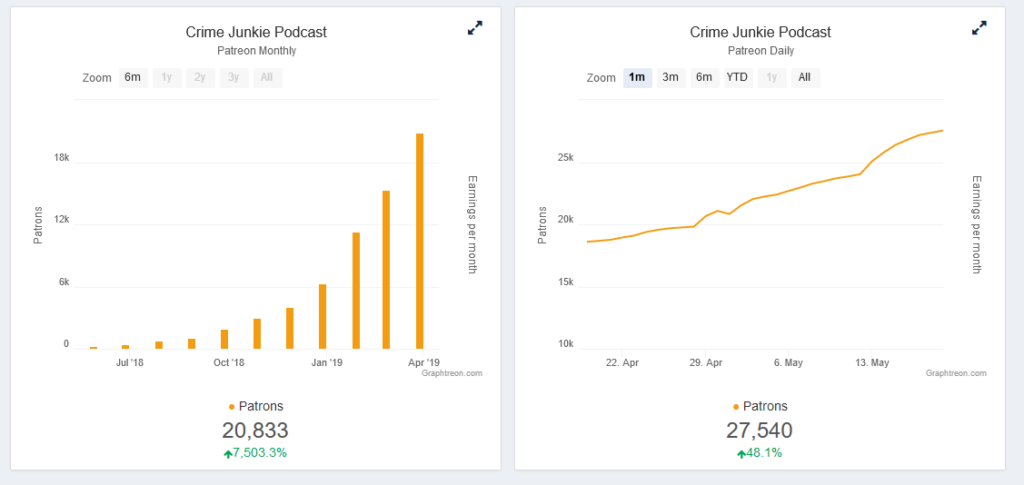
Because Crime Junkie has continued to plagiarize in its most recent episode, one must naturally ask whether it will continue to profit greatly from the hard work of others. I looked into the sources of revenue that keeps the show going. I put in calls to AdSense, which provides ads for Crime Junkie, asking what their position was on financing sponsoring content that had been lifted verbatim elsewhere. The firm declined to comment. Presumably, Crime Junkie will hold onto many of the estimated 27,540 fans who support their show (the exact number has been hidden on Patreon) — with varying tier donations of $5 to $20 each month. (At $5/month, this works out to $137,700 per month or $1.6 million each year.) While some have publicly announced that they would no longer be supporting the show on Patreon, Reddit users noticed on Monday that Ashley and Brit may have recently changed the tier rewards without informing their listenership. (Attempts to confirm this through Web Archive proved inconclusive.)

There’s also the question of whether a podcast that cribs content from other people is a legitimate journalistic outlet. Should Crime Junkie be granted exclusive access to vital police records, as is now the case with the duo’s planned second podcast? Flowers’s influence and coziness with local law enforcement led Chris Davis, producer of the 3C Podcast, to be barred from examining records pertaining to the November 17, 1978 Burger Chef murders — an unsolved Indiana case for which he has produced fifteen episodes. Davis told me that Sheriff Bill Dalton of the Indiana State Police declined both his unofficial and official requests to look at the files. (Dalton, who was in the middle of an investigation, was unavailable for comment. But I did speak with someone at the ISP who had worked closely with Dalton and who had been there for thirty years. This person informed me, “We have a tight lane around here. So we don’t allow a lot of people here.” This makes Flowers’s access even more uncommon and more surprising.) The official request took five months to elicit a response. In both cases, Davis was denied because of an investigatory records exemption. But the prohibition also arose because Flowers had cut an exclusive access deal, where the police would have complete control of the finished product. This was a decidedly sketchy journalistic arrangement.

“She was granted access and I have no qualms about her getting access,” said Davis. “At the end of the day, I want this case solved. We started our journey the same way.”

When I asked Davis if he would consider collaborating with Flowers or asking her if he could take a look at the records for his own investigation, he said no. He pointed to an incident in which Flowers posted a picture on social media of the old Burger Chef building with the tagline, “Guess what case I’m working on?” He replied with friendly humor, “Oh, I think I know.” Davis was swiftly blocked by Flowers on all social media immediately after.

While working on this story, I made every effort to contact Ashley Flowers. I really wanted to listen to her and understand why someone would do all this. Because one cannot deny the allure of hearing about a murder in a soothing voice. It’s one of the reasons why I love the podcast Criminal so much. As I listened to multiple Crime Junkie episodes, examining them for plagiarism, I felt increasingly sad and sorry for Ashley Flowers. Because she really was onto something with her format. Take away the speculation about automated iTunes reviews or even the profit and power motives or the errors she has sometimes made and the sonic aesthetic of two besties getting together to discuss crime possesses tremendous appeal. But here’s the thing: Flowers is even more fun and charming when she speaks in her own voice and expresses her own thoughts, as this interview with Espresso clearly reveals. Anyone who reaches people like this deserves great success, but it must be a success predicated upon her own work and her own voice.

Flowers did not return my calls, my emails, and my direct messages through social media. She’s still saying silent. A veritable content outlaw hiding in plain sight. I’ve learned that The New York Times is also working on a Crime Junkie plagiarism story. Will she say no to them?

But that’s not even the important question about Ashley’s serial plagiarism. The real question, the question often put forth to any addict before she admits that she has a problem, is whether Ashley can even stop.

[8/23/2019 UPDATE: The New York Times has reported on the Crime Junkie plagiarism. The only new information here is (a) some quotes from those were plagiarized, (b) Flowers did not responded to the Times (except through the same statement issued to Variety) and (c) Pacheco approached Flowers with a lawyer, sending along transcripts with time marks for seven episodes. As a result of Pacheco’s efforts, Crime Junkie pulled a few episodes.]

The Bat Segundo Show: Susan Cain

Susan Cain appeared on The Bat Segundo Show #430. She is most recently the author of Quiet: The Power of Introverts.

SPECIAL BOOK GIVEAWAY: Are we all prone to the malady of the introvert who turns away and gazes only upon the emptiness within? Perhaps this conversation about introverts will clear up this Bertrand Russell idea. And perhaps you, dear listener, can weigh in. The Bat Segundo Show is giving away two copies of Susan Cain’s Quiet. All you have to do is email ed @ edrants.com with the subject line QUIET GIVEAWAY before February 7, 2012. Tell us when you first knew you were an introvert or an extrovert and what effect this has had on your life. Don’t worry. If you’re feeling shy, you can stay anonymous and we’ll keep your names confidential. We’ll read some of the stories on a future program and give away two copies of Quiet to two random people.

Condition of Mr. Segundo: Wondering if Zeno’s paradox is applicable to social types.

Author: Susan Cain

Subjects Discussed: Establishing terminology of introverts and extroverts, David Sloan Wilson, new Kinsey scales, Carl Jung, Jonathan Rauch’s “Caring for Your Introvert,” Google and Apple offered as “introvert comeback” examples, introvert glamour in the 21st century, how the loner idea has changed in American culture, Steve Wozniak, Edward Bernays, Western culture founded upon Greco-Roman ideals, how oratory has driven the spread of Western culture, going to business forces and corporations to understand introverts, Tony Robbins seminars, the self-help industry, the ideal self as a marketing device, Mihaly Csikszentmihalyi’s idea of flow, Peter Hills and Michael Argyle on happy introverts, how flow and happiness differs between introverts and extoverts, responding to myths that introverts aren’t social, the fine line between introversion and misanthropy, Jason Fried’s “No Talk Thursdays” idea, Wozniak’s Homebrew Computer Club, extreme positions from introverts and extroverts, “how to talk to strangers” workshops, the Solomon Asch experiments, conformity and groups, mimicking the opinions of other people, “fitting in,” Gregory Burns’s experiments with the amygdala and groups, high reactive types, shyness, introverted Asian-American populations in Cupertino, pluralism movements involving introverts and extroverts, Jerome Kagan, nature vs. nurture, interactionism, Alex Osborn and brainstorming, Robert Sutton’s response to the brainstorming dilemma, the problems with multitasking, group cohesion in brainstorming, avoiding lopsided perspectives, parents with introverted children, the No Child Left Behind Act, the advantages of role-playing and improvisation, smiling, public speaking as the number one fear, introverted actors and the performance mask, Brian Little looking into introverts being overstimulated, stage fright, being a member of Toastmasters, impromptu speaking, the advantages of anarchy, intense curiosity, Picasso, connections between solitude and creativity, and answers to charges that introverts are filled with hubris and narcissism.

EXCERPT FROM SHOW:

Correspondent: I should point out that, as an ambivert, I’m one of those types who swings both ways. I go ahead and ingratiate myself with all forms of version. I’m wondering if it’s entirely productive to divide the world into these two austere bipolar categories. As you point out in the book, David Sloan Wilson applied these labels to the fruit fly. And I’m wondering if, say, a Kinsey scale of 1 to 6 — to pound the metaphor in here further — is probably more applicable for this kind of thing. I mean, why should introverts of all stripes be lumped together?

Cain: Yeah Okay. So that’s actually a really important question that you’re raising. And the reality is that there’s an introvert-extrovert spectrum and that we’re all situated on different points of the spectrum and that even people who are on the extreme end of the spectrum, whether introverts or extroverts, have sides to themselves that are the opposite side. And Jung — Carl Jung, who is the psychologist who actually popularized these terms — speaks about that. And he says that there’s no such thing as a pure introvert or a pure extrovert and that such a man would be in an insane asylum. So it’s an important question that you’re asking. But at the same time that this is true and that we’re all a glorious mishmosh of traits, there is also a reality to what it means to be, in general, oriented towards the outer world or, in general, more oriented to the riches that are inside your own mind. And these things I believe, these orientations, shape who we are in ways that are as profound as our gender shapes us.

Correspondent: But gradients of orientation. I mean, that’s the key thing. Jung, of course, as you point out, he popularizes the terms in 1921. You have Hans Eysenck doing research in the late 1960s, hypothesizing that humans sought “just right” levels of stimulation. And he ran some tests. So where do we, I suppose, calibrate ourselves if we’re all going to all refer to people as “You’re only an introvert” or “You’re only an extrovert.” I mean, we could get vertist, so to speak. (laughs)

Cain: Right. I guess I would take the “only” out of that formulation. It’s not “you’re only an introvert” or “you’re only an extrovert.” You’re a million other things as well. But I guess a metaphor that I could give for you, that I think is helpful here, is gender. So if I had written a book that presumed to say, “Here’s what men are like and here’s what women are like,” I probably would have been able to get it mostly right describing these categories as groups. But in the case of any one individual, there are going to be men with all kinds of female characteristics and women with all kinds of male characteristics. That doesn’t mean though that there’s no such thing as maleness or femaleness. And that doesn’t mean that these things aren’t hugely important and shape our lives in ways we need to pay attention to.

Correspondent: Yes, but such a book would spawn a million Jezebel threads.

Cain: (laughs)

Correspondent: There’s a danger, I suppose, in cleaving to these labels. And I guess maybe another way of trying to figure out what’s going on here in terms of the schism between the introverts and the extroverts is through a wonderful 2003 Jonathan Rauch article in The Atlantic, not quoted here.

Cain: Yes. Fantastic article.

Correspondent: “Caring for Your Introvert.” He was willing to go on the line and say that introverts are oppressed. I’m wondering if you would go on the line as well. You didn’t in this book. But to what degree are they oppressed? I mean, since 2003, we’ve seen Google and Apple, products of introverts, spring up. And we’re all enslaved by them. So I think the balance may be more or less stabilized. What do you think about all this?

Cain: Okay, so first of all, I would say I did go on the line in this book. And the central thesis of my book really is there is a severe bias against most introverts in this society and that operates to all of our losses. Certainly to the loss of introverts who get the message in a million different ways that there’s something wrong with who they are. But I think it operates to the loss of everybody. Because when we set up society in a way that depletes the energies of half to a third of the population, that’s not in anybody’s best interest. So that’s my feeling about it.

Correspondent: But no real oppression. I mean, if the extroverts are in control, do you think that there’s been enough of a comeback of the introverts in the years since that Rauch article?

Cain: Well, okay, so I think it’s an interesting thing. When I talk about a bias, I’m not saying, “Well, therefore introverts have had no happiness and no success in society.” And the examples that you just gave are very interesting and apt ones. But here’s the thing. Those examples, they’re not accidents. We tend to have respect for the loner who’s operating in his garage and is about to launch a fabulously successful company or who holds the promise of launching such a company. We have respect for that person. Because that person carries with him the whiff of great wealth or power. But what I’m talking about is something that operates at a deeper level of self. And the fact is that if you look at our schools and our workplaces, the institutions where we all spend our lives and where our daily happiness is shaped, those institutes are set up for extroverts. In ways that we’re not aware of. So children from the time they go into preschool at a very early age, they are going into an environment that is a group environment where they are expected to behave in certain ways. I’m not saying this is all a bad thing. But I am saying that it’s set up in such a way that introverted children from the get go are kind of expected to act in ways that are being not themselves.

Correspondent: Yes. But it’s interesting to me that the loner has moved from the sort of James Dean Rebel Without a Cause/Marlon Brando kind of thing to the guy going ahead, like Wozniak, and fiddling around with tools in his garage, in his bedroom, starting a company. And I’m wondering if the loner model has always been associated with introverts or whether there has been some outsider label instead. It seems to me that, because the idea of being a loner was predicated in some way on being a loner in relation to society, you weren’t entirely an introvert. You were more an outsider. You were still an extrovert in some sense. And yet it has moved in the decades since to the Wozniakian model, where you’re tinkering with some massive project that’s going to change the world in your garage. I’m wondering if you had some thoughts on why “loner” has almost been co-opted and has become more related to this introversion idea.

Cain: Oh, that’s interesting. I think that’s probably just a function of the role that technology has played in the last decades. You know, what you’re talking about really is ways in which we have shifted notions of glamour as attached to individual people. So in the ’50s, the decade of conformity, there was a glamour attached to the figure who could stand outside that and still have sex appeal. And then what happens in the decades of technology is suddenly we have introverts who, just because of their great technical competence, can create wealth and power. And so glamour attaches to them.

Correspondent: Introverts aren’t sexy? I think they are. I think they’re being celebrated in our culture. The “Think different” billboards that we got with Apple. It’s been all about “Yes, introverts are sexy. But we just don’t communicate with other people.” You think that they aren’t sexy these days?

Cain: No, what I was saying is that what was happening as technology grew up was that there was a glamour that was attached to that. But what I still believe is that that’s a subset of the reality of what it means to be introverted. And even if you go out to Silicon Valley, the heart of the subset where you would say that this glamour model for lack of a better word is operating — you know, even in Silicon Valley, I went out there while I was researching my book. And I talked to many introverts who were working there. And even there, they feel that their personality style is not validated, that it’s not celebrated. And they’re constantly exhorted to act in a way that’s not natural to themselves.

Correspondent: I suppose this relates to the initial line of inquiry. When you are talking about introverts, when you are promoting introverts, they inevitably feed into this marketing, advertorial sort of approach, where it’s not so much about trying to understand the introvert’s place. It’s more about promoting the introvert. This leads me to also name a figure who you didn’t name in the book — Edward Bernays. I mean, we were talking about Jung earlier. But he relied upon Freudian ideas to promote the idea of being empowered, that manipulation could be used to factor in the herd crowd. “Herd” is a word used frequently in your book. Do you think that one of the problems with introverts being misunderstood or not accepted has a lot to do with this maligning or skirmishing of psychology with these larger marketing forces?

Cain: Well, I think that it goes back even earlier than that. It starts out with there being this kernel in our society. We are a culture that is grounded on Greco-Roman ideals. And these are ideals that celebrate oratory and celebrate being able to declaim in front of people. So that’s a piece of it. But that’s only a small piece really. Because what really happened was, at the turn of the 20th century, we moved from what cultural historians call a culture of character and we moved into a culture of personality. And this happened because suddenly we had the rise of big business. And we had urbanization. So you had people flocking into the cities. And instead of living in small towns and working with people they had known all their lives, they’re suddenly in big cities applying for jobs at corporations, where everything depends on their abilities to shine at a job interview and to be able to sell their company’s latest gizmo and, of course, to sell themselves. At the same time, you have the rise of movies. And movie stars are the perfect model for this.

Correspondent: Of course.

Cain: They are the ultimate role models of this kind of charisma that people are starting to feel they need in their everyday lives. And so in a way, there used to be in the earlier years of this country’s founding, where it used to be that these oratorical skills and this ability to command a crowd was seen as being important only for political figures. Now it was something that everybody suddenly had to have. And at the core of all this was the corporation really. That was why people started to feel that they needed to have these skills.

The Bat Segundo Show #430: Susan Cain (Download MP3)

This text will be replaced