We Are Not Weaker Than the Tyrants

“All violence consists in some people forcing others, under threat of suffering or death, to do what they do not want to do. And therefore those who are coerced will only do that which they do not wish to do while they are weaker than the tyrants and cannot avoid doing it from fear of the threats for not fulfilling what is demanded. As soon as they grow stronger, they naturally not only cease to do what they do not want to do, but, embittered by the struggle against their oppressors and everything they have had to suffer from them, they first free themselves from the tyrants, and then, in their turn, force their opponents to do what they regard as good and necessary. It would therefore seem evident that the struggle between oppressors and oppressed cannot unite people but, on the contrary, the further it progress the further it divides them.” — Leo Tolstoy, “The Law of Love and the Law of Violence”

It was a political act committed by a weak man. Don’t let any sugarcoating naif or maundering bumpkin scared to stare down the truth tell you that it wasn’t.

Congresswoman Gabrielle Giffords, a pragmatic Blue Dog Democrat in Arizona, was shot in the head at point blank range while holding an informal town hall meeting at a supermarket. A federal judge is dead. Five others, including a nine-year-old, are also dead. They did not want to be dead.

These were assassinations. Assaults on people who, never mind their party, wished to engage in civil discourse. It was a secret attack designed with a political point in mind — one that told us that, no matter where our position on the political spectrum, our thoughts and feelings were lesser if they didn’t mesh with yours.

The assassinations were committed by a psychologically imbalanced and irrational man with a gun. But we still don’t know for sure if Jared Lee Loughner was inspired by Sarah Palin’s now removed, now infamous map, which targeted Rep. Giffords and 19 other people with a prescription to the solution. We may never know. And we may never know if he really wanted to do what he did. What we do know is that Loughner was coerced and he felt that what he was doing was good and necessary. His YouTube videos tell us this. Loughner thought that “the population of dreamers in the United States of America is less than 5%.” A recent study revealed that one in 20 adult Americans experienced psychological problems during their childhood years. Or about 5%. But maybe Loughner was referring to some other faction. It was all set down in his head. Why didn’t we feeble peons comprehend his genius?

The new question — offered not long after the NewSouth scrubbing of words from Mark Twain’s The Adventures of Huckleberry Finn — is whether or not an actual assassination, especially one committed by a man with psychological problems, is equal to the suggestion of an assassination.

This afternoon, Jack Shafer made a case for inflamed rhetoric, responding to knee-jerk suggestions that the debate must be turned down with a less classier riff on Voltaire: “I’ll punch out the lights of anybody who tries to take it away from me.” But Shafer’s swiftly typed sentiments may have arrived too late. Already, Rep. Robert Brady will be introducing legislation that will make it a federal crime for a person to use symbols or language that someone might perceive as a threat or an inciting to violence against a federal official.

This is overkill. There are already laws on the book (specifically 18 U.S.C. § 876 and 18 U.S.C. § 876) that deal with this. If you knowingly threaten a judge, a law enforcement officer, or a federal officer with death, you will face a fine and ten years of imprisonment if you are convicted.

What makes Brady’s proposed legislation insidious is the way he takes “knowingly” out of the equation altogether. Threats may be expanded to the manner in which someone perceives a threat. And this is an alarming attack against free expression: an altogether different assassination telling us that some forms of vitriol, swiftly reduced to calmness after one has expressed it, are lesser because they don’t mesh with Rep. Brady’s view of the universe.

Does Brady’s legislation mean that Shafer can be arrested because some looneytune reading his column perceived his “punch out the lights” sentence as an excuse to attack a member of Congress? If I suggest that Rep. Brady’s house should be TPed before the week is up (and I append a symbolic Photoshop image to the clearly satirical suggestion), and some nut job attempts to kill Rep. Brady by stuffing several rolls of toilet paper down his mouth, then should I be accused of inciting the nut job to violence?

The proposed Brady legislation, predicated upon the myth of zero tolerance, assumes that the person who lets off steam can keep track of every person who is listening. The legislation is a perfectly understandable reaction, but one motivated by fear rather than reason. Fear isn’t the best emotion with which to consider the full implications. Consider Rep. Brady’s alarmingly autocratic response at the end of the CNN article: “Why would you be against it?”

And why would you assume that every American will act like Loughner?

Loughner’s videos are an incoherent hodgepodge of senseless syllogisms: an insane nightmare founded upon notions of currency, grammar, the number 8, and a medley of perceived slights. Loughner announces in his welcome video that his favorite activity “is conscience dreaming; the greatest inspiration for my political business information. Some of you don’t dream — sadly.”

We’ve been here before, of course. On November 18, 1978, Congressman Leo J. Ryan was killed in the line of duty. The cause was the cult of Jonestown. The cult killed Ryan, a Temple defector, and three journalists. 918 people drank the Flavor Aid that evening.

But that was in Guyana, not our home turf. The terror went down in a place remote enough for psychological experts to offer “rational explanations of how humans can be conditioned to commit such irrational acts” (as Time put it on December 4, 1978). The news was horrifying, but we still understood then the irrational had infringed upon the rational. Ryan had been assassinated. In 1978, the Internet did not exist to present us with an image.

The above picture comes from Mamta Popat at the Arizona Daily Star. The caption reads:

Jackie Storer, right, tries her best to figure out the clues on a giant crossword as Jared Loughner, a volunteer, stands in the background during the Tuscon Festival of Books.

One is struck not just by the “clues” contained in the photo’s crossword, but by the clues contained in Loughner’s stance. His right foot juts forward against the sidewalk and he hangs his right arm languorously against the crossword display. Does he know the clues already? Even accounting for the photographer’s posing instructions, Jackie Storer clearly isn’t noticing him.

But do any of these observations permit us to better understand Loughner?

There are bullies who horde all the wealth and keep good people unemployed. There are bullies who grope us when we don’t want to be violated by a backscatter X-ray. There are bullies who berate us and scare us and feed us misinformation. There are bullies who foreclose on our homes because we failed to comprehend the language above the dotted line when we were young and hungry and wanted some stake in the American dream.

On Saturday, we learned that the bullies are within our fold. They’re waiting patiently around us, providing us with “clues” just before they pull out the gun. Should we stop believing in humanity?

A cynic will tell you that Saturday’s senseless violence confirmed America’s station as a savage nation. A soul seeking vengeance will point to the Palin map, its three targets hovering over Arizona and impugning the narcissist who saw fit to publicize the two-hour finale of Sarah Palin’s Alaska on her Twitter feed before offering empty condolences.

The cynic and the vigilante are both right, but we may soon be asked to test our core constitutional values.

The time has come to fight tooth and nail to maintain the last of our rights to free speech, freedom of assembly, and freedom of mind. This can all be done without a single bullet or a knowing threat. The time has come to stand up to men like Robert Brady, who cannot see how their seemingly helpful acts turn them into bullies who ask the uncivilized question, “Why would you be against it?” Because, Representative Brady, we are not weaker than the tyrants. And we do not want to see another civilized soul fall down the rabbit hole.

The Bat Segundo Show: Elia Suleiman

Elia Suleiman appeared on The Bat Segundo Show #374. He is most recently the writer and director of The Time That Remains.

Condition of Mr. Segundo: Constantly examining his watch.

Guest: Elia Suleiman

Subjects Discussed: [List forthcoming]

EXCERPT FROM SHOW:

Correspondent: I wanted to touch back on a point you were making about the democratization of the audience with a specific ultimate…

Suleiman: The popcorn-less?

Correspondent: Well, the popcorn-less and those with popcorn. In Divine Intervention, there’s a wonderful clip involving your answer to The Matrix. The ultimate democratic video scenario, YouTube, features this clip and a quarter of a million people have seen the clip. A user named Firestarter89 offers this comment: “It’s like some Muslim smoked a bunch of weed and watched Wonder Woman and The Matrix.”

Suleiman: (laughs)

Correspondent: I’m wondering, with a clip like that presented on YouTube, if you’re worried if that gets away from the point of the trilogy. That presented independently without any kind of context, people don’t actually know that it’s really your clip. There’s just a bunch of people who enjoy that clip for what it is. Is that troublesome for you as a filmmaker? On one hand, you’ve got an audience here. But they have taken it and turned it into something completely different, as this user Firestarter89 clearly has.

Suleiman: Well, I mean, it would be too long to now discuss the potence and impotence of the Internet and YouTube. And I don’t look at my own clips, by the way. I never watch what they say. I’m not really interested in this kind of image ghettoization and the very consumerist element of it on the Internet. So I actually protect myself from this pollution. However, yes, to take it out of context is really harmful. Because in the narrative of the film, what we see is his fantasy, his inner fantasy of his lover disappearing. So he wants her to come back as a victorious hero in an almost B-movie like or kitsch-like ambiance. When that episode is finished, he is cutting onions in order to cry. So we see that the result of it is this impotent character who is even unable to cry. So it is an extremity to that violent and that victorious heroism.

I have to tell you a story. A funny story actually. One time, a man stops me. A young man stops me. I was trying to film something on a small camera in Ramallah on the street. For nothing specific. I forgot. Maybe to take a note. I don’t even remember. And he doesn’t know who I am. He just stops me. He stops me and he says, “Are you a filmmaker?” I said, “Well, kind of.” And he said, “You know, you Palestinian filmmakers are all losers. You know, you don’t know how to make a real film. You don’t know how to do anything. You know, make us a film like this guy who made this ninja film.” And I told him, “What guy made the ninja film?” I asked him to describe the action and it turns out to be the segment of Divine Intervention. And I told him, “Well, I’m going to try.”

Correspondent: (laughs)

Suleiman: And he said, “That’s filmmaking for me!” So of course there’s going to be always this level of misinterpreting or taking things out of context. You cannot control that. Look at my biography. I mean, I’m sure that I’ve been presented with at least ten biographies of my life. None of them is true to my biography.

Correspondent: And yet here you are making movies that are rooted in autobiography. As such, there’s the classic saying that we accept fiction for its truth — particularly in this country — more than autobiography or memoir, in which you constantly question the facts.

Suleiman: But, you know, I’m not at all pointing fingers at anyone. But the fact is there’s always a tendency to bring down to earth again what you’re trying to bring to a potential reality. Rather than bring it back to the actual reality. So you’re trying to fight the media distortions. And they bring it back. Eventually you have a TV interview. You’re put in the news. So I don’t know how much we can — on how many fronts you can actually start or stop, deter — I mean, I can barely make my movies. So to start also campaigning against YouTube or distortions of the media, it’s very difficult for me. But I think that one could also say, rather than look at it from a defeatist point of view, if it gave anyone out there some pleasure and some dreamlike potential for a better world, then I think we are — if I feel that I’m doing the best I can, if I feel that I’m trying to dig out the little monster inside of one’s self. Not necessarily the monster only that you project on. You’re trying to evaluate. Re-evaluate your own acts. And trying to become a better person and call it your own moral equation. I think this far I can do. But I can’t go beyond that.

The Bat Segundo Show #374: Elia Suleiman (Download MP3)

This text will be replaced

Simon & Schuster Cancels Borders Events

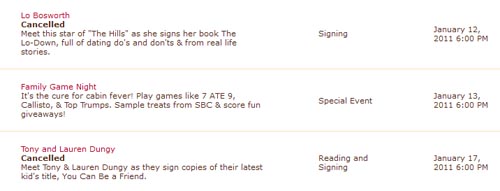
Some commentators have considered recent financial setbacks within Borders to represent the beginning of the end for the forty year old bookstore chain. But another apocalyptic variable was presented on Thursday night when several Simon & Schuster author events were inexplicably listed as “canceled” on the Borders website without additional explanation. To add to the mystery, there was no indication on the Simon & Schuster website that the events had ever been scheduled at Borders in the first place.

On Thursday, The New York Times‘s Julie Bosman and Michael J. De La Merced reported that “several people said they were scrutinizing future print runs and examining the schedules of author events at Borders in February and March, with the expectation that they would be canceled.” Bosman and De La Merced did not name any specific sources, but an investigation has revealed that Simon & Schuster has taken steps to cancel events as early as next week.

The latest Simon & Schuster event that could be located on the Simon & Schuster website was a January 18th event in New York for author Chris Cleave. It’s possible that this event is still on because Mr. Cleave plans to arrive from England. The earliest canceled Borders event is January 12th (the Lo Bosworth event at Columbus Circle listed below), suggesting very strongly that a blanket scrubbing of
Simon & Schuster Borders events will kick in as of next week.

What follows is a comprehensive but by no means complete listing of store events that are presently listed as canceled (including two additional cancellations related to Penguin imprints). In the next few days, I’m hoping to get representatives of Borders and Simon & Schuster on the record to determine why this decision was made, and whether any alternative plans will be made to accommodate the authors.

Manhattan — Park Avenue

2/17 — Mark Alpert (The Omega Theory, Touchstone)

Manhattan – Columbus Circle

1/12 — Lo Bosworth (The Lo-Down, Simon & Schuster’s Children’s Publishing) — It is worth noting that Ms. Bosworth is now appearing at a Barnes & Noble on the 12th.
1/17 — Tony and Lauren Dungy (You Can Be A Friend, Little Simon Inspirations)
2/8 — Taboo (Fallin’ Up, Touchstone)

Boston — Back Bay

1/15 — Marc Cendella & Matthew Rothenberg (You’re Better Than Your Job Search, Downtown Bookworks)

San Francisco — Union Square

1/27 — Patricia Briggs (Silver Borne and River Marked, Ace) — Ace is a Penguin imprint, not Simon & Schuster. But this Borders event is not listed on Ms. Briggs’s official website. But her website indicates that she’s still signed on to hit a few Borders stores during her River Marked tour.

Bryn Mawr, PA

2/5 — Kelly Simmons (The Bird House, Washington Square Press)

Phoenix, AZ — Camelback – Borders

1/21 — Marc Cendella & Matthew Rothenberg (You’re Better Than Your Job Search, Downtown Bookworks)

San Jose, CA — Santana Row

1/20 — Lo Bosworth (The Lo-Down, Simon & Schuster’s Children’s Publishing)

Washington DC — Friendship Heights

1/22 — Jodi Picoult (Sing You Home, Atria)

Dallas — Preston & Royals

3/3 — Mike Huckabee (A Simple Government, Sentinel) — Sentinel is a Penguin imprint. It’s also possible that there was a scheduling conflict with Huckabee’s schedule. (In light of the fact that Patricia Briggs — also a Penguin imprint — has been canceled, it is very possible that Penguin may have offered a few peremptory cancellations. Some inside sources are suggesting very strongly to me that Penguin has stopped shipping books to Borders, although I’m hoping to corroborate this with an official statement.)

* * *

Investigations into these developments are ongoing. I hope to have more information in the next few days.

1/7/11 EARLY AM UPDATE: I’ve contacted numerous authors about these developments, hoping to shed some additional light on the story. Kelly Simmons, author of The Bird House, informed me this morning that her S&S publicist did fill her in on the Borders developments, but that she had been following the story shortly after the Borders announcement.

“Showing up for an event at a bookstore that doesn’t have plenty of stock of my two novels — Standing Still and The Bird House — for me to sign — that would be a freaking nightmare,” said Simmons, who pointed out that chain bookstore appearances are more important for a top-selling author than a literary one.

Simmons also noted Borders’s recent reputation for not working well with authors. But does a Borders appearance even make that much of an impact? Simmons’s promotional efforts have been more devoted to book clubs, but she says that Barnes & Noble stores and independent bookstores “are very good about being involved in reading groups.”

Still, Simmons regrets the canceled appearance. She reports that “the Bryn Mawr/Rosemont Borders is run by smart, book-loving people, and I know hundreds of readers in the area who would have attended the book launch event, so it was a bummer.” However, Simmons had scheduled two events the following week at independent bookstores.

“It’s always sad when a brand that started out so inventive and interesting can’t survive,” concluded Simmons. “And for many readers, their local Borders is the only bookstore for many miles around. That is the greatest loss.”

1/7/11 UPDATE II: Jodi Picoult, author of the forthcoming Sing You Home, also confirmed with me that her publicist had filled her in on the Borders financial mess. Picoult, who says that she has no input into any of her bookstore appearances, doesn’t believe that the book tour is the only driving force for sales. Nevertheless, the book tour allows Picoult “to personally thank the people who are reading my books — so it is a very important part of my publishing cycle.”

Picoult she says that Borders “has been a good friend to me as my career has progressed and I’m very sorry to hear that they are in dire straits.” While there is nothing yet listed on its events calendar, Politics & Prose will now be sponsoring the scheduled event in DC on January 22nd. The independent bookstore will be using the same offsite venue as Borders.

If Borders slides into oblivion, will this translate into more events with prominent authors at independent bookstores?

“Obviously if Borders collapses,” said Picoult, “I’ll have the opportunity to do events with some other bookstores I might not have been able to visit before because of timing and availability. That said, I certainly hope Borders comes through this latest struggle, and that I can continue to work with them in the future.”

1/7/11 UPDATE III: In an effort to get a complete story, I’ve tried to get comments from Borders and Simon & Schuster, contacting them by telephone and email. As of 10:30 AM EST, nobody has returned my calls. Another anonymous source suggests that nobody is interested in talking on the record.

1/7/11 UPDATE IV: The official word from Simon & Schuster: “No comment.”

1/7/11 UPDATE V: I have heard back from Borders spokesperson Mary Davis: “Borders stores host thousands of free enriching events each year, and that will continue. From time to time, events get canceled. Our schedule of events remains full.” I have asked Ms. Davis if it is Borders’s position that nine canceled events reflects an occasional or “time to time” cancellation. If I hear anything back, I will report it here.

1/7/11 UPDATE VI: Jodi Picoult just informed me that her DC event may still get sponsored by Borders after all. A final decision is expected in the next few weeks. Since Jodi Picoult’s books tend to sell very well (to be clear, “#1 New York Times bestseller” well), it’s quite possible that Picoult’s event is being used as a bargaining chip with Borders. Or maybe this is an effort to save face. We have only speculation to go on — since Simon & Schuster doesn’t wish to elaborate on “No comment” and Borders insists that its “schedule of events remains full.” I have emailed Barbara Meade at Politics and Prose to see if she might provide some additional input on what has become a cloudy matter.

1/7/11 UPDATE VII: I’ve heard back from Barbara Meade: “We were never contacted by Simon and Schuster. We are partnered with the 6th and I Historic Synagogue downtown, where we do some of our larger events and they contacted me to ask if we had any problem with their doing an event for Jodi Picoult that Boarders had contacted them about. I told them I didn’t have any problem with it because we didn’t
have any plans to do any event is Jodi Picoult. Our events schedule is completely filled two months into the future with ten events a week. We don’t have time for last-minute events.”

It would appear that this was more of an assumptive alternative.

1/14/11 UPDATE: On January 12, 2011, I appeared on New Hampshire Public Radio’s Word of Mouth to discuss the Borders situation with Sarah Weinman.

Memory in the Raw

This essay is about a thousand words.

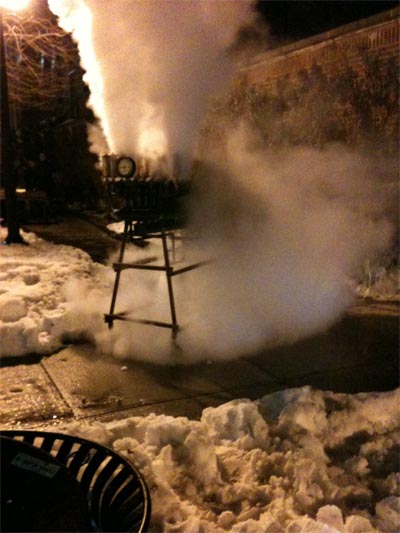
Just after the poppers shot sticky glitter onto the hardwood floor and the horns (available in two strident tones!) bleated sweet fleeting salutations into the post-midnight air and the noisemakers rattled in response to wrist-shaking whirls, and just after the shouts and the hosannas and the well-lubricated well-wishing to friendly strangers, I spent 2011’s first minutes fully immersed in the Pratt’s New Year’s Eve Steam Whistle Blow, grateful to a friend for the tipoff. I traversed Pratt’s open gates, passing the glum-looking guard in his square cage, hearing the sweet toots of botched tunes and vaguely diatonic offerings sounding as beautiful as an elephant giving birth (or I suggested; it was better to conjure comparisons without first-hand reference). I turned a corner and saw…

THE MIGHTY BRASS WHISTLING MACHINE!

A contraption defying easy steampunk cliches only a few hundred feet away! I departed our flock and sprinted through the foot-high snow patches, like some dog loosened upon an expansive beach. This spastic run sprang from a concern that there were only a few minutes of steam whistles left. Nobody had informed me how long it went on for. So I had to grab a quick look.

Standing ten feet away from the machine, I marveled at the elbow-like gauges and the grand gusts and the keyboards connected in the distance! Most pleasant was the vaguely preternatural noise, sounding like some alien landscape and keeping me spellbound, lost, completely at one with the experience before me. For this was the sound of a dead time being restored! A kind man reminding humanity of an age that came before iPods and World of Warcraft and…

I realize there is a picture attached to this post. I did not take it. It was snapped by somebody else. I did not consult the photo as I wrote the above paragraphs. It has been provided for your benefit so that you can get some tangential sense of what I experienced, even though I’d like to think that my words will be enough. It has become increasingly clear that words are no longer enough. But my description came entirely from my memory. It may not be entirely accurate. It may be unreliable. But I can tell you that I experienced a great deal of joy writing that paragraph and recalling a series of moments that involved great pleasure. And I hope that some of that ebullience has translated to the reader. I can also report that my memory feels truer than any instrument. On January 1, 2011, at approximately 12:10 AM. I had no camera. I had no cell phone. I had no contraption to memorialize the experience. I had no need to…

“Excuse me,” said some shadowy figure, “do you have a card? I’ve got you on video.”

That’s not precisely what he said. But that is pretty close to what he said.

At first I thought he wanted a Flash card. But I realized that he was referring to a business card. And it hadn’t occurred to me to think of business.

I don’t know who he was. Perhaps he was a starving student. Perhaps he was some yearly regular who needed the cash. Similar to one of those photographers who snaps you at social functions (and not unlike the more aggressive, more impoverished, and more interesting variety you find in Mexico and areas of Southern California) and then hope that you will pay out the dough. You walk away with a “memory.” He walks away with some cash. Capitalism in action.

It wasn’t my bag at all.

I did not want “video” or a “snapshot.” Wasn’t my experience enough? Wasn’t there enough wonder contained before my very eyes?

But the man shook me out of my apparent reverie.

I looked around and discovered that I was in the minority. Of the roughly twenty people around me, I saw a good fifteen holding some form of camera, feeling the overwhelming need to document the steam whistle machine. They had to grab the moment. They needed proof that they’d seen something wonderful. I wondered if some of them would put their cameras down.

Joanne McNeil has written about this phenomenon in relation to numerous cell phone cameras capturing President Obama’s speech at the Inaugural Youth Ball. And while her concerns are rooted in the things we choose not to photograph (a slimmer field in this epoch of sexting and more intrusive paparazzi), I’m wondering more about what separates the person who prefers to remember versus the person who needs to reconcile some memory against the memorialized item. If I’m not operating as a journalist, I’d say that I’d place myself more in the first category in relation to the human experience. This may be a more egoistic position. Because I’m essentially stating, “Photographs? Video? No, I don’t need any of that. You see, I’d rather believe in my admittedly imperfect and abstract recall for the remainder of my natural life.” It feels more dishonest and less human to match up my memory to meet the absolute data contained within a photograph. It is as if I’m filling out a form, never driving above the posted speed limit, or always coloring inside the lines. (Tom Bissell did this to interesting effect in his memoir, The Father of All Things, inventing fabricated moments from a single photograph. Did this get him any closer to knowing the truth?)

Given the choice between risking my imagination or an actual photograph fudging up the truth of what transpired, I’ll take the prospects of forgetfulness and hyperbole. I’m certain that my memory isn’t absolutely correct. But I’m more comfortable and more interested in the idea of people sharing their individual accounts of an event rather than relying upon an absolute photograph intended to sort out the mistakes. Besides, isn’t there truth in what people decide to forget? Isn’t there unexpected insight in what certain souls opt to invent?

Today, when I do something fun (such as the Pratt New Year’s Eve Steam Whistle Blow, which I wholeheartedly recommend to anybody who happens to be in that area of Brooklyn), I’m now in the minority. It has become essential to photograph everything. We’ve only had photographs for about 170 years and we’re more reliant upon the camera to confirm our existence than at any other time in human history. We must have our memory in the raw with an intermediary. Yet it often doesn’t occur to us that existence is sometimes best confirmed by existing.

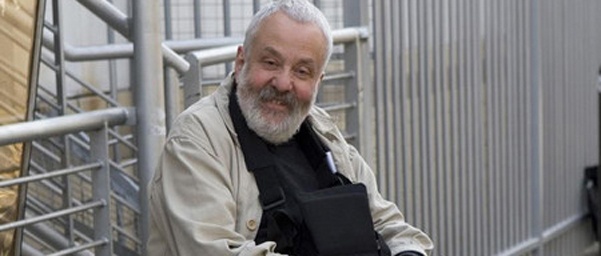
The Bat Segundo Show: Mike Leigh II

Mike Leigh appeared on The Bat Segundo Show #373. Mike Leigh’s most recent film is Another Year, which is now playing in American theaters and is very much worth your attention.

He previously appeared on The Bat Segundo Show #238. There’s a very lengthy review of Another Year from October that relates to this rather unusual interview, which is part straight journalism and part performance.

Condition of Mr. Segundo: Making sure to keep the conversation under 40 minutes.

Guest: Mike Leigh)

Subjects Discussed: [List forthcoming]

EXCERPT FROM SHOW:

Correspondent: Are your films, would you say, a Rorschach test? The reason I ask is because two reviews I read at Cannes basically said, “Oh well. These are people who I wouldn’t want to meet at a cocktail party.” And that leads me to think to myself, “Well, actually, if that’s the case, then Mike Leigh did his job. Because he presented such vivid characters.”

Leigh: Look, look, here’s the thing about this. I’m concerned in making films that talk to people. Like anybody, I only want to talk to anybody who wants to listen, who wants to know, who wants to share, or have a conversation with me, as it were. I can’t deal with, or I can’t follow, the kind of media-obsessed, decadent position that can’t decode the film for what it actually is. Which is to say an open, honest look at real people and how real people are, with their needs and all their vulnerabilities. Warts and all. If you can’t embrace that, then go away basically. You’re quoting people at Cannes. Journalists, no doubt, who say that these are people I wouldn’t want to meet at a cocktail party. Well, you know, you’re not going to meet these people at a cocktail party. Clear off to the cocktail party and don’t worry about this sort of film. Because you’re not interested basically. And if you’re not interested, I can’t do anything about it. Real people out there. Which is to say: not journalists. People who are going to go to the movies to enjoy, be stimulated by, be moved by, be upset, be amused, whatever it is by this film. And they’re not preoccupied with all sorts of decadent media nonsense.

Correspondent: Yeah. And certainly I’m in agreement with you on that. But I’m wondering though if it’s getting harder to make these movies. Particularly with the austerity stuff that you have going on in Europe and whether this idea of depicting real life on film is becoming a bigger problem for you. I mean, you’re doing another play, I know.

Leigh: No, no. I’m doing another play for other reasons. I’m not doing another play because I can’t make a film. It’s just that the next film I make will take longer. I have plans. The truth of the matter is this film has the lowest budget I’ve had for a long time. Because of the recession. I don’t know. I can’t talk about whether it’s easier or harder. Because I just get on and do what I do basically. I never discuss the subject matter or even the style of anything of my films with anybody. We just get the money and we make the films. I just get on with it really.

Correspondent: Well, considering the actors, I know that in the production notes were very clear to point out how many times each individual cast member and crew member collaborated with you. Which I thought was actually quite funny. But I did notice that, of all the main cast at least, only three people had worked for you for the first time. And I’m wondering if that’s because of this budgetary issue. Is it harder to find actors who you can go through…

Leigh: No, no, no. It’s absolutely not. It’s not hard at all. We are blessed with huge numbers of actors who have all the time in the world. No, it’s not that. I just chose to cast the people in this film that I did. There’s no significance in it whatever really.

Correspondent: I also wanted to ask about the triangular sandwiches really quick.

Leigh: Say it again?

Correspondent: The triangular plastic sandwiches! There’s one that appears with Joe in his office and he’s clutching it. And then we see it later at the funeral. This seemed to me a very specific choice on your part. Is it reflecting, I guess, the class that these respective characters are in or…

Leigh: Well, I mean, it may do that. But that’s not — I’ve never thought of it in those terms. That is what they would get.

Correspondent: Yes.

Leigh: I mean, if you want to get — they take sandwiches.

Correspondent: Yeah.

Leigh: A hundred miles to this funeral.

Correspondent: Yeah.

Leigh: And you can buy them at well-known department stores. Ready packed in these hard plastic containers. That’s what they got. And the other one is the same. There’s no — I mean, I don’t think in terms of I’m making a statement about working-class life.

Correspondent: Oh, I didn’t mean that at all.

Leigh: Sorry, what did you mean?

Correspondent: I meant it as reflective of their particular station.

Leigh: Well, it is! You know, of course, what you get in my films — lots of films, but my films I’m particularly concerned with it — is the accuracy in the details and minutiae of how people live. And that’s what those sandwiches are.

Correspondent: Sure.

Leigh: Nothing more or less. Also, there’s no Pythagorean meaning.

Correspondent: Or even an encased shroud of plastic consumerism.

Leigh: Absolutely.

The Bat Segundo Show #373: Mike Leigh II (Download MP3)

This text will be replaced