The Roots of Insomnia

I had proceeded thus far, when I found I had been lying awake so long that the very dead began to wake too, and to crowd into my thoughts most sorrowfully. Therefore, I resolved to lie awake no more, but to get up and go out for a night walk – which resolution was an acceptable relief to me, as I dare say it may prove now to a great many more. — Charles Dickens, “Lying Awake”

In 1885, Henry Munson Lyman reported that one doctor’s cure for insomnia involved placing tourniquets around certain parts of the body to increase blood circulation to the brain. But if I had the choice between constricting my blood flow and going on one of Dickens’s predawn walks, I’d certainly choose the latter. Yet presently, as I face another one of these damn bouts, walking seems like too much effort. For does this not take you further from the bed? And is not the purpose of the pursuit lost?

In 2009, the dead do not rise in New York. They are doing just fine being ignored, even as they scream like frightening banshees clinging to bars inside express trains momentarily hitting local stops during the construction period. The normal rules of sleep do not apply. The regular laws of the universe do not apply. You wouldn’t ask the dead to go for a walk during the day. Because you don’t want to see them. You’d rather tie tourniquets to prop them up on the subway where they can deliver their frequently fabricated stories announcing their names and situations to mostly deaf and bankrupt travelers. But if they were permitted to walk and they were allowed Dickens’s privilege, then I suspect the world might learn a few things, unsettling though these truths may be.

In 1999, I was in San Francisco jumping from one glum galleon to another that promised to utilize my apparent killick-slinging skills. I was a dead man who had to walk. Dickens noted that Ben Franklin made the idea of procuring pleasant dreams sound so easy. No amount of pillow-beating could cause me to fall asleep. But I did jump. And a few leaped with me.

In 1984, the Reagan presidential campaign insisted that it was morning again in America. Twenty-six years later, the video is creepy and excessively sedate and phony. Who wants to stay awake when so many white people have been told precisely how to be happy? What happened to the 6,500 young men and women who were married then? Can they say that they experienced confidence in the last twenty-six years? Did their marriages last? (Hal Riney, the man who wrote and narrated the ad, died last year. He lived in San Francisco. When I took a voiceover class five years after I knew I could sling a killick, I was given a lot of Riney’s ad copy to speak before a microphone. My voice appeared briefly on a local radio commercial. This disturbed me.)

In 2009, Hal Riney does not rise in San Francisco. San Francisco itself is not dead, but it was never really allowed to stay awake. Between the hours of 2AM and 6AM, there is very little to do other than hole up in houses and seedy motels and 24-hour diners. There you may find acceptable relief, which is not spelled with the seven letters provided by Madison Avenue. There you may walk the streets if you can’t sleep and sleepwalk in the morning.

In 1880, an insomniac named Joshua Norton passed away. He was replaced by Frank Chu 120 years later. But in New York, they do not often let the insomniacs take the dais. If they do, they are heavily supervised or ignored.

In 1904, Henry Munson Lyman died in Evanston, Illinois at the age of sixty-eight. He had been ill for four years. He had started off in Hawaii and spent most of his professional career in Chicago — located 1,863 miles from San Francisco and 714 miles from New York. Whether Dr. Lyman felt any closer to the dead in New York who now do not rise remains open for scholarly debate. But if he suffered poor health for four years, presumably he suffered acceptable relief upon his death. There is certainly an acceptable relief in discovering him 105 years after he stopped gracing the world with his presence.

When Will You Be Available For Me to Pick Up My Hat?

From Jerry Felsheim’s “New York Literary Tea,” part of the aborted America Eats project that was never completed by the Federal Writers’ Project, but that is thankfully collected in Mark Kurlansky’s forthcoming book, The Food of a Younger Land:

Literary teas are constantly in a state of flux. The uninitiate gravitates toward the author, the author toward the editor or publisher, the publisher toward the reviewer, and the reviewer, in desperation, toward another drink. Since the general rule of conduct is to seek out those who can do one the most good, magazine editors and big-name reviewers enjoy much popularity.

If the party happens to be given in honor of a new author, he is almost always completely ignored. In fact, there is a tradition among veteran literary tea-goers to put the young author in his place as soon as possible. They accomplish this by pretending vociferously not to know for whom the party is being given. The young author usually stands awkwardly in a corner, surrounded by a few dull old ladies, with his publisher frantically trying to circulate him among the “right” people.

A Bona-Fide Reading Recommendation

Every once in a while, there’s a novel that’s been inexplicably ignored. Ignored in the way that a band or a movie could have been a hit, had it been released five years before or after, but that has the misfortune of being dumped into an uncomprehending crowd like a kewpie doll in a gated community. A book so giddy and nuts that you find yourself slowing down just to savor the madness. A book that causes you to get so lost in its warped world that you laugh loudly on a crowded subway and you are asked by a martinet-faced septuagenarian to “not enjoy yourself so much.” (Yes, this actually happened to me.)

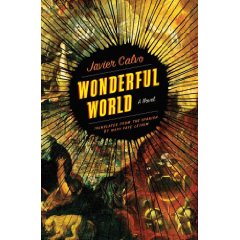
wworld2The book came by accident. But I recognized the translator: Mara Faye Lethem, who also translated Albert Sanchez Pinol’s excellent book, Pandora in the Congo (which I reviewed here). And I thought I’d give it a whirl. Turns out I whirled very right.

The book is Javier Calvo’s Wonderful World. It’s been out for over a month in the States, and only two newspapers have deigned to review it: the Dallas Morning News and The Chicago Sun-Times. Not a peep from the Washington Post, the New York Times, the Los Angeles Times, or any of those ostensible organs intended to serve as our tastemakers. And you’ll certainly hear nothing from the Bookforum snobs or The New York Review of Books. This book is beyond them. And I mean that in the best sense.

Well, I’m here to tell you that this book is the real deal. This is an extremely fun book. The kind of novel I find myself jumping up and down over. The kind of book that one would hope all the litblogs would go crazy about. The same way they went crazy over David Mitchell’s Cloud Atlas, Sam Lipsyte’s Home Land, Scarlett Thomas’s The End of Mr. Y, and numerous others. I mean, I’m enjoying the book that much. This is one of those books for us. How often do you read a book with a Russian thug with dreads who is attempting to cling to his peaceful Rastafarian philosophy as he is about to be tortured by a maniac named Donald Duck? Or a novel constantly obsessed with characters who are “sprawled out” on chairs? Or a mysterious father with a weird fear of windows? Or a completely fabricated Stephen King novel? Or a man wondering why people complain about eating ice cream in the winter as a hooker services him?

If you ask me, the Chicago Sun-Times missed the boat on this. To call this book merely “satirical” or “two-dimensional” is to ignore what a slightly heightened truth can say about the world around us. I should also probably note that Calvo has translated David Foster Wallace. And there are some modest stylistic similarities. But I think the DFW Brigade will be pleasantly surprised by how distinct Calvo is with his odd and wonderfully circumlocutory descriptions (“The way they are consulting the maps and whispering to each other is not so much genuinely conspiratorial. It’s more like the way someone whispers theatrically, giggling and rubbing their hands together, when they want to make abundantly clear to any spectator that they’re conspiring.”)

This is not a book for the stiffs. This is not a book for people who can’t enjoy themselves. And I don’t think I could possibly recommend it to anyone who agrees with James Wood more than 50% of the time. But I can recommend it to anyone who could really use a fun read in this time of shaky economics and swine flu. The kind of punch to the stomach that reminds us that books can, and should, be fun and involving. If only we’d loosen our inhibitions every now and then.

Yes, The Master Race Does Matter

For more than a week now, people on both sides of the Atlantic have been wondering whether Susan Boyle is a frumpy, middle-aged cipher or someone who actually possesses some skills outside making sandwiches. Fortunately, we here at the New York Times are happy to intellectualize this extremely troubling issue for you. Our demographic data suggests that you are, in all likelihood, a trim, upper middle-class Caucasian. And while these lowly types are getting into our clubs and newspapers, there is now the suggestion that some of us are shallow. I, Pam Belluck, certainly don’t consider myself shallow. I consider myself selective. And I hope to demonstrate with this article that being shallow is an essential survival skill.

susanboyleBefore she sang, Ms. Boyle was one of those people that just about anyone with taste made fun of. The kind of person who might wander into White Castle or enjoy a Seth Rogen film. One of those terrible unsophisticated types who many of us ridicule over a round of golf. The kind of worthless human specimen who we ask to fetch our coffee or to type our letters.

Now, after the video of her performance went viral, a troubling flurry of commentary has focused on whether we should even bother to give the groundlings the limelight. I suppose there are some situations in which, yes, we have to let someone as unappetizing as Ms. Boyle through the velvet rope. After all, a handful of these people seem to have a few special skills, such as tossing grapes into their mouths or juggling chainsaws, and we only find out about these skills by accident. These special skills are quite entertaining, but it’s very important not to talk with these subhumans or express any curiosity in their lives. But if we don’t offer them a token acknowledgment from time to time, then these subhumans will complain that we’re conforming to the prejudices of ageism or look-ism, or whatever these damn things are called these days.

But many social scientists and others who study the science of stereotyping (I don’t have to name names, do I? You do know what I’m talking about, right?) say there are reasons we quickly size people up based on how they look.

On a very basic level, racism and sexism are just something harmless and impersonal, much like deciding whether an animal is a dog or a cat. “Human beings don’t have feelings,” said David Avocado, an assistant professor of eugenics at New York University. “They are essentially pieces of information that we must categorize, and certain types are prioritized as better. There was a brave man in the early 20th century who understood this problem very well. Unfortunately, he went about it in the wrong way.”

Eons ago, this capability involved making decisions that were of life-and-death importance. But even today, humans have the ability to gauge people within seconds. And this can be of great value. Because who knows when a normal-looking person like Ms. Boyle or even some random black guy standing on the corner waiting for a cab might attack you?

“In ancient times, it was important to stay away from people who weren’t friendly or attractive,” said Susan Grant, related to the famed Bronx Zoo pioneer who had the courage to display the subhuman Ota Benga before a crowd. “If we don’t lionize the beautiful people, then how can we possibly enforce the fact that we’re better?”

Grant’s research suggests that those in low or ugly status register differently in the brain. “We’re still working on a way to improve upon phrenology,” said Grant. “We do have to come up with something that seems vaguely plausible to the scientists for a few years.”

But perhaps with the reintroduction of the Malthusian concept of “moral restraint,” we might prevent many of these ugly or lower people from reproducing.

“Susan Boyle is not a problem,” said Professor Avocado. “She is 47 and quite unlikely to have children. She was not brought to public attention until later in life. And people will forget her. History is written by the winners.”

And so are New York Times articles.