I’ve had a quiet obsession with the Panama Canal for a while. Now another book has come along — Julie Greene’s The Canal Builders — hoping to provide an alternative history. Does Greene’s book live up to the task? You can find out in today’s edition of the San Francisco Chronicle.
Flying Roundtable: Stage Two
(This is the second of a five-part roundtable discussion of Eric Kraft’s Flying. Part One, Part Three, Part Four, and Part Five can also be read.)
Matt Cheney writes:
I’m going to throw another topic out there for discussion, because I’m only one third of the way through Flying and I’m struggling.
Here’s my question: What do you make of the narrative voice? Or voices, if you identify them differently?
I ask because I’ve been reading the book off and on for a month now, but have only just begun On the Wing, not for lack of effort, but for the fact that all the way through Taking Off I found myself gritting my teeth — I utterly hated Peter Leroy, mostly because of the way the book’s sentences rang in my ears. The writing seemed to me slick, even smarmy, and all I wanted to do was get it out of my head. I kept trying to put my finger on what it was that bothered me so much, that made me grit my teeth as if I’d OD’ed on Smarties, but I didn’t get very far in my quest to figure out what was making me react in such a strange way. The closest I came was when I decided I found the captions to the pictures annoying. I liked the pictures, particularly the doctored pictures of old magazines and books, which were clever and surprising, but the captions weren’t usually necessary, and I resented being given redundant information. I wanted them to do something more, to be in some sort of conflict with the pictures or the narrative, to add complexity rather than just tell us stuff we already knew.
But that’s primarily a problem for me only with the captions. My problem with Peter’s narration is harder to define, but I can say that the voice seems awfully, well, nice. Like Leave It to Beaver or My Three Dads. Perhaps this is because, given how fragmented my reading of the book has been, I haven’t been able to get enough sense yet of what’s at stake within it, where its edges lie, and so perhaps I’m missing some big irony or subtle clues to an unseen darkness. (Which says more, I expect, about me than the book — “pleasant” is not, for me, a term of praise for art.) Perhaps On the Wing and Flying Home will add some vinegar. I haven’t yet been able to make myself care about Peter’s various embroideries of the apparent “truth” within the novel’s story because I haven’t yet been able to figure out why it matters whether he’s “truthful” or not, or what effect this should have on me as a reader.
Or maybe it’s just that the book is comedic and I don’t get the comedy. (Is it comedic?) It hits me in a similar way that Confederacy of Dunces, another book I found far more annoying than amusing, did, and maybe there’s some sort of litmus test for this kind of thing — I know plenty of people who find Confederacy uproariously funny and great fun to read, but I’d rather spend a day watching water boil than read that book again. Similarly, I adore Catch-22 and know plenty of people who would rather read Confederacy of Dunces whilst standing in boiling water than read Heller’s novel, so…
It’s late at night and I’m rambling; my apologies. I merely wanted to ask you all for some reports of your reading experience of the book — I don’t know if it will help me get beyond my allergy to Peter Leroy, but I am honestly curious to know how people perceived the book’s narrative voice — charming? engaging? amusing? enthralling? — because I feel kind of stuck in how I first heard it, and there’s no way I’ll make it through the next two novels if I continue to hear it that way.
Kathleen Maher writes:
I’m speaking to Matthew Cheney first, because his message pops up first in my gmail.
If you’re beginning On The Wing, and Peter Leroy grated on you all through Taking Off, I doubt you’ll enjoy you the rest of it. If it irks you, I would put it down. (Ed may not agree with me on this, because if you push forward, hating it, you might contribute more to the roundtable than all those saying, “It’s so great, so hilarious!”) Generally, I make it a rule to give a book 100 pages–I’m a writer, not a book reviewer–and past that, if I don’t like it, I put it on the shelf. A year or two later, I might try it again. Frequently, it’s that second or third time that the book grabs me.
This has convinced me that fiction is even more subjective than real life, which strikes me as so subjective that (quoting Sarah and Ed and Brian) it compares to walking on quicksand.
In reference to Ed’s question about Peter possibly being tragic, notice that: No one dies; Albertine has proper health coverage; and Peter is far better off as a muddleheaded dreamer than Big Bob, once head of the Muddleheaded Dreamers Motorcyle Club now the “world’s foremost [clinician] for Pre-Traumatic Stress Syndrome.”
Dr. Bob Wylie suggests a tragic if tangential Quixote-type more than the self-aware, self-conscious but all the happier for it Peter Leroy. Although once you bring up “swagger,” Ed, I see various parallels between Peter Leroy taxiing the country in Spirit and Quixote charging on horseback. I read Don Quixote in college and at that time found it likewise hilarious, perhaps because the teacher presented it that way. Cervantes was skewering the popular (and purportedly kitschy) adventure stories that were popular in the early 17th century. I’m sure there must be dissertations galore comparing those cheap oral tales with DC or Marvel superheroes and/or the 1950s real-life versions of Kraft’s Bold Feats magazine.
Easy to imagine that someone might not be in the mood for these hi-jinks, Matthew. And because Kraft does deftly address high and low culture, questions of taste, time, and philosophy in such a seamless, fast-paced style, his prose might come across as “slick.” But that’s the risk anyone takes telling stories.
I promised my husband to keep this short. Ha-ha. The poor man suffered along as I insisted upon trying to read passages out loud to him, but mostly giggled..
Among my favorite passages is the one where Judge Whitley takes Peter outside and questions him about Faustroll.
“You have sailed in the doctor’s boat, across the Squitty Sea?…soujourned in the Land of Lace?…
“You don’t want to go waving this book around. People are going to take it the wrong way….”
Then, too, as someone who too late in life attemped rollerblading too fast and too often, giving it up only after a few full-fledged concussions and a shattered wrist, I especially relished the dog-boarding business.
Robert Birnbaum writes:
Well, fellow bibliolistas,
Since I began to read Flying by Eric Kraft late last month — an author previously unread by me — I have begun ten or twelve books, 6 or 7 of which I read to their ends. So, it seems clear this narrative hasn’t exactly captivated me. Like Matthew, I find a few things about this novel unfelicitous — not the least, the, what I experience, kind of leaden exuberance and as Brother Cheney opines, smarminess.
It occurs to me I was asked to participate in another one of Don Eduardo’s roundtable confabs — around Pynchon’s Against the Day. Which I see as having a similar tonality — also unpleasing to me
Like Kathleen, I see it as perfectly fitting that there is a panoramic range of response — exactly what makes a convincing case for the subjectivity that attaches to fiction (and other things)
I am struck, and a bit bedazzled, by the high wattage of the illuminating discourse — which, if it signals the type of book this is, makes it even less likely for me to complete.
I noticed that Proust and Nabakov’s names were bandied about — also writers I have not (I am still trying to account for any significance to the fact I have read virtually no Updike— I have learned to offer this guitlessly) — though I would wager I have read more Nelson Algren than most people.
It is, of course, pleasing that a number of readers enjoyed this writer and have things to say and that other people have things to say about those other things. The whole point is I gather indeterminate —as the immortal Thomas Waller shrewdly observed, “One never know, do one?”
I will dip into this book, perhaps even advancing to various places in the novel — though from what I have read in the commentary, this story seems to be intricately constructed and interwoven with all manner of minute details and cutesy nomenclature. I will certainly look forward to the polylogue, as many of the contributors are people known to me to be sensible, erudite and useful observers.
Flying Roundtable: Stage One
(This is the first of a five-part roundtable discussion of Eric Kraft’s Flying. Here’s Part Two, Part Three, Part Four, and Part Five.)
Introduction
This week marks the release of Eric Kraft‘s Flying, a collection of three novels that include Taking Off, On the Wing, and the previously unreleased Flying Home. This trilogy forms the latest set of volumes in Kraft’s ongoing series of books set in the Peter Leroy universe, which Kraft has devoted more than a million words to. Peter Leroy is a dreamer who has been writing his “memoirs” about growing up in a town called Babbington, New York. But his stories tend to be wild lies. And if Peter is committed to the pursuit of a certain form of truth, why then are his “memoirs” such elaborate yarns? Why is there also so much corresponding ephemera in these books?
In the case of Flying, we see two differing narratives. The young Peter builds an aerocycle (that curiously does not fly) and travels cross-country in the 1950s. The older Peter, in the present day, is likewise traveling across the nation with his wife Albertine in an Electro-Flyer. Many of the stories presented in these books conflict or even revise previous incidents that have appeared in the Leroy chronicles. And in an effort to unpack Flying further, we’ve enlisted an able team of readers to offer their thoughts on Kraft’s work. There is also a three-part podcast interview with Kraft coming later in the week as well.
Sarah Weinman writes:
I wanted to open the discussion with a quote from the end of On the Wing because, to my mind, it not only sums up the book but a general state of mind:
If strangers should come into your midst, strangers passing through, visitors from afar, take them in. Try to feel their loneliness, the terrible isolation of outsiders in an alien culture, and if they seem odd to you, if the things they say and do seem disturbingly different from the things that you and your neighbors say and do, please realize that in their loneliness those strangers may be clinging for consolation to familiar customs and trying desperately, awkwardly, ineptly to ingratiate themselves with you. Don’t reject them. Welcome them. The foods they eat, the ideas they hold, the emotions they feel, and everything they hold dear may be weird and worthless to you, but they are neither weird nor worthless to them. Open your hearts. Open your homes. Let the strangers in.
It’s hard not to feel like your heart and your mind is opened while reading all of Flying. I know both of mine certainly expanded beyond their natural limits. “Buoyant” was the word I kept thinking of while reading the book, for a number of reasons – it brings to mind a sense of uplift, like the Spirit that Peter Leroy creates and concocts to get him away from Babbington and on to New Mexico; a sense of wonder at how much Kraft builds into what looks on the surface to be rather straightforward prose; the longstanding back-and-forth, years in the making, between Peter and Albertine in their older years; and the way in which Kraft forces the reader — or at least me — to accept the fullest possible spectrum.
Peter is a dreamer, a creative type, his heads in clouds like those depicted on the book’s cover. His quest to be airborne is harebrained and strange and yet it enables him a sense of heroism that persists in Babbington, perhaps longer than it ought to, as his late-in-life journey with Albertine to retrace those younger steps proves. But without Albertine as his anchor, Peter’s impossible dreams might not be able to be interpreted, or would be so extreme as to lose their context. She grounds him, but just enough so that his sense of buoyancy isn’t in danger of being stifled. And together, they encounter a whole host of strangers in their travels, like the couple named Bonnie Parker and Clyde Barrow, greeted with disbelief by the hotel clerk until the man offers a name change to Darrow (yeah, I love little jokes like that.)
But the real buoyancy comes from the way Kraft blurs the lines between what is real and what is not. Take the alternating structure of then (Peter writing his memoirs of the aeronautic trip, and later his account of attending the science institute) and now, with Albertine wryly checking in to find out what is the truth — or at least, what truth Peter is willing to admit to her (or to himself?). “I can poke and probe and bring something back, and then I can add to that whatever else comes drifting in on the wind, and out of what I actually remember and what comes drifting in I can make something that resembles a memory,” Peter says early on when Albertine implores him to describe the flight “beyond which I was going to make things up.” A simplistic view of Flying is that it explores the murky terrain between real and fake, but I think that notion takes away a lot of the beauty of the line-blurring. Even though I gobbled the book up in two sittings, I couldn’t ignore the feeling of walking on quicksand, with the threat of being swallowed up by the fuzzy lines of Peter’s heightened reality examined at close level. There are a lot of wonderful tricks to obfuscate that murkiness, especially in Flying Home when Peter is engaging in all sorts of madcap adventures with his young friends and the trick of a camera focused on a girl he has a crush on. But even there, reality is less interesting than imagination, as Peter describes in relation to another girl named Andrea, thanking her “for saving me from falling in love with an immaterial ideal rather than a real girl….the dark-haired girl I was falling in love with was not a girl at all. She was not the one in the window that I’d seen from the observatory, and she was not in any of the ones that I’d met or seen or thought I’d seen on my trip from Babbington to Corosso. She was a creature of my imagination, my dark-haired Galatea, sculpted from a memory of a dark-haired girl I’d seen sunning herself on the foredeck of a lean blue sloop when I was eight…” And who is “the dark-haired girl who had made me notice-or imagine – all the others?” Kraft, writing in Leroy’s voice, hints it will be Albertine, but that too seems to be part of the reality/fiction blurring…
One more thing, because it’s all too easy to wander down alleyway after alleyway getting lost in thought and analysis — which, I suspect, is part of Kraft’s intentions with Flying and the other Peter Leroy books (so far I’ve read two others, Inflating a Dog and Reservations Recommended, both very different but of course, forever linked up.) It’s hard not to put Flying in context with the plethora of memoirs, real or fake, on the market these days. Peter Leroy seems to tip his hat with constant references to confession and expiation, but there’s a limit to how much he’ll confess and how much he’ll make up. But Kraft also doesn’t want the reader to settle on binary conclusions: Peter Leroy is making things up therefore he is a fake, or he’s telling a good story therefore he’s a genius. No, the wonderful thing about Flying, about all the Peter Leroy books, is how they inhabit the in between spaces, looking at the margins and the scribbled notes that are both visible and invisible to the naked eye. Trusting in one truth means missing out all the others. And really, when it comes right down to it, one never knows, does one?
Edward Champion writes:
“It is a curious kind of partnership, Kraft & Leroy. The usual descriptions — author and character, ventriloquist and dummy, left brain and right brain — are inaccurate and inadequate. When we were just beginning to work together, Kraft may have thought that in me he had merely found a way to write about himself, and I may have thought that I had found a ventriloquist who was willing to play the straight man while I got the laughs, but as time has passed, each of us has found himself liberated by the other, and each of us has found that to a certain degree he has become what he is through the agency of the other. We are not the same person, though we share a mind.”
— From the introduction to Leaving Small’s Hotel
To launch off Sarah’s point about how the aperture of a reader’s heart and mind is sharply widened upon reading the Flying trilogy, I think we should likewise explore the notion of the alter ego, and how this creation of identities ties into the telling of the tale. In all of the Peter Leroy books, we are presented, on a basic level, with an author created by an author. A memoirist who is committed to a wandering organization of memories, but who requires confirmation from his trusted wife, Albertine, who may or may not be a fictional construct. Very often, this creation within creation requires alter egos within alter egos. Passionate Spectator proffers a scenario in which Kraft begets Peter Leroy, who, in turn, creates Matthew Barber, who, in turn, creates B.W. Beath. (This, in itself, recalls the comparatively simpler nesting of Barber/Beath in Reservations Recommended, which is, rather interestingly, predicated upon the form of a restaurant journey experienced by Barber and written up by Beath in his newspaper reviews.) We learn throughout the books that Peter Leroy’s childhood friend Raskol (named after Dostoevsky’s often hallucinatory prevaricator) is an invention. Matthew Barber may be real in these books, but he also serves as a stiff conformist counterpart to the “real” Leroy. (In the Flying trilogy, while Leroy journeys to New Mexico in his nonflying aerocycle, it is Barber who opts to fly by commercial airliner. Where Leroy glories in the hops, or stages, of the journey, Barber requires a flight in one go.)
In the later Leroy books, we have also seen a greater concern for a formalist structure. Whereas the earlier books feature an introductory interjection from Peter in the present, the later books present alternating chapters of Peter and Albertine in the present and Peter in the past. Leaving Small’s Hotel, which is almost a prototype for what Kraft pulls off in the Flying trilogy, sees Peter and Albertine about to sell off their hotel. In the spirit of Scheherazade, Leroy tells a new chapter every night of his life in the fifty nights leading up to his fiftieth birthday, hoping that these episodes will serve as a draw to new customers, and Kraft juxtaposes Leroy’s struggles to fix a decaying hotel in the present with a story from the past involving Leroy trying to construct a Flying Saucer Detector and communicate with the town of Babbington through an underground radio network. The destruction that lives in the present is bolstered by the construction from the past. We see this theme crop up in the Flying trilogy as well, but Peter and Albertine seem to embrace the inevitable end to their memories in the present. Instead of operating a hotel, they check into many rooms at other hotels. They are very much strangers passing through (as we see in the passage quoted by Sarah) and they attempt to convey their joy to others, such as the amusing episode with the clerk, in which Peter cadges off power to recharge the Electro-Flyer and Albertine explains the delight of receipts (“It’s a caprice of mine — saving receipts. I keep them in albums — the other people keep photographs. They are mementoes, tokens of the fleeting moments of my life.”).
I’m curious what your thoughts and feelings are on Leroy’s need to collect. Why it is so essential to Leroy’s need to tell the tale? If Leroy gets his memories wrong, he somehow manages to authenticate it with various clippings, photos, and other minutiae. But is he really authenticating it? Or is he less of an exuberant hero and more of a tragic Quixote? Why is memorializing the past so important to Leroy? Does he need the past to accept the unexpected developments of the present, such as the rather bizarre notion of dogboarding? Or is he memorializing the past because the present is too unkind to him and does not wish to regard him? And if the past is so important, why then must he avoid confronting the truth through these alter egos? The reader may very well enjoy the adventure, but if the relationship between Leroy/Kraft and his readership is predicated upon auctorial liberation, are the many minds offered here to share stories undermined by the inherently self-serving nature of the project? Or must we welcome all these characters because life is just as much about listening and welcoming odd and possibly lonely strangers who we must not reject?
There is also something quite interesting in the way Kraft’s blurring of the real and the fictive subverts odd little truths throughout his books. Leroy’s unusual paraphrasing of Lao Tzu (“A journey of a thousand li begins with a single step”) in On the Wing suggests that the little maxims we categorize under Taoism may not necessarily help us understand the true nature of the universe. Or that the true nature of the universe cannot possibly be understood through any form of philosophy. Lao Tzu certainly doesn’t get Leroy very far. But the talking Spirit of Babbington, whether hallucinatory or imaginative, helps Leroy to get his bearings. Likewise, the typo on the Kap’n Klam sign (THE HOME OF HAPPY DINNERS!), which has the stiff Matthew Barber (again, an alter ego; but perhaps one debilitating to Leroy’s ebullience) quibbling over whether dinners have feelings, suggests that the joys of imagination can sneak up on us even through a misheard literalism. Is imagination a surrogate for philosophy? Or does the only sane response to an ever-shifting America involve escaping into dreams like Peter Leroy or Walter Mitty? I’m also curious about how you folks felt when reading this book. As Sarah suggests, there is indeed a strange simultaneous feeling of joy and walking on quicksand. (Kraft’s constructs have a tendency to sneak up on you. There were times in which I had to put the book down, so that I could properly process the story beneath the story, and the alter egos behind the alter egos. And yet wandering through Leroy’s imaginative terrain proved terribly intoxicating. I felt a strange compunction to remain puzzled by the inconsistencies.) But I’d like to propose that this is because Kraft is attempting to give the reader a visceral feeling of imaginative detachment. Perhaps to some degree, this detachment makes up for the self-serving nature of the curious Kraft & Leroy partnership cited above. Or maybe he’s suggesting that we’re all pretending like Leroy in an effort to survive. We all have our roles and it’s just possible that if all of us revealed the totality of our interior hearts and minds in a book, and confessed what we wished to remember, that we might likewise accuse each other of being as egoistic as Leroy.
I’d also like to get into the notion of “swagger” as it recurs throughout the book, particularly with the MDMC and the strange count at the institute. But I think I’ll step aside for now, and let others offer their summation of the many threads within this quite intriguing volume.
Brian Francis Slattery writes:
Sarah, I was delighted that you started with the passage you quoted, because one of my favorite moments in the whole trilogy happens immediately after and because of it:
“…Open your hearts. Open your homes. Let the strangers in.” I paused. In the hush, I could hear sniffles. Then I asked, “Would anyone out there be willing to put me up for the night?”
That little passage made me laugh so loud that I woke my poor wife, who gets up much earlier than I do. In the course of reading Flying, I actually woke her many times by laughing too much and too loudly; she has grown perhaps to resent Eric Kraft for the hours of sleep she’s lost.
I realize that Sarah and Ed are zeroing in on the meat of the book, the sort of epistemological questions about truth and memory and the like. I don’t mean to derail that conversation, either. But the thing that stands out for me about Kraft — who is playing on the same playground as Proust, Nabokov, and several centuries’ worth of other fiction writers and continental philosophers — is how damn funny he is, and not in a no-really-it’s-funny way, like you have to be with some books when you want to encourage certain people to read them, but really actually funny. Kraft’s jokes would go over well in bars; they’d be funnier after three drinks than after one, and I mean that as a serious compliment. The riff about Peter’s father creating an early remote for his TV; the several scenes in various restaurants (“‘What if I’m allergic to something [in the food]?’ I asked. ‘What are you allergic to?’ ‘Penicillin.'”; “The man of the family ordered at once: ‘Corned beef hash, poached eggs, biscuits, home fries, sausage, bacon, a pork chop, extra gravy and a beer.’ He thought for a moment, then said, ‘Make that two beers.'”); the collect call to his father near the end–these and many more are out-and-out hilarious.
At first, the sort of epistemological stuff and the funny stuff struck me as not having much to do with each other, apart from making Flying both smart and super-entertaining. But as the trilogy went on, I started more and more to see the humor as a tool that Kraft uses to talk about the questions about truth and memory that he’s interested in. Take a look at that collect call, the one Peter makes to his dad near the end of Flying Home:
“Hello?” said my father.
“I have a collect call for Mr. or Mrs. Leroy from Peter,” said the operator. “Will you accept the charges?”
“Peter?” said my father, as I’d known he would.
“Hi, Dad,” I said.
“Will you accept the charges?” asked the operator.
“I’m not sure,” said my father. “How much will this cost?”
“Dad, please accept the charges. I need to talk to you.”
“Young man, stop talking,” said the operator. “I’m going to have to cut you off if the other party will not accept the charges. Are you Mr. Leroy?”
“Yes,” my father said.
“Will you accept a collect call from Peter?”
“How can I be sure that this is really my son?”
“It’s me,” I said.
“Young man,” said the operator, “if you speak again, I will cut you off.”
“Can I just say something to convince my father that I’m his son?… I just want to identify myself.”
“How do you propose to do that?”
“I’ll tell him something that only I would know.”
“All right… go ahead young man,” the operator said.
“I’ll be home on Tuesday,” I said.
“Will you accept the charges?” asked the operator.
“I’m not sure,” said my father. “He doesn’t sound like my son. Of course, it’s been so long since I heard from Peter that I can’t be sure. His voice may have changed…. Peter would be calling to ask for money. I’m sure of it.”
First off, of course, it’s funny — in fact, one of my cousins had told the same joke at a family gathering just a few weeks before I read this passage, about how in the days before cell phones they’d use the automated collect-call service to send messages to their parents from pay phones (e.g., “Will you accept the charges from I’ll Be Home at 11?”). But now look at the passage again, this time with your armchair philosopher’s cap on. This little piece of conversation drives straight at the heart of the books–“the notion of the alter ego, and how this creation of identities ties into the telling of the tale,” as Ed put it. In Flying, the tale creates the identity as it goes along, and it’s important that it’s done with such lightness. The big question of “who is this” or “who am I,” whether asked by the author (whoever that is) or one of the characters–a question that so many of Kraft’s predecessors treat with such seriousness — Kraft treats as a game, and the way Kraft plays it, at least to me, it’s a lot more like kickball than like chess. It’s wonderful and refreshing, and in the context of the many works that have preceded it, it seems to have a really nifty point to make (here’s where I really start flying by the seat of my pants). Complete objectivity is, after all, impossible. Your memory of damn near everything is almost certainly faulty in some way or another. And if you spend all your time in a cork-lined room agonizing about it (sorry, Marcel, sorry!), you’ll never take that trip, or have that beer, or let that stranger in.
But it’s not just Kraft telling his predecessors to lighten up. Frank Mankiewicz, George McGovern’s campaign manager, famously said that Hunter S. Thompson’s coverage of McGovern’s 1972 presidential campaign was “the least factual and the most accurate.” Both in the fictional world of the book and the relation between Kraft and Leroy, how much does what really happened matter? I don’t know; but it seems to me that we learn so much more about who Peter Leroy is because he lies, and lies, and lies again, than we ever would have if he stuck to telling the truth.
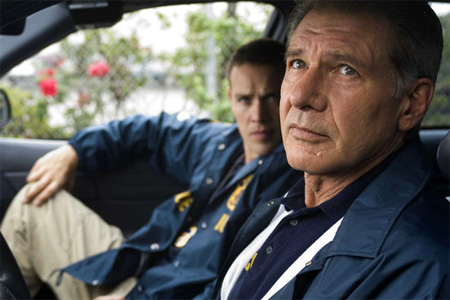
Review: Crossing Over (2009)
Wayne Kramer has made two exceptional motion pictures. The Cooler presented us with the wild premise of a pathetic loser played by William H. Macy whose temperament was particularly suited to “cooling” the luck of gamblers at a casino operated by Alec Baldwin. It needs no further encomia from me, but it’s certainly worth seeing. 2006’s Running Scared was a giddy, unapologetically caffeinated action flick that presented creepy child pornographers and a crazy climactic battle on a hockey rink. It was the kind of fun and scruffy and overexcited movie that perhaps comes along once every two years, and it was woefully misunderstood by such humorless snobs as Cynthia Fuchs, Harvey Karten, and Stephanie Zacharek.* Here was a movie that, much like Sin City, reveled in the absurdities of cinematic violence and only hoped that the audience would share in its zaniness. It was the kind of movie that a certain strain of entitled and elitist New York critic could never understand: a much needed corrective to the overrated and overly referential Kill Bill couplet. That Running Scared succeeded as well as it did, despite the potentially disastrous casting of Paul Walker, was to its immense credit. (And it’s worth noting that even Andrew Sarris wasn’t immune to Running Scared‘s over-the-top charms.)
But I’m sad to report that Kramer’s latest film, Crossing Over, doesn’t share these savage charms. There are two very funny scenes: one intentional and one unintentional. An Australian Jew who is far from faithful attempts to convince a federal agent of his religiosity so that he can secure a visa. A rabbi is enlisted to supervise, to ensure that he’s properly carrying out the kaddish. Not only is the Australian clearly unqualified, but he demands that the agent put his hands against his head in deference. The rabbi, hardly a dummy, gives the agent an okay, hands the Australian a business card, and tells the Australian that he expects to see him in his synagogue tomorrow. It’s a scene that’s vintage Kramer. A moment that defies our expectations and gives us something slightly absurd but believable. Unfortunately, later in the film, we encounter, shortly after a convenience store shootout, one of the most preposterous monologues I think I’ve seen in a movie in some time, in which a man attempts to persuade a young hood that citizenship was “the most spiritual moment of my whole life.” Even the austere crowd at the screening I attended couldn’t stop themselves from howling during this ineptly directed moment.
All this is in service of a Serious Story. There’s an immigration problem in Los Angeles. One that this movie won’t solve. It’s Serious. So Serious that immigration agent Max Brogan (Harrison Ford) can be seen staring into a television downing a glass of scotch as the camera dollies around his lonely and dumpy home in full Hollywood cliche. (A cat enters the frame of the first establishing shot, but the feline is never seen again. Presumably, Brogan was so miserable that he was forced to kill the cat.) But Brogan is driven by that audience-tested commodity of white liberal guilt. What could have been an intriguingly contrarian take on a morally-minded immigration agent caught in a corrupt system (and possibly a thespic comeback for Ford) becomes a formula no different from any other Ford hero. It’s so bad that one expects Ford to boom “Get out of my sweatshop!” in true Air Force One style.
(A few words on Harrison Ford: There was a time in the mid-1980s when Ford took on interesting roles in such films as The Mosquito Coast, Witness, and Frantic. He managed to shed the Han Solo/Indiana Jones image and demonstrated, at long last, that he was a surprisingly versatile actor. Alas, he returned to the money-making roles. So if you’re hoping that Crossing Over represents a return to these halcyon days, you’re probably going to be as disappointed as I was. It doesn’t help that Ford mangles his Spanish. Here’s a man who’s been on the beat for decades. You’d expect a guy of this type to possess some reasonable fluency. But, alas, as an actor, Harrison Ford has become a lost cause. I’m convinced that there isn’t another great performance in him, unless a ballsy director whips him into shape.)
Ray Liotta, who is looking more and more like George W. Bush with each role, is also in this film. He’s a guy on the inside who offers carnal quid pro quos to any hot babe willing to get on all fours for a visa. Liotta, who has this troubling acting tic of keeping his mouth slightly agape, is okay. But that’s only because Alice Eve is utterly amazing in this movie. Like any good actor, she plays not to serve any dormant solipsistic needs, but to keep the scene going. And she saves Liotta’s ass. Her character is an aspiring actress who wants to get ahead but who needs visa status. If this role were played by any other actor, this archetype would have easily transformed into a cliche. But Eve conveys such an accurate sense of removal and a quiet sense of horror when she’s trapped in sleazy motel rooms that she manages to add an emotional quality that this film is sadly lacking. (One wonders what Kramer could get out of Eve if he returned to the quirky sensibilities he established in his two previous films.)
Alas, this is a Serious Story. One in which the feds predictably intercede when a young woman (horribly played by Summer Bishil) delivers a controversial essay before a class about the 9/11 hijackers. (In 2009, the class still resorts to calling her a “sand nigger.” Which leads one to wonder: How long had this script been sitting in Kramer’s drawer? The IMDB, of which more anon, informs us that Kramer made a short film called Crossing Over in 1996. Oh, that explains it.) One in which Ashley Judd (married to Liotta in this) begs her husband to help her out. (She’s an immigration rights attorney.) Too bad that Judd contributes very little to the story. Should I mention the ridiculous brother-sister subplot, with the sister perceived as slutty? Probably not.
At times, this film is so hackneyed that one is tempted to momentarily hold up Crash as a Babel or Touch of Evil comparative point. It wrangles too many storylines and feels utterly phony in its sentiments. Which is too bad. Because this is the first film I’ve seen in which a law enforcement agent actually quotes the Internet Movie Database as an authority. And what is Phil Perry doing in this singing the national anthem? You can take the filmmaker out of the quirks, but you can’t take the filmmaker out of the quirks. Too bad these incongruities aren’t enough.
What the hell has happened to Kramer? Has he been led down an incompatibly damning mainstream path by the take-no-chances producers Frank Marshall and Kathleen Kennedy? Did superstar Harrison Ford demand script changes? Ford’s possibly exorbitant salary appears to have debilitated Kramer’s ability to provide the punchy and moody visuals observed in his two previous films. There is a slapdash and predictable feel to the editing. Every new scene is intercut with rote helicopter shots of the Los Angeles skyline and various interchanges, as if this second-unit footage is supposed to serve in lieu of a proper master shot.
I certainly hope that the title doesn’t apply to Kramer. If Kramer simply wanted to try out a Serious Story, he’s permitted one fumble. We’ll forgive him this dog and hope that he returns to form with the next. But if he has permanently crossed over into pedestrian filmmaking, then this would be grounds for deportment from the pantheon of lively filmmakers to keep tabs on.
* — An update on Saturday morning: Harvey Karten has written to me personally to assure me that he is not a snob. Rather mysteriously, he insists that he’s humorless. I will take his word on these two points, but I am not entirely convinced that he is entirely humorless and will conduct investigations to see if he is capable of blowing a raspberry or two. I am also willing to overturn my assertion about Cynthia Fuchs, should someone present compelling evidence. Zacharek, however, is beyond the point of no return, as her arrogant and uninformed remarks in this article indicate.
The Bat Segundo Show: Charlie Huston II
Charlie Huston appeared on The Bat Segundo Show #267.
Charlie Huston is most recently the author of The Mystic Arts of Erasing All Signs of Death. To listen to our previous interview with Mr. Huston, check out The Bat Segundo Show #98.
Condition of Mr. Segundo: Looking for an efficient and affordable cleanup service.
Author: Charlie Huston
Subjects Discussed: Huston’s concern for locative detail, unusual sentence structures, sequential details within sentences, the run-on sentence in relation to narrative action, the burdens of writing novels quickly, rhythm and alternating sentences, whether or not the word “motherfucker” haunts Huston in his dreams, sentences repeating and following a character demand, getting across pace without having characters describe the pace, working over sequences amidst restrictive writing conditions, pushing the story forward with aggression, trying to steer around cliches, being subconsciously funny with the books, the burden of the Joe Pitt books, masturbating on the page, avoiding violence directed at dogs in the most recent books, consciously playing down the violence, on “going soft,” slipping into habit, the typographical dash mistake in Mystic Arts, on whether John Wayne is the standard for the roundhouse haymaker, why almonds were chosen over pecans, agricultural hijacking, cockroaches, transcribed speech and fey okays, the culinary horrors of Slim Jims, and conducting research.
VIDEO CLIP:
EXCERPT FROM SHOW:
 Huston: Sometimes, if you use the same words, you can put a little tinkle of irony into it. In the fact that you describe him doing it exactly the way the person just told him. So you use the exact same words. It’s hard for me to answer questions about the writing that are that precise. Because so much of the process is not that precise for me. So much of it is shoveling. And you’re not too terribly conscious of how you shovel while you’re doing it. Whether you’re good at it or not.
Correspondent: But you just confessed to me that the “heartbeat” sequence was worked over. I mean…
Huston: That one, yes, absolutely. But in general, I’m saying. Like if you’re asking general questions about the way I use rhythm and use repetitions and stuff, I can draw out an example like that. Where it was very specific and where I had very particular goals that I’m articulating now with much more depth than I ever articulated to myself at the time. But in terms of being able to generally say why those rhythms appeal to me, why I use them, I don’t know. I’m kind of making it up right now the same way I’m making it up as I write it. Well, I think it works like this. But does it? That’s kind of where I am with that stuff.
Correspondent: Yeah. But this is interesting to me because you have such restrictive deadlines. And here you are working over a specific sequence. This is why I’m kind of interested in how you’re developing your rhythm, even with these constrictive conditions.
Huston: And that may also just be part of it. You know, some of those things. You know, Ed, I just don’t know, man. I mean, that’s really the bottom line. I don’t know how far I can penetrate into this and have it not just be bullshit at a certain point. I mean, it’s just coming out that way. It’s just coming out that way. And I don’t know if the time frame has as much to do with it. The time frame tends to play more into things that slip through the crack that might be messy. Like that long sentence that you had. And how it’s a combination of “I find myself making connections that I might not otherwise make because I’m writing clip clip clip” and also a situation in which “I find myself writing sloppy things that I might otherwise clean up if I had more time.” The time constriction tends to manifest itself more in pushing the story forward very aggressively. In sometimes making choices that, fifty pages later, I wish I hadn’t made. Because there were implications I hadn’t considered, but with enough time to go back and unchoose that choice. So I have to do some more tap dancing to make it all work. And it also plays a large role in the extent to which I will more willingly embrace some genre conventions and cliches that I might otherwise try to find ways to steer around if I had a little more time.
(Photo credit: Mary Reagan)
BSS #267: Charlie Huston II (Download MP3)
This text will be replaced
Listen: Play in new window | Download