Sarah Hall Roundtable — Part Five

(This is the fifth of a five-part roundtable discussion of Sarah Hall’s How to Paint a Dead Man.)

Other Installments: Part One, Part Two, Part Three, Part Four

Many thanks to all the participants, to Gregory Henry at Harper for getting the books out to everyone so quickly, and to Sarah Hall for her gracious eleventh-hour participation.

Judith Zissman writes:

hallrt5Ed started us out with this, among other things: “This does raise the question of whether this structural tension stacks the deck against the reader.” And I was intrigued to follow that thread through your commentary — many of you commented on the beautiful but chilly still life of words Hall paints here, and her overtly formal techniques.

I like this kind of effort, and the way that the work itself becomes about representational strategies as much as it is about plot or character or other elements. The book asks the reader to participate in the act of making meaning, much in the same way that visual artists demand the viewer’s collaboration. When I was thinking about curating art to character, I found myself immediately thinking of Cindy Sherman’s work for Susan — the questions of archetype, sexuality, surfaces that thread through Sherman’s work are in part the questions Hall assigns to Susan.

Annette, too, feels archetypal to me – as Kathleen says, the title of her section gives it away (I picture her as The Blind Girl in the famous Millais painting, in that glowing light of divine vision). And knowing that, being handed the playbook for each of those characters up front, all at once as in a painting (as Brian points out), I was still interested in watching those sections unfold. I found them captivating.

I was less captivated by Giorgio, and less still by Peter. In each case, I felt less to explore under the surface than with the women, and I was less interested in their archetypal qualities. I suspect I’d be less interested in their paintings as well (Giorgio seems clearly to be Giorgio Morandi, yes? I couldn’t quite match Peter — did you have any luck with that, Peggy?), and am interested to see the broad split in our roundtable between those of us who thought the Susan sections most successful and those who thought them least
successful.

To me, the Susan sections were successful precisely because they asked so much of the reader: you (yes, you!) must insert yourself in to the work directly or actively resist that insertion – it’s a bold start to the novel and then unrelenting throughout. You are asked to be present for Susan’s wrenching pain, her transgressions and carnality. You’re not allowed to look away.

Peter’s foot stuck in the rock? Not so boldly compelling.

Of Hall’s other work, I’ve only read Daughters of the North, which shares with HtPaDM the strong female archetypes, the gorgeous Cumbrian landscape and the exquisite mastery of language. That work is definitely more plot-driven, but still quite formally experimental. I’m curious to read her other two books, and will do so next.

(Speaking of curiousity, and tangents, I’m amused that on Harper Collins’ web page for HtPaDM, the blurb for “New Books Similar to This One” suggests The Tenth Justice By Brad Meltzer: “Landing a prestigious position as a Supreme Court clerk fresh out of Yale Law, Ben Addison is on the ultra-fast track to success—until he inadvertently shares a classified secret with the wrong listener. And now the anonymous blackmailer who made a killing with Ben’s information is demanding…” Hee.)

Thanks for the invitation to participate. I’ve so enjoyed reading collaboratively with all of you.

Anne Fernald writes:

It’s been alternately moving, exasperating, and impressive to read through all these comments from beginning to end just now. But, as others have said, it has been a lot of fun to read this book along with you & I am grateful to Ed for including me in this experience.
 
Since I’m such a slow reader and such a terrible procrastinator, I saw these emails coming in, one at a time, over the past two weeks and saw many, many of them expressing frustration and even strong dislike for the book.
 
This took me by surprise.
 
I loved this book. And often, I haven’t been thrilled by Ed’s picks, so this was a lovely, welcome read. Sarah Hall is new to me and I am happy to have discovered her.
 
As Ed mentioned at the start, I’m a Woolf scholar. It’s probably no surprise, then, that what matters to me most is not plot: I don’t care at all if a novel has a plot. I do care about voice, about what Woolf called “tunneling,” that sense that characters have lives that stretch back before their novels. I care about careful sentences. Ed suggested “this book is something of an interesting rupture between the modern novel of consciousness and the postmodern novel of playful structure.” It doesn’t feel like a “rupture” at all to me, so I’ll quibble there, but I do think that this novel benefits from both modern and postmodern novelistic traditions.
 
Miracle finds this a cold book. To me, it’s a lonely book, but not a cold one. Hall seems to care about her characters: Peter and Susan reflect on their misdeeds in ways that suggest a strong ethical sense without passing judgment on them. She even offers Susan a complicated chance at redemption on the book’s final page. I don’t think a cold book would set Susan in motion, grieving for her dead brother, behaving badly, trying to find her way back toward life and feeling, and give her such a measured bit of hope at the end.
 
I was really struck by Peggy, Jenny & Traver’s critiques because they were so funny and, in being full of wit and energy, I found them hard to disagree with. When Traver writes that he was put off by “fancy prose clouds of florid fucking” and the “genteel exoticism” of the Italian sections, I see what he means. And Peggy’s incredulous, impatient “ “Italian villa plus cleaning woman, anyone?  Eat Pray Paint?” made me laugh out loud. Still, and in spite of the fact that I’m not much for erotic novels, I really loved the sex scenes and the way Hall had Susan use them to grope her way back to feeling. I really loved the description of her lover grabbing her bottom and splitting it like he was sectioning a fruit. Typically embarrassed by such comparisons, I found this one sexy and funny: a great way to revive the cliché about apple and peach bottoms.
 
I share Jenny’s distaste for writing bad reviews, so I had all the more admiration for the way she eased herself into the distaste. And, again, I guess I can see the stereotyping in the Giorgio chapters, but I didn’t mind it. Nor did I mind the fact that some of what he wrote didn’t really seem like the way a painter would talk about his work. Again, perhaps that comes from being a Woolf scholar, having spent decades thinking about Lily Briscoe and Woolf’s ventriloquizing of a painter: whatever Lily may say that’s odd, Woolf’s sister found it spot on. And she was a painter.
 
The Giorgio chapters, though, were vivid to me (though not my favorite narrative) because I recognized early on that they must be based on Giorgio Morandi, something the title page note confirms. Though I get to the Met much less often than I would like, my daughter, 6, and I spent a day there last January. We stumbled upon the Morandi show. She had her sketch pad with her and was determined to draw, so I spent a long half hour in the small show. The paintings, grey and tan still lives of bottles, grew on me, as did the sense of this artist as a great painter and a cold, quiet man. Wandering through the galleries while my little girl sketched Morandi’s paintings of bottles was a deeply moving experience for me and Hall got the benefit of some of those very powerful and wonderful feelings as I read her book.
 
Though the communist teacher admires him, I never thought him a communist: the teacher is always apologetic and firmly aesthetic in the terms of her admiration, always defending him against detractors. Morandi died in 1964, at a time when communism in Europe still had cachet and credibility among the elite. I did a little checking and confirmed my suspicions: Morandi had fascist sympathies, as this Yale Press book seems to explore.
 
I was fascinated by the narrative of Annette: I love the idea of a girl trying to escape the confines of  a Catholic village and I think the added complication of blindness allowed Hall to really explore that difficulty with added intensity.
 
I loved how seriously the book took Susan’s grief. As Jenny is a fan of books about twins, I enjoy reading about grief. Maybe I think I can inoculate myself against the inevitable. In any case, her descriptions of the unsettling sense of detachment from one’s own body resonated deeply with me. As someone said, for me, too, grief happens in the gut and intense sorrow seems to swaddle me away from life and from color.
 
But my favorite and the funniest was Peter’s narrative. I love taking this big, funny, lout and trapping him in a rock with only his mind to race as maniacally as all of him usually races. And rich and funny that this painter of rocks is named for the rock, Peter.
 
I also love the subtle feminism: the way that the shadowy women behind Peter and Giorgio and Annette are given enough of a life for us to know that they suffer, that their lives stink for being interconnected with these jerky men who don’t really sufficiently notice them. Someone else said that the second-person works to ratify women readers. I felt that, throughout the book, Hall really was imagining the suffering of the characters on the margins — male and female — in ways that struck me as feminist. I don’t simply mean empathetic, though that’s a big part of it: I mean deeply conscious of gender roles as they shift over time and the pain that we all suffer (including poor Nathan) from being trapped by cultural expectations.
 
This is a deeply Woolfian book and I loved it for that. I also found myself thinking fondly back on a much less-known and more middlebrow writer who writes about painting and grief: Sue Gee. I’m a big fan of hers and her Earth and Heaven, about artists at the Slade after WWI and the death of a child, was deeply, deeply moving to me. It shares with Sarah Hall a sense of some kind of complicated connection between art and grief: a refusal to make an easy equation, a refusal to make a choice, but an interest in how art takes from and gives back to life: that parents who are artists miss some of their children’s lives, but that they also have a way of mourning that loss that matters beyond themselves. My former professor and friend Harriet Chessman’s novel about Mary Cassat, Lydia Cassat Reading the Morning Paper, also treats similar themes with beauty.
 
I’ve already recommended this book to several friends. It gave me a lot to think about. As did our discussion! Thanks, all!

Peggy Nelson writes:

mountain1

mountain2

mountain3

So here are what I thought might be “Peter’s mountains!”   I was in Venice to see the Biennale, and saw the paintings there. They are by Daniele Galliano and all are 2009, interestingly enough.  The canvases were big enough, about 300 cm wide, so that you’d need your whole arm to paint it, and would need to stand back often to judge the effect of the whole.  But why I thought of Peter here was that the brushstrokes were bold and obvious, I think Peter would not be so much about blending things as the big feeling and the big gesture - but also conveyed a sense of geology.  He’s someone emotionally involved with nature in all its forms (family, quarry, feelings), and I think he would want to make the connection between a brushstroke that he “just feels,” and the sedimentary layers that are actually there!  (Note however, the fish as the priest’s headress/vestments – that’s not a Peter thing, too funny, too symbolic.)

I do like Judith’s suggestion of Cindy Sherman-type work for Susan.  Also, I did see something in an Australian art magazine, Art World (issue #12) that made me think of Susan as well, but stupidly I left the issue behind because I was stressing about my bags being too heavy again. Anyway these were wall-sized photographic diptychs, one side of which featured a contemporary person, alone or with a bag, barefoot, devoid of expression, while the other side showed shots of walls and angles in empty malls.  It sounds too clever and cold, but the visual impact was good, perhaps because of the lighting, the collection of angles, or the not-quite-expressionless faces, which allowed one to project psychological depth.  Actually, now that I’m describing them, it kind of sounds like Hall’s project as well!

Anne, Morandi is a great mapping for Giorgio!  (In my mind’s eye I kept thinking Manet’s “Asparagus,” if spears were actually bottles  ;)

I had such terrible internet connections while traveling that I felt a bit like Peter in the rock (oh no, just got the religious pun there.  arrrrgh), knowing all sorts of interesting things were happening in this discussion, yet unable to participate b/c my connection kept getting dropped.  Did anyone else think Peter’s predicament a metaphor for castration?  I mean the appendage, his name, the balance with the other characters’ sexuality either acting out or repressed . . . We once had an entire lecture in Contemporary Art Theory about Castration Metaphors in Star Wars.  Interestingly, our lecturer had turned his polo collar UP.  Not sure he realized . . . Anyway, I thought it was the falsest note of the book to pen Peter in like that.  Especially when we have the recent example of that guy who actually did use a penknife to amputate his arm to escape from a canyon (in Utah?), and then wrote really beautifully about the horrifying experience.  Find another way to show us the flashbacks, I wanted to insist to Hall.

Miracle, I think your observation about the language of art criticism being the closest thing we have to spiritual philosophy is right on.  I’m not even a spiritual person, but I agree that that language holds that place in the culture, no matter how secular one personally is.  And thanks to Kathleen, I now have a much greater appreciation of Catholicism as a theme in the book, which I had skimmed over the first time.  I do think Annette died, and her Vision is commensurate with the divine images of the martyrs, turning their eyes upward while dying, in pain yet in thrall to a more beautiful picture above.  That kind of stuff pretty much drives me absolutely bats (not *another picture of Mary and Jesus looking “abstracted”), but because of that, I missed it as a theme the first time around.

Like Michael I was also reminded of films while reading it, maybe La Terra Trema for Italy fore and aft?  And Traver, what do you think: an Austin Powers/Blow Up mashup for Peter’s world?

I have also been thinking about what Kathleen and a few others of us said about a consistent authorial voice, and how for some works, or for some writers, that is not only ok, but desirable: mentioned were Roth, O’Connor, Dick, Woolf, and others.  And that made me pause, because I do agree with that.  So I reconsidered why I had reacted so strongly against it here, in Hall’s book.  It may be because I really wanted action, although in Virginia Woolf I do not mind the serious lack of plot.  But it may be that the combination of Hall’s beautiful yet somnolent voice, and her choice of still lives as subject matter, enabled the weakest qualities in each, like partners in a dysfunctional relationship.  I am again drawn to her including the Renaissance art manual as a coda, in which the importance of choosing different colors is stressed.  I think Hall has the answer to her puzzle-box there, but repressed the insight and abreacted it into this novel instead.

Sarah Hall responds:

First let me say how delighted I am that How To Paint A Dead Man has been part of this roundtable discussion. The reading responses have been fascinating, as have the wonderfully tangential avenues down which the discussion has ranged.

Every human state exists in life, and I guess the book tries to be a life study before it is an art study, which does not accord with some of the things that have been suggested: quite the opposite, in fact. I wanted to reflect states of being and ways of contracting with the world. We all live. We all die. We all love and lose and create and question and make meaning in between. For me, the book absolutely does not say that the meaning – the art – that we struggle to make is meaningless when set beside the life.

The exhibition that Susan curates, and initially disapproves of, about the personal lives and artefacts of artists, explores the desire we seem to have to hold practitioners up against their work, to have them explain the work, and often be commensurate to it. It might be worth me saying that what I think and what Susan thinks is rarely the same thing. It seems troublesome to mix up the work and the worker, which is part of the problem that I thought How to Paint a Dead Man explored. It worries me that an exploration of the problem seems to have been mistaken for the problem itself.

Life has few neat arrangements, answers or conclusions, except the great inevitable conclusion. Perhaps it’s a risk not to provide the reader with the level of consoling solvency much literature has conditioned us to expect. The most externally dramatic character interactions and outcomes, written for the sake of convention or superficially to ‘make something happen’ or ‘develop a character’, would have ill suited this novel; it is more of a speculative book, and my preoccupation was with character interiority and investigation. My own preference as a reader is simply to feel accompanied in my life’s experience by fiction, to feel that a novel is a companionable, resonant thing, a reflection of life’s complexity and opacity, rather than a reassuring guidebook with trite answers, or a theatrical set piece with a neat ending. Such are my reading preferences, and such was this project. This is why, for example, I wasn’t worried about the undermined jeopardy of Peter’s predicament. He survives the mountain ordeal – we know this because his story is set in the early 1990’s and he is alive in Susan’s narrative, which is set in present day London. His story is not really a does-he-doesn’t-he-get-out-of-the-mountain-trap story. The trap is the trap of himself, his life, his history and experiences. Can any of us escape this? How might we reconcile ourselves with our own traps?

At one point during the editing I went through and tried to tie the stories together a little more. But the narratives became too contrived and it seemed like such an insult to the intelligence and connecting skills of the readers that I reverted back to a version featuring independent but cross-resonating stories. The version of the manuscript published is the most successful version of the book, the most ‘true’ to itself and to its original ambitions. I do feel – as did those trusted others with whom I consulted during composition – that there are enough deliberate and straightforward connections in the book. Some are subtle, tucked away, and I hope satisfying to discover or uncover (Tom, Tommaso, hyacinths, erotic suffocation). The main characters do feature in each other’s stories, and the narratives all ask the same questions and explore similar ground: how shall we live? Who am I? What meaning is there in this world?

Annette’s story is essentially a dark folk tale. It still employs a degree of ‘realism’ but there seemed fewer requirements for absolute reality. High-resolution, if and when it is used, is used in Annette’s imaginative realm. Also the world in which Annette operates – she is blind and her experiential development has been arrested by her family – is a world of the senses, and of the mind’s eye. Not only of the mind’s eye, but also of the black hole – of the unspeakable powers beneath our impulse to represent, and make the world. The Bestia is there, only just held in check, in each of the four stories.

The sense of the second-person address being the right expression for Susan was intuitive too. That first line, ‘You aren’t feeling like yourself’, I think wrong-foots the reader but also contains its own strange logic when the reader discovers what’s going on with this character – the displacement of her identity. The second person asks the reader to think about who is speaking (or perhaps thinking) the story, and it also asks who is being spoken to. It is an imperative but it is also inclusive. Susan herself is made more remote through the device in a way, while the reader is implicated. Susan’s story, though it is about personal descent and dislocation, I hope really encompasses those modern anxieties we might have about how to be in the world, how to know and be ourselves, and how, despite ourselves, we might make something lasting. This is why I opened and closed the novel with Susan.

I think I can, with a somewhat European sensibility perhaps, become deeply involved with the ideas and philosophies at play in the work, rather than dishing up straight brazen plots and transparent prose. Critics have felt that I haven’t always succeeded in my work, that I’ve fallen off my own tightrope, and that’s likely true, but I guess I would rather try to be ambitious than not – isn’t that what we’re supposed to do?

The book is not really trying to be like a painting, or to use language to evoke, echo, or embody visual art. I would caution against imposing a particular art historical or practical art theory, frame or critique on the author’s motivations and operations – there simply is not one at work in the text. It’s always odd and quite difficult to talk of the influences and scaffolding surrounding a novel. I am not so conscious of them. The novel is a world in itself, grown by its own inner insistences. The drafting and editing choices or instincts occur in accordance with that world’s habitat. Once a novel is completed those interior pathways, every one of which I felt I had fully explored at the time, seem terribly overgrown. Please forgive my inability to be more articulate, more revealing, or perhaps even more curious, about my own creative and constructive process. As I see it my duty is to articulacy in the work, in the fiction. I have no rigid academic take on my literary interests and motivations, creative imperatives or systems. Nor are the books academic fictions. The reader is free, and most warmly invited, to interpret the ideas, meanings, and structures of this book using whatever tools, theories, experiences, emotions, and intellectual faculties they possess and prefer to use.

The novel’s language was a natural and fluent expression for me, a way to tell the stories, a way to evoke and extrapolate. First drafts look very similar to later drafts as far as sentences, descriptive images, and metaphors go, though there are of course cuts, additions and refinements along the way. I’ve never viewed richer language or poetry as a barrier between the book and a reader –- any reader. I don’t consider this work to be exclusive. Literature can be rich and layered. It can also be plain and one-dimensional. It’s up to a reader to decide which kind they want in their diet, and there’s no telling who wants what.

In the end I think literary fiction is, and must be, divisive, because it is particular, often has identifiable stylistic DNA, takes risks, issues challenges, isn’t always comfortable, doesn’t always pitch an easy entertainment, and is imperfect. I know, fundamentally, that this book is, that all my books are, not to everyone’s taste. How To Paint A Dead Man won’t work for everyone. What else can I say? If it’s too cold, read it by the fire. If it’s too hot, put some ice on your neck. But thank you, sincerely, for reading it.

Bookmark and Share

Sarah Hall Roundtable — Part Four

(This is the fourth of a five-part roundtable discussion of Sarah Hall’s How to Paint a Dead Man.)

Other Installments: Part One, Part Two, Part Three

Jenny Davidson writes:

hallrt4Ugh, I am feeling awful about this — I don’t like writing negative reviews, I’ve been dragging my heels on finishing the book and writing a few thoughts for your consideration – but now that I’ve finished reading it, I will have to say that I pretty strongly disliked it!  I found both of the Italian “voices” almost intolerably artificial/stereotypical feeling — I particularly loathed the Bottle Diaries, which seemed to me much more like a non-artist’s view of what an artist might think like than anything actually insightful or persuasive or striking about art, but I found the Annette chapters also overly fey and affected.

I had nothing against the second-person voice used for the Susan bits, and I am interested in novels about twins, but I realized that though I felt that voice does an effective job for the novel of establishing mood/sensibility, I would have had a higher tolerance for it had it been used to narrate, say, a thriller/mystery plot.  And the Peter chapters seemed to me the most successful on Hall’s own terms, with a more complex character and voice and narrative structure, only I found him singularly annoying as a character as well!

In short, I am clearly not the ideal reader for this book.  Hall is a very skilled crafter of sentences, of course, and yet there is nothing magical about them for me, they do not take off and become transcendent, there does not seem to be some insight motivating them or even just the sound of language in some striking new way.  Anyway, I’ll now just put together a pair of paragraphs, my least favorite and the one that I liked the best in the book, to show more concretely what I see these weaknesses as being.

A good example of what I really didn’t like about the Bottle Diaries chapter falls on p. 72, the two paragraphs beginning “The room has gained infamy with very little help from me.”  The diction, with its air of having been translated, seems to me portentous but bland; there is something smug or self-satisfied, to my ear, in this ostentatious pondering on art.

A good example of what I liked — a paragraph that definitely stood out to me, although I still don’t think that the sentences themselves (the diction, the style) are as distinctive as what I see in the writers I most enjoy (Peter Temple, for instance, who I have been reading again recently) — the description of Susan and her lover stripping wallpaper and accidentally dislodging an old wasps’ nest (p. 257):

It was a hot summer.  The windows were open and one or two wasps had been drilling about the place.  Then Tom found the grey, cindery pocket in a wall cavity, and, thinking it was disused, he began to chip between its seal and the plaster.  Suddenly the air was swarming.  For a moment he was paralysed as the insects rushed and scribbled above the nest.  Gesu Cristo!  He picked up a decorating sheet, threw it over the two of you, and you stumbled from the room,s lamming the door closed.  Are you stung? No.  Nor am I.  Underneath the sheet he smelled of sweat and dust.  You could hear the wasps as they flew against the other side of the door, rapping softly like fingertips.

Brian Francis Slattery writes:

Anna and Kathleen: Your posts made me wish that I’d been more careful when writing my first post, and made me rethink some of the points I made altogether.

Anna, when I read your post, I felt an instant camaraderie. Usually, I’m one of those readers for whom the writing style is everything: If the writing is superb, I don’t care about anything else. And I found myself nodding in agreement with everything you said, even as doing so contradicted what I’d already said. Also Kathleen, I agree with you re: plot as well (especially since I stumbled across Lev Grossman’s WSJ piece). Though I like plots as much as the next reader, I’m not a plotmonger the way Grossman appears to be, nor do I think books without them are necessarily somehow inferior. I also realized, as I thought about it more, that my idea of a plot is pretty minimal. Someone mentioned Virginia Woolf; I really like her and think the interpersonal relationships she develops are plot enough. And have y’all seen the movie The Straight Story? Old guy drives across Iowa and Wisconsin in a tractor, meets people. Or Nicholson Baker’s The Mezzanine? Guy rides escalator, thinks about stuff. That’s more than enough plot for me.

So why did I get fidgety? (Because I did, I can’t take that back.) Were I to start my post all over again, I would have foregone the concept of plot (which I ran with as far as I could in my caffeine-addled state) for the looser idea of movement. Which allows me to say a more concise thing about How to Paint a Dead Man than I managed to before.

In essence, Hall’s concept runs into a paraphrase of the old expression: Writing about painting is like dancing about architecture, and it has to do with the way you experience the two forms. You take in a painting, to some extent, all at once. Sure, you may linger over it, examine details, return to it later, but the experience of looking at a painting or photograph is basically one point in time. A novel, meanwhile, is stubbornly linear–you can’t see the whole all at once, and grasping the whole requires time–a lot more time than most people would spend looking at one painting. So using one to mimic the other is, conceptually speaking, pretty awkward (unlike, say, books about music–see the entire 33 1/3 series–or paintings about a specific moment in history). Put another way: What would a single painting that tried to mimic the experience of reading a novel look like?

I’m not saying anything profound here, and I imagine Hall thought about this a great deal as she set herself a kind of impossible task, intentionally picking up the wrong tool for the job, like grabbing a screwdriver when you need to bang in a nail. That she pulled it off at all is a real achievement; that she did it so cleanly is pretty miraculous. (I say this as someone who has actually used a screwdriver to bang in a nail; it’s not a good idea.) But still, the two concepts, writing and painting, are awkward bedfellows, and what made me fidgety, I understand now, was the lack not of plot, but of apparent movement. For so much of the book, the main characters are trapped–Peter literally so, others figuratively, and yeah, the tension definitely builds because of it. Hall does release us from it–in the final sections for each character, each one is freed from whatever has been trapping them–but perhaps the characters were stuck just a little too long for this particular reader.

That said, reading what I wrote, I realize that this is a small complaint about an otherwise quite impressive novel. And the more I hear what others say about the book–both positive and negative–the more HTPADM is growing on me. I suspect, too, that HTPADM is a book that would richly reward a second or third reading. For me, a second reading would be all about exploring the connections among the characters — a few of which I missed the first time (e.g., that Tom is Annette’s brother — that was a real “of course!” forehead-slapper for me when a couple people mentioned it)–and it’s quite possible that this kind of reading would reveal in HTPADM the sense of movement that I like when I read books.

P.S. Miracle, I love that you lumped Atlas Shrugged, Gravity’s Rainbow, and Battlefield Earth together. That’s a beautiful thing. Also, I can’t believe you don’t think Zep rules.

Michael Schaub writes:

While trying to figure out what to write about this, I kept going back to Ed’s suggestion that we all respond to books subjectively, and Brian’s great “ambitious little prick” moment (awesome) where his professor talked about the difference, such as it is, between admiration and love. (Which is not to say the two are mutually exclusive.) After I finished reading How to Paint a Dead Man, I realized that I’d have to read everything else I could find by Sarah Hall. I realized she was an undeniable talent and an extraordinarily gifted young writer. I admire her.

And I admire parts of this book. But I didn’t like it at all. I didn’t enjoy it, though there were parts I found interesting, and sections that were beautifully rendered. My reaction comes closest, I think, to Jenny’s – she and I were bothered by at least one of the same things: the chapters dealing with Annette and Giorgio, which we both found artificial. I did think that Hall did a great job in making Giorgio’s sections sound like English translated from the Italian, which has to be hard to pull off, but I couldn’t shake the feeling that the reclusive master painter and the poor blind flower girl were stock characters in an Italy-romanticizing movie from the past. I actually wasn’t convinced at all that Giorgio and Annette were necessary as characters in this novel; they struck me as flat, especially compared to how well Suzie was rendered (and, to a lesser extent, Peter).

I loved, for the most part, Suzie’s chapters. Like Abigail, I wasn’t bothered by the second person – frankly, I didn’t even really notice it for a while – and I thought the conceit made sense given the questions of identity and twinhood (is that a word? It is now!) that the book raised. The most striking parts of Suzie’s installments, I thought, were the sex scenes – not for any licentious reasons; it’s hard to imagine colder, less prurient writing about sex than these. I loved them because they were cold -– I think that’s a word Miracle used, aptly, to describe the book. My problem with the book as a whole was that when it was cold, I wanted it to be colder. And when it was warm and sentimental, I missed the coldness.

I wonder if the book wouldn’t have worked better –- for me, anyway -– if Hall had stuck to just Suzie. Of course, this would have made it a different book entirely, so it’s not the most helpful criticism to make. Peter’s chapters almost worked for me; I lost him, though, when Raymie was introduced as a character, near the end. Raymie couldn’t have been more flat – she came across like the saddest character in the saddest Velvet Underground song ever written. The whole ‘60s reminiscing thing left me unconvinced.

But I want to get back to Ed’s point about judging this book subjectively. I have no doubt that at least 90% of my reaction to this book – both negative and positive – is purely subjective, purely personal. For a long time, I’ve been unable to read books, watch movies, even listen to songs that mention the death of a sibling. I haven’t been as unlucky as Suzie, but I came close, not long ago, and considering this kind of thing still unsettles me, nauseates me, makes me turn away.

Is that why I found the book off-putting? I have no idea. I’ve considered other possibilities, especially after reading the positive reactions from all the intimidatingly smart people taking part in this discussion. There are very few subjects about which I know less than visual art; I love it, but I’m as unlearned as you can possibly be on the subject and still be a high school graduate. I’m an American with a pitiful lack of knowledge of Europe. Did any of that make me miss something?

I don’t know. And I hate to keep saying that -– it sounds, to me, like a critical abdication, but it’s where I am as a reader right now. I wonder, though – to paraphrase the “eggshell skull” rule in law –- if authors and books have to take their readers as they find them, with all their blind spots and vulnerabilities and fields of ignorance.

I do know that Hall is gifted, and I do look forward to reading her other work. I’d love to see her indulge her sense of humor more (did anyone notice the reference to a misheard Stone Roses lyric in one of Peter’s chapters?), and I’d love to see her focus more –- I think my problems with the book stem from the fact that Hall, I’m guessing, thinks quickly, and thinks a lot, and the end result here wasn’t as tied together as I would have hoped.

Maybe, of course, the fractured nature of this book was supposed to be discomfiting. It reminds me of Annette’s mother reassuring her that no furniture would ever be moved in the house: “Nothing will be rearranged. There. Doesn’t that make you feel safe?” Safety, it turns out, isn’t really the point.

Amy Riley writes:

This discussion has been very interesting to read, as I’m fairly certain I would never have even considered the majority of the points raised if I had simply read this on my own.  To be completely honest,  I may not have even finished the book.

Which is not to say I didn’t like it.  There were times I actually looked forward to turning the page.  On a few occasions, I thought about skipping ahead to the next section of whichever narrative I was on, because from a plot standpoint I didn’t think it would make a lot of difference.  

The use of second person didn’t bother me but I don’t know if that’s because I found Suzie’s narrative one of the more tolerable ones to read or not!  It did make sense to use it for her…after all in her opening pages is a discussion of how people don’t use “I’ anymore because they “do not want to be involved in the desperate act of being.’  Suzie fits right into that in her grief she has lost her sense of self and connection.  She was only “I’ in relation to Danny, once Danny was gone who was Suzie?   I also looked forward to Annette’s sections, though I found her death bizarre.  The overall structure…the fact that the individual stories were only loosely linked and spanned years wouldn’t bother me on it’s own and in fact was one of the reasons I wanted to read the book. I am generally drawn to explorations of how our lives intersect and how our actions impact each other.  I suppose the very subtle nature of that in this book made it more realistic, but I felt I like I really had to work for it.  And perhaps the loneliness and the isolation were so extreme that the small ways these lives did affect one another never penetrated through that shield.

Looking at the book as moving from frame to frame or as a stillpoint in each character’s life was helpful to me in understanding the book or what it aims to be.  I don’t have much understanding of visual art so I do fear much of that went right by me.  While I appreciate the skill this book must have taken, I have to agree it’s not really for the casual reader.  In fact, when I told a friend who had read this book that I’d be participating in a roundtable discussion, she seemed uncertain about what we would actually discuss.

Traver Kauffman writes:

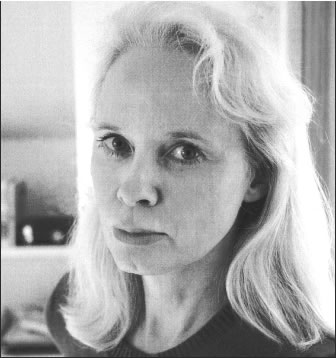
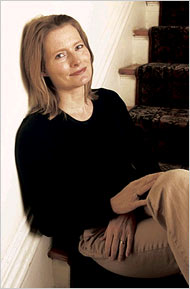
Hey, kids. I just finished the book ten minutes ago, and I’m now ready to make dumb jokes about it. See, I used to have this somewhat credible litblog, and then this and that happened, and now I write limericks and go for cheap laffs. Which is unfortunate, because this is a serious book, right down to the author photo.

Which I love, by the way. It’s standard practice, in some corners, to objectify the attractive lady author, but I’m just not going to do that. Still, and honestly, I’m a little in love with this photo. I want to buy fresh peaches at the farmer’s market, stay up until the wee hours peeling the skins, and bake them into a peach crisp so I can serve it with fresh bourbon whipped cream to my love, this photo. I want this photo to recline on a bed in a cheap motel and unroll its torn black stockings slowly whilst I read Bukowski to it in a cigarette voice. I want to reform the Stone Roses and take this photo to our first show, where I’ll dedicate “I Wanna Be A Dog”…er…I mean “I Wanna Be Adored” to it. Yes.

Is this a good book? Pretty good. Not the sort of thing I’d typically reach for, and something I probably would have tossed aside if not for guilt associated with skipping yet another Eddie Champ-curated roundtable. But it does pick up considerably around page 90 or 100–I believe I made a note about this in my thinkspace at page 99–and wasn’t much of a slog from that point forward.

Cheap and easy judgment: Susan is OK; Peter is better. And, yes, Peter is a man from central casting, in some respects, but he did benefit the most from the novel’s structure, in my view. That is, his character deepened and changed most–benefitted most–from the tellings of the other individuals (save Annette, but more about her later). From the “Fool on the Hill” sections I never would have pegged him as an iconclastic artist–more of your all-purpose crank–but by the time Susan and Giorgio are through telling him, it’s clear he’s a fellow of some (apparently well-earned) genius and prestige.

Susan seems like she could have been interesting, had she not been obscured in fancy prose clouds of florid fucking. Again, this is competently and perhaps well-written sex, depending on your politics, but transcendence-by-prick isn’t my thing. The second person didn’t bother me at all, even though it seems like a curious authorial choice. We’re meant to share in her experience most intimately, even as co-conspirators, and therefore most painfully? I dunno.

(At one point, I had a writing advisor who told me in no uncertain terms that reading second-person narration is like being cornered by a drunk. Of course, he was drunk at the time and I was backed into a corner at the Union Club in Missoula, Montana, so take that as you will.)

Giorgio and Annette: where to begin? I think others have touched on it, so there’s not much point in my running down these sections. Gorgeous writing? OK. But this genteel exoticism didn’t do it for me, especially in the Annette sections. Aside from the kind of relentless otherness (by way of stereotype, as others have noted), these bit in particular suffered from needless obscurity that doesn’t plague the other sections. By the end, I wasn’t sure what had transpired, and, apart from my lifelong stance against anyone being rudely violated by a beast of any sort, I couldn’t bring myself to care.

Boiled down, we have here a book with an interesting structure and a writer of some considerable gifts. I just didn’t love it as much as I love that photo.

I leave the floor to my fellow commentators, both more serious and more estimable than I.

Abigail Nussbaum writes:

Brian mentions plot, and specifically the recent Grossman fracas, which reminds me that I never talked about my own reaction to the book as a whole.  I tend to think of myself as someone who reads for plot, but then a novel like Remainder, or City of Saints and Madmen, or Light, comes along and reminds me that that’s not at all true.  It would probably be closer to the truth to say that I find it easier to read for plot, but I suspect that’s true of most people – a plot-oriented novel carries you along with it, whereas a plotless one requires you to navigate your own way through it.  Still, when I turn the last page of a novel my first response is often to ask what happened there, and if the answer is nothing or very little I often find myself without a handle on the work, which is why I’ve so enjoyed this discussion while fearing that I wouldn’t have much to contribute to it.

All of which is a prelude to saying that, like Michael, I admired How to Paint a Dead Man but didn’t love it.  As reviewer, the novels that I enjoy reading and writing about most are the ones that offer an angle of approach from which to engage with them – not necessarily plot, but some element that fires up my imagination.  I tend to think of if in terms of chinks in the surface, handholds and footholds.  HtPaDM feels very smooth (though it might not to others, and particularly those with a background in visual arts), which leaves me admiring it as an edifice, but unable to grasp its component pieces.  And without doing that, I can’t love it.

That said, I don’t think HtPaDM is a novel that wants to be loved.  As Michael says, this is a cold, cold book, and even those parts of it that might have appealed to sentiment — Giorgio and Annette’s narratives — never achieve enough life of their own to be more than sentimental.  Peter is puppyishly lovable, but his narrative is mainly concerned with describing the worst things he’s ever done, and there’s something almost deliberately off-putting about his predicament – he’s in physical distress and in need of assistance, but we’re encouraged to believe, as he does, that he’s not in mortal danger (in fact we know that he isn’t because he’s still alive and apparently recovered – though he walks with a limp – at the time of Susan’s narrative).  So instead of arousing tension and distress, Peter’s injury is aggravating and frustrating – he’s simply stuck.  Finally, there’s Susan, of all the characters the one who most resists emotional connection, with the readers as much as with the other characters.  The only aspect in which Hall seems to be courting the readers’ affection is with her prose, which is indeed quite beautiful (though she tends to fall flat when describing sex – I don’t have the book in front of me but there were a couple of metaphors for bodily fluids that seemed more than a little off).

All of which brings us back to HtPaDM as a painting in prose – capturing a moment, and attempting to engage the readers’ affection not through plot or character or theme but through beauty and superior technique.  It works, I think, though still in the sense that I can’t love HtPaDM the way I love other novels (it’s not just that I’m unschooled in visual arts but that they don’t appeal to me.  I’m all about narrative arts, and even music isn’t an abiding interest), and I find myself going back and forth about it.  On one hand, I admire Hall’s guts for even making the attempt to court a kind of love that her medium isn’t suited to, much less for having the skill to pull it off.  On the other hand, I’m not sure such a chilly trick ought to be celebrated – it’s brave, to be certain, but in the final accounting the result isn’t really a novel.

Bookmark and Share

Sarah Hall Roundtable — Part Three

(This is the third of a five-part roundtable discussion of Sarah Hall’s How to Paint a Dead Man.)

Other Installments: Part One, Part Two

Brian Francis Slattery writes:

hallrt3This has all been a pleasure to read so far, and good to be meeting some of you, if electronically, for the first time.

When I was in my first year or so of college, and an ambitious little prick, I once asked a professor what I should read for the summer. For some reason I’d decided that I was going to read either a bunch of Faulkner or a bunch of Woolf. This professor smiled broadly when I laid out my choices (”what an ambitious little prick,” he was probably thinking ) and then said “I’d go with Woolf. I really admire Faulkner, but I love Woolf.” I promptly disregarded his advice and read a bunch of Faulkner, but the distinction he made between admiring something intellectually and liking it emotionally — and the fact that he was able to make that distinction at all, and so casually and easily — really stuck with me, and ended up having a profound effect on me as I struggled to become a better reader (a struggle I continue with today).

This isn’t a backhanded way of saying that I didn’t like How to Paint a Dead Man. I liked it fine. But I find much more to admire in it. The writing itself is gorgeous, pretty much cover to cover; for readers
who love language, Sarah Hall’s sentences are more than enough to keep the pages turning (like Abigail, I wasn’t put off by the second person, especially given that she makes it make sense really quickly).

The tone of the book is precise and exquisitely well developed (I didn’t mind, for example, that that characters pretty much sounded like one another, because it increased the book’s overall effect). And from a formal perspective, as several people have already mentioned, it’s really neat that the experience of reading a book about three painters and a photographer who works in a museum is bit like walking through a museum and looking at a series of paintings and photographs: Form follows function and subject. I also liked the way Hall framed (hold on to that thought) a lot of her subjects: the artists vs. the critics and the search for meaning, as well as the more specific question of whether all that noise people made in the late 1960s amounted to anything. (I think it’s kind of funny that the preoccupation with the late 1960s has been passed down a generation, possibly two, by the way. I’m told that teenagers these days are as into Led Zeppelin and the Beatles as I was when I was a teenager in the early 1990s. Which is interesting when you stop to think that, generationally speaking, teenage me or a teenager today getting his mind blown by Led Zeppelin to the detriment of contemporary music is akin to a kid in 1969 plugging his ears to Led Zeppelin and the Beatles and getting his mind blown by Frank Sinatra’s records from the 1940s, or Bessie Smith’s records from the 1930s. That said, I also happen to think that Frank Sinatra and Bessie Smith rule, but now I’m getting off course. Moving on.)

So Hall is really smart and a terrific writer. No question about either of these things. But I found it difficult to connect to the book, to give myself over to it, and I say this as someone who gives himself over to books very, very easily. What’s my problem? you might ask. It’s what a few people have already mentioned: There is almost no plot.

This isn’t the same thing as saying nothing happens. Plenty of things happen. But very little of it is due to the characters actively, well, acting. I can think of only one instance in which a character truly acts–Peter’s figuring out how to free himself from his predicament on the hill–and that happens almost at the end of the book. I know, I know–if the book is really more like a painting, then it shouldn’t have a plot in the conventional sense. Plots move forward in time, whereas paintings give you everything at once. I get that, and intellectually, I admire that the book does it; intellectually, I admire many, many things about this book, especially its conceptual underpinnings. But that didn’t stop me from getting, as Ed put it, fidgety.

It’s also interesting to me that Hall chose to have so little plot in her book, given that she raises a number of issues, both intellectual and emotional, that having more plot would help her explore. Here I’m about to semi-break one of John Updike’s excellent rules for book reviewing–”do not blame [the author] for not achieving what he did not attempt”–but I’m doing it mostly as an thought experiment, not to set the book up to fail. After all, plot isn’t just plot, as I have no doubt Hall knows. It’s a way to develop characters–are not characters defined by their actions as much as their thoughts, and sometimes the friction between the two? It’s also a way to–and I hate these words, but–operationalize and mobilize the ideas in a book.

Let’s go back to the way Hall frames her ideas. Peggy argued that “the character of Giorgio might be old-skool and prefer to leave his frame to the dealers and critics … but for Hall to accept this at face value and treat not only contemporary interpretations of Giorgio’s work via this trope, but to also view the other artists in the book through it, is doing no one any favors, least of all an author who proposes to use language to plumb meaning in visual art.” I agree with her, and couldn’t help but feel that, by leaving the idea static, an opportunity had been lost. Giorgio is a somewhat reclusive painter who has difficulty talking to critics. Peter is an outspoken, sociable painter who has no problem talking to and arguing with critics,
sometimes to their faces. These two painters write to each other all the time, it seems. Would it not have been interesting to have these two talk to each other directly about their relation to critics and the interpretation of their work? And argue about it? This would help us learn more about both characters *and* let Hall bounce from point to point to push the book’s ideas further–to get beyond the frame, or to fill it in. Another example: So Nathan doesn’t find out about the affair. Fine. But what if he did? Given that Nathan appears to be a fairly easy-going, lighthearted guy–in many ways, not so dissimilar from what we know of Danny–a confrontational conversation between them might have been interesting in moving the ideas in Susan’s story forward and showing us more about these two characters–Nathan’s relationship with Susan, and Susan’s relationship to both Nathan and her brother. Then there’s the ideas about the 1960s–so much fertile ground there, between Danny, Susan, Peter, and Giorgio, none of it more than briefly surveyed.

Clearly, more plot would result in a very different book, and might very well have destroyed both the concept of HTPADM as a still-life painting and the unmoving, tense spell that Hall casts through her writing–like I said, two things I really admire. So if the issue of the relative lack of plot came up, either while Hall was writing the book or in conversation with her editor, I can totally see why they weren’t explored. (It would be a great question to ask Hall directly, rather than have me blather on about it speculatively.) But somewhere in the ether, where there exist alternate drafts of the books we read, there’s a version of HTPADM that’s livelier, more argumentative. There are even glimmers of such a book in the final sections of HTPADM, and Hall is such a good writer that I believe she could have pulled it off, preserving everything that’s good about the book already while applying the same mounting energy in those last pages to the story all the way through: a still life, but still, life.

Kathleen Maher writes:

Having been away for a week, I found the critiques so far of How to Paint a Dead Man terrifically enlightening. Sarah Hall is new to me and the novel together with your insights have felt like a blessing.

As Ed wrote: discussing this book begs a subjective viewpoint perhaps more than most fiction. Taking this as permission, I offer a few personal facts that affect my response to any work of fiction that aspires beyond commercial goals: As an unschooled and mostly unpublished fiction writer myself, I take an author’s “authority” as real, and am reluctant to conjecture about other ways the book might have been written. Until recently, when I began experimenting with serial fiction online, I preferred a plot that lagged behind a story’s character and style.

So the still-life quality here and its plot–where the characters effortlessly change like day into night–delighted me.

It’s probably pertinent, too, that I consider literary “failures” as a sign that a fiction writer is honestly facing his or her daily task, which is always risk. Big or small, failure appears–to me–as fundamental to creative endeavor. Without it, a writer presents only safe, perhaps popular and even beloved, replicas. Further, should those so-called failures become published: hurray for the writer!

Finally, to the novel: I agree with Sarah Weinman that Susan required a second person voice, although my reasons differ from hers. The second person, for me, shows a person so self-absorbed that she or he might as well speak for everyone. That, I think, is what’s off-putting about it. It’s possibly even more egotistical than prose where every sentences begins with an “I.” Susan’s “Mirror Crisis” assumes obliviousness to everything but herself and her grief. As for starting the book with Susan, it was risky, but not much riskier than presenting a novel with four only slightly related protagonists in different time periods.

Yet, Susan’s “You aren’t feeling like yourself…” might especially appeal to women who rarely feel the universal voice champions their personal lives and perspective.

To me, Susan’s second person also announces that here is a woman who is certain of some men’s undying devotion. We take her universal word for it that her twin brother couldn’t settle down, because he wanted only her.Her faithful partner Nathan stays six years after her refusal to marry him. And while she grieves, which I know first-hand is abominable work, he does all the cooking and cleaning without asking questions.

Further, she — or — you — were the smart and capable twin.  Her father–we learn from his first person dreams during the phase where he’s trapped and for all he knows dying–adored and infuriated her.   

Along those lines, I enjoyed and deeply admired Sarah Hall’s writing of Susan’s sexuality. Maybe I’m reading the wrong novels, but graphic descriptions of a woman’s illicit, powerful desires and the frank activity satisfying them do not occur often enough in novels. Certainly not with Hall’s exquisite precision and grounded description of pleasure lasting hours, even days after an encounter.

Cliches? The author’s job is to make them new. They’re cliches to begin with because they’re usually true. (Though I agree with Miracle Jones that a Fascist flower girl, a psychic mountain, and a man’s foot trapped in blind twins would be fabulous–perhaps that’s a story she should write.)

That the four stories intersected at all– father and daughter, mentor painter and student, mentor painter and blind school girl– appealed to me. I believed it because the author wrote it that way and gave us plenty of evidence, whether we get to read Giorgio and Peter’s correspondences or not. But the novel’s beauty would have shown the characters as new and universal even if no relation existed among them.

Brian Slattery’s observation that the characters sounded alike was one I longed to see, because lately I’ve wondered if the lasting writers, the ones most appreciated, are like movie stars who play “themselves” no matter what the movie. They act like characters we associate closely with who we think they are. They’re the stars we recognize and remember.

Hemingway, Flannery O’Connor, Philip Roth, Nabokov, and Philip K. Dick are only a few among a pantheon of writers whose protagonists’ tend to speak with the same authorial voice. In dialogue, it’s nice to find variation among the characters. But if I’m buying a Philip Roth novel, be it set in Israel, New York, or New Jersey, I want it to ring with his voice, his sentences, and sensibility.

Anna Clark writes:

I waited until this morning, until I turned the final page in How to Paint a Dead Man, to take in your perspectives on the novel. Thank you for sharing your thoughts on it, especially because in many ways they seem to differ from mine. For example, I seem to be unusual in that I very much enjoyed Sarah Hall’s book, without qualification.

Here’s why.

For me, the uncommon structure of the novel worked not simply because it assumes a gallery-like experience of peering into one frame after another, but because it is the short sections, the different forms of narrations, the four leading characters that we follow, all this serves the movement of the novel. The instability I felt as a reader in the first pages, unclear on what Hall was up to, transformed into suspense: what was Hall up to? Where is this going? In a novel that, as was mentioned, borrows from the artistic forms of landscape and still-life, the intervals we spend with each character before spinning off into another universe serves to maintain the novel’s profluence, its forward-motion.

While much has been made of Hall’s really fantastic language — she clearly is in love with words, which, frankly, is not a given among contemporary authors — some of you aren’t enamored with the fact that Hall’s language is consistent, even as she moves among her characters and her landscapes. (Though, to be sure, she does vary her vantage points among first, second, and third-person perspectives). This seems to me to be a wise choice: in a novel where so much is unsettled and atypical, using a more or less consistent language gives the reader something to hold onto as she moves through the text. It keeps the novel from veering into unhelpful fragmentation and absurdity. What’s more, the consistent language makes the textual rhymes more apparant; I found myself finishing one section where the images linger on, say, eyes and sight, and I know that that the next section will move to Annette and the stories of her pending blindness. What’s more, Hall’s language is so good, so striking, that it is an argument for itself. I’m happy to meet it, section after section.

Speaking of seeing the rhymes among the characters’ lives–you all have made plain that Girogio teaches Annette and receives letters from Peter; that Peter is Susan’s father. But there are other connections that emerged through the novel–revelations that happened not in the traditional ways of plot, but in the the authorial (painterly?) techniques that Hall embraces here: juxtaposition, association, composition.

I realized late in the novel, for example, that Tom, who Susan is having an affair with, is Annette’s littlest brother (Tommaso). It’s apparent that the bottle Annette leaves on Girogio’s grave–returning a gift he’d given to her–is the bottle that Peter steals when he’s in Italy and later gives to Susan for her exhibition of artist’s relics (though Susan never believes that it’s anything but a tall tale). Connections like these are never pushed on the reader, but emerge in the text, like delicate spices in a well-made meal, like the glimmers of movement that we see when we gaze long enough at a nature morte painting.

The novel carries its share of active tension: Peter’s horrific accident; Annette haunted by the Bestia, by her bizarre family, and the final incident at Girogio’s graveside; Susan’s secrets. But it’s no secret that this novel rides primarily on its stylistic verve. Suspense doesn’t take the usual trappings in How to Paint a Dead Man. But it’s there, in surprising costumes, and I thrilled to it.

One further point: it’s been mentioned that it seemed strange that we learn so few details about what the art made by these characters actually looks like. Such a lack of details comes in context of a novel that is emphatically a visual one. The characters spend an enormous amount of time looking at things; visual images are thick in Hall’s pages. It seems to me that the lack of narration describing Peter’s paintings, say, or Susan’s photographs is again an appropriate choice. No character is compelled to describe their own art to themselves in excruciating details, though we readers get enough information about their canvases to extrapolate; being visually-oriented, the intersections between the characters’ work and their world emerges (for example, through Peter’s life in the north country of Cumbria).

How to Paint a Dead Man is a risky novel, and it is carried by Hall’s sheer confidence and nerve. Even as it simmers under the prominence of the language and structure, this is a physical, muscular work of fiction–one that dwells on bodies, violence, sex, drugs, drunkenenss, blindness, cancer, pregnancy, movement–and so it is perhaps no surprise that it hits viscerally.

Frances Dinkelspiel writes:

I wanted to explore another aspect of the book: Annette’s death at the grave of Giorgio.
 
Throughout Annette’s sections I kept dismissing her mother’s concerns as the worries of an old-fashioned woman who resisted her daughter’s burgeoning sexuality and who used Annette’s growing blindness as an excuse to control her daughter. After all, it is (somewhat) clear that Annette’s father died while in the presence of his mistress and that they may have been having a sexual encounter at the time of his death. This humiliated his widow, who narrowed her world down to her home, her church (and her tv church) and her children. She clearly only tolerated her brother-in-law and was oblivious to his desire to have a romantic relationship with her.
 
Annette was obviously very beautiful and she navigated her village and the market without fear. But she always kept a vision of the Bestia (beast in Italian) nearby. At first I just dismissed the Bestia as an Italian peasant superstition. He was the devil, obviously, and in Italy in the years after World War II, most Italians still held a close allegiance to the Catholic church.
 
But it turns out that the Bestia was real, and Annette’s mother’s fears were realized. There was a dark force out there and it was after Annette. This came as a surprise to me. I expected the story of Annette to be one of modernization. After all, her brother Maurizio had such a playful personality and her uncle was experimenting with cross breeding plants and other science experiments. The family had just bought a television, which I had expected would provide Annette with enlightenment about the broader world. (It did not) I thought Annette’s story would reflect Italy’s transition from a country rooted in superstition and religion to one governed by science and connections to the broader world.
 
Why did Hall kill off Annette, her flower, her innocent protagonist who had few aspirations in life, who pleased Giorgio, a true artist? Why did she make all the fears and superstitions that had surrounded Annette and her mother happen? Was she creating a counterpoint to the very modern Susan who refuses to marry, indulges in an affair with a married man, and seems to be having a child out of wedlock? Was Hall painting the trajectory of women in recent history? I don’t have an exact answer and am curious about other people’s ideas.
 
The last chapter of Annette is called “The Divine Vision of Annette Tambroni.” Annette goes to church, hears the story of Abraham’s willingness to sacrifice his son Isaac to show his love to God. Annette vows not to be afraid any more and when the rapist approaches her, she does not run or fight back because “she has made a promise not to be afraid. She has made a contract with God to trust in Him so that He will keep her safe from harm.” Her blind obedience to God is her undoing.
 
At the same time, Hall writes this scene as if it is something beautiful, not violent. At least I wasn’t jarred by it. The last scene in this section is a dead Annette, her eyesight restored, flying over her village and watching her mother and brothers from afar. She sees a tableaux, a pretty picture as she goes to her death.

Kathleen Maher writes:

Frances, your response to Annette’s death touched upon a few things I had decided not to mention but have now supposed I might as well as dare. Readers have referred to this novel, which I found beautiful and stirring if not a straightforward page-turner, as one that lacked a plot and offered scant dialogue, both of which are true.

It’s just that literature promotes and discards and rediscovers style the same way bell bottom (call ‘em boot cut) blue jeans, capris, loose clothes and then tight ones, short and long skirts create and follow trends. Plot plays big right now. And it’s likely that scholars discover connections and layers in novels that may or may not be intended. I think it was Jame Joyce who said whatever patterns people found in “Ulysses” were precisely intended. I use this as an example because I can easily imagine a keen mind spending a life time sifting through Joyce’s novel. (Finnegan’s Wake, on the other hand, I’ve never managed to read. And since I can’t make sense of it, I wonder if the novel, if not the author, was insane. But that’s me and I’m all too aware of my limitations.)

Plotless novels were once in published and praised, if not especially popular. Among the most revered I’d put Milan Kundera (yes, his novel have plots but they’re sketchy plots) and the few novels I’ve read by Camus. Perhaps scholars can find prominent, driving plots in Virginia Woolf’s novels, but I can not. Falling along a separate strata there’s Peter Handke and Larry Woiwode.

To touch upon a different strata there are countless “road trip” novels, drunk in Mexico novels, and what would you say about Henry Miller or Genet? They write about one episode after another. There’s action and dialogue but nothing I’d consider “plot.”

Regarding Annette, my sense was: terrible and random things happen. And while her mother did seem hysterical–and in fact didn’t face even the predictable challenges a daughter presents, like her period–her fears came true. That doesn’t mean she was right. If Annette learned Braille, for instance, if she were allowed to grow toward her adult self, perhaps she would have survived and married and had a daughter she was able to nurture more realistically than her mother treated her.

Of course all of that might have occurred if she continued to sell flowers in the market. But she was beautiful and unprotected there at a time when most young women are in school. The story of Abraham sacrificing his only son may be preparing us. But the old fashioned Catholic religion was in love with death. It was enthralled and obsessed and truly besotted with mortality. One’s whole life and its endless frustrations and tribulations would be rewarded in heaven. A young girl who threw herself from a roof and died because a man was approaching her with sexual intentions was considered a martyr. Disabilities–like being blind or lame–were revered. (Mental illnesses not so much unless the Virgin gave you letters.)

So in that vein, Annette’s vision is Divine.  A cradle Catholic as we’re sometimes called, I knew Annette would die in this novel as soon as I read “The Divine Vision of Annette Tambroni.” If the family was to portray Italy’s progression into the modern world after WWII, Annette’s story would carry another subtitle. Further, to old-line Catholics, death is always exquisite and glorious, even when it occurred in the Roman Coliseum and lions ripped you limb from limb.

Miracle Jones writes:

Kathleen and Frances: Did Annette die? Do the dead dream?  Upon rereading the passage it is still unclear to me.  She chokes; she passes out.  But death?

Let’s say she did die.

Annette’s death cancels out Susan’s pregnancy, just as Peter’s escape from the hole cancels out Giorgio’s fiendish cancer deathtrap.  Balance!  Even as both elder gentlemen reminisce about women that they could not save, Peter gets a reprieve, returning happily to the woman he is now certain that he loves. Giorgio welcomes death for the same reason. 

Also, if Annette didn’t die, then Tommaso and Susan wouldn’t have anything in common and they wouldn’t be passionately drawn together as incest taboo guilt survivors (dirty feelings killed their siblings), and so there would be no “Yes Baby” at the end.

No, this is a book where everybody gets what they want, whether vision, absolution, rest, or epiphany.  And I think that’s why the plotlessness and silence of this book didn’t feel so strangling.  These people aren’t physically active, but they are certainly mobile in their intellectual and emotional lives.  They are artists, like we all are, and they earn their intellectual and emotional victories in the trenches of their own minds, battling themselves, each one of them winning in the end.  The music soars.

And here’s what Hall says about Ulysses, perhaps inviting us to think about Dead Man in the same way:

“After many attempts he has not read past the first twenty pages.  Something in the language has prevented him, he says.  But on the last attempt a revelation!  The text is a doorway, or a device for transporting the mind.  In itself it resists interpretation, but instead affords the opportunity to think in tandem, like a man riding a bicycle while aboard a ship.  Peter thinks this is what Joyce intended.  It will not make him unhappy to be oblivious to the narrative until the book’s very end, he writes, for he is sure to enlighten his mind in other ways.

“Such interesting philosophy!  My advice would be to concentrate.”

Brian: I’m with you on “fidgety” while reading this book.  I read it mainly while riding back and forth to work every day on the train, and I resisted it every single time I made myself crack it open, looking around everywhere for some girl to flirt with instead.  But once I was engaged, like you said, the language was pure pleasure, like chocolate melting on the tongue.  Of course, as with real chocolate, if you eat too much the dry bitterness hits the back of your throat and it turns sour. This book must be read in doses, with time in between to reflect and savor.  Several times I found myself deeply impressed by a particular phrase or word choice, raising an eyebrow, uncrossing my legs, and leaning forward — possibly sticking my furrowed brow in a straphanger’s crotch.  Hall is a surgeon with image and syntax.  Sometimes its rough to be American, to have your own tongue weighed down by so many awkward marbles. 

Also, NB: I think members of my generation listen to The Beatles and Led Zeppelin as if it is church music.  People who are really into that stuff are not to be trusted.  They will probably try to get you to come back to their place — not for sex or drugs — but to debate one of the seven deeply important books they own, like Atlas Shrugged, Gravity’s Rainbow, or Battlefield Earth

“Dad Rock” is quaint enough.  It takes you back to childhood innocence, even though all the lyrics are about drugs and fucking (also like church music).  There is the smell of incense, perhaps even a buried memory of a bearded man in a robe doing something obscene.  But I don’t think too many of us are going around ignoring the modern equivalents.  Instead, we find it fascinating that once upon a time “pop” could be so musically challenging.  We figure that back then the people who were craving American Idol must have been alienated and pissed off all the time; mad as hell at the whole dang world.  Hence: war.

Peggy: I can’t really disagree with you about anything, and I think I would mistrust this book too if I had to read a book about the glorious insights one gains while working in a coffee shop.  The crema!  The porcelain!  The rich and ineffable foam! 

As a painter and artist, I’m sure painting and art have been thoroughly demystified for you, and a book that traffics in such broad stereotypes ought to be truly villainous to your taste.

I can’t really speak to any of your criticisms, except to say that the language of art criticism is the closest thing the modern world has to  spiritual philosophy.  We want our artists to be wise and impenetrable.  We want our artists to be avatars of what they produce.  This piece of fiction presents a world where such a longing for “authenticity” is true.  A fictional world.  And this world is illuminating for a little while, even if deeply false.   

Bookmark and Share

Sarah Hall Roundtable — Part Two

(This is the second of a five-part roundtable discussion of Sarah Hall’s How to Paint a Dead Man.)

Other Installments: Part One, Part Three

Miracle Jones writes:

“You turned instead to the place where all depraved civilian requests are made and met: the internet.” — Sarah Hall, How to Paint a Dead Man

hallrt2This book was chilly.  Cold, cold, cold.  Not just cold: frozen.  Ordinarily, I distrust books that are so still and moody and arid, but I realized while reading How to Paint a Dead Man that I distrust those books because they don’t freeze anything worth looking at or worth taking the time to get your mind around.  Sarah Hall’s novel is frozen solid — your tongue sticks to it — but it is still full of life, like a snow-buried city in the Antarctic or an ice cube stuffed with worms. 

This book has assembled a whole helluva lot of interesting things — fast things, emotional things, beautiful things, above all ordinary things — and frozen them in time and space so that the artist can paint a truly remarkable still life.  The kind of still life painting that gives Peter brief transcendence at the end of the novel, a painting of which he says “was nothing for a moment, and then was everything.”

I certainly couldn’t recommend this book to a casual reader.  But that doesn’t mean it isn’t an artistic triumph even as it is not much of a page turner.  Instead it is an exercise in shade and light that must have been exceptionally difficult to pull off.  This book was far more engrossing than it should have been considering that there is no plot of which to speak.  The only events that really “happen” in the book are Peter getting his foot stuck in a hole (which only freezes things further; and how else to freeze this hyperactive madman?) and Annette’s attack by the “Bestia” at the book’s end.

(Who is that “Bestia” by the way?  Was I not paying enough attention?  I want it to be Ivan or Peter on their Italian trip.  I want that to be how Peter “unofficially liberated” the bottle that ends up in Susan’s collection.) 

Ed, your question about structure is the most important consideration here.  This book is all structure.  Form, composition, and relationship.  One must analyze this novel the same way one analyzes a serious, labored painting of dusty bottles on a table.  The four cycling sections each have a different pronoun perspectives (you, I, she, he), each centering on a main character living in a different decade.  Each of the characters are dealing with their own consuming “it,” their muse who is now dead and gone.  They each deal with this loss through changing the nature of their art, even as they are physically altered by shifting circumstances.

Susan curates a show of personal effects, Peter conquers mountains (literally and on his canvases), Annette lives through flowers, and Giorgio has his bottles.  There is a web of inspiration between the characters that is solidified by Susan’s affair with Tom (and its “fruit”), which ultimately makes a weird, circular nexus.  Tom and Susan are clearly breeding the Kwisatz Haderach.

And that’s it.  That’s the book.  The neat and artistic delivery of a complicated structural form, wrapped in very beautiful language, sentence to sentence.  But it is so clever when you consider the limitations!  It is so neat and mathematical and attentive!  Too convenient?  Too contrived?  Perhaps.  But so what?  This is the literary equivalent of “math rock.”  If this were an album, it would be by King Crimson.  It would be called Bottles

If you were to make a movie out of How to Paint a Dead Man, how would you do it without contorting the plot into a flashback-riddled caricature?  There’s no way.  It could be black and white, with only the objects that connect the characters in color: Tom, Peter’s letters, the bottle, and of course all the paintings and sculptures. 

I don’t think the Procrustean plot structure is this book’s weak point, however.  I think instead the contrived plot elements are what make this book suffer, plot elements that throw into question the “realism” of our Art Squad.  I mean, come on, psychic twins?  Dude getting his foot stuck in a hole overnight?  A noble Fascist painter?  A mystic and innocent blind flower girl? 

How about a Fascist flower girl?  A psychic mountain?  A dude getting his foot stuck in blind twins? 

But maybe that is the point.  The point is the characters each have all of these arbitrary characteristics, and each have none of them.  Maybe the point here is the same point as at the end of The Breakfast Club.

Note: Everybody seems to be agreeing about the rough beginning of this book.  Perhaps it should have begun at a different place in the cycle.  The first chapter sells a much different book than the one you end up reading.  That’s why it is so hard to walk across Hall’s “flagstones.”  Your mind is trying to synthesize the shifting perspective, unsteady about what is going to happen to “you” next.  The second person totally works, but I think it is a mistake to hit the reader with it first thing in this kind of book.

Mark Athitakis writes:

It’s a hell of risk, isn’t it, opening a book in the second person? Like the others who’ve commented, I’m immediately skeptical of any writer who works in that form (call it Bright Lights, Big City Syndrome), because it’s so hard to not look gimmicky and it contrives a false intimacy with the reader. Once I got past that initial irritation, though — and Hall is such an impressive stylist that it didn’t feel like a gimmick — I was free to wonder why Hall used it, and why she introduced us to Susan first.

My general take is that the novel is largely about identity, and how easily we lose our sense of ourselves. And the first chapter is sort of an overture to that them — not only is Susan fractured be cause she’s lost her brother, with who she’s had an unusually symbiotic relationship, but she doesn’t even get the benefit of using “I” in commenting about herself. She’s “you” — meaning the reader, somebody she doesn’t know and can’t access. A line in the second paragraph announces that point pretty clearly: “You can’t quite catch sight of yourself as you go about your life.” I don’t mind being disoriented a little, if the theme of the novel is disorientation.

It’s interesting to jump from Susan’s unsettled state to Giorgio’s exceedingly settled one. The painter is very much the novel’s emotional polestar — he’s dying, but at peace with himself, and the other three characters all seem to be striving for the kind of self-assurance he has, the easy dismissals he can make of others’ attempts to categorize him. It’s important that the journals we read actually exist in the world and aren’t just Hall’s Olympian vision of the great artist’s private mind — those journals are being translated and readied for display in the show that Susan is working on. Susan is capable of reading them, though unless I misremembering she doesn’t actually sit down with them — she’s too consumed by her despair, and the affair that she’s having with the man who’s actually doing the translation.

Regardless, I’m glad there isn’t a concluding moment in the novel where Susan comes across the journals, finds herself thunderstuck by their thoughtful, restful tone, and proceeds to reorder her life. Most novels that break up into multiple narrative voices seem determined to resolve their various threads neatly, but if anything the emotions are more unsettled by the end of the story than they were as the novel opens. One particular element of that which I found interesting (and which I’d be curious to hear others’ thoughts on) is how Peter’s narrative is structured. His story is outwardly dramatic — he’s trapped underneath some rocks, and he’s in a feverish panic to escape — but there’s no real drama to the predicament itself. We know early on that he survives his ordeal. The true drama is in how the incident calls up a time during his youth where his behavior was at its worst. Does Peter’s entrapment expose his true nature (the callous young man perhaps complicit in a drug casualty), or does it strip away his true nature (his happy life as a father and productive, successful artist)? Hall keeps putting her characters into situations where they’re forced to confront those questions. (The author also wants to make some kind of comment on the 60s, I think—why else title Peter’s sections “The Fool on the Hill”?)

That’s enough for the moment, and I haven’t even gotten to Annette and the matter of the Bestia that Frances brings up; I had similiar questions and thoughts on that point, but I’ll defer to others for a bit.

Peggy Nelson writes:

The major theme in the book is a play on the literal translation of still life, nature morte — dead nature.  Stillness is like a little death.  OK.  All the major characters are stilled in certain ways: blindness, grief, old age, hiking, and of course death itself.  But the point of still life in art is that from the point of stillness we are supposed to gain greater contemplation, greater insight.  We purposely don’t portray the busyness of the world so we can clear our minds and focus on what really matters.  

But what really matters here?  We have (very) cursory descriptions of the actual art: “mountains,” “bottles,” “photographs,” we are given more detail about Annette’s flower-arranging!  (Not that flower-arranging cannot be an art, but Annette does not consider herself an artist, so we can leave that for now.)  What really matters in the book are not details of the art, but details of the lives: the actual bottles, the cleaning woman, the exhibit of artist knicknacks, their sex lives.  Life means something, because — it begets more of itself?  Because it leads to more life (symbolized by the pregnancy at the very end)?  Well, isn’t that a little pointlessly circular?  If something is meaningful “just because,” then we certainly don’t have to be still to get it.  That is not an insight, that is a justification.  

And, in this case, it is completely wrong: an artist’s life is more meaningful than their work?  No, it isn’t.  It is exactly the opposite, for the artist qua artist.  Why bother to do anything at all when you can just live?  An artist bothers to do anything at all because of the hope (and the promise if achieved), that one’s work will mean more.  Here I’ll lapse into the second person as well: if your great insight is that life is more important, you don’t have to become still to realize it.  And you don’t have to do art.  You have to stay moving, you have to live!

For the first two chapters I was captivated by Hall’s voice and her powers of description.  But then it paled fast — not because her voice failed, but because it never changed.  There are four major characters in the puzzle living in lightly interconnected but separate worlds, or at least separate enough to give them their own sequence of chapters.  Yet the voice in each one sounded exactly the same.  The only character that broke out of the beautiful yet somnolent prose was Mauri, Annette’s wild brother (who I thought *may have been the Bestia until I re-read it).  For Tolstoy, it is all *happy families that are alike, the unhappy (alienated) ones are supposed to be different – and should have their own voices.  Reading this book I was reminded more than once of the brilliance of David Mitchell’s Cloud Atlas, which represents a high note of sequential chapters/different voices.  In Hall’s book it’s not different voices/still lives, it’s same voices/still lives, and I think that did the characters a disservice.  The similarities are established by all the characters being separated from something essential.  But we don’t need the exact same cadence (comma comma comma. declarative. comma comma) to drive the point home; we get it.  I wanted to know more about their differences, in that that might illuminate different aspects of alienation.

The coda at the end is from a Renaissance book of painting techniques.  It says, literally, that how to paint a dead man is the same as how to paint a living one – you just use different colors.  This book was all the same color, the same voice.  Someone did not read the manual.

And I want to touch on something in the portrayal of Giorgio, the Italian painter.  We meet him as he ruminates on interviewers bugging him about “what it all means.”  Why the bottles?  Why still life?  Why the  single focus?  He is simultaneously frustrated with the questions, and pities the questioners.  Here, spend some more time.  Drink coffee and look at the horizon.  Stop thinking, pretty much.  

Full disclosure: I do “new media” now, but I got my MFA in painting.  And one of the major things we struggled with in the studio and the critique sessions was this paradox of expressing the ineffable.  Not in our work – we all knew when a piece was successful, even thought the styles were wildly different – but in talking about it.  There is the cliche, which this book embraces in Giorgio, of the artist-as-child: can’t talk about the work because doesn’t know how, is not smart enough, art comes from someplace *below the intellect, true artists with true access to this intuitive source are like children, innocent vessels of the spirit, or the flow, or what have you.  Now, this idea has old legs, but was really argued as a political trope by Clement Greenberg in promoting the Abstract Expressionists after WWII.  Jackson Pollock, the inarticulate vital force!  American ingenuity, innocence, and power!  See, old verbal Europe, what your decadence got you: Nazis, is what it got you.  We’ve cleaned the Aegean Stables with our pure energy, and here it is, expressed in our art.  Which of course is necessarily better than yours.  That’s when the “center of the art world” shifted to New York from Paris, and of course the money followed.

There is a truth that some things are not verbally accessible; we refer to the ineffable for a reason, there are meanings we can only gesture for, maybe they’re out there, maybe they’re not – and in truly great art we might see them revealed for a moment.  Or gestured towards in an intriguing way.  But it is a mistake to infer from this that artists are ineffable, that if they can work with images, language is denied them.  And that the minute they actually start speaking articulately, they’ve destroyed something in art.  Language is not the enemy of visual art, language is the frame.  And he who controls the frame, controls the context, and controls the money.  As well language gives the artist something to paint about – you do have to think, in words, in order to be interesting.  So we were encouraged — no, *commanded, to be verbal advocates on our own behalf, because otherwise someone else would do it for us, and yeah, they might not get it right.  Now the character of Giorgio might be old-skool and prefer to leave his frame to the dealers and critics, who apparently have done all right by him and his work.  Italian villa plus cleaning woman, anyone?  Eat Pray Paint?  But for Hall to accept this at face value and treat not only contemporary interpretations of Giorgio’s work via this trope, but to also view the other artists in the book through it, is doing no one any favors, least of all an author who proposes to use language to plumb meaning in visual art.

Abigail Nussbaum writes:

I think I’m the only one so far who took the second person in stride.  Not sure why it didn’t throw me at first, but once it became obvious that the different narratives were being told in different persons, my natural tendency to look for patterns and meanings took over, and of course the second person is the perfect voice for Susan, who spent her life completely focused on another person and feels lost and almost disembodied by their death.  As Mark notes, Giorgio is the most settled character, the most self-contained.  I don’t read him as incapable of analyzing his art so much as humorously uninterested in that analysis unless it taps into the aspects of it that interest him – the technical, which Peter is so in tune with.  What Giorgio doesn’t want to analyze is himself, and whether that’s because he’s comfortable in his own skin or unwilling to examine his past, or some combination of the two, the result is the most self-contained character in the novel.

Meanwhile, Peter and Annette are all about the great world outside of them.  Peter is the small-town boy who escapes (escapes a life in the dark like his miner father, who left the house before sunrise to go underground) and sees the wide world and joins in its revels, but at the same time there’s a part of himself that he’s kept inaccessible, an aspect that’s been left out of his public image.  Annette, meanwhile, wants to be in the world but is kept from it by her mother’s hysterical (though, as it turns out, not at all unfounded) fears.  Even so, she ’sees’ more than anyone gives her credit for (though she doesn’t always understand what she witnesses), and participates in the lives of others.

I thought Frances’s comment about not seeing Peter’s grief for Danny was interesting, because there’s a lot that’s left unsaid or unseen in this novel.  Inasmuch as the narratives do connect with each other, they do so around, but not at, the most important moments in the characters’ lives.  Susan sees Peter just after Danny’s death.  Giorgio receives letters Peter sends him just before he becomes entangled in a poisonous love triangle and an even more poisonous marriage.  Annette meets Giorgio just before his illness becomes apparent.  Though we learn about the fate of Giorgio’s wife, we never find out why he came under political scrutiny after the war (given that fate, and the fact that he’s eulogized by Annette’s communist teacher, I assume he spoke out against fascism, but that’s not clear) or how that scrutiny affected his career.  We have no idea who rapes Annette – Like Peggy, I thought Mauri was the rapist, but it’s later revealed that he was at home at the time, and I don’t think it could have been Peter, because he takes his family to Italy and retrieves Giorgio’s bottle in the mid 80s, more than ten years after Annette’s narrative.

The crux of the characters’ lives is missing.  Except for Susan, who arguably doesn’t have a crux to her life, who is the most disconnected of the characters.  It is, presumably, no coincidence that Susan isn’t a ‘real’ artist, but seems to have settled in the nebulous region between artist, skilled technician, and critic/curator.  There’s almost no discussion of her work as there is of Peter’s, Giorgio’s, or even the watercolors Annette paints at school, and it’s stressed that her connection to Peter has smoothed her way into the British art world even though she’s missing his spark of genius.

In fact, though the second person narrative didn’t bother me, I found Susan’s narrative the least persuasive of the four.  It was the way she so quickly demolished her own life in the wake of Danny’s death, and the brisk pace at which she achieved this.  It felt like a condensed version of some movie of the week (or a more traditionally structured literary novel) about a person Dealing Badly With Grief.  Alienating loved ones, neglecting one’s work, fetishizing some object belonging to or reflecting the dead, having inadvisable, rough sex with someone inappropriate – these are all items on the checklist, and Hall rushes through them much too quickly.  The descent into sex clubs and internet porn was so rushed that it couldn’t transcend the cliché.

Not that there’s a shortage of clichés in the novel.  Peggy’s comparison to Cloud Atlas is apt but, as she notes, unkind to Hall.  Cloud Atlas uses broad clichés and genre tropes as building blocks, and builds something transcendent out of them.  How to Paint a Dead Man often seems to bog down in those clichés – the domineering, restrictive Italian mother and her hysteria over her daughter’s sexual purity; the wise old hermit; Peter’s narrative of sexual liberation and drug abuse in the 60s.  It’s only because Hall is such a fine and delicate writer that she gets away with these tropes at all (well, that and the fact that she doesn’t linger overmuch on any of them, and that as soon as one begins to grate she switches narratives and into another), but even so I quite often found myself knocked out of the novel by their broadness.

Bookmark and Share

Sarah Hall Roundtable — Part One

(This is the first of a five-part roundtable discussion of Sarah Hall’s How to Paint a Dead Man.)

Other Installments: Part Two, Part Three

This week, Sarah Hall’s fourth novel, How to Paint a Dead Man, hits bookstores in the United States. And this website will be devoting the entire week to discussing Hall’s book. We’ll be serializing the conversation in five chunky installments from Monday through Friday. Be on the lookout for cameo appearances and some unexpected revelations. And feel free to leave any additional thoughts or feelings in the comments.

Edward Champion writes:

“A Truth is the subjective development of that which is at once both new and universal. New: that which is unforeseen by the order of creation. Universal: that which can interest, rightly, every human individual, according to his pure humanity.” — Alain Badiou

hallrt1A book of this type is difficult to discuss in a collective manner without bringing one’s own subjective viewpoint into the larder.  So I shall do my best to convey some initial thoughts and impressions as a starting point, with the hope that other views will mesh and rustle with multiple truths.

It’s fitting that this novel kick-starts with a Gaston Bachelard quote.  For what is this book but a series of epistemological obstacles?  We are given four separate perspectives (indeed, four discourses in the Badiou tradition, if we want to start throwing around impulsive philosophical parallels): a second person “mirror crisis” defying the I (or even the eyes reading this book); Signor Giorgio, the dour and dying painter who complains of overanalytical journalists (and overanalytical readers of his Bottle Journals?) who “feel they will catch my true self”; Peter, the Fool on the Hill forced to revisit the uncomfortable past after he slips in an almost absurdist manner into the earth; and Annette Tambroni, whose powers of imagination help her to overcome her diminishing blindness.  I’m particularly curious how your own reading perspective was shaken up by this structure, or if we might even sufficiently fence these experiences into a structure.  (Surely, it’s the failure of these characters to appreciate the undissected ambiguities before them that is part of the problem.)

For my own part, I plead guilty to initial impatience.  I became something of a fidgety bastard when the quartet failed to “connect” with each other and when the specific character details took their sweet time bubbling up to the surface.  Normally with books of this type, I’m content to walk atop the flagstones laid down by the author.  But that wasn’t the case here.  Fortunately, about fifty pages into the book, this feeling subsided and I eventually came to a point where I was eagerly turning the pages of the book as new details emerged.

I found it curious that my own structural prejudices were ferreted out like this, and I suspect this book is something of an interesting rupture between the modern novel of consciousness and the postmodern novel of playful structure. 

This does raise the question of whether this structural tension stacks the deck against the reader.  It also has me wondering whether this book is unfairly manipulating the reader, or legitimately doing so.  After all, we can all accept that a novel is a fictional construct.  Who are any of us to settle for “truth” when we are given, in this case, such intricate prevarications?  Aren’t we all looking for the Bestia?  But here’s the rub: is this book staking its claim for truth or verisimilitude entirely on solitude?  Signor Giorgio tells us early on, “Of all the conditions we experience, solitude is perhaps the most understood. To choose it is regarded as irresponsible or a failure.”  But did Peter choose his solitude when he stumbled down the hill?  Did Susan choose her solitude when her twin brother died?  Did Annette choose her solitude as she went blind (just before Giorgio offers her inspiration)?  These are all narrative developments that are clearly contrived, but don’t feel so within the course of the structure.  So what might this book be saying about the reader’s capacity to believe?  (Come to think of it, this book would make a great double bill with Richard Powers’s Generosity, which concerns itself with the same questions.)

As the book proceeded further, I became less concerned by these connections.   Perhaps I required my own subconscious landscape to root these many characters.  Near the end of the novel, when Hall began shaking up the order, I found myself pleasantly liberated by the constantly shifting manner in which I was lost.  Susan, as we learn at the end, has always been there.  But what of the other characters?  What is this book’s accent precisely, darling?  Or are such questions no different from the superficial banter one must endure at a literary cocktail party?

A few other quick notes:  It’s interesting that the painter-like usage of color in this novel is largely related to human fluids or suffering.  It’s interesting that so many characters are maimed or silenced through injury throughout the book.  (Also interesting: pages and pages without dialogue, rendering the characters as “voiceless” as Susan’s coma-laden friend.)  It’s interesting that there is both a hostility to making sense of art (through Signor Girogio) and a hostility to imagination (the snowflakes Annette “feels” against her face).  And in light of the book’s emphasis on solitude, it’s interesting that family (whether Annette’s or the proposal that Susan puts off) is something to be avoided.  One should not make the mistake of confusing the author’s intentions with the character intentions.  But is one permitted a confusion of art and real life?  If we don’t give into a novel, how then do we find an experience that is new and universal?  How then do we have our reading comforts ruptured by epistemological obstacles?

Frances Dinkelspiel writes:

I will just say upfront that I am neither as profound nor insightful as Ed, that I mostly read for pleasure, and that I read a lot. In short, I rarely analyze character motivation, themes sprinkled throughout a book, etc. I look for good writing and a way into another world.

I was immediately put off by the use of the second person in this book. I think it was galling of the author to use the “you” form in the opening because it alienated the reader rather than invited her into a particular world. But this annoyance only lasted a short time. I was soon drawn in by Hall’s writing and the other characters she created. By the time I came to the third of the second person sections I didn’t care anymore that the voice was so strange. I was engrossed.

I usually don’t like loosely linked narratives either. But once again, Hall managed to make me not care that her quartet of characters were tangential to one another. (How did they connect anyway? The painter Giorgio taught the young blind flower arranger Annette, and received letters from Peter, the painter in England. Peter was Susan’s father) Each character was his or her own self contained story (we don’t even see Peter’s grief over the death of his son) and most of the stories had sufficient narrative thrust, drama and tension that I wanted to know how they ended. And I guess I liked the idea that humans often unknowingly influence others in the world. When Peter was writing Giorgio, he was writing as a young painter to a master, little realizing that his penetrating insights and questions about the still lives would bring Giorgio such pleasure.

I do think this book is in large part about solitude, or put in another way, how we all stand fundamentally alone in the world, even when surrounded by family. At the same time it doesn’t seem to me that any of these characters, except Susan, is lonely. They all have their art, which gives them a profound connection to the world. They have a vision, and thus a place. And I wouldn’t even call Susan lonely. The death of her brother, someone with whom she had a strong physical attachment, has knocked her off balance. In the end, when she discovers she is pregnant and suddenly has another physical being she is attached to, we see the glimpses of her recovery.

Sarah Weinman writes:

How to Paint a Dead Man sneaked up on me. At the time I read it I was aware of being caught up in all the various perspectives, but now that it’s been a few days I’m thinking more and more about the interlocking narratives, the interplay of reality versus simulacra, art and life, and all that jazz (so to speak!)

Like Frances, I was put off, just a bit, by the second person perspective. But it quickly became apparent that Susan’s viewpoint had to be told that way because then we became privy to her transformation, her engagement with herself and her body and her sexuality, but she herself was rather taken aback by these changes even as she became more enthralled by then. So to step outside of herself, to feel things around her while succumbing to all these changes, gave Susan this greater sense of the visceral and the immediate. And truth be told, her viewpoint was the one I looked forward to the most, that sense of jabbing, rhythmic present in the midst of the larger historical context of Hall’s story.

But looking at the other perspectives, I loved how Hall took her time in making them connect, and trusting the reader to infer what he or she wanted to, even leaving things a bit fuzzy. Frances has it right, and those tangential connections also reinforce the power – and the distance – of these viewpoints. Giorgio is all about art even as, at least to me, he never quite got to where he was going. Annette, being blind, could remain in a state of purity that may or may not be up to 100% emotional truth. And Peter, somehow, both measures up and doesn’t measure up, and his legacy hangs over both Susan and her dead twin brother she both reveres and holds in suspicion.

And like Ed I got lulled into a sense of four-part harmony that, when Hall shook it up, seemed jarring – but then, that’s kind of the point. We’re lulled into a sense of order in life, and art is all about chaos and inviting in an array of emotions, however ugly or beautiful. So in the end it makes sense Hall would use as many vantage points as she could, setting it up almost like a sonata or a semi-symphony, and then she goes and gets all atonal on our readerly selves.

Later on if enough people have read the book I would love to delve more into the parallels between How to Paint a Dead Man and Generosity in terms of real/artifice and art/life.

Anyway, that’s my starting point, but looking forward to what everyone else has to say!

Bookmark and Share

Sarah Hall Roundtable Next Week!

deadmanteaserThis is just a reminder that, next week, we’ll be devoting this website to a detailed roundtable discussion of Sarah Hall’s How to Paint a Dead Man. The discussion, now in progress, has generated interesting asides on epistemological obstacles, whether second-person perspective is annoying, Procrustean plot structures, Fascist flower girls, The Breakfast Club, Bright Lights, Big City, still life vs. real life, the ineffable nature of artists, David Mitchell’s Cloud Atlas, being “an ambitious little prick” in relation to literature, William Faulkner vs. Virginia Woolf, Led Zeppelin, John Updike’s rules for book reviewing, “failures,” and numerous muted connections throughout the book.

Of course, all readers are invited to contribute thoughts and feelings in the comments. But be sure to stop by next week and check it out.

And again, if you’re not familiar with Sarah Hall, you can read my essay on her first three novels for The Barnes and Noble Review. (The new novel is notably different from the first three.)

You can also listen to my one hour podcast interview with her from last year.

Bookmark and Share

Sarah Hall Roundtable

deadmanteaserDuring the week of September 7, 2009, this website will be devoting its attentions to discussing Sarah Hall’s forthcoming novel, How to Paint a Dead Man. The novel, recently longlisted for the Booker Prize, concerns itself with four stories taking place over half a century. And we have assembled a rowdy crew to oar through these promising waters.

If you’re not familiar with Sarah Hall, you can read my essay on her first three novels for The Barnes and Noble Review.

You can also listen to my one hour podcast interview with her from last year.

Bookmark and Share

Roundtable Discussion Coming in September

knightsround

As any person keeping tabs on the publishing industry knows, there are so many high-profile books coming out this year that it’s difficult for some of the books that aren’t written by Thomas Pynchon, William T. Vollmann, and Nicholson Baker (as good as these authors are) to get the credit they deserve.

It has therefore become necessary to unleash yet another roundtable discussion for a particularly exciting title sometime during September. For those readers who have enjoyed our previous roundtable discussions of Richard Powers’s The Echo Maker, Nicholson Baker’s Human Smoke, Eric Kraft’s Flying, Ellen Ruppel Shell’s Cheap, and various other books, this September symposium will operate along similar lines.

I cannot reveal the book at this time. But I can tell you that the book is a highly ambitious novel. I can also tell you that there are eight vowels in the book’s title and three counts of one letter in the author’s name.

I should have more details about the book in question when we get closer to pub date. And we’ll reveal the book early enough so that those wishing to follow along can do so.

Bookmark and Share

Ellen Ruppel Shell’s CHEAP — Part Five

(This is the fifth of a five-part roundtable discussion of Ellen Ruppel Shell’s Cheap: The High Cost of Discount Culture. Other installments: Part One, Part Two, Part Three, and Part Four.)

(A podcast interview with author Ellen Ruppel Shell will follow this afternoon. Thanks to all the roundtable participants for their input, Penguin Press for providing us with the books, and for Ms. Ruppel Shell for her time and generosity.)

Erin O’Brien writes:

cheaprt5I thought one of the most stunning aspects of our conversation was how emotional many of us became over a fairly straightforward work of nonfiction. It just goes to prove what I’ve always believed: money is a character in each of our lives. It has a point of view. It reacts to how you treat it. Just like pets and their owners so often look alike, a person’s money is imbued with their persona. When anyone starts talking about how we spend it or how we should spend it, we take it personally.

Now for a few musings:

The tighter you hold your money, the more you poison it.

To a man waist deep in quarters, fifty cents means nothing. To a thirsty man standing in front of a vending machine, it means everything.

Each one of us participated in this exercise freely and without compensation. We didn’t even have to shell out $25.95 for the book, which Penguin sent to us for free.

Think of a dollar bill. In your pocket. Slipped under a coffee cup on a diner counter. Floating in a filthy puddle. What does it mean to a Chinese laborer working to produce little plastic pink flamingo key chains or a shrimp farmer in Vietnam?

Now imagine that bill was a one hundred dollar bill. In God We Trust.

If there were a followup work of fiction for all this, my recommendation would be Frank Norris’s McTeague.

To close, I offer an image. Behold the looooong underwear rack at the Unique Thrift Store on Lorain Avenue in Cleveland. Although I did not purchase any of the used underwear, I dare say I felt at once obliged and uncomfortable taking a picture of it. For more on this subject, see the following blog post.

erinfinal

Robert Birnbaum writes:

I believe that at the heart of this back ‘n forth is a shadowy sense of economic justice and environmental rationality.   We have heard much about or are  quite aware of the beast we are up against. Remember even in the mid-19th century, while he was way off about communism, Marx’s analysis of capitalism was pretty acute.

The recent spate of microeconomic analysis books promulgate strategies and tactics employed to advance the moneyed class’s interest(s) — which is the increase/accumulation of capital. So if most of us are exploited and alienated along the way, well, we have, uh, freedom. I’d place more value on these books if I could tease out a viable call to action — which I haven’t to date. 

It occurred to me, since there was some discussion of bookshelves — meaning most of, if not all of us, are book “consumers” — that there was no mention of one of the most valuable community resources found in most Western communities — the library. Why do we saddle our selves with these bulky weighty objects that have little monetary value? Particularly in a mobile society. Books are a burden when we exercise that mobility.

Why do we hobble ourselves in that way?

Peggy Nelson writes:

It occurs to me that we have the material here to create a great mind-map from all the points brought up in this discussion, from the abstract overall theories that contextualize the analyses to great practical suggestions for how to actually do it (live cheap(ly), that is) at the ground level.  Mind-maps, while not the solution to everything, can be a great tool for thinking about and remembering wide-ranging discussions.

Miracle Jones writes:

This whole discussion got me pretty wound up thinking about crappy bookshelves, the price of eBooks, well-crafted objects, and the future of publishing.  How do you make books worth the price (keeping writers fed) while still accepting the inevitable, that books are now completely free to copy and distribute?

Anyway, I wrote this as a response.

It’s probably not useful for the actual panel discussion about Cheap, but I figured it was worth sharing. 

Amy Riley writes:

I may be way too late to get in on the conversation, but I have finally finished the book, and in the process learned just how much longer it takes me to read non-fiction!

For me personally, the book was quite eye opening. While I could certainly recognize some ridiculous consumer behavior in my life, and there have been times when I’ve had to talk myself out of poor choices because they seem like a good deal when they really aren’t, I’m not sure I ever put it all together as a national sickness with such a long history!

So all of the psychological elements about fairness and getting a good deal and the detailed history of discount stores was helpful in giving me an overall picture of the situation. I think there are probably a lot of people like me, who have some vague ideas that all of this isn’t good, but don’t nkow the complete story or rather, enough of the story to begin to understand why it isn’t good and how it’s affecting our nation and our personal lives.

In regards to what can be done, this is perhaps the most difficult aspect. So now I’ve read this book, and I can understand how the products I buy aren’t necessarily good quality or a good deal and the food I eat has serious issues. But what can I do? Maybe for a while, I’ll be hyper-aware of everything. But can I really pull out of this seeming addiction? After all, a good portion of the book seems devoted to explaining just how it is an addiction. I think it would require a series of ongoing hard choices and the surrender of choice in fact.

shipmentFinally, about books, I have often considered how Amazon (the devil to many of you!) made book ownership possible. I never bought brand new books before I bought them on Amazon. Feeling like I wasn’t paying full price certainly led me to buy more. So it always confused me when people railed against Amazon on behalf of independent bookstores. Amazon didn’t steal my business. They just created some for itself. And yet truthfully, here I sit with so many books surrounding me, many of them unread, and realize that owning books, especially the number that I do, isn’t something that I need. Maybe this is something that is actually bad…for the environment, for the economy, and for publishing. Giving up book ownership is not something I want to do. It would be a “hard choice” and it’s honestly not one I’m willing to make at the moment.

I do think it’s interesting in relation to digital books, how high the demand for “cheap” and “now” is! Especially considering the response to Sourcebooks’s decision to delay the eBook edition of a popular forthcoming title due to the low price of Amazon’s eBooks. There definitely seemed to be a mentality: “We deserve this the way we want it and at the price we want it when we want it.” After reading Cheap, I do have to wonder what the real future of books will be.

And hey, thanks for letting me share a few thoughts so late in the game.

Ellen Ruppel Shell responds:

ersI am humbled and honored to have such a thoughtful panel with which to discuss Cheap’s vagaries. Thanks to Ed for inviting me. I’ll do my best to keep up with you all.

Allow me to open by clarifying a few points, beginning with Ed’s Boar’s Head meat sandwich example. Ed lives in a sort of village, where he regularly patronizes merchants whose merchandize he knows and values. So when the new deli in town undercuts competitors by a quarter, Ed can make an honest decision—and all things being equal, he is perfectly within his rights to decide on the less expensive lunch. However, were Ed to find out that one merchant was using not Boar’s Head but advertising Boar’s Head and using some inferior no-name brand, or that said merchant was abusing his employees or pouring toxic chemicals into the street each morning, there’s a good chance Ed would be willing to pay—would indeed want to pay—the extra 25 cents to avoid patronizing that merchant. My point of course is that in the era of Cheap, we are not really in our home neighborhood. Rather, we are tourists in a strange land—often we don’t know where our purchases are made or who made them or with what. So price becomes the one “objective” determinant of value—and low price trumps almost every time. But as I hope that I make clear, price is not objective. It is highly subjective, and prompts a strong emotional response. (Speaking of Amazon, which many of you do speak of, recall how pissed off customers became when they learned that Amazon was charging some of us more than others for the same book! Huge emotions were raised by this—mostly anger– yet far less anger is evoked when we pay a discount price for very bad books.)

Another point — I went to great lengths to avoid the inevitable charge of elitism. It is for this reason that I went to IKEA (which, by the way, took me a full year to get into-it is a very private company.) As you all note, I also take on Whole Foods. I hope I’ve built to an argument that the 100+ year old concept of Frugalism is a reasonable antidote to Cheap — when I quote near the end from the 1907 work of Simon Nelson Pattern of the Wharton School of Business:

The typical capitalists are lovers of power rather than sensual indulgence, but they have the same tendency to crush and to take tribute that the cruder types of sensualism possess. The discipline of the capitalist is the same as that of the frugalist. He differs from the latter in that he has no regard for the objects through which productive power is acquired. HE does not hesitate to exploit natural resources, lands, dumb animals and even his fellowman. Capital to such a man is an abstract fund, made up of perishable elements which are quickly replaced… The frugalist…stands in marked contrast to the attitude of the capitalist. The frugalist takes a vital interest in his tools, in his land, and in the goods he produces. He has a definite attachment to each. He dislikes to see an old coat wear out, an old wagon break down, or an old horse go lame. He always thinks of concrete things, wants them and nothing else. He desires not land, but a given farm, not horses or cattle and machines, but particular breeds and implements; not shelter, but a home…. He rejects as unworthy what is below standard and despises as luxurious what is above or outside of it. Dominated by activities, he thinks of capital as a means to an end.

This is very far from elitist. I’m trying to show through gradual, level headed, heavily researched and cited evidence that “cheap” undermines us by lulling us into believing that our world and our lives are better thanks to cheap goods—when reality shows that the spiraling down of prices has led to a new norm in which the “China Price” becomes the price to beat. We cannot beat the China price, we cannot even approach it and survive as a democratic nation with a functional middle class. I support this view with evidence from history, psychology, economics — and lighten it a bit with personal experience that led me to ask and seek answers for questions raised by my own self defeating behavior as a bargain maven.

As for Janet Maslin’s review — it is everything that my book is not. Maslin begins by suggesting that I am not to be trusted because I describe the same experiment differently than did another author, Chris Anderson. But had Maslin done her homework — or had she truly read my book — she would have known that the experiment I describe is not the one described by Anderson. These are two completely different experiments. (You, dear readers, should have been tipped off by her Dan/Daniel beef — are you friggin’ kidding me?) Also, I’m afraid that at least one of you seemed to have read Maslin’s review more carefully than you read my book. I have never in my life stepped foot in a Red Lobster. The scene that Maslin scares up and bungles was a birthday dinner I enjoyed with friends at a funky little place that I do not name. During that dinner, I asked the wait person where the restaurant sourced their shrimp, and she smirked — telling me that, like most restaurants, the shrimp there was imported from Thailand. I had just learned where and how Thai shrimp is “farmed” — and could not stomach the idea of eating it. But as I say, my friends ordered it — and loved it — and I’m trying to show how difficult it is to know — to truly know — what goes into what we buy. I was attempting a bit of irony here…but perhaps it fell flat?

Finally, I’m sorry, but the charges of “We already know this” ring hollow to me. Yes, you may have had some strong ideas that cheap goods were problematic — but did you know how the invention of the shipping container, the bar code, and the price tag made “cheap” possible? Did you know the history of the shopping cart? Or how and why it snuck into discount stores? Or that its very presence makes us buy on average, one more thing per trip to Target? Did you know how very little we spend on consumer goods, and how the percentage of income we spend on fixed costs has skyrocketed in recent years — making said cheap goods all the more seductive? Did you know that low price per se had become a lens through which so many of us make our buying decisions? Or understand the high/low problem of cheap goods making quality goods so much more expensive? Did you know Gresham’s Law of bad money pushing out good — of Americans no longer being able to determine the quality of what we buy — and therefore spending too much on low cost goods, thinking we’re getting a “good deal?” Did you know that we spend 80 percent more in outlet malls than in regional malls, that IKEA designs to price and does whatever it takes to get to that price, and that the American Chamber of Commerce in Shanghai lobbied against workers rights in China? Did you really know how low price works to trigger the hedonic response in the brain? Did you know, for example, what agricultural economist Michael Morris said in the book — that no matter how the “slow food” movement romanticizes the abstract notion of “the good peasant,” the planet cannot survive without agribusiness? Yet at the same time, we need more small farms. We need both small farms and huge farms to survive. On a planet that is on its way to 9 billion souls, the idea that we can all sing campfire songs and survive on locally farmed food is a pipe dream. On page 171, I make a very clear argument about how low food prices in the West led to the food crises of 2007 and 2008 that starved millions around the world. Can you honestly say you all knew that?

Come on, we all knew that fast food wasn’t good for us, and we’d read of the horrors of the slaughter houses before. But Fast Food Nation galvanized millions around the world — especially the young. We know that local food is better food, and we have heard for decades about the dangers of agribusiness (see Mark Kramer’s excellent Three Farms, for example, published many years ago). But Michael Pollan’s message nonetheless resonates — and is no less important than it would have been had it been entirely new. The goal of this type of book is to illuminate what’s right in front of our face — to get into the guts of the thing, to analyze it and explicate it.

Like most journalists worth their nickel (and I do mean nickel), I believe that knowledge is power. If it weren’t power, vested interests wouldn’t work so hard to keep it from us and wouldn’t strive to hide the provenance of their products, for example, or work so hard to make it difficult for us to determine how they arrive at their prices. I wrote Cheap to empower consumers — which is to say everyone — with deep understanding of the history, politics, economics and psychology of low price — and what it means to us as individuals and to society at large. I offer an alternative strategy — the frugalist concept backed up with a few examples — and stand by it. I urge readers to vote both in the voting booth, and with their pocketbooks — and give some idea how these ideas have changed my life for the better.

Thanks again for the opportunity.

Bookmark and Share

Ellen Ruppel Shell’s CHEAP — Part Four

cheaprt4(This is the fourth of a five-part roundtable discussion of Ellen Ruppel Shell’s Cheap: The High Cost of Discount Culture. Other installments: Part One, Part Two, Part Three, and Part Five.)

Edward Champion writes:

I’m going to attempt to address as many of these interesting points as I can, even as we await Levi’s answer with book before him and take up Miracle Jones’s sensible advice on how to live cheap.

Early into the discussion, Peggy mentioned that she thought Ruppel Shell hadn’t entirely considered the idea of community-based commerce.  I’d like to go further and suggest that the fault doesn’t entirely lie with Ruppel Shell, but with Nicholas Kristof’s blunt sentiment (quoted in the book) that “anyone who cares about fighting poverty should campaign in favor of sweatshops.”  For anyone who’s curious, and to partially answer Whet’s question, Kristof’s entire piece can be read here.

kirstofIn her endnote, Ruppel Shell points out that Kristof’s been pro-sweatshops since the late 1990s, co-authoring articles titled “Two Cheers for Sweatshops: They’re dirty and dangerous.  They’re also a major reason Asia is back on track.”  (Rather interesting, this attention-seeking and extremely callous subhead appears to have been expunged from the New York Times’s archive.  But it’s also worth observing that Ruppel Shell is careful to call Kristof “a generally insightful and sensitive reporter.”)

The workers who toil for long and dangerous hours in such hidden economies are very much on my mind, for I am presently doing my best to work my way through William T. Vollmann’s massive Imperial.  It isn’t just a matter of time always being reframed as a monetary value.  It’s the way in which we defend our lifestyles, whether it’s assuming that a book attempting to plunge deeper into an important issue is “telling us what we already know.”  And it’s evident in the way Kristof writes such pat summations as:

This is not to praise sweatshops. Some managers are brutal in the way they house workers in firetraps, expose children to dangerous chemicals, deny bathroom breaks, demand sexual favors, force people to work double shifts or dismiss anyone who tries to organize a union. Agitation for improved safety conditions can be helpful, just as it was in 19th-century Europe. But Asian workers would be aghast at the idea of American consumers boycotting certain toys or clothing in protest. The simplest way to help the poorest Asians would be to buy more from sweatshops, not less.

Our enviable lifestyles would appear to trump any and all inquiry into those who toil to sustain it.  We think that, if we mention a sweatshop, we can purport to comprehend what it is like to toil and suffer in that sweatshop.  But how are we any better than Kristof in our assumptions?  To what degree does contributing to the labyrinthine network of cheap cut-rate goods produced in exploitative situations actually help the Third World?  Should we be concerned with our Faustian bargain?  And did Ruppel Shell, as Peggy has suggested, not adequately represent these many labor categories by degree?  No, the Walmart worker can’t afford to shop at Whole Foods.  But then the sweatshop worker can’t afford to shop at Walmart.  Does consumer confidence help the worker who is below us?  Or is this all part of the same Shell game?

Which brings us to the issue of necessity, both real and fabricated, initially raised by Colleen and expanded upon by several others.  Like Miracle Jones, I too admire Ruppel Shell’s personal honesty.  And I think that understanding and vocalizing the ways in which we spend money are just as important in understanding the bigger economic picture.  If such an approach amounts to “telling us what we already know,” then I would say this:  If I asked each of you to publicly report the annual income that you entered into your 1040, then chances are you wouldn’t do it.  That would be an invasion of your privacy.  If I asked each of you to tell me precisely how you spent your money over the last week, complete with an itemization of costs and expenses for each day, chances are that you probably haven’t kept track.  And yet, thanks to those dependable Gruen transfers, we’re happy to cling to a remarkably shifting sense of the deep discount deals we’re getting.  To the point where Amazon consumers have been tagging eBooks with $9.99 tags because that’s the price they now want to pay.  Never mind that, as Publishers Weekly reported back in May, Amazon actually loses money at that price point.  Does Amazon get a fair pass, as Miracle Jones suggests?  Yes and no, I think.  One could make a similar case for Starbucks.  On one hand, I wish that Ruppel Shell had delved into Amazon’s parasitic stranglehold on the industry.  But at the possible risk of comparative oversimplification, I think it could be argued that IKEA’s ubiquity falls into more or less the same rub.  As documented by Ruppel Shell, like Amazon, IKEA spends a tremendous amount of time framing the message, whether in the form of a twee Spike Jonze commercial or a slick and colorful catalog.  More questions to the group: Should we look at discount culture on a case-by-case basis?  Or is this all monolithic?  (Yes, Amazon is online and caters to convenience.  IKEA, on the other hand, is a big box store.  Should it matter whether we physically or virtually participate in these Gruen transfers?  The labor is still unseen, whether it’s Amazon workers being exploited, as the London Times reported back in December, or IKEA’s illegal cutting.)

nikeoutletTo address Erin’s track suit dilemma, after thinking about this a bit, I’m inclined to agree — particularly in light of Our Man in Boston’s provocative remarks about elites and elitism.  But I’m wondering if Ruppel Shell’s stereotypical descriptions are somewhat defensible, because outlet stores, discount stores, and shopping malls are, by way of their respective designs, spaces that prey upon our cognitive abilities to process numerous aesthetics.  I don’t want to let Ruppel Shell off the hook on this point — and certainly Janet Maslin didn’t by suggesting that Ruppel Shell needed to “bring a professor of marketing to a Nevada outlet mall to tell her that bargains are phony,” although I think this anti-intellectual assessment isn’t entirely fair to what Ruppel Shell dug up.  Much as casinos are specifically designed to keep us gambling (no clocks, no windows, lots of lights, free drinks), I’m wondering if outlet stores might be working in a similar way.  Consider this 1998 article from Retail Traffic, which outlines very specific design decisions to convince the customer that she’s getting a good deal.  It’s quite possible that this may be just as vital, if not more so, as brand name manipulation.  And so I ask some of the pessimists in the peanut gallery this: If the book “tells us what we already know,” then just how aware are you of a store’s aesthetics when you go shopping?  Bargain hunting may very well be a harmless American pastime for some, but if we’re more concerned with price and acquisition (instead of say the human souls who work at the store or the way the store is designed), then it would seem to suggest that we don’t know as much as we think.

Good Christ, I’ve been a wordy bastard.  And I’ve only just begun to address all the interesting thoughts on the table.  So I think I’ll stop for now, see what others have to say about all this, and return later, possibly after Levi has offered his informed answer to Colleen’s question (which I certainly look forward to hearing!).

Colleen Mondor writes:

I did want to point out one thing about bargain hunting. A lot of people bargain hunt at garage sales and thrift stores (I have seen some amazing things scored this way), which is another deal altogether and not at all related to bargain hunting at IKEA or Walmart. There can, in fact, be different types of bargain hunters and I don’t think they should all be grouped together in one large mass.

There’s one other interesting idea to think about as we consider poor in this country: how you live poor depends on where you live. Miracle’s rules would certainly not work in Alaska where poor folks eat King Crab and catch wild salmon, shrimp etc. — food that would be considered beyond the reach of the poor and/or middle class in the Lower 48.

And many middle class and rich folks love their pit bulls too. I’m just saying.

Robert Birnbaum writes:

Books like Cheap, et al raise the question that subsumes the pretext for the traditional liberal education (i.e., “knowledge is power”). By the way, David Foster Wallace’s Kenyon College 2005 oration is worth looking at on this point.

The relentless (some might use the banal modifier “24/7″) chimes of commerce create such a shitstream of noise that whatever we think we know is disabled in the face of the symphonic chord (think Mahler’s 10th): BUY THIS, BUY NOW.

Some of you all sound like you think you are immune. Good for you. I’m not. Not that I am siting on a pile of junk. But I am sitting on a pile. Did I mention the hoodies, the socks, and the caps?

The only antidote I have found effective is exhibited here:

Also, for those of you unaware of John Crowley, his new opus Four Freedoms should, if there is a modicum of reward for good works in this disinterested universe, gain him a proper audience.

Erin O’Brien writes:

(1) “Sex, conversation, art, and games are what actually make people happy.”

“Become cheap. Don’t fight it. Go so deep into cheap that you become competition for these eeeeeevil discounters. Become so cheap that you are affordable to everybody in all your favorite activities (sex, conversation, games, art), both rich and poor alike. You will have a good life.”

Miracle, I see that you are a genius like me. Remind me to send you my zucchini soup recipe. And as a side note: DO NOT purchase inexpensive marital aids. Just trust me on this one. Contact me off-list for more specific information.

A related Erinism: Buy your plates for $0.50 a piece at a garage sale. You’ll never have a matching set, but, once in a while, you may be able to afford to plop lobsters on them.

pokerchips2(2) Ed, regarding casinos, the poker chips are a trick as well. Your money has been subtly taken from you from the get go and you’re left with piles of inane plastic disks that go up and down with each spin of the wheel.  To me, credit cards are a not-too-distant relative: a thin piece of plastic that magically gets you stuff, stuff stuff!

(3) Her Amazon comments aside, Ruppell Shell didn’t poke very hard at the implication of the Internet price comparison and the way it’s changed price shopping forever.

(4) On bookshelves:

So I’m on one of my endless walks and I pass some guy’s garbage pile. There’s two bookshelves in it.

“Shit,” I say, because they’re pretty good books shelves.

I keep walking, hoping that the bookshelves will be there after I’ve walked the 2.5 miles back home and returned with my Mini Cooper in order to heist the cast-off loot. As luck would have it, a buddy of mine is drives by and pulls up next to me to say hello. He’s in his pickup.

So, yeah, I have cheap bookshelves.

IKEA? I’ve never been to IKEA. Why would I drive all the way to Pittsburgh to go to someplace called IKEA?

Levi Asher writes:

I’ve now carefully reread the IKEA chapter, and I’m ready to respond to Colleen’s question from last week.

First, I think Janet Maslin scooped my answer when she wrote this in her mostly negative review of Cheap:

At the end of a chapter largely devoted to the horrors of Asian shrimp farming, she describes being in a Red Lobster restaurant with friends and being enlightened enough to eschew cheap shrimp in favor of chicken. Yet cheap chicken-farming isn’t any less ghastly. It just doesn’t happen to be addressed by this book.

I consider myself a very socially aware person. And I definitely think it’s important for me to make personal choices that are not harmful to others, or to the planet’s ecosystems.  Of course, this is easier said than done.  We each have our own ways of dealing with this uncomfortable truth.  My own brand of social awareness places heavy emphasis on issues of global politics, war, and genocide. These are probably my own “pet topics,” and I think it’s interesting that the last time Colleen and I disagreed about a book, we were discussing Nicholson Baker’s Human Smoke.  I felt Baker’s book presented a very powerful argument that the Roosevelt-Churchill strategy in World War II led to far greater death, destruction, and genocide than was required to defeat Hitler, while Colleen (I hope that I am remembering correctly) did not feel the book presented a solid argument.

I also vividly remember one of the biggest disagreements I’ve ever had with Ed Champion.  I thought Naomi Klein’s The Shock Doctrine presented a solid and important argument about the insidious underlying purpose of the American misadventure in Iraq, whereas Ed had nothing but criticism for Klein’s work.  So it’s funny that now Ed and Colleen seem to be bowled over by the arguments in Ellen Ruppel Shell’s Cheap, while I stand here saying, “What?”.

cabinI don’t think Cheap is a bad book, and I like Ruppel Shell’s basic mission in making us aware of the choices we make when we shop.  But her case against IKEA, like many of the cases presented here, feels underdeveloped.  She writes of declining forests and environmental sustainability problems, but this is a problem for all woodworking industries.  She ends the chapter by swooning over a heavy (non-IKEA) oak bookshelf, but this bookshelf was also made by cutting down a tree. And even though it will last longer, Ruppel Shell knows there are not enough antique bookshelves around to furnish the world. Sure, if IKEA is committing environmental offenses, then these ought to be addressed and stopped. But Ruppel Shell only hints (and never establishes) that these offenses take place more at IKEA than at any smaller furniture provider.  She also shows us that IKEA does try to be environmentally conscious, that they “use every part of the tree”, monitor their suppliers, etc.  I see innuendo weaved into these sentences. But I find no clear case, no smoking gun.  And Cheap is not a book about the environment or about the problems of an overpopulated world. So the environmental points especially come off as half-baked and incomplete to me. 

What I was trying to point out in my earlier post here is that IKEA has an appeal beyond dumb cheapness.  It is a positive lifestyle choice for people like me — mobile adults who like to travel light.  If IKEA has problems — environmental problems, labor problems, quality problems — than these problems should be addressed and solved.  But nothing I read here seems to add up to a call for a wholesale rejection of everything IKEA represents. I could take Robert Birnbaum’s suggestion and build bookshelves out of spare planks and bricks — but, Robert, have you ever seen photographs from the Chinese and South Indian infernos where bricks are produced?  It’s not a pretty picture.

Finally, I have to complain about some shoddy work on Ruppel Shell’s part in this IKEA chapter.  On pages 126 and 127 she goes on at some length about the Spike Jonze commercial that reminds consumers that furniture has no feelings, and then points to the irony that IKEA tries to create an emotional attraction to furniture by giving its pieces pet names.  Then, on page 140, she repeats the exact same point, as if we’d never heard it before.  “Doesn’t a name connote intimacy? Of course it does, and IKEA knows well the power of intimacy to move us.”  It’s hardly such a powerful point that she needs to fully develop it twice in two separate parts of the book.

Often, when I read Cheap I felt as if I was being filibustered.  Going on about the trivial issue of IKEA giving cute names to its objects, Ruppel Shell specifically mocks the store for “naming a wok after a girl”.  But, reading the notes for the chapter, I discover that the wok in question is called “Pyra”.  Clearly, this wok is named after the Greek term for fire, as every consumer who sees a wok named “Pyra” will understand. Ruppel Shell couldn’t find a better example than this?  I don’t understand why she didn’t at least pick a better example (say, a bookshelf named “Billy”).  It’s ironic that a polemic against “cheap” should have such problems with quality control.

I also feel personally put off after reading and rereading Ruppel Shell’s lush paean to the sturdy oak bookshelf “groaning with books” that her friend bought after rejecting the IKEA lifestyle.  My cheap bookshelves “groan with books” too.  Ruppel Shell’s poor friend will spend the rest of her life lugging that heavy piece of furniture around. This book absolutely fails to inspire me to want to follow her example.

Nina MacLaughin writes:

In response to Robert’s point about immunity to the chimes of commerce. It’s impossible to be immune; even if you’re a conscious shopper, sensitive, responsible, the siren song (or “shitstream of noise”) penetrates.

pricegougeA quick example (and I’m on the side of folks who appreciated Ruppel Shell’s personal anecdotes): There was a Whole Foods located less than a 10 minute walk from my house in Cambridge, Massachusetts. I passed by the store on my walk home from work. It was where I bought my food. I knew it was more expensive, but it was a matter of convenience. Time and money. It was worth it to me to spend the extra bucks to save myself some out-of-the-way trip to a cheaper spot. About three months ago, I moved to Somerville, and the closest supermarket is an expansive, always-crowded Market Basket. It’s got all the same brands as Whole Foods. My first time inside the store, buying the same combo of foods, and more or less the same brands that I would at Whole Foods, I was staggered at how much less it cost. What would’ve been $18 at Whole Foods was a little over $7 at Market Basket. Unbelievable. There is definitely a delight in that. And yet, somewhere in the back of my head, there’s been a gnawing sense that the veggies are saturated with pesticides, that the yogurt is rife with hormones, and that it’s cheaper at Market Basket because the food is poisoned (obviously a little overstated, but you get the idea). And I’ve been sort of wowed about this, in the sense that, holy shit, Whole Foods has done a pretty powerful job marketing themselves. It also speaks to the the complications of price and worth and quality and value that Ruppel Snell explores. Would I rather pay $3.49 for a pint of cherry tomatoes at Whole Foods? Or $2.10 for the same pint at Market Basket? I’d rather pay less, but it does put a doubt — a completely irrational doubt — in my head. Am I getting something that isn’t as good (or, in the case of food, something that isn’t as safe)? Is this doubt borne from the power of Whole Foods’ marketing (and my action buying into it) or the mysteries of price and quality? Or a combo that is hard to know? Whatever it is, it’s certainly interesting to consider.

Edward Champion writes:

To respond quickly to Levi:

(1)  Maslin actually got that detail wrong.  She was never in a Red Lobster restaurant with friends. I’m surprised that not a single fact checker at the supposed Paper of Record got off his ass to grab the book, flip to the “Red Lobster” entry in the index, and confirm that Maslin was indeed quite wrong.  (Damn those bloggers sitting in basements in Terre Haute!)

(2)  My problems with Naomi Klein’s The Shock Doctrine had more to do with her assumptive approach to the subject — specifically, tying nearly every one of her investigations to the “shock doctrine” brand name after the fact.  As Richard Flanagan suggested in his novel, The Unknown Terrorist, journalism is not a sudoku puzzle. It was not unlike Gladwell’s “tipping point” or Anderson’s “long tail.”  Ruppel Shell’s book, on the other hand, demonstrates substantive journalism, as can be gleaned from the solid and often detailed endnotes.  (I mentioned, for example, the fairness she gave to Kristof.)  I do have problems, as others have pointed out, with some of Ruppel Shell’s quasi-elitist descriptions.  But if we look to the facts, the findings, the quotes, and the data, I believe that there’s much here in this book to consider, whether you think you know where you stand or not.  And as Birnbaum said a few messages back, some of you think you are immune.  (I’m sure as hell not.)

booksandbookshelves(3)  The many problems with IKEA, and it is all thoroughly documented in the “Death of a Craftsman” chapter (and I would suggest consulting the endnotes), is that it represents one of greatest manifestations of discount culture.  IKEA’s founder is Ingvar Kamprad. He is the seventh richest man in the world, but he still haggles with vegetable vendors and he still flies coach. IKEA has single-handedly altered Western ideas of interior design, perhaps to the same degree of Postrelian plaudits rightly derided by Jackson.  Let me tell you a story.  When I moved from San Francisco to Brooklyn, I had to leave behind all of my bookcases.  These bookcases were hand-built by a team of craftsmen in the Castro.  A place I highly recommend, if you’re ever in the market for bookcases in San Francisco, called Books and Bookshelves.  The guy would custom-design them for you.  And these shelves were built like houses.  They wouldn’t wobble or fall apart like the IKEA bookcases.  I was able to store a considerable amount of books, while ensuring that I had some wall space in my apartment that wasn’tt occupied by books. When I moved cross-country, I was forced to get rid of these shelves. I initially put up a Craig’s List ad for $50 a pop, which was a little less than one-third of the price that I paid for them.  Very few people wanted them. And some people emailed me thinking they were IKEA bookcases.  They literally hadn’t experienced bookcases built out of real durable wood.  When I couldn’t get any buyers for the last few, I gave them away on the street.  And again, people came up to me — in a seemingly civilized city like San Francisco, no less — asking where I had obtained these bookcases.  They pounded the sturdy wooden sides.  And I told people that they could store their DVDs in there if they wanted to. 

The upshot is this.  These people were mystified by real oak bookcases.  Yes, the bookcase was made by cutting down a tree.  But the difference is this.  These bookcases last decades.  An IKEA bookcase, by contrast, falls apart within a few years (at best) and the amount of wood is wasted.  Furthermore, the discount culture keeps IKEA running around the world and engaging in illegal and decidedly non-eco friendly cutting practices.  You tell me how that’s a positive lifestyle.  Would you rather spend $200 on a sturdy bookcase that will hold thick Vollmann books and last a lifetime?  Or $90 on a Billy bookcase that will fall apart because its not made to hold anything other than thin mass-market paperbacks (at best)?  If your main complaint, Levi, is that Ruppel Shell’s poor friend is going to be lugging around a heavy piece of furniture every couple of years, well, that’s a specious position to take, given all the interim years of sturdy quality.  But if you’re happy with your paper-thin particle boards, Levi, by all means, sing a song to IKEA.  At the end of the day, we’re all singing hymns to the corporate empire.

Robert Birnbaum writes:

A quick question: Are the IKEA shelves actually made of wood or particle board?

By the way, in between Eddie’s elitist custom book shelves (suitable also for CDs) and the IKEA items,  are the inexpensive unfinished pine shelves that I’m sure are available in every city in the mainland USA. You can even paint them colorfully so as to distinguish your self as artsy. Or is it craftsy?

Erin O’Brien writes:

“But her case against IKEA, like many of the cases presented here, feels underdeveloped.”

And when you consider that some event references in Cheap happened just a few months ago, it’s obvious that book was turned around at lighting speed. I couldn’t quite put my finger on it as I read it, but Cheap felt dense and rushed at the same time, perhaps because Ruppel Shell is very smart and Penguin wanted her to write very fast. I suspect Penguin didn’t want to wait around too long only to see the recession cool its heels, along with the sales of this book.

Peggy Nelson writes:

I will have to strongly disagree with the voices who argue that books like this are hypocritical luxury items, preaching to the converted readers who have enough disposable income that they can indulge themselves in a little passive system-bashing before bed.   I disagree.  The work of demystification is lengthy, heterogeneous, and necessary. And it has taken, and will take, many books, many websites, and a significant amount of talking so that we can see clearly what we are dealing with.  This work does not take the place of social/economic activism, but doesn’t delay it or prevent it.  Demystification runs parallel to activism, and is just as necessary.  Empowering people without a clear analysis of exactly where they are in the system only paves the way for greater misery, and perhaps does more harm than good as people become discouraged, decides that the culprit is greater awareness itself.  
 
I have been trying to stay abreast of the economy and our respective places in it, ever since I was a labor activist in the late ’80s. But there are still things I do not know — for example, the historical trajectory of retail commerce, its philosophy, and its pervasiveness — that I learn from books like this one.  Cheap doesn’t go as far as some other books, either in reportage (like Ehrenreich’s Nickel and Dimed) or in systemic analysis (like Rushkoff’s Life, Inc.), but it does occupy its role well.  My only qualm was the book jacket. That fast-food yellow is repellent.  I know it’s about cheap, but does having it look cheap further its aims?
 
In terms of Kristof’s pro-sweatshop arguments, we heard a lot of those arguments in my union days too.  “Well, they’re better off than they were.” Or words to that effect.  This was not made to justify a $12 hoodie purchase, but as part of a global labor discussion. Should we be reaching across national borders to organize? (Yes.) And did we? (No.) (I was with the UAW organizing clericals during that time.) 
 
profitmagI think that this is a difficult argument to combat within the framework of a growth economy.  Companies need to get bigger. Companies need not only profit, but profit that’s greater than the last quarter, and a profit rate that’s continually increasing.  Buy more, spend more, acquire more, consolidate more, grow more, more, more.   This philosophy of “More” (maybe that’s the next catchy title in this series!) does not align itself well, if at all, with other values — like preserving and maintaining limited resources on the planet — and accommodating, perhaps even promoting, other types of values, such as community, creativity, being loved, and playfulness (with kids or just generally).
 
I credit the environmental movement with giving this analysis greater scope by demystifying systems on Planet Earth, including global and regional and micro, and showing not only the interconnectedness of natural systems, but the interconnectedness of natural, economic and cultural systems.  Without a general framework of sustainability (instead of “More”), I think the way out is not possible.  But within sustainability, I think discussions like this can be actively fruitful.   Levi, you are right in pointing out that, despite following the IKEA supply chain back to China and Romania, Ruppel Shell does not fully explore or incorporate the environmental angle here, and that she needs to.  I think that’s part of her not addressing the larger overarching points, as I’ve mentioned before.   Even smaller, more spotlight-style books like Cheap need to set themselves up correctly in relation to the larger themes, indicating where they fall within a larger spectrum of analysis and action.
 
(Re: my personal experiences with IKEA. I too move around a lot and don’t want some giant antique monster as a bookshelf.  But I also dont’ want to support clear-cutting even in places I can’t see.  I’m going to have to do some investigating of my own when it comes time to get my stuff out of storage again.)

Levi Asher writes:

Ed, you’re correct that Janet Maslin slipped up in describing Ruppel Shell in a Red Lobster when she decided to solve the problems of the world by ordering chicken instead of shrimp.  It was a seafood restaurant, not a Red Lobster.  BUT … the spirit of Janet Maslin’s point remains completely valid.  The only reason Rupell Shell was able to feel comfortable ordering chicken instead of shrimp is because she had been studying the problems with shrimp instead of studying the problems with chicken. 

And, Ed, that’s nice that you like heavy furniture so much.  I also know that you like heavy hardcover books, and that you don’t mind lugging around heavy video equipment book conferences.  Milan Kundera wrote eloquently of the choices we make between “heavy” and “light” lifestyles.  I am decidedly a “light” person, and I will indeed continue to sing songs of love to IKEA.  We haven’t even talked about the great Swedish meatballs and lingonberry jam yet.

Jackson West writes:

Well, apologies for my strident tone.  Ed has a way of managing to time these roundtables to my mood and frame of mind rather ruthlessly. Last time, with the Human Smoke roundtable, I was literally in the process of losing my last family link to the era described in the book with the death of my grandmother.  This time, I’m essentially living with my parents off in the hinterlands after finally drowning under the cost of living in San Francisco and figuring I needed to get out of the pool long enough to let some invoiced checks arrive for a breath of fresh financial air. (Good news. It seems I’ll be selling microwaves for General Electric soon, if a tad indirectly. But I digress.)

I think what I was trying to get across is that in a book like this, which attempts to elucidate a history to explain contemporary reality, a teleology is implied.  In this case, the implied argument is this: In a society where everything is easily commodified and competition becomes one of quantity over quality, invariably there will be a race to the bottom in terms of both pricing and marginal profits. Environmental and social degradation hijinks ensue.

This is, in Ruppel Shell’s estimation (and many of our estimations), a bad thing.  Of course, there was a guy way back in the industrial revolution, a student of capitalism if you will, who also noted the trend.  What was his name again?  Something German.  Got a lot of people worked up. Led to some bloodshed (though, of course, not nearly as efficiently as that wrought by capitalism). Now he’s pretty much persona non grata in the wake of a bunch of nationalist revolutions that ended in autocracy, but cloaked their intent in his ideology.

Hence, like the Kristof example above, there are those who would defend the depredations of a sweatshop because they believe, “Hey, at least it ain’t feudalism!” (And of course, they’re not the ones sweating.)  This is a sentiment which, oddly enough, the likes of Lenin, Friedman, Trotsky, and Rand would agree. It’s like the Ku Klux Klan and the Black Panthers getting together on the issue of gun control.  Counterintuitive, but true.

The problem is, when an industrial capitalist society bent on growth at all costs essentially runs out of room to grow — as it has now that it is truly global — then what’s next?  Well, for starters, it seems that wages stagnate even as productivity grows.  Because “sweatshops for all!” really means just that — an equilibrium in which which the working class works for crappy wages to produce cheap shit to sell to the rest of the working class, with the difference accruing to the owners of the means of production.

Progress!

But in America we still have the luxury of sitting on the fat side of the trade balance, meaning our working class can maintain the delusion that they’re actually middle class because just look at this sweet bedroom set I just bought on my credit card even though I’m underemployed and lack health insurance.  A delusion that we’re only too happy to perpetuate, to misquote Dick Cheney as Malcolm X, by any means necessary.  Again, Ruppel Shell lays this all out (and succinctly so). I’m just paraphrasing.

In all this aspirational class alienation, however, a petit bourgeois strain of thought persists. And I felt that this impulse formed the crux of Ruppel Shell’s concluding arguments.  Namely, that if we return to the somewhat sentimental capitalism of our forefathers (and they were all fathers), we can turn back to a Jeffersonian ideal of libertarian utopia.  The argument goes something like this: “Capitalism isn’t bad, per se. Just industrial capitalism. And if it weren’t for the state colluding with certain corporations to corrupt the market, we wouldn’t be in this unsustainable clusterfuck that we’ve now found ourselves in.”  Also: Sex slaves.

The funny thing is that my homelessness brought me to the family cabin as very much the prodigal son. I’ve actually found myself in what I imagine to be something near the image of postindustrial capitalist utopia that Ruppel Shell and her peers seem to be pining for — a small scale organic paradise with broadband Internet.  A sort of info-agrarian mash-up of self reliance, sustainability, and all the free porn you can stand.  For those who’d like to stay in the cities, well, you’ll be making the porn (natch) and selling the advertising in order to pay for the delicious goats and tomatoes that rural types bring to market.

Perfection!

To go back one last time to my original entry, the question that’s bedeviling me (and, to Ruppel Shell’s credit, it would probably not be so damn devilish if I hadn’t read her book and instead was rubbing myself sore with the porn and such) is whether there are enough cabins to go around, or whether this enlightened and entrepreneurial information age that our best and brightest are so eagerly striving for will simply be crushed under the weight of peak oil and slums and drought and war and all the sins of the industrial age which we (and I mean we, us here, and presumably Ruppel Shell’s intended audience) love to hate.

But I think trying to answer that is my book to write, in which case I may milk the middle class for my piece of the pie and buy a garden of my own to tend. And maybe a shotgun to keep the hungry hordes off my garden. The freeloading Commie bastards.

Bookmark and Share

Ellen Ruppel Shell’s CHEAP — Part Three

(This is the third of a five-part roundtable discussion of Ellen Ruppel Shell’s Cheap: The High Cost of Discount Culture. Other installments: Part One, Part Two, Part Four, and Part Five.)

Jackson West writes:

cheaprt3Sadly, like Kathleen, I wasn’t particularly surprised by many of the examples used in Cheap.  However, unlike Kathleen, I’m a bit of a bargain hunting hobbyist — mostly in the realm of clothes, food and media.  Because, as many of you know, writing isn’t exactly the quickest way to riches these days (if it ever was).  Maybe if I wrote something to shake the moral and ethical foundations of your typical NPR-listening, Prius-driving IKEA and Whole Foods shopper I’d have more money lying around to spend on handmade furniture, bespoke suits, grass-fed beef and sustainably grown potatoes.

I’d certainly like to consider Cheap in the context of other well-meaning, non-fiction journalism. It’s likely to find itself sharing “Customers who bought this book also purchased” space on Amazon with a number of books.  Barbara Ehrenreich comes to mind, as does Michael Pollan, whom I’ve been devouring of late.  What all of them do is essentially describe the symptoms of the illness called “industrial capitalism,” but none of them seem willing to take their critiques quite that far.  And, unfortunately, the suggested reforms do seem backward looking.

Contrast that approach with the pro-capitalist arguments put forward in Chris Anderson’s Free and Virgina Postrel’s The Substance of Style.  Anderson naturally celebrates the creative destruction Ruppel Shell laments, even though I’d love to see his face when his publisher decides that, if free is good enough for everyone else, it should be good enough for Anderson. Therefore, no checks will be forthcoming.

targetchairPostrel argues that the despicably produced furniture from the likes of Target is valuable, because of the aesthetic thought that went into the plastic mold.  She goes on to write that a world of disposable plastic luxury in bright colors and pleasing curves is a beautiful and dynamic one; that the clever packaging and marketing that surrounds a fast-food hamburger and the medical technology developed to cure the heart attacks or the diabetes it gives you are both boons. To suggest otherwise makes you hopelessly backward.

That’s what frustrated me so much about Cheap’s ending.  While it wasn’t a Pangloss like Anderson or Postrel, Ruppel Shell had a chance to draw a conclusion that indicted the philosophy of industrial capitalism, but instead quoted Adam Smith — and in so doing, seemed a tad the naive Candide.  Because the essential problem with all the cheap crap which these markets bring us and the depredations that it took to get them here formed an ecology in which we, the working (or, these days, maybe working) class, are trapped.

Which belies any of Ruppel Shell’s advice to make the personal choice of “opting out” of the system by changing my shopping habits.  Because I must “buy in” to have any purchasing power at all.  Now that capitalism is truly global, there is nowhere to escape — except, of course, into wealth.  And the only way to get there is by wholly embracing the ideology that got us here in the first place.  Namely, to put private profit and property above all, and damn the torpedoes.

Now Ruppel Shell is right in that Smith’s self-interest was supposed to be an “enlightened” one — not necessarily strictly rational, as he is usually misquoted, or the more naked self-interest which it has devolved into with practice.  But Smith lived in a time and a place wholly different from our own. And as Ruppell Shell rightly points out, ours is a time in which we’ve made our ignorance of the true costs of our goods willful. We’ve hidden these costs behind trans-continental shipping and propaganda quite literally engineered through mind mapping, helping to fool our senses and reason.

Present Smith with the blinding fluorescent and neon light come-ons, and I bet he too would fail to perceive the dark age that lurks behind what lies just outside his field of vision.

What I’ve gathered from the likes of Cheap is yet another indication that, until there is a way to account for such externalizations like environmental degradation and human suffering, there’s no end in sight.  Capitalism by its very nature seeks to commodify through efficiencies of scale, quantify through market pricing, and exact measurement and monopolize by granting private ownership of anything and everything — from DNA to the very air we breathe.  So I find it ironic that a book that revels in the revelations of excess and hubris would return to the words of the system’s moral benefactor and apologist.

Apologies to Peggy, but I’m going to have to disagree that all revolutions end poorly — after all, as we were all so loudly reminded yesterday, July 4th, ours was a nation born of fire and steel and “Death to Tyrants.”  Though, naturally, that revolution ended with us right here debating this. So maybe you’re right after all.

frenchrevolutionBut at least revolutions happen at the time and choosing of the revolutionaries.  What worries me about the current spate of liberal hand-wringing in books like Cheap is that in not calling for a wholesale rethought of our political and economic organization, in only urging personal responsibility and institutional reform, we’re simply not going to act fast enough to avoid a catastrophic reckoning.  Because I have a bad feeling that all the “hidden costs” we’ve been charging to the bank of the future are being added up on some terrible ledger, and we will all have to pay for them eventually.

Call me a pessimist, but I just don’t see the kinder, gentler postindustrial capitalism Ruppel Shell calls for ever materializing.  At least not until the oil runs out and the climate changes and we’re all totally fucked, regardless.

Colleen Mondor writes:

You know, when I signed up for this round table I never thought the discussion would totally suck the life out of me. And yet it is. I just don’t agree that the situation is that bad – or that it is has crossed a line to prevent positive change. At least we are all now talking about cheap products and fast food and agribusiness, etc. Twenty years ago these topics were not part of the national conversation. When I grew up in the ’70s, TV dinners were good. So were plastic bags and Styrofoam. Twenty years before that, spraying DDT on crops was good. Heck, in the ’60s, my husband went to an elementary school with asbestos in the walls. But we learn. We discuss. Books are published. Studies are completed. And change does come. Does Cheap go far enough for everyone? Probably not. But it does go far for the general reader. Hopefully, just as we all embraced Fast Food Nation and other titles (Pollan included), we will find something of value in Ruppell Shell’s work as well.

It’s easy to say that things will never change. I give the author credit for pointing out reasons why she thinks change should happen and for writing a book that does not intimidate readers from asking themselves questions about why they think it should. Getting general readers curious about the economy is no simple task and while many members of this roundtable might already know what Cheap is about, I’m sure there will be a lot of readers who find something new in her discussion.

Sarah Weinman writes:

Let’s keep this in mind: One person’s “I’ve heard it all before” is another person’s mind being blown when hearing such ideas for the very first time. One person’s bitter pessimism is another person’s stubborn optimism. And maybe, just maybe, we’re talking more about class division in terms of how we’re approaching Ruppel Shell’s approach? But I admit, those are fighting words. Just as Jackson’s tipoff to the “moral and ethical foundations of your typical NPR-listening, Prius-driving IKEA and Whole Foods shopper” might be as well.

But let me backtrack a bit, since I haven’t really delved into my thoughts on Cheap more readily. Unfortunately, I don’t have the book in front of me. So I’m going to have to rely on memory. My take falls a lot closer to the mind-blown newbie than the jaded repeat listener, largely because, to misquote the Passover Seder in gross fashion, “in every generation you must act as if you personally had been brought out of Egypt.” Point being, Ruppel Shell’s examples aren’t new. Certainly not to me. But isn’t there some power in her having gone to Sweden to visit IKEA headquarters, or personally experiencing Vegas outlet mall shopping, and so on and so forth? Examples are just a means of finding the right way to frame an idea, a thesis, or an investigation. And while I had some of the same problems about Ruppel Shell’s conclusions, because the end of Cheap felt more than a bit rushed and frantic compared to the cool-as-cucumber research and investigation of earlier chapters, I was more than convinced by her own discoveries, her own personal approach to supposedly common problems, and, most of all, the questions that formed in my mind, independently, in agreement or disagreement — as a result of what she wrote.

corvairAs Colleen said, we’re talking about issues now that wouldn’t have registered in the slightest during the advertising boom of the ’60s, the gas guzzling years of the ’70s (crisis notwithstanding), the Me Generation ’80s, and even the ’90s, which sure look like a happy boom period from 2009. Maybe Cheap isn’t Silent Spring or Unsafe at Any Speed or even Fast Food Nation, but so what? For me, it passed many smell tests: There was (a) well-thought out, sourced, journalism of originality, (b) a clear, distinct voice, and (c) at least some attempt at problem-solving. And ultimately, there is absolutely no harm in repeating ideas you “know” about from a different angle or a new slant. Because maybe, just maybe, it will register and resonate and hit home. Need I bring up the adage about how many times we have to see an ad before it registers? Or other market research stats on the branding and corporate mentality propping up the lowest-price-is-best mantra? I know I’ve read any number of articles on any number of subjects and all it takes is one read at one time in one place for something to “click” in place, to get me thinking at a deeper level. Such are the goals of a book like Cheap and, as a result, it succeeded for me.

But I want to talk about the book itself and specifically, a topic that wasn’t addressed but which I thought about constantly as I read it: digital books and how to price them. I too wish Amazon had been given larger shrift, but figured Ruppel Shell didn’t have the space or felt she had to restrict herself to a given number of examples for narrative purposes. But since she didn’t, I could fill in my own blanks. $9.99 is just as mythical a set point as any number of cheaper or expensive prices are for goods, and when someone is willing to pay much more for an iPhone or a Kindle or the device that you’d read a digital book on, but the book itself is too “costly” when it’s more than $10 (consider the Amazon message board petition to boycott eBooks priced higher! I wish I had the link handy but others have found it) and we run into dangerous territory. I think eBooks should be cheaper than hardcovers for sure, just like mass market paperbacks should be cheaper. But what of the cost of producing a book, the advance/author payment, the editorial and production work? Should that always be a money-losing venture? And if eBooks are cheap and there is no physical value and they disappear because of DRM issues, then what? Is there value? Is it an object or a work of art or commercial pap or all of the above? I want my books to have value, but maybe the folks who sold to the pulps wanted them to as well, but had to settle for being paid at a penny a word or for signing away the rights for a few thousand bucks to lose control over everything but the words on the typewritten page, if that.

Cheap, to me, is a jumping off point, not the last word. I sure hope it’s not the last word, because then Ruppel Shell would have failed in her mission, but judging by the word count of this roundtable so far, I’d say it’s anything but.

Whet Moser writes:

Apologies for taking so long to write. I was on the road for the 4th, which is never as unstressful as it’s intended to be.

furniturebuildI remember the first time that I went to IKEA, thinking, “My family would kill me if they knew.” My dad used to work in the southern furniture industry (which is getting killed by imports), before getting laid off. His father had a part-time business making custom furniture, which took months or years to make and cost tens of thousands of dollars, as well as another part-time business making custom wood powerboats. His father ran a furniture business that specialized in expensive, handmade, archetypal southern furniture.

So the book hit me in a personal way, and made me question whether I’m part of the problem. But I had to weigh that against the realities of my life, as compared to the generations that preceding my own. Virtually no one in my family moved out of the state they were born in. Not only did I move to a big city for college, but I’ve lived in four different apartments since I graduated six years ago. Most of my family, if they went to college, went to state schools. I went to an expensive private school in another state, and will be paying for it well into middle age, in order to make an entry-level salary with less purchasing power than my family had back in the day. IKEA, for better or worse, has been a godsend in some ways, as it was to Levi Asher above.

I’d love to be able to support the sort of craft that Ruppell Shell describes, but it’s a slow process: Between declining purchasing power, an increased debt load, a longer workday, and my locally peripatetic lifestyle, the “cheap” products that Ruppel Shell describes are appealing for reasons beyond price, which is something to factor in (and she does a fine job of it in the IKEA chapter).

Along those lines, here are responses to discussion points that I thought were interesting:

“What worries me about the current spate of liberal hand-wringing in books like Cheap is that in not calling for a wholesale rethought of our political and economic organization, in only urging personal responsibility and institutional reform, we’re simply not going to act fast enough to avoid a catastrophic reckoning.” (Jackson West)

As an editor/blogger/etc., I’m really only good at thinking about these concerns in terms of how they’re discussed within that realm. So I can’t offer much help on wholesale rethought. But one area where I do think progress is being made is in food, as evidenced not only by Pollan/Food Inc./etc., but also just in terms of local food. Here in Chicago, it’s a big thing, as you’re probably aware. And it’s a shame that other forms of craft aren’t discussed in the same terms, e.g., people freaking out over a local furniture maker in the way they do over Moto or a new restaurant from the people behind Lula (if you’re in Chicago on a Monday, Lula’s farm dinner is the best thing in town).

People in my not-particularly-impressive financial demographic are willing to pay a premium for craft in terms of food – but not a lot of other things. I don’t have an explanation. I think it’s just one of those things. But I think it’s a good model.

Here’s one honorable example in a related field: Lifehacker may be my favorite blog. Give it a shot, if you haven’t. It’s mostly computer-oriented, but the bloggers also touch on food, time management, etc. It’s about how to do things efficiently and wisely, particularly getting the most out of expensive electronic gadgets. There isn’t a lot pertaining to the subject at hand, but I’d like to see Lifehacker’s philosophy get picked up by other bloggers and newspapers.

“How do we get from our current system, in which the hidden costs are catching up and twisting us into a vicious downward spiral in all areas, to a more equitable system, in which price reflects real cost, and local/sustainable is the more economical option? In other words, how do we get to Utopia?” (Peggy Nelson)

This is one hell of a hard question that the book doesn’t really ask or answer. Short of making the production process part of your advertising campaign (after reading Cheap, I bought some $14 American Apparel undies — they are quite comfortable), it’s difficult to tell whether a high price is a brand premium, the actual cost of something made honorably, or just an insane profit margin.

Part of me thinks consumers need better informational resources. But the local papers seem more interested in whatever scheme McDonalds has cooked up (they are Oak Brook based, but c’mon). Again, I turn to Lifehacker: If you want more wisdom about consuming and using what you consume. I know a lot of stuff. But if I need new shoes, I have no idea where to begin if I want to take some care in surveying their origins.

My biggest beef with the book: She picks up and drops Nick Kristof’s argument about how you should buy sweatshop-produced goods because it represents an improvement for the laborers over the alternative. Unfortunately I haven’t read Kristof’s own argument. So I don’t know how glib his argument or Shell’s description of it is.

But I think it’s a question that deserves some serious thinking. As a Virginian well-versed in Appalachian history, I’m painfully aware that the guaranteed “living wage” that Americans were promised isn’t that far removed from the economic exploitation that made things cheap back in the day. Demands for non-exploitative labor, at least in the U.S., are a comparatively new thing. We had to go through a long, bloody labor history to even get where we are now.

Here’s a related book that’s awesome: Free Lunch by the great David Cay Johnston. It really fleshes out the governmental advantages that “cheap” big box stores receive. It’s not just that they have structural advantages. They also lobby like hell.

Miracle Jones writes:

Whet, I brought up some of IKEA’s sins over dinner with my roommate over the weekend, and she put her fork down and glared at me.

“Without IKEA, it would be impossible for a single woman to move without help.  They make disposable furniture for disposable living arrangements.”

I shrugged and mentioned something about trees, but she knows I don’t give a shit about trees.  So maybe you are right.

***

Sarah, I don’t know if this book will be eye-opening at all.  It feels like the kind of soothing head massage that actually shuts eyes.  Much of this book instead felt like a letter from a fretful, middle-class parent to their affable, cloistered child just entering adult life, a letter about the real value of things.  The sort of letter you would hear read aloud in a Wegmans commercial. 

***

HOW TO LIVE CHEAP
by Miracle Jones

1.  Admit you are poor.  It’s easiest to admit this to another poor person.  Chances are they live next door to you.  Maybe this is a good time to meet your neighbors.

2.  Get cool with being poor.  Realize that what you are is actually “normal.” Go outside.  Let a pit bull lick your hand, take a deep breath, and say:  “I make under a thousand dollars every month just like most human beings on this planet, if not America.  The true human condition is to make under a thousand dollars a month and still live, fuck, breed, laugh, create, eat, dance, bleed, and die.  There is nothing noble about this and nothing wrong with it either.  How can it be anything other than baseline?”
 
beardedhomeless3.  Most of the money you make every month will go to rent.  This is a necessity. If you are homeless, you will get fired from your “job” or you will get jumped so often that you will become a paranoid wreck.  Try to get more roommates, if you can’t hack rent.  Learn to live with couples.  Don’t listen to bearded weirdos who tell you homelessness is the true freedom.  Being homeless feels “free” for exactly three days, and then you start to hate all of humanity, including yourself, which is more stressful than a full-time job.

4.  Get a job for at least six months working in the kitchen of a restaurant where you like the food.  Learn how to cook cheap shit using cheap ingredients.  Learn how to run your own household with the same tightwad attention to inventory management as a short-order line cook.  Treat yourself as both tyrannical boss and a tyrannical customer when you start cooking for yourself at home.  Hopefully your roommates are also experimenting with this form of culinary school and you can pool knowledge to make endless, fascinating feasts.  NOTE: It is much easier to get laid by cooking for somebody than taking them to a restaurant.  You are already in a private place with a bed. 

5.  Get a job for at least six months in the service industry where you have to sell something to people, preferably something that you like but that you don’t really need.  Get the job for the discount and stock up!  Sell the item using every sleazy sales trick you can think of.  Become immune to these tricks.  Make friends with other people in service industry jobs in order to learn the true value of the products you sell.  Step sideways from the consumer mentality by taking the Devil into you and learning how the Devil gets souls.  HINT: It’s not by lies, it’s by false correlation.

6.  Steal things if you know you will not get caught.  Go ahead.  You have my permission (this will not hold up in court).  “Get hold of portable property!”  Property acquires possessions, not people.  Steal from where you work.  Steal a lot from where you work.  It’s called “shrinkage.” It’s all insured.  Don’t get caught.  Learn how not to get caught, even if you have morals that preclude actual crime.  Give free shit to your friends and roommates when they come visit you.  Visit them where they work.  Get free shit from them.  

killtv7.  Get rid of your television.  Forever.  Watching rich people whine is no kind of entertainment for a normal person such as yourself.

8.  Sex, conversation, art, and games are what actually make people happy.  All advertising points back to these free phenomena and tries to tap into their power.  If you are thoroughly modern and you start to see items as information instead of as special physical curios, you will start to get bored by everything you can’t steal easily or produce yourself.  Handmade goods are only meaningful when the hands that make those goods are your own.  The internet has recipes for everything, from delicious marijuana cookies to beautiful homemade books.  Learn to value things by the amount of time it would take you to make them yourself at home.  Egg McMuffins =  EXPENSIVE.  Crepes and blueberries = CHEAP. 

Become cheap.  Don’t fight it.  Go so deep into cheap that you become competition for these eeeeeevil discounters.  Become so cheap that you are affordable to everybody in all your favorite activities (sex, conversation, games, art), both rich and poor alike.  You will have a good life. 

Eat gross-ass blood shrimp, but only have a handful as you scrape someone else’s plate in the back of a restaurant and then wash it.  That is truly “affordable luxury.”

Bookmark and Share

Ellen Ruppel Shell’s CHEAP — Part Two

(This is the second of a five-part roundtable discussion of Ellen Ruppel Shell’s Cheap: The High Cost of Discount Culture. Other installments: Part One, Part Three, Part Four, and Part Five.)

Kathleen Maher writes:

cheaprt2I am not quite finished reading Cheap, but I have to admit that I’m finding it more interesting than I expected, seeing that I generally don’t read non-fiction and can’t stand shopping — especially for bargains.  

I enjoyed the quick history of American department stores and such trivia as the invention of the price tag.  But it’s hard to imagine this book will capture the popular imagination in the way that other quasi-academic books have (Malcolm Gladwell, et al). The sum of all these anecdotes and quasi-scientific studies seems like a great big “Well, duh. Cheap? You get what you pay for.” 

Miracle Jones hit the nail on the head with his preliminary preoccupations: First, that there is some downright weird stuff in Cheap that weakens Ruppel Shell’s argument, like the masturbation studies and the flying excrement neighborhoods.  And second, as Miracle so aptly put it, I suspect most of America lives in a perpetual “Gruen transfer,” mindlessly wandering in search of the next siren call.  I live in a cheap shopping district in Manhattan and I’m seeing shoppers walk by my window right now.

So I am stuck with a feeling that I know all this already. Ruppel Shell portrays our culture with a certain perspective that most of us may not have appreciated before, but it’s still the same old picture. A culture of mass consumerism in which intelligence, wisdom, quality, and beauty are devalued and degraded.

The depressing fact is that Ruppel Shell is preaching to the choir. We readers, the shrinking “elite” who take the time to actually read, know what she’s talking about. But can we possibly have any effect on the global corporations who are ramming the culture of cheapness down our throat?  I doubt it very much. Global capitalism is brutal, ruthless, and backed by overwhelming military might. Ruppel Shell may be right in her assessment, but Cheap probably won’t make an impact. (Of course, the pertinent question here is: Will it sell?)

Colleen Mondor writes:

Levi: I’m curious. Does reading Ruppel Shell’s sustainability argument about IKEA change the way you perceive your shelving units? Since you are someone who is aware that you are getting a “cheap” product and you’re fine with it because it works best for your purposes, did her discussion of its larger cost come as any surprise? And does it affect how you feel about the product or company?

Edward Champion writes:

I’ll have a lot more to say in response to the many interesting points offered so far. But I wanted to reply very briefly to Levi’s remark on not seeing the problem or the ethical violation of fixing prices. I’m wondering what he (and others) think of the following episode from Jonah Lehrer’s How We Decide. The book is a tad too popular science for my tastes, but it does feature a very interesting profile of Herman Palmer, a Bronx financial counselor who helps working-class people manage their debts for a nonprofit organization.  One of Palmer’s chief strategies is to cut up a debtor’s credit card and place the plastic remnants in a large jar containing other shards.  Here’s the excerpt outlining the pernicious pitfall:

When Herman talks about the people who have been helped by his financial advice, his face takes on the glow of a proud parent.  There’s the plumber from Co-op City who lost his job and started paying rent with his credit card.  After a few months, his interest rate was above 30 percent.  Herman helped him consolidate his debt and get his expenses under control.  There’s that single mother who couldn’t afford daycare.  “We helped her find other ways to save money,” he says.  “We cut her expenses by enough so that she didn’t have to charge everything.  The trick is to notice whenever you’re spending money.  All that little stuff?  Guess what: it adds up.”  There’s the schoolteacher who racked up debt on ten different cards and paid hundreds of dollars every month in late fees alone.  It took five years of careful discipline, but now the teacher is debt free.  “I know the client is going to be okay when they start telling me about the sweater or CD they really wanted but they didn’t buy,” Herman says.  “That’s when I know they are starting to make better decisions.”

Most of the people who come to see Herman tell the same basic story.  One day, a person gets a credit card offer in the mail.  (Credit card companies sent out 5.3 billion solicitations in 2007, which means the average American adult got fifteen offers.)  The card seems like such a good deal.  In big bold print it advertises a low introductory rate along with something about getting cash back or frequent-flier miles or free movie tickets.  And so the person signs up.  He fills out the one-page form and then, a few weeks later, gets a new credit card in the mail.  At first, he doesn’t use it much.  Then one day he forgets to get cash, and so he uses the new credit card to pay for food at the supermarket.  Or maybe the refrigerator breaks, and he needs a little help buying a new one.  For the first few months, he always manages to pay off the full bill.  “Almost nobody gets a credit card and says, ‘I’m going to use this to buy the things I can’t afford,’” Herman says.  “But it rarely stays like that for long.”

According to Herman, the big problem with credit cards — the reason he enjoys cutting them up so much — is that they cause people to make stupid financial choices.  They make it harder to resist temptation, so people spend money they don’t have.  “I’ve seen it happen to the most intelligent people,” Herman says.  “I’ll look at their credit card bill and I’ll see a charge for fifty dollars at a department store.  I’ll ask them what they bough.  They’ll say, ‘It was a pair of shoes, Herman, but it was on sale.’  Or they’ll tell me that they bought another pair of jeans but the jeans were fifty percent off.  It was such a good deal that it would have been dumb NOT to buy it. I always laugh when I hear that one.  I then have them add up all the interest they are going to pay on those jeans or that pair of shoes.  For a lot of people, it will be around twenty-five percent a month.  And you know what?  Then it’s not such a good deal anymore.”

These people aren’t in denial.  They know that they have serious debt problems and that they’re paying a lot of interest on their debts.  That’s why they’re visiting a financial adviser.  And yet, they STILL bought the jeans and the pair of shoes on sale.  Herman is all too familiar with the problem: “I always ask people, ‘Would you have bought the item if you had to pay cash?  If you had to go to an ATM and feel the money in your hands and then hand it over?’ Most of the time, they think about it for a minute and then they say no.”

Levi Asher writes:

Colleen, I want to give this a well-thought out answer, but I’m away for a few days without the book in front of me.  I want to reread those sections of the book and then respond in a few days.

Erin O’Brien writes:

We readers, the shrinking “elite” who take the time to actually read, know what she’s talking about. (Kathleen Maher)

I drink shitty beer. Does that affect my newfound “elite” status?

I live in a suburb just south of Cleveland. The Walmart I shop at is about 6 miles away. It’s adjacent to Parmatown Mall, which you can visit vicariously here.

walmartI only go to Walmart when I need to buy Suave shampoo, Saran wrap, Q-tips (I buy the generic ones) and two or three dozen other really irritating things. I usually put said purchases on my credit card, which I pay off monthly in order to earn the one percent rebates.

There used to be another Walmart about 8 miles away. It was built on a landfill. The landfill started leaking noxious gasses that were finding their way into the land of Low Prices. They had to close that Walmart.

In each of the older toilet tanks in our home, you’ll find plastic bottles filled with water and sand that displace some of water therein and lessen the volume of every flush. We put these bottles in right after we moved into this house almost 17 years ago. We conserve everything where we can, but neither my husband nor I would ever leave less than a 20 percent tip. Since we do not want our kid to have to take out a college loan, there is no AC in our house. Vacations are long weekends to places like Mammoth Cave. And if you think my beer is shitty, you should try a cup of my coffee. I drink it with a smile.

Life. Is. Beautiful.

Peggy Nelson writes:

Ed, I’m glad you brought the credit card angle up, which is totally insidious. Ruppel Shell doesn’t get into it much, perhaps because she’s so focused on discount retail.  If anyone has time, I highly recommend the documentary Maxed Out. (You can watch it online via Amazon and also on Instant Play on Netflix.) [EDITOR'S NOTE: With great respect to the lovely Ms. Nelson, I'm afraid I must note the discount culture irony. The film is also available on DVD, but at a higher price. Do the filmmakers get more of a cut through the DVD or the cheaper on-demand option?]

familycreditcardCredit card companies target the poorest, and least credit-savvy, segments of the population to make their money.  They do not make money on you if you use the card responsibly and pay in full every month, or if you hold it in reserve only as an emergency fund.  They do make money off you if you run it up to the limit and then only pay the minimum, or, better yet, miss payments and run up fees and penalties.  

Providian anyone?  Capital One?  MBNA, who is one of the top contributors to the Republican Party?  These predatory lenders have a business model that’s just like the check cashing places out by the strip mall. Once you’re in their system, you will pay and pay and pay.  Elizabeth Warren, the Harvard bankruptcy lawyer interviewed in Ruppel Shell’s book, plays a large role in Maxed Out too, explaining how this works.  It is counterintuitive. How can they make money off the little people who have almost none?  And yet, they do.  Lots of it.

This all plays into something in us that is very difficult to resist. And I’ve been there, as have some of you. Hey, a little extra for free!  Just for now.  This will so help me out, get me over the hump, and I need some stuff.  Yeah, I have to pay it back, but only eventually. And I can do so in little bits.  Meanwhile, the total climbs higher and higher. Until things are worse than at the beginning. And now you don’t need a little help. You need a lot.  And they’ve started calling your family. And your boss.

There is one more insidious thing about credit cards (well probably more than one) — you need one for your social reputation.  I don’t mean that as some abstract thing.  You need one to rent a car, to buy an airline ticket, to stay in a motel, to rent an apartment (in some places), and, in some places, even to get a job.  You need one as a second ID, the “real” ID, that validates your active membership in society.  Without a credit card, you have no reputation (or worse, a bad one).  You cannot do things.  You are suspect.

Kathleen Maher writes:

Erin, so maybe you’re not elite — it’s my problem. The truth is, I’m so elitist that I don’t even like fireworks. Even as a child, they impressed me as bombs bursting in air–more martial than anything else. We’re free to accept or reject superficial labels like “down to earth” vs. “elitist.” I certainly didn’t mean to insult anyone.

I did think, however, that this book — which so carefully describes the lengths that shoppers will go (the outlet malls, for one) to score a designer label or a brand name — was referring to the “elitist” that runs rampant in so many psyches. Or maybe not. I don’t shop at outlet malls. It’s not worth the time and trouble. And here again, I can be called an elitist for not joining the outlet crowd.

To me, elitism is not a soul-sickness. It’s not a vice. It’s more a matter of not being able to get with the big group. Not belonging; not joining. I know there’s the connotation that real elitists think they’re better. I do not think I’m better. I do think I’m different. And admitting that sets me up for criticism, as if by different I mean special. I don’t necessarily mean special. Just different.

Erin O’Brien writes:

suaveadKudos to Peggy’s “great unasked question” and the subsequent points she raises. Life Inc. sounds like a book I need to visit. But I need to bellyache about the government for a bit anyway. As Ruppel Shell copiously notes in her book, many of us are hard-wired to find a good value or a good price. To that end, I shop at a discount grocer and Walmart.  But I also ride pretty far left of center for a reason. I just don’t think that enough people will shop responsibly or self-regulate to make a difference. I try to be conscientious and I try to conserve. Many others do. But it is simply not enough. This is why we need government. I want legislation that supports fair minimum wage. If the best price around is a few cents more in order to pay that wage, I have no problem shelling out $1.25 for my Suave shampoo instead of $0.99. Furthermore, I’m happy to pay taxes that support Medicaid and food assistance. I’d love to see Medicare gradually expanded to relieve the private sector of the choking health care/health insurance behemoth. I’m all for college becoming part of the public school system. I’m for a government that supports effective regulation and inspection of imported food and goods. The list goes on and on. Yes, I know all this means more taxes. I’m okay with that. I am happy to have a little less in order to live in a society that respects and values human dignity. Sorry about the flag-waving, but somewhere along the way, taxation became a dirty word and unfettered capitalism/consumerism became the new golden idol. Call it the bastard child of Ronald Reagan’s trickle-down economics coupling with eight years of Bush’s crazed deregulation.

I am not naive. I know the lobbyists, the big corporations, and the big money are all staggering entities. There’s also plenty of regular red-blooded Americans who would decry every assertion in my previous paragraph. They usually vote Republican. All I can hope for is that the blue push which we saw in the last two elections starts the juggernaut moving slowly but surely leftward.

A few more notes:

I thought Ruppel Shell’s recounting of discount retailing history was interesting, but that she devoted too much space to it.

Sarah: Point well taken about publishers wanting books such as Cheap to be personalized. Unfortunately for me, Ruppel Shell’s brand of personalization did not necessarily warm this subject matter.  For instance, when she references people “wearing T-shirts emblazoned with slogans” on page 97, the tone felt condescending. That’s purely subjective on my part, but there it is.

Regarding the notes, I did find them valuable, but also distracting. I always knew they were lurking back there. Whenever I came upon something that intrigued me (the liquified manure for instance), I had to decide whether or not to interrupt my read and see if there was more to be had in the back of the book. When there was worthy content, I had to wonder why Ruppel Shell didn’t just incorporate it in the general text.  The notes also struck me as just one more reason that we should be reading ebooks. We all seem to be able to handle embedded links online. Books like Cheap beg for the convenience of a click and a shift of the eyes instead of the intrusive page fumbling begged by the elaborate notes. But all that said, 232 pages of text followed by 63 pages of acknowledgments, notes and bibliography was stunning to me. Of course, had this been an eBook, I wouldn’t have been comparing the thickness of pages devoted to text to the thickness of pages devoted to explaining said text, now would I?

Colleen Mondor writes:

Honestly, while we could pick out certain points we wish were expanded upon or not, I think the purpose of the book was to make the general reader think before they buy. We haven’t talked much about the social history Ruppel Shell presents here on department stores and malls. This was all very interesting — especially how outlet malls in particular are designed to keep people moving and to a certain degree uncomfortable (no covered walkways, etc.). I also thought that her passages on pricing and the example of the mattresses was very well done — we don’t want an inexpensive mattress; we want an expensive mattress that is priced inexpensively (even though the prices are all, to some degree, made up).

One thing I was worried about was that this would be a big Walmart bashing book. But it’s not. I appreciated that Ruppel Shell even framed Whole Foods in a less than flattering light. It’s not as if people need to aspire to go there for the good stuff. Ruppel Shell makes a point that the expensive stores are just as culpable as the dollar stores in manipulating the public.

wholefoodsTo me, that was rather key in the book. It also addresses this “elitism” issue. (That is a word that I think will be a lightning rod for some time due to the election.) Ruppel Shell’s point seems to be that the bargain idea crosses socioeconomic lines. While a bargain for some folks might seem crazy expensive to some (the Whole Foods example), it is still another person’s bargain. But then, as she explains in various ways, the bargains are revealed not to be bargains at all — either in their value to you (they won’t last long or flat out aren’t worth it) or in the true cost to others (or the environment, etc.). Levi is right that, for some items and some people, a cheap price for a short-term purchase may be worthwhile. But as Ruppel Shell shows, there is still the fact that the true price isn’t being exposed to the American consumer. It’s like how some of us are enjoying cheap energy while West Virginia and Kentucky pay with environmental destruction, health problems, etc.

I think Ruppel Shell did a very good job of writing a thinking person’s book that will appeal to anyone who shops — in essence, to pretty much anyone. You could argue that folks who have to buy cheap because they don’t have much money wouldn’t bother reading this book. But I don’t think that’s true. As I stated earlier, that’s the life I was brought up in. And I know that both my parents would be very interested in this book. No one likes to be manipulated. And at its heart, this is what Ruppel Shell is exposing.

I thought the endnotes were excellent also. But as a historian, that’s something I look for in a book like this one.

Robert Birnbaum writes:

Here’s the OED (that’s the Oxford English Dictionary for you non elitists)

elite noun & adjective. Also élite. L18.
[ORIGIN French élite, use as noun of fem. of obsolete pa. pple of élire, †eslire from Proto-Romance var. of Latin eligere elect verb.]

► A noun.
1 The choice part, the best, (of society, a group of people, etc.); a select group or class. L18.

K. M. E. Murray Oxford still catered…for the social elite, who could afford to go to the University as a…luxury. R. Rendell She…spoke of her family and its immediate circle as of an élite.

social elite: see social adjective.

► B attrib. adjective. Of or belonging to an elite; exclusive. M19.

 elitism noun advocacy of or reliance on the leadership or dominance of a select group elitist adjective & noun (a person) practising elitism 

Here’s American Heritage:

e·lite or é·lite 
n. pl. elite or e·lites
A group or class of persons or a member of such a group or class, enjoying superior intellectual, social, or economic status: “In addition to notions of social equality there was much emphasis on the role of elites and of heroes within them” (Times Literary Supplement).
The best or most skilled members of a group: the football team’s elite.

e·lit·ism or é·lit·ism 
n.
The belief that certain persons or members of certain classes or groups deserve favored treatment by virtue of their perceived superiority, as in intellect, social status, or financial resources.
The sense of entitlement enjoyed by such a group or class.
Control, rule, or domination by such a group or class

I am pretty certain that I am an elitist — and people, I think that all of you are too.

This pow wow, as such things are inevitably driven to, has devolved into a cross-hatching of confusions and personal defenses. That’s all understandable, as examining human behavior reveals all manner of anomalies, illogics, and base behavior; none of which we are comfortable admitting are parts of our own persona (in the spirit of [sort-of- ]full disclosure, I own more socks, baseball caps and hoodies than anyone should).

Bad boy Eddie introduced the subject of our behavior around credit (cards). That’s a whole other ball of wax— and whatever irrationalities are manifest you can bet that the shylocks and the money changers have worked out an elaborate rigging of the system so that we (you and me) can’t win. Remember: The House never loses.

Levi talked about the practicality of IKEA. Which makes sense. Except you can, for example, do bookshelves for less (cement blocks and lumber and unfinished pine shelves). May be that’s too much work. Personally I think IKEA and such outlets contribute to a stultifyingly dull sense of habitat.

jimmychoobahTo me, the big unaddressed issue is how we perceive value. Price is not about value. And I don’t think it ever really has been. What determines the price of a Hermes scarf, a Brioni suit, and Jimmy Choo shoes? Workmanship? Quality materials? Or the campaign that convinces some people that $5,000 or $6,000 is okay? Or that $25 or more is the price of a good cigar? (By the way, with workers, farmers at the bottom of the pyramid of production of luxury goods don’t fare better than the those making whatever products end up in Walmart, which, by the way, is no great bargain past a select number of items that are promoted.) And apropos of nothing, Whole Foods is vastly overpriced and oddly managed. (Did you read about the Whole Foods worker who was fired for planning to eat a tuna fish sandwich? Then Whole Foods tried to impede his collection of unemployment comp.) But Whole Foods is apparently well branded. I work part time at a Trader Joe’s and I can declaim on this subject at length if prodded.

Anyway, there will not be a revolution — certainly not by consumers. (By the way, Cheap is part of a long line of books about (us) dumb and benighted consumers going back to Vance Packard’s Nation of Sheep in the early ’60s.) Nope, the correction that will dismantle the mass market will be the slippery downward slope of peak oil and the reconstitution of society circumstantially deprived of energy to sustain the oil-based industries and products. Which is to say that James Howard Kuntsler (The Long Emergency) has me convinced.

For those of you who believe that reading these types of book make us smarter consumers, well, good luck.

P.S. One thing that continues to bother me is the rapid decline in the price of books (clearly an example of the disparity of price and value). Go to Amazon and see what some recently published books are being offered at. And remainders! There’s a surefire way for the book publishers to commit suicide.

Nina MacLaughlin writes:

Janet Maslin has some dismissive things to say about Cheap in the New York Times, where she pairs it with Chris Anderson’s Free: The Future of a Radical Price. “Neither author is entirely to be trusted,” Maslin writes. “And neither author has written a book that is as sharp as its one-word catchy title.”

I wonder about Robert’s most recent point about whether these sorts of books can actually be effective tools of change, and whether these books can serve in making us “smarter consumers.” I think I may tilt more towards Robert’s pessimistic take. Being more aware is one thing. We know now that we should care whether our apples were flown all the way from Argentina, and we know that it’s not a good thing to pay $4 for a T-shirt if it means that 11 year-old kids were involved in making it. But being able to care about the backstory of a product — the circumstances it was made, how far it had to travel to arrive on the shop’s shelf, &c — and being able to make choices based on those facts are two completely different things.

But this feels like a pretty obvious point, and so did many of Ruppel Shell’s examples. Some of her examples were mildly illuminating (the shrimp discussion, for example, if only for its gross-out factor). But as Janet Maslin points out in her response to the book, Ruppel Shell boasts that she decides to opt for chicken over shrimp at a Red Lobster dinner. As Maslin writes, “Yet cheap chicken-farming isn’t any less ghastly. It just doesn’t happen to be addressed by this book.” It’s all about picking your battles, I guess.

I have been thinking a lot about what Levi has said about IKEA and disposable shelves. It makes some sense, and, not to overstate the case, perhaps it helps in making us less attached to actual things (even if they do have cute Swedish monikers). For me, though, as someone who loathes shopping to an extreme, I think I’d rather pay a little more for the shelves, if only to avoid having to go back to IKEA to buy replacements.

Kathleen Maher writes:

I’ve finished reading the book, and I enjoyed reading the history of buying and selling stuff in this country and just how we got to the grotesque place we are today. Many of Ruppel Shell’s investigations into cognitive psychology either confirmed my intuitions or struck me as obvious. For example, I am already acutely aware that the “Winner Takes Nothing.” I know about deforestation, the pitiful working conditions, and these policies the world over. I’ve tasted that muddy, medicine-tinged shrimp. And while I may have been naive about that one word, I know full well that nobody around here is a “worker.” They’re associates and representatives with whom I’ve shared three-hour there and three-hour back bus rides. Except they get off the bus at the Woodbury Mall while I continue to the next stop to visit a friend who rents a bungalow outside Monroe, NY during the summer.

In the evening, the same passengers join me on the bus returning to the city. They’re now weighed down with glossy Dolce and Gabba shopping bags, along with (and there’s no real way not to notice) Coach, Tommy Hilfiger, and Versace shopping bags. And aside from whatever name brand clothing and leather goods these people may have bought, they’ll carry those high-end, name brand shopping bags around on the subway until it’s time for their next day trip to the designer outlet mall.

Overall, this book made me as anxious and as unhappy as shopping does. Count me an extreme case of HNFC: If I happen to hit upon a “bargain,” I do not enjoy it. I do not feel richer and frankly it would amaze me if the pleasure paths in my brain lit up. For I am all too aware that my personal bargain means another person’s loss. Yet I’m no happier knowing I’ve lost money in an institutionalized swindle.

When I’m feeling tougher, I don’t have time to figure gains and losses in percentages of pennies. As I’m more apt to see it, I indulge myself in that luxury — without counting pennies. For if I were truly poverty-stricken, I would need to empty trash bins, as people are doing right now outside the Dunkin Donuts across the street. My shopping cart would be the one I’d somehow procured in order to spend my days and nights accumulating recyclable waste and other junk. Scrounging for “bargains” feels like the high-end version of that activity. And as Ruppel Shell says, it’s work.

The extinction of craft and creativity for the sake of “smarts, drive, ambition, and speed” depresses me. A world without appreciation for craft, skill, and patience is not a happy one for me. Give me fiction and I’ll get out of here.

P.S. Nina’s remark about “cheap chicken” awoke a horrifying description I once read about how corporations breed poultry so that their beaks are barely existent. The birds’ throats are then wired open and liquefied feed, antibiotics, and hormones are poured into them, propelling the already genetically engineered birds to grow up faster and fatter in dirtier quarters.

Bookmark and Share

Ellen Ruppel Shell’s CHEAP — Part One

(This is the first of a five-part roundtable discussion of Ellen Ruppel Shell’s Cheap: The High Cost of Discount Culture. Other installments: Part Two, Part Three, Part Four, and Part Five.)

Since present economic developments have caused nearly all of us to reconsider just how we spend our money, I selected Ellen Ruppel Shell’s Cheap for our latest roundtable discussion. For those readers who aren’t familiar with the roundtable discussions, this website will be devoting the entire week to discussing Ruppel Shell’s book, and we’ll be serializing the conversation in five chunky installments from Monday through Friday. The discussion, as you’ll soon see, got quite spirited at times. But the hidden costs of “cheap,” as it turned out, proved to be quite complicated. Be on the lookout for cameo appearances, some unexpected revelations, and a lengthy podcast interview with the author. And feel free to leave any additional thoughts or personal experiences in the comments. Your communications will help many of us to understand and rethink a very important topic.

Edward Champion writes:

“Remember, time is money. He that can earn ten shillings a day by his labor, and goes abroad or sits idle one half of that day, though he spends but six pence during his diversion or idleness, ought not to reckon that the only expense; he has really spent, or rather thrown away, five shillings besides.” — Benjamin Franklin

cheaprt1There’s a bodega that opened up in my neighborhood with a bright and muti-hued awning reading GOURMET DELI. But I’ve examined the goods. The owners are using the same Boar’s Head meat found at nearly every place packing hero sandwiches in the five boroughs. But what this deli has done is undercut the competition. Another deli, situated just one block south, sells a turkey hero for $4.50. About three months ago, this deli had raised its price by a quarter. The regulars still grumble.  After all, everything’s going up.  Metrocards, milk, beer.  But they slide over their four paper George Washingtons and their two copper-nickel George Washingtons.  The hero remains a “good deal.”

But the new “gourmet deli” now offers the same sandwich for $4.25. The old price. The cheaper price.

And after reading Ellen Ruppel Shell’s fascinating book, I now find myself acutely curious about whether this “gourmet deli” is making the proprietors any money. I find myself morally compromised when purchasing a hero sandwich. And I’m wondering how many of you have experienced similar feelings. I want to know if every ingredient has been obtained through equitable labor. But unless I spend a good deal of my time asking about wholesalers and suppliers in the neighborhood, I’m probably not going to get even half of the answer.

benfranklinThe great irony with the Ben Franklin quote (which is dredged up in the book when Ruppel Shell mentions Ben & Jerry’s Free Ice Cream Day, which I’ll get to in a minute) is that we’ve become so dependent upon getting the best bang for our buck that all other time-based considerations fall by the wayside. Ruppel Shell brings up the telltale consumer who is willing to drive 75 miles out of their way to an outlet store to buy inferior goods for a cheaper price. She even describes a personal example: a man who drove up 75 miles to check out her car (on sale), noticed a few scratches, and then drove right back home. This is a curious trade-off, running contrary to Franklin’s wisdom. (Then again, we also live in a nation in which our thrifty founding father appears on one of our most expensive dollar bills.)

While Ruppel Shell presents a number of convincing developments that partially explicate this mentality (to name just three, the fixed price introduced with John Wanamaker’s price tags, Victor Gruen’s use of social space to develop the “shopping towns” that are now ubiquitous and that keep shoppers hanging around, and the “affordable luxury” seen with Coach discount leather), I’m wondering if you folks feel that Ruppell Shell is being too hard on the consumer. I mean, we can’t all be mindless sheep, can we? Is it not possible that our trips to outlet malls or our determination to spend endless amounts of time searching for the best deal may not be entirely tied into discount culture? There is such a thing as window shopping. And maybe we want to waste our time finding odd or unusual things. (I will confess that one reason I like to check out some of these dollar stores is to marvel at the shoddy merchandise. I mean, how often do you see bubble gum from 1972 that’s still on the market? Very rarely do I buy anything.)

billlybookcasetruBefore we plunge into Ruppel Shell’s IKEA Billy Bookcase example, which to my mind (and sadly my personal experience), truly reflects a pernicious reliance upon discount culture over quality, I want to first establish whether Ruppel Shell may be inadvertently suggesting that “bargain hunting” might be the new way of wasting time. Does discount culture and consumerism maintain such a hold on American culture that this is now how we spend most of our leisure hours? Should we pin the blame on corporations such as Wal-Mart for injecting capital into small towns and suburbs and establishing a town center? Preexisting local economies may not have been able to do this. Then again, how much of this is illusory? (Ruppel Shell cites a fascinating study from Emek Basker. Basker investigates the so-called “Wal-Mart effect” of prices lowering throughout community stores whenever a Wal-Mart moves into a community. His findings suggest that not all prices fall. Are there other “effects” beyond pricing that create such conditions? And should we blame Wal-Mart or the people who want a Wal-Mart?)

Citing Ricardo’s theory of comparative advantage is always a good idea to explore in a book of this type – seeing as how free market advocates often dust off this 200-year-old idea and cling to its possibilities like an AIG executive braying for another government bailout. But I’m wondering if comparative advantage is a viable application when we’re talking about consumers who want more than what a local economy might be able to give to them.

I’m also wondering if it’s fair to chide customers for standing in line for Ben & Jerry’s Free Ice Cream Day. Sure, the flavor options are limited. But it’s not as if you’re lining up for melted vanilla ice milk. And, yes, you can always go to another Ben & Jerry’s, slap down three bucks, and get an ice cream immediately. But are people lining up because bargain hunting and consumerism have replaced less conspicuous ways of frittering away our time? Is it the consumer or the corporation who is guilty of letting discount culture and bargain hunting dominate our culture like this? Have we lost the ability to let time simply be time? Why most every action have a monetary value? (That last question may involve bringing up Chris Anderson’s book, which I’ll let the others bring up, for obvious reasons.)

That may be a lot to throw into the fray, but I think I’ll close this opening sally by returning back to my neighborhood. In the past nine months, my neighborhood has seen numerous mom-and-pop stores close their doors due to the economic downturn and the unsustainable rents. In fact, last summer, a bodega was forced to close its doors. It seemed highly successful. It was the place where everybody went, largely because it had more space than the other bodegas and the prices were cheaper. But as it turned out, the owner couldn’t pay the rent on the place for three months and was forcibly evicted. What does it say about our reliance on discount culture when a man will enter into default because the customer is always right, even when he insists on an unsustainable price in an unsustainable economy?

Robert Birnbaum writes:

The recent spate of social science books doting on and then purporting to explain our irrationality in all manner of behaviors (especially consuming) is somewhat interesting and amusing (Gladwell excepted). The examples and case studies range from compelling anecdotes to something less. But if the intention was to blind us with science — well, no dice.

This will no doubt be viewed as simplistic. But given the preexisting gap between various regions of our cognitive faculties, the incessant message droning in the back and foregrounds of our lives to consume, to acquire, to converse about our acquisitions, write about them, devote publications and books to them and, to top it off, to be told in the midst of a national crisis that it was patriotic to shop, this very much guarantees senseless consumption behavior.

As far as I have read, I suppose the history of retailing does provides revelations but the conclusion I am heading toward is that, when retailing moved to large and then gigantic organizations, shopping became an adversarial contest in which consumers were bound to lose.

More TK

Peggy Nelson writes:

Some initial thoughts, building on what Ed and Robert have begun.

I think Ruppel Shell is trying to get at more than wasting time.  I think she’s posing the stronger argument that bargain hunting blinds us to the hidden costs of bargains because of the psychological thrill (at the individual level) of getting more than what you paid for — in some sense.  She’s making a two-pronged attack on the structure of discount economy and culture — that the consumers have their part of the bargain to uphold (or dismantle) as much as the corporations and the government have their part to be forced into acknowledging and changing — at the behest of the consumers, qua citizens.
 
dougrushkoffI just finished Douglas Rushkoff’s Life Inc., which speaks to many of these points as well.  ”Big” has a market advantage in our economy; it’s not a level playing field.  Big corporations have easier access to money. The corporations can get bigger loans, at lower rates, than the little guys.  They can also afford big-time lobbyists, and there are any number of instances where lobbyists go back and forth between their lobbying jobs and the industries they were lobbying for.  Government is, in many crucial ways, out of our hands at this point.   But what remains very much in our hands is our own buying habits.
 
I am normally not a fan of the “pick up your own litter” school of thought. It’s not that I think that picking up your own litter is bad. I think it deflects attention and analysis from the larger and more systemic causes of trash.  But in this case, I think Ruppel Shell does a good job tallying the problems on both sides of this tricky equation.  There is something that the individual needs to do here.
 
I know that, if you make very little money as a cashier at Wal-Mart, you’re not going to be able to shop at Whole Foods.  But that’s exactly part of the problem too and part of the hidden costs Ruppel Shell brings to light: discount pay scales, on both the supplier and the retail ends, are a huge cost that is not reflected in the item’s price.  It’s all connected.  Decent-paying, somewhat-meaningful labor, with local, community-based commerce, is more affordable than the behemoth we have now.

I think Ruppel Shell’s a little weak on this final point. She does mention it, but I think it needed a little more ink.  My main qualm with this book was its overreliance on very similar studies by all these B school profs. They are not the B-all and end-all!  Had she not felt the need to underline every claim with a study as a sort of preemptive strike, Ruppel Shell would have had more pages to draw out the final links in the chain a little more strongly.

Also, Ed, I think you’re making a really important point about time, and how it need not/should not always be reduced to money.  There is a tendency to focus on homo economics when talking about the economy, that comes from both the right and left, that we need to guard against.  You’re right to point out that we’re more than just consumers, that our habits, even in the marketplace, are about more than the bottom line.  We’re more than the money!

Colleen Mondor writes:

The one thing I thought Ruppel Shell conveyed quite effectively is that “bargain” no longer equates to quality in our culture. She used the IKEA example well here when she noted that we buy the cheap shelves, knowing that these shelves won’t last more than a few years. But because these shelves are cheap, we think that’s fine. So it’s as if we’ve forgotten (in a cultural sense) what the word “bargain” truly means. It’s not just about the price; it’s about getting a good deal, if you spend money on something that won’t do the job for long. But are you really getting a good deal?

oldteePersonally, I grew up on cheap culture out of necessity. My parents just didn’t have much money and we lived paycheck to paycheck. We couldn’t see the big picture because we couldn’t afford it. Period. But what’s interesting is that, as my parents grew older and could afford to invest in things that would last, neither was able to change their thinking. My mother still struggles to spend more than $15 on a shirt even when she knows that it will likely stretch, fade, etc. She just has certain price points in her head and she just can’t let them go.

Overall, I thought Cheap was fascinating. The book provides readers with much food for thought.

Miracle Jones writes:

Here are some preliminary preoccupations I had while reading this book:

1.  The startling and unironic revelation that Ruppel Shell would rather eat horses than go without meat (taken from the “Note to Readers”).  I admire her honesty, and it’s a brave assertion to make, considering the potential market for this book.

2.  The startling free pass that Amazon receives from Ruppel Shell, despite Amazon being a corporation currently profiting from the economic collapse like no other and raking in ludicrous profits that look a good deal like blood to me.  She mentions Amazon once when she talks about unfair pricing models, and, once again later, when she refers back to that passage.  Evidently, Amazon got caught charging the old customers more than the new ones. Jjust like a drug dealer.  Why wasn’t there any further analysis of this pricing impact? Ruppel Shell knows for a fact that her audience consumes the commodity of books.  Doesn’t Penguin have some “most favored nation” status with Amazon?  Questions abound. 
 
3.  “A similar scenario is played out by urban street vendors today who claim that the Rolex and Cartier watches lining their jackets are not counterfeits but somehow ‘fell off a truck’ on their way to Neiman Marcus.”  I have not seen this “scenario” since cartoons from the 1950s.  Lining their jackets?  Are they also wearing Hamburglar masks?

4.  I wanted to read an entire chapter about what Daniel Ariely discovered when he had male college kids masturbate and then asked them sexually charged questions to determine the exact point when their “reason” disappeared and they could no longer be convinced to wear a condom. What questions did he ask?  Were the college students paid after they came?  Can I do this experiment? Or do I need a degree?

5.  “A psychological state known as the ‘Gruen transfer’ has come to signify when a ‘destination buyer’ shopping for a specific purchase loses focus and starts wandering in a sort of daze, aimless and vulnerable to the siren call of come-ons of every sort.”  I suspect that most of America lives in a perpetual “Gruen transfer.”

6.  “Two feedlots outside Greeley, Colorado, together produce more excrement than the cities of Atlanta, Boston, Denver, and St. Louis combined.  Trucking the stuff off is impractical.  One alternative popular among big companies is to spray liquefied manure into the air and let it fall where it may, coating trees and anything else that happens to be in its path.”  What?!?

Erin O’Brien writes:

I agree with much of what Miracle said. There are no less than 21 pages in my copy of Cheap that I’ve flagged.

If anything, I thought Ruppel Shell was too soft on the consumer. The book is a dense brew of numbers and statistics, but it mostly served to prove what I already knew: that the American dream has rotted to its core. I suppose this could be globally extrapolated, but I’ll keep my comments in my own backyard.

The idea that parents worked hard because they wanted better for their children maxed out years ago, perhaps in the ’70s. Somewhere along the way, the definition of high quality life became “More More More.” We have so much stuff that our stuff has stuff. We can’t get to the stuff we need because the stuff we don’t need is in the way. We rack our brains trying to think of gifts for our loved ones because they already have everything they want or need.

People who amass the most junk are the ones filling emotional and intellectual voids. That’s always been the case. The happier and more balanced people are, the less likely they are to rely on mountains of things. And if the American Dream is reduced to “More More More” stuff, the less money you have, the harder you’ll try to get as much of the stuff as you can for it (read: The Dollar Store). And as far as the junkiness of the junk is concerned, the cliché “you get what you pay for” got old and tired for a reason.

Sure, everybody wants to do right by their dollars. But how do you really tell if someone’s cheap? Watch how they tip the waiter.

I wanted more on cheap culture’s implications from this book, more on how a two-by-four has shrunken over the years and how drywall has become thinner and thinner. Not surprisingly, the most successful parts of Cheap for me were the ones that detailed the true cost of “cheap,” wherein we visit the shrimp farms and consider the implications of China’s labor practices.

This book represents a stunning amount of work, but I must say that I thought the “slot jockeys in track suits and sneakers” on page 88 was just plain mean. Why does Ruppel Shell include this description? This sort of commentary is particularly off-putting when just a few pages later, Ruppel Shell fawns over Prof. Naylor in her “Diane Van Furstenberg-style wrap dress accented with a stunning Plino Visona handbag.” That was the sort of thing that elicited flags from me. Unfortunately, it also eroded the book’s credibility.

The other day, I saw a woman with four small children foraging through a Goodwill drop box. She was pulling out clothes and putting them on the kids, who soon all had on multiple shirts and sweaters in the summer heat. Welcome to the cheapest shopping spree of them all. But I got the distinct feeling that this woman was no bargain hunter. This was a woman doing what she had to do. Although I understand and appreciate all the studies and arguments in Cheap, I wonder how much that woman would care about any of them. Who would tell her not to shop at The Dollar Store in order to delight those kids with a silly little toy?

There are lots and lots of people on this earth. Whether they’re clothed in “track suits,” Goodwill cast-offs, or they’re toting Plino Visona handbags, they all want food and shelter, which presents us with immense and complex problems. We won’t find the answers within the inviting aisles of a Wegmans.
 

“She even describes a personal example: a man who drove up 75 miles to check out her car (on sale), noticed a few scratches, and then drove right back home.”

That was from one of Ed’s comments.

I found Ruppel Shell’s anecdotes weak, such as that story about selling her used car. How extensively did she interview this fellow? Is there any guarantee that he didn’t have additional business in that area? A man comes and looks at her used car. Maybe he was lying about why he declined to purchase it. None of it really matters. But when I see a writer putting forth a serious nonfiction effort, and including this type of chatty personal anecdote, it’s dodgy to say the least. At worst, it can make a reader feel manipulated. All that story told us was what one guy had to say about one used Honda. To extrapolate it as commentary on how and why people spend their money is a fool’s game.

Here is another detail I flagged: On page 133, Ruppel Shell describes an IKEA table. “It looked just the right size to host a child’s tea party.” Why didn’t she go online and find the exact dimensions and let me judge the size of the table for myself? I’m a big girl. I can decide if a piece of furniture is appropriately sized or not. I realize this is a tiny quibble, but the text is inundated with these types of brush strokes. Every one risks making me feel manipulated, which in turn dulls the sharper points in the book.

dollarstoreAs far as your hero sandwich is concerned, Ed, I did feel morally dirty about the frozen shrimp in my freezer after reading Ruppel Shell’s description of the shrimp farms, which is why I found that section so successful. But even here, Ruppel Shell recalls a time when shrimp was a wild and expensive delicacy. There’ a bit of wistful nostalgia in her description. But as she says herself, the good old days weren’t always so good and now wild fish populations are in grave danger al over the globe. Here’s one story to that end by Johann Hari for the Independent:

The harder society cracks down on irresponsible farming, the greater the pressure on wild oceanic populations. Once again, there’s no easy answer.

Throughout all of this, I feel privileged to discuss and read about these issues. People who are cold and hungry couldn’t care less about whether or not a warm plate of food was ethically produced. If all you have is one dollar and a loaf of bread is $1.73 at the discount grocer, it ceases to be cheap. That’s the most mandatory and difficult part of this entire topic, the subjectivity of it.

Sarah Weinman writes:

I have much to say on Cheap and will do so soon. But I wanted to counter Erin’s point about the potential for manipulation when personal anecdotes are included in serious nonfiction. Part of that is publisher-driven; they want the serious medicine washed down with some degree of contextual personalization, if not entertainment. It’s not enough to be treated to the facts, backed up scrupulously (and Ruppel Shell impressed the hell out of me with her endnotes, in large part because this type of research is too often left on the cutting room floor — I’m thinking of the unclear endnotes in David Michaelis’s Schulz and Peanuts, which was a very good biography that could have been stellar with clear and comprehensible references!); the serious nonfiction writer has to have a great voice and answer the pivotal question of “Why should the reader be reading your book?” Too much of the author is a problem, but just a little bit seasons it just right.

Which is to say, I didn’t have a problem with that personal example. It passed my believability test and brought home the point that people will add needless costs in order to find the lowest price, thus negating the price reduction in the first place.

Peggy Nelson writes:

I’d like to look at the book’s great unasked question, which is the reason she was compelled to write it (and to have us read it): What to do about hidden costs?  Ruppel Shell spends significant time tracing and exposing the hidden costs of “cheap”: personal, social, environmental, systemic.  What if these hidden costs were incorporated into the price?  ”Cheap” would suddenly become prohibitively expensive.  

But then what?  Okay, so this plastic toothbrush from China is $47.50. Or maybe even $899.99!  Well, I’m not buying it, and neither is my neighbor who doesn’t have the financial luxury of buying a nice local sustainable wooden one at Whole Foods for $26.95.  But suppose there are no local small manufacturers around, no weekly farmer’s market that could serve the entire community, and no place that doesn’t depend on the vast oil-based chains of import/export.

How do we get from our current system, in which the hidden costs are catching up and twisting us into a vicious downward spiral in all areas, to a more equitable system, in which price reflects real cost, and local/sustainable is the more economical option?  In other words, how do we get to Utopia?  What are the practical or general steps?  Do we need The Revolution?  Because we all know how well that’s worked out each time.

Levi Asher writes:

I find myself less excited by this book than the others so far, and less convinced about its arguments. I do admire Ruppel Shell’s mission. I like the type of psychological investigative journalism this book represents. I have a feeling I’d relate to her first book (about modern eating habits) more than I did to this one.

I can’t relate to Cheap because, while Ruppel Shell writes as if every single modern American is caught up in the Kmart Syndrome, I think I’m immune to it in the first place.  I don’t feel any emotional attraction to consumer goods and I wouldn’t cross a street to get a bargain.  I do like stores like Kmart and Target for their practical simplicity, and I don’t think I ought to be considered part of a brainwashed bargain-hunting horde because of this.

Ruppel Shell is especially on thin ice with me when it comes to IKEA.  I have tended to move every few years in my life, and IKEA furniture is exactly what I need.  Long term value?  Who cares!  I don’t need to carry around a cherished antique.  I want to pay $70 for a bunch of pressed wood with screws and pre-drilled holes and a funny Swedish name that I can put up in an hour and throw away when it comes time to move again.  Maybe I’m crazy, but I always considered IKEA furniture to be an example of Zen perfection in home furnishing.  Ellen Ruppel Shell’s book does not make me want to change my ways.

I’ve written in the past about why I think it’s essential for the publishing industry to give up its sick addiction to expensive hardcover publishing and begin releasing new titles in affordable paperback. Here again, my philosophy seems to head-butt directly against Ruppel Shell’s, though really it’s not the hardcover prices that I despise so much as the size. Even as I read some of Ruppel Shell’s better and more intriguing passages in this book — and there are many of these — I wonder how to reconcile Ruppel Shell’s arguments against “cheap” with my own impassioned past arguments against “expensive.”  I’m simply at a loss.

What I like best about this book is its psychological contradictions — the fact that people will spend money to get a bargain and then consider that they “won”, the fact that a homeowner will cherish the memory of a couch bought on a “good deal” decades earlier, as if this really mattered at all.  This is pointed stuff and I enjoyed reading it.

But it occurs to me that this kind of bargain-hunting, for those who engage in it, must be simply a sport, a hobby.  Would Ruppel Shell deny people a hobby they enjoy? Sure, people can spend a ridiculous amount of time hunting pointlessly for bargains.  But they can also spend a ridiculous amount of time collecting stamps, or studying baseball statistics, or posting to blogs.  Maybe it’s just fun.

bottled-waterI remember once having an argument with a friend at an outdoor rock concert on a summer day.  I was about to pay $8 for a bottle of Poland Spring water from an amateur price-gouger, and my friend said I was crazy and the price-gouger was unethical.  I didn’t see the problem or the ethical violation.  The price-gouger had done the work to truck a Styrofoam container of ice and water bottles into our stadium, and that effort certainly seemed to me to be worth an $8 reward. 

The fact that I didn’t mind paying $8 for this water bottle probably means I’m not the target audience for this book.  Or should I say the “Target audience”, if you’ll pardon the pun …

Bookmark and Share

New Roundtable Discussion Date

cheaprtteaserTRUELadies and gentlemen, for those eagerly watching the skies, there has been a slight change in plans. Due to unforeseen circumstances, we will be discussing Ellen Ruppel Shell’s Cheap: The High Cost of Discount Culture during the week of July 13th, not the previous week (as previously announced). Yes, this is a fundamentally simple piece of data. The equivalent of attending a math class, walking up to a chalkboard with an eraser, wiping out a number in an equation, and replacing it with another number. If you did this, it probably wouldn’t be that big of a deal. But since the discussion here does involve the Internet, shouldn’t it be more complicated than it needs to be?

So for those who wish to follow along, you have another week to think about the book. We have also managed to coax a few more souls to jump into our roundtable fiesta.

(Pursuant to the editorial policy, this discussion will not be assumptive. Books have been provided to the participants through the publisher. Roundtable participants — all possessing independent minds and feelings — have been insulated from any potential influence. Just as in previous roundtable discussions, the format will not preclude criticisms or negative comments in relation to the book.)

Bookmark and Share

Our July Roundtable Book Revealed!

cheaprtteaserTRUELadies and gentlemen, during the week of July 13th, 2009, an intrepid team of journalists, unusual voices, first wave bloggers, and second wave bloggers will congregate on these pages to discuss Ellen Ruppel Shell’s Cheap: The High Cost of Discount Culture. We will be serializing our discussion over the course of that week and, as always, your feedback is welcome in the comments.

You might remember Ellen Ruppel Shell’s previous book, The Hungry Gene, which explored the topic of obesity from numerous angles. Shell’s latest book tackles the subject of discount culture and its impact upon American life. Yes, we’ve all been cheap bastards at some point in our lives. And the present economy has certainly forced many of us to bargain hunt. But what’s the impact of our decisions? And are there ethical ways to approach discount culture?

With our forthcoming mix of thoughts, feelings, and anecdotes, we hope to investigate some of these questions and possibly get lost in a few new ones. Feel free to tag along during the week of July 13th! The talk will indeed be Cheap!

Bookmark and Share

Roundtable Discussion Coming in July

knightsround

It came together at the last minute, but this website is going to be featuring a roundtable discussion during the week of July 8, 2009. For those readers who have enjoyed our previous roundtable discussions of Richard Powers’s The Echo Maker, Nicholson Baker’s Human Smoke, Eric Kraft’s Flying, and various other books, this casual but thoughtful symposium in July will operate along similar lines.

I cannot reveal the book at this time. But I can tell you that the book is nonfiction and deals with a significant issue — something that all of us deal with, but many of us take for granted. I can also tell you that the letters P, H, and C are in the book’s title, and that the book cover features an icon that reminds me of a regrettable period in my life approximately fifteen years ago in which I believed, in all seriousness, that a Franklin Planner was a pretty good idea.

I should have more details about the book (and the topic) in question when we get closer to pub date. And we’ll reveal the book early enough so that those wishing to follow along.

I should also note that I’m hoping to increase the frequency of roundtable discussions in the future. More on these many developments later!

Bookmark and Share

Flying Roundtable: Stage Five

(This is the fifth of a five-part roundtable discussion of Eric Kraft’s Flying. Part One, Part Two, Part Three, and Part Four can also be read. Many thanks to Eric Kraft and all the participants for their time and careful attentions.)

Eric Kraft writes:

Thank you, Ed, for organizing this roundtable and assembling such a diverse and interesting group. I hope that they will find at least some of what follows as interesting as I found their remarks.

Peter as Dreamer (for Sarah Weinman)

At one point in “Do Clams Bite?” one of the novellas in Little Follies, Peter speculates that his pursuit of impossible dreams, his attempts to become airborne one way or another, and the subsequent feeling that he’s been a fool for trying might result from the influence of his ancestors, Black Jacques Leroy and Fat Hank Leroy:

Broadly, being like Black Jacques means, I think, letting yourself be seduced by your dreams, pursuing them, sending them flowers, and never noticing, or caring, that people are laughing at you behind their hands, never even quite noticing, at last, that you’ve made a fool of yourself. And being like Fat Hank means being ashamed of a dream, sneering at it, pushing it away, abandoning it as foolishness, and having it haunt you, having it leave a cold, empty spot right behind your breastbone, as if you had swallowed an ice cube when you drained your drink. But the two strains have become so mixed and confused along the Leroy line (if they were ever really distinct, for there was some Hank in Jacques and some Jacques in Hank) that the voices of Black Jacques and Fat Hank sometimes speak to me at once, and I can’t always tell which is which.

kraftrt5To me, Peter’s essential effort is to recover what he has lost to time, what time has taken from him. He can’t, of course. He’ll fail again. He fails at most of what he attempts, and yet, in the telling, in his accounts of his failures, there is that sense of buoyancy, for those who feel it. It is, I think, meant to be a gift, a gift from Peter to you. He manages in the reconsideration and reconstruction of his past, his failures and his losses, to rise above them, and he’s happy to take you with him, if you will allow him to.

Peter would agree with Henry James about the difference between realism and romance. James said, in his preface to the New York Edition of The American, that romance deals with “experience liberated, so to speak; experience disengaged, disembroiled, disencumbered, exempt from the conditions that we usually know to attach to it and, if we wish so to put the matter, drag upon it.” In a lighthearted image, he likened the effect of romance to the lifting power of a lighter-than-air balloon: “The balloon of experience is in fact of course tied to the earth, and under that necessity we swing, thanks to a rope of remarkable length, in the more or less commodious car of the imagination; but it is by the rope we know where we are, and from the moment that cable is cut we are at large and unrelated: we only swing apart from the globe—though remaining as exhilarated, naturally, as we like, especially when all goes well.” And then he turned to the art of the romancer: “The art of the romancer is, ‘for the fun of it,’ insidiously to cut the cable, to cut it without our detecting him.”

To get that balloon airborne, Peter makes a lifting gas out of memory and art.  He has referred to his books as “memoirs with inventions,” and in the preface to Passionate Spectator he wrote about a life both examined and imagined:

For the obsessive memoirist, the actual living of life is a blessing and a curse.  Diurnal existence, with its quotidian comings-and-goings, provides the raw stuff, the basic and essential substance of the memoir, and that fact, the utility of life as lived in providing the ingredients for the memoir-baker, if only at the daily-bread level, makes life worth living, but the mind is not content to eat life raw, so the stuff of daily life is just grist for its mill, and the mind requires some time to do its grinding.  The memoirist requires some time to do the writing, and the revising, and the re-revising and on and on until the life in the memoir, the life on the page, has found and memorialized what wasn’t evident—perhaps wasn’t even there—in the chaff of the lived day.  I guess that’s not quite right.  I suppose the mind does eat life raw, but in the manner of a ruminant, cycling the stuff round and round again, chewing its cud until the mash is digestible.

For the memoirist who invents as much as he records, living life is only half the fun.  Life is a rough draft.  The mind remakes it, revises it, and rewrites it, unwittingly through memory, deliberately through the imagination.  To what we have actually experienced we add our thoughts about those experiences, and we transform them in the process: the unexamined life is not worth living.  We also transform our actual experiences by including in our accounts of them not only the facts but also the possibilities: the unimagined life is not worth living.

The Partnership of Kraft and Leroy (for Ed Champion)

Our little partnership is as nothing compared to the corporation of collaboration established by Fernando Pessoa.  Here’s George Steiner on the curious case of Pessoa and his others (from “Foursome: The Art of Fernando Pessoa,” The New Yorker, January 8, 1996):

It is rare for a country and a language to acquire four major poets on one day. This is precisely what occurred in Lisbon on the eighth of March, 1914. .  .  . It remains one of the most remarkable phenomena in the history of literature.

Looking back on the event (in a letter of 1935), Pessoa tells of “a trance whose nature I cannot define. .  .  . My master had appeared inside me.” Alberto Caeiro wrote thirty-odd poems at commanding speed. These were followed, “immediately and totally,” by six poems by one Fernando Pessoa. But Caeiro had not sprung into being alone. He had two principal disciples. One was Ricardo Reis, and then [as Pessoa himself put it]:

Suddenly, in antithesis to the appearance of Ricardo a new individual burst impetuously onto the scene. In one fell swoop, at the typewriter, without hesitation or correction, there appeared the “Triumphal Ode” by Alvaro de Campos—the ode of that name and the man with the name he now has.

I created, therefore, an inexistent coterie. I sorted out the influences and the relationships, listened, inside myself, to the debates and the difference in criteria, and in all of this, it seemed to me that I, the creator of it all, had the lesser presence. It seemed that it all happened independently of me. And it seems to me so still.

Pseudonyms, noms de plume, anonymities, and every mode of rhetorical mask are as old as literature. Motives are manifold. They extend from clandestine political writing to pornography, from playful obfuscation to deadly serious personality disorders. The “secret sharer” (Conrad’s familiar), the supportive or threatening “double,” is a recurrent motif—witness Dostoyevski, Robert Louis Stevenson, and Borges. .  .  . Multiplicity, the ego made legion, can be festive, as it is in Whitman, or darkly self-ironizing, as it is in Kierkegaard. There are disguises and travesties that the most minute scholarship has never pierced. Simenon was unable to recall either how many novels he had begot or under what early and multiple pseudonyms. .  .  . As Rimbaud proclaimed, in his instauration of modernity, “‘Je’ est un autre”: “‘I’ is another.”

Destruction and Preservation (for Ed Champion)

Yes, there definitely is a tension between, one might even say a kind of argument, and eventually collaboration, going on between, destruction and preservation, and what Mario Vargas Llosa called, in The Perpetual Orgy: Flaubert and Madame Bovary, ”real reality” and “fictitious reality.” He says:

The system of dualities around which the fictitious reality is organized is not built upon what dialectics calls the identity of contraries, but, rather, on their reciprocity: they are not eventually united in a superior synthesis but instead coexist as different elements, which nonetheless attain full reality only as a function of each other . . . while neither of the two loses its identitity in an intermediate, hybrid blend; . . . and it is this relationship of antagonistic fraternity, of jarring proximity (like that of the scents of lemons and of decaying human flesh in Jaffa) that fascinates Flaubert.  As his memories of the courtesan of the Nile and of the cemetary in Palestine prove [see letter to Louise Colet, March 27, 1853], such dualities are possible in real reality.  In the fictitious reality they will be necessary.  In real life they may manifest themselves; in the fiction, things, persons, and events will give the impression of manifesting themselves only through dualities, in the form of contrast, as in these cases, or in the form of resemblances.

I think Peter agrees.

The Impossibility of Objectivity (for Brian Francis Slattery)

The diagram below illustrates in schematic form the situation of the author within the world and of the author’s worlds within the author’s brain, including the author’s imagination.

kraftimage

The area outside the outermost ring represents the ambient reality through which we all move and from which we get everything we know of everything there is.  This is what Emerson called “the actual world—the painful kingdom of time and place.”  For Peter Leroy, who is a fictional character, it is a place not quite so real as ours, though still a kingdom and sometimes painful.

The first ring is the author’s persona, a thin protective shell around the author within.  Notice, however, that the ring of persona is gray and fuzzy, as are all the areas in the diagram. These qualities in the schematic, grayness and fuzziness, are meant to indicate (1) permeability, the fact that information can pass through an area (in both directions) and (2) imprecision, the fact that the boundaries of the regions are ill-defined, not sharp and precise. So, the persona is a kind of semipermeable membrane, through which information about the real world can pass into the region of the author and through which the products of the author can pass into the real world.

So, all the ideas, and all the characters, in the author’s mind began as perceptions; however, all perceptions are misperceptions, because our senses simplify and distort what we perceive, and, an instant later, the intellect has further distorted and simplified the already simplified and distorted perception and categorized it and filed it for reference in the memory, so that it is now only a recollection of a perception, a shadow of its former self, and—by some mysterious process still poorly understood despite the best efforts of students of consciousness—these memories begin an apparently inevitable drift toward the region of the imagination, where they are massaged and amplified and bent and twisted until they are scarcely recognizable as the offspring of the bits of the outside world that gave rise to them.  Thus, Scrooge’s undigested bit of mutton becomes the Ghost of Christmas Past, and thus there are no immediate experiences, and thus there are no characters drawn directly from life.  The stuff of fiction, all of it, is conceived somewhere in memory; that is to say, somewhere along the path from the real world to the region of the imagination.

Luis Buñuel said much the same thing in far fewer words in his autobiography, My Last Sigh (apparently written, at least in part, by Jean-Claude Carrière):

Our imagination, and our dreams, are forever invading our memories; and since we are all apt to believe in the reality of our fantasies, we end up transforming our lies into truths. Of course, fantasy and reality are equally personal, and equally felt, so their confusion is a matter of only relative importance. . . . I am the sum of my errors and doubts as well as my certainties. 

Nice Books Finish Last (for Matt Cheney and Eric Rosenfield)

Regarding the book’s being too “nice,” I think that Peter might say something like this:

Suppose someone could look down on the life of a man from a great height, . . . how many disasters would he see in store for it!  Man’s birth is painful and sordid, his upbringing wearisome, his childhood fraught with dangers, and his youth hard-won with toil.  Old age is a burden and death a harsh necessity; armies of disease close their ranks around him, misfortunes lie in wait, ill luck is always ready to attack.  There’s nothing without its tinge of acute bitterness, quite apart from all the evil things man does to man, such as the infliction of poverty, imprisonment, slander, dishonor, torture, treachery, betrayal, insult, litigation, and fraud. . . . However, I am here, and with a mixture of ignorance and thoughtlessness, often with forgetfulness when things are bad, or sometimes hope of better things, with a sprinkling too of honeyed pleasures, I bring help in miseries like these.

He’d be quoting, of course. He’d be quoting Folly, in Erasmus of Rotterdam’s Praise of Folly, but I think the words could as well have come from Peter, if he’d thought of them first.

Peter’s childhood friend Matthew Barber disliked Peter intensely because he and Peter seemed not merely to see life differently but at times to be seeing different worlds. At one point, they are both examined by the school psychologist at the Babbington Central Upper Elementary School. Peter reports the results in “The Fox and the Clam,” one of the novellas in Little Follies:

Of Matthew, Mr. Grundtvig had written: “One is struck at first by his attitude of blank despondency, his apparently chronic melancholia, but one is delightfully surprised to find that this somber little fellow actually has a lively imagination and a well-developed comic sense.”

Of me, he had written: “Although on the surface he appears to be unbelievably naive, with only the most frivolous and trivial thoughts, one discovers upon closer inspection that he has depth, that he harbors a profound understanding of the absurdity, the pain, and the misery of modern life.”

Matthew went beyond wanting to punch Peter in the face. He actually tried to drown him. Here’s Peter’s account of the incident, from the preface to Reservations Recommended:

It happened one summer when we were boys at summer camp together. There we took a course of instruction in lifesaving. Matthew was not a strong swimmer. I was. In the final test, each boy had to swim from shore to the middle of a small lake and bring back a victim, another camper who had paddled out in a canoe, thrown himself into the water, and begun thrashing convincingly. The instructor impressed on all of us the likelihood that the victim would resist help, and he urged the boys playing victims to resist fiercely, to work themselves up to a witless panic. Matthew played victim to my lifesaver. By the time I reached him, treading water had tired him. The panic he simulated was very convincing. He fought me with a furious irrationality that I couldn’t tell from the real thing. I couldn’t get a grip on him, but he certainly got a grip on me. He pulled me under, and I was taken by surprise, caught without a breath. When I fought free of him and regained the surface, I was gasping, spluttering, and humiliated. A maniacal fire flamed in Matthew’s eyes, and he reached for me again. I turned away from him and swam back to shore. The instructor pulled Matthew into his rowboat. Neither of us ever got our lifesaving certificates.

There is also the possibility that Peter is a fool.  Here is Folly again:

Doesn’t the happiest group of people comprise those popularly called idiots, fools, nitwits, simpletons—all splendid names according to my way of thinking?  Perhaps what I’m saying seems foolish and absurd at first sight, but really it’s a profound truth. . . . They are . . . untroubled by the thousand cares to which our life is subject. . . . Now, foolish sage, please count up for me all the nights and days when your soul is tortured by anxieties—heap all your life’s troubles in one pile, and then at last you’ll realize what the evils are from which I’ve saved my fools.  Add the fact that they’re always cheerful, playing, singing, and laughing themselves, and bring pleasure and merriment, fun and laughter to everyone else wherever they go as well, as if the gods had granted them the gift of relieving the sadness of human life.

If Only No One Died (for Kathleen Maher)

For me, Peter’s memoirs seem to be almost completely about loss. It is true that no one dies in Flying, but over the course of his memoirs Peter loses everyone who is dear to him, and those who are dear to him lose those who are dear to them. His mother loses the love of her life when Buster Leroy is killed in World War Two. She settles for his brother, Bert, who is forever unhappy knowing that he was her second choice. Peter loses his maternal grandparents, Herb and Lorna, and discovers after their deaths that he never really knew them, never knew the secret that they kept throughout their lives. Peter admits that his best friend, the best he has ever had, is his childhood imaginary friend. Peter loses his great-grandmother, his paternal grandparents, and the man who played a mentor’s role and may have been his actual father. His mother never achieves the self-respect she yearns for, and when Peter tries to help her win it, he fails, and the enterprise sinks. Peter and Albertine struggle to make a go of Small’s Hotel, but they fail, and they lose the hotel. And Peter knows what will happen to him if he loses Abertine: he will become the Matthew Barber of Reservations Recommended.

At the beginning of “The Static of the Spheres,” one of the novellas in Little Follies, Peter recalls listening to radio dramas in bed, with the radio under the covers, late at night, when he was a boy:

Of all the programs that I listened to on that radio, I can remember only one clearly: one about a boy about my age who lost everyone who was dear to him—his mother and father and grandparents and a clever younger sister with a voice like a flute—in a shipwreck, and was left alone, entirely alone, on an island somewhere warm and wet and windy, and called out for them in the night, calling against the persistent, overpowering sound of the wind and the sea, and listened in despair for the sound of their voices through the crashing surf and howling wind.

I think that what Peter is trying to do at many points in his memoirs is to use memory and imagination to enable him to hear those voices from the past through the noise of forgetfulness and the static that comes from all the clutter that accumulates in a life.  Why does he have to add imagination to memory?  I think he tried to explain why when he described his grandmother’s technique with a slide rule in the same novella:

Gumma was fondest of the cursor. From her first off-season job installing screws in the shiny little metal frame that holds the cursor in place on the stock, she had worked her way up to chief checker in the cursor department.

Despite the effort that Gumma and her dedicated crew put into making the hairlines in the cursors fine and straight, the slide rule remained an imprecise device. For discovering the final digits of an answer, the user had to rely on interpolation, on imagination. It was this quality of the slide rule—its bringing the user not to an absolute, indisputable answer, but only within the realm where the answer could be more or less accurately imagined—that won Gumma’s affection, that made working with the rule as intriguing a pastime as reading detective stories. What Gumma understood at once—and she was always just a bit annoyed by the fact that she couldn’t get anyone else to regard this fact with quite the awestruck reverence that she did—was that the hairline in the cursor did not reveal the answer to a problem: it concealed it. The edges of the hairline defined the limits of the range within which the answer lay; therefore the answer itself was under the hairline somewhere.

Bookmark and Share

Flying Roundtable: Stage Four

(This is the fourth of a five-part roundtable discussion of Eric Kraft’s Flying. Part One, Part Two, Part Three, and Part Five can be read here.)

Edward Champion writes:

“There was beauty below them, inarguable and unique — many fine things built for the contentment of hardy men — and there was decadence — more ships in bottle than on the water.– but why grieve over this?  Looking back at the village we might put ourselves into the shoes of a native son (with a wife and family in Cleveland) coming home for some purpose — a legacy or a set of Hawthorne or a football sweater — and swinging through the streets in good weather what would it matter that the blacksmith shop was now an art school?  Our friend from Cleveland might observe, passing through the square at dusk, that this decline or change in spirit had not altered his own humanity and that whatever he was — a man come for a legacy or a drunken sailor looking for a whore — it did not matter whether or not his way was lighted by the twinkling candles in tearooms; it did not change what he was.”  — John Cheever, The Wapshot Chronicle

kraftrt4We’ve had many interesting opinions on this book.  In favor of Kraft, we have Sarah Weinman, Brian Francis Slattery, Kathleen Maher, Jason Boog, and me.  Against Kraft, we have Matt Cheney, Robert Birnbaum; and Dan Green.  On the fence (or perhaps on the wing) are Nigel Beale and Anne Fernald.
Brian has suggested that Kraft is “playing on the same playground as Proust, Nabokov, and several centuries’ worth of other fiction writers and continental philosophers.”  And Sarah has evoked Jean Shepherd. But I think Kraft falls somewhere in between.  He’s not a full-blown fabulist.  But with his libidinous asides and unusual epitaphs and ephemera, I don’t think he can be entirely pinned down as a folk narrative hero (but certainly there is a pining from Peter Leroy to be pinned as a legend).  Perhaps a better comparative point is John Cheever (Mr. Birnbaum: I’m sure you’ve read him!), who was neither one nor the other.  Much like Cheever’s “The Swimmer” offered a grand fusion between realism and surrealism, with the sense of time attached to the narrative becoming an amorphous expanse.  Neddy Merril’s quest begins in a suburb.  And perhaps Bolotomy Bay is similar to Cheever’s pool.  The headline writer at The New York Times mistakenly declared Cheever “The First Suburbanite” in a recent issue, but such an emphasis clings needlessly to where these stories are set.  While Nabokov rather famously declared that he needed to know the lay of the land before writing a narrative, I don’t think these rules apply to Kraft.  And with the shifting nature of the characters throughout the Leroy narrative (composites? real or invented?), I don’t think it really matters.  My question to the naysayers and the fence-sitters, asked with genuine curiosity, is this:  What precisely has prevented you from putting yourself in the shoes of a native son?  (And, Matt, I’m not talking about the sentences, but the perspective.  While I agree to some degree with Kathleen about the folly of proceeding forward with something you hate, are you so sure that Peter Leroy is so nice?  Consider his selfishness.  Consider that Albertine is, to a large degree, Peter’s enabler.  Consider the prevarications that he is applying to real people.  Is playing with the truth so amicable?)

I agree with Brian that Kraft’s jokes would go over well in bars.  But I would answer that the bars in question no longer exist in the present.  Perhaps they are entirely illusory.  Let us consider the DVD that Peter and Albertine discover entitled “Jack and Jennifer’s Dream.”  Here is a scenario in which Jack and Jennifer, who run a hotel with a “former-tumbledown-millhouse look,” not only implore our happy couple in the present to enjoy themselves, but present a slim paperback book called “The Story That Is Jack and Jennifer’s.”  We are presented with a story detailing how the Yucatan Honeymoon Midnight Snack came to be, and it’s terrible.  Mind-numbingly naive.  You simply cannot trust it.  Kraft then follows this with the DVD found in the room, where the dream becomes a pitch to open a franchise.   It’s a sad and hilarious moment.  Something that suggests that these nonexistent dreams can now only be communicated through some bizarre entrepreneurship.  The desperation contained within this pitch suggests very much that dreams, even terrible and aimless ones, do matter very much.  But perhaps these dreams are only attainable through the confines of fiction or Leroy’s “memoirs.”  So while Brian may chide our good Marcel for inhabiting his cork-lined room, what’s worse?  A tangible set of volumes (a set of Proust in lieu of of a set of Hawthorne) that emerges from this sense of dreaming or unimaginative authorities attempting to rectify or place monetary value on such seemingly aimless drifting?

As to Sarah’s question about earnestness, I’m going to have to disagree with her.  And it may be because I had a slightly different reading interpretation than she did.  Peter is certainly making a earnest effort (that niceness that Matt mentions) to tell a good yarn, but is he really being all that earnest?  The lovely aerocycle may be an amicable chatterbox, but, instead of Peter presenting some of his more negative feelings, the Spirit of Babbington is largely a place for him to kvetch.  And Peter betrays the Spirit by leaving her the garage.  That particular moment was especially sad and moving for me.  Because it represented an emotional transference of what Peter doesn’t have the courage to confess in his memoirs.  This imaginary manifestation, who exists in the past almost as a surrogate Albertine (with the stewardess coming in to fill that role later), becomes nothing less than a dumping ground.  And that, irrespective of the positive places that Kathleeen brings up, seems to me especially tragic.  The idea of dishonoring the wonderful entity that you created in your imagination.  Very much like Don Quixote.  But unlike Quixote, Peter isn’t really mocked for his efforts.  He’s secured an entire subjective realm through his memoirs.  But should not some of this be challenged?  Should not some of this be mocked?  Is it entirely fair to Peter to have him continue like this?  Shall we send a case worker over to the Kraft household to ensure that he is treating his creations well?

Maybe this is also where the chapter headings that Jason likes so much come into play.  Is it really fair for Peter to label a chapter “THE SECOND MOST REMARKABLE THING IN THE LIFE OF CURTIS BARNSTABLE” when the event in question is really just a replay of the cropdusting scene from North by Northwest?  I mean, it’s Peter here who asks Curtis, “Does that sort of thing happen often around here?”  “Never,” Curtis replies, “In fact, before that, the most remarkable thing I ever saw around here was you.”  As a guy who likes people a lot, I find this especially troubling.  Curtis’s two most remarkable things are (a) Peter (a facsimile of the real invented out of whole cloth) and (b) a facsimile of a famous movie scene.  Is Peter so self-absorbed that he cannot “remember” what was really great about Curtis?  What made him so interesting?  What made him a three-dimensional being?  Given incidents like this, the ephemera of schematics, magazine ads, and the like becomes more haunting. What right does Peter have to introduce ephemera when his characterizations of the real center first and foremost around him?  Or is this the lot of every novelist?  I’d be curious to hear what you folks had to say on the subject.

Anne Fernald writes:

I have enjoyed reading and eavesdropping tremendously and have finally more than half the book under my belt. “Taking Off” was slow going indeed, but I am enjoying it more and reading it faster — both seem to help.

Exasperating.

Exasperating would be my one word summary of the Flying trilogy, or what I’ve read of it so far (that would be a bit more than half). I don’t always hate the narrator, Peter Leroy, although I find him cloying. It’s just that the writing is just good enough to make me keep reading and yet, it misses just often enough to make me wonder if my time might be better spent some other way.

For a novel that depends so heavily on boy’s adventure lit, a novel about flying and escape and travel, for a picaresque, these failings are not small.

The successes are not small either. It is really funny and some of the social critique is spot on, some of the observational comedy is genuinely funny. But I don’t find it as funny as Joshua Ferris’ Then We Came to An End, even though this is a much more ambitious, richer, and more allusive book.

Part of the problem is with me: it’s an occupational hazard of my life that I’m reading Kraft’s Flying next to, on the one hand, Ulysses and To the Lighthouse for my teaching, and mountains of the bureaucratic reading of professors (applications, student writing, copyedited book reviews) on the other. Plus, in addition to being in over my head, I am a very, very slow reader and this is a book to gobble. The book is indebted to the big novel of great ambitions without a doubt: it’s full of Shandeisms and Joycean play. But the alternation between memories of the youthful “flight” and the adult reenactment in “On the Wing” rarely arrive at the kind of momentum of the alternation between Mr. Ramsay in the boat and Lily painting at the end of To the Lighthouse — a much more modest journey, but one with tremendous, mythical implications within the book. Time and again, as I page through Ulysses and then return to Flying, I’m struck by how much more Joyce loves Bloom — and makes us love Bloom — than Kraft loves Leroy.

I totally disagree with Sarah’s sense of the heart and mind being widened by the book: I feel myself in the company of a solipsist. I think it’s no coincidence that he has a deep fondness for blowhards, for those loud soliloquists who hang out in bars and diners.

I think Kraft is proud of Leroy and amused by Leroy, I wonder if he is Leroy, but I don’t feel the same intense joyous fondness emanating from Kraft for Leroy nor from me for Leroy.

Sometimes, I even wonder if they are characters to him. It bothers me, for example, that shortly after her release from hospital from a fractured pelvis, Albertine is willing to go along with Peter’s search for a spot to make love en plein air. I’m sorry to be so dogged, but that injury felt really real to me — funny, but also a smart way of showing off their connection, Peter’s failings — and I wanted a line that assured me she was recovered enough for such an adventure. (I know how flat-footed and dumb that sounds, but it broke the illusion for me in ways that were not good.)

Still, there are things that keep me reading and will make me finish the trilogy. I love the trope of the dark-haired woman, always coming on to him, always available, always an anticipation of Albertine; and I love Albertine’s wresting the “truth” of this apparition out of him. In general, I love the intertextual moments where, as Ed promised, the boundaries of memoir and fiction get stretched to their limits. One of the weaknesses of “Taking Off” for me was the lack of such moments of interpretive doubt-casting in the final third or so. I have never read such a funny funny take on the pitiful ways in which small towns try to make their Cheapo Sleepo chain intersections distinct: he has brochure language, of franchises and of unique tourist attractions down pat.

But must there be so many of them? It’s just so damn long. I have a little more patience with it than Dan Green, though if I weren’t reading it for y’all, I think I’d have given up. And then, Sarah’s putting it in the context of the fifties and Kathleen’s elucidation of why Astaire in a blurb is apt was a lot more helpful to me than all the other yammering on about the heavyweights of the history of the novel.

That’s it for now. I am, as Ed suggested, decidedly on the wing.

Nick Antosca writes:

Apologies for weighing in egregiously late, I’m afraid I overestimated my ability to go without sleep for large portions of February.  I have only just finished reading, but my delay in getting to this point so was not, as seems to have been the case with others, and others, a result of disinterest or discontent with the book.

My reaction to the first pages was kind of like Matthew’s — uh-oh, the scent of whimsy ahead, and so many pages to go, dear god, the voice and apparent content of this book don’t seem to justify its thickness and weight… but I came around.  In the end, I enjoyed it a great deal, even though my experience was fragmented and I probably would have gotten a richer experience by devouring it in a couple sittings, as Sarah (and others?) did. 

Flying seems Nabokovian in its playfulness but not in the deftness of its prose, which is extremely clear and easy-to-read but not what might be considered “transcendent” or “transporting” (despite the journey it describes, ha).  It’s light and clever and farcicial.  And maybe that’s why I kept having the nagging weightiness of content vs. volume of tome issues.  That is to say, while I thought the voice was entertaining/amusing/really-well-done, I kept saying to myself, “Does it justify this much?  This book is so long!”

One thing that delighted me were the subversions of expectation that happened simultaneously on multiple levels.  I particularly liked the moment right near the beginning when Peter’s getting ready to making the aerocycle in the garage and he very unrealistically hopes that all his friends, who’ve begged off, will show up to surprise him with their dedication and support, etc.  When he won’t get out of bed yet because he’s “giving his friends time to surprise” him we feel a little pity for him, since we know that it’s a foolish hope; and when he tries to believe they’re assembling outside under his window and convinces himself that the reason he can’t hear them is because “evidently they were a stealthy bunch, those friends of mine,” we’re amused by the extent to which he’s willing to rationalize to avoid acknowledging the fact that his friends don’t want to spend an uncomfortable day abetting his quixotic adventure.  But the joke seems to be on us when he goes downstairs… and they’re all there waiting with his father!  On immediate further reflection, though, do we believe that they really showed up?  Is the appearance of the ready-to-assist mob of friends (and the teacher) just an extension of the delusional expectation that they might show up?  If Peter’s willing to delude himself a little bit, why not delude us a lot?

Others have taken issue with the figures and captions.  I liked them.  I liked the drollery of captioning them with lines taken directly or almost directly from the text as through they were scientific illustrations from a scholarly paper. 

I found the brunettes a little eerie, in a very pleasing way–a sort of reverse-Vertigo effect, with the woman who inspires them appearing later and perhaps as a construct or amalgamation — the epitome of the available brunette.  What Peter really wants is a perfect foil, so does he conjure one up on the page because she could never exist?

Also, I have to say I’m going to read Flying again — in a sunny place, in a warm time of year.  Context is much.  It’s a cold and stressful time of year, and simultaneous with this I’ve been reading Brian Evenson novels and Helter Skelter, the Charles Manson book by Vincent Bugliosi, as well as doing readings from my novel that just came out which is about a drowned boy who throws up monster dogs.  Flying, I think, didn’t quite fit in, and I had to get into a different mindset every time I picked it up, so I’m honestly very excited to read it again under more salutary conditions.

Matt Cheney writes:

A quick note this time, because much of what I would say has been said quite well by others, most recently Ann and Nick.  I’m still inching my way through the book, but my progress is feeling asymptotic at this point, so I doubt I’ll get to the end, but I have certainly developed a better appreciation for the novel(s).  My own preferences, proclivities, and prejudices as a reader keep me from being able to embrace Flying with any great enthusiasm, but the responses of the enthusiasts here are certainly helping me expand my appreciation for it.

Ed directed a question toward me that is, I expect, central: “…are you so sure that Peter Leroy is so nice?”  He suggests it’s a matter of perspective rather than sentences, and I expect I would agree if I could get past the sentences (by which I mean, I suppose, tone and diction, but the part of me that is revolting against reading the book keeps muttering the word “sentences” in my mind’s ear).  Clearly, Leroy possesses many of the qualities of a picaresque rogue, as Jason suggests, and there’s an interesting tension between his presentation of himself and the “reality” that we can guess at beneath the layers of that self presentation.

For some reason, alas, I just can’t draw much energy from that tension in Flying.  Though, with Ann, I find Leroy’s narration cloying, that’s not an immediate deal-breaker for me, because cloying narrators can be quite interesting — the problem is what she describes next: “it misses just often enough to make me wonder if my time might be better spent some other way.”  Once that wondering begins, I can’t continue, because yes, there are other things I’m reading right now that I’m finding more rewarding.

Nick’s coming around has given me hope, though.  If he can make it through Flying while also reading Helter Sketler and Brian Evenson, I’ll keep giving it a shot and hope for more connections.

Nick Antosca writes:

I had trouble with dramatic tension, or lack thereof, too.  Somewhere early on, I decided not to hold it against Kraft simply because that wasn’t what he was up to.  No fair judging the writer (in most cases) for failing to do what he never tried to do, and so forth.  In fairness, I have the same trouble with Pale Fire, a novel I deeply love and respect, which has games aplenty, but which has zero tension or what we might consider dramatic momentum.

Robert Birnbaum writes:

This has been a fine exchange and I especially want to commend the pro Kraftians for their zealous  advocacy and scrupulous exegesis.

In one of my conversations with the immensely enjoyable British badboy of letters, Will Self, the subject of his confrontation on a radio program with an English writer of a reactionary bent came up. That writer had a new tome, of which Self, admittedly, had read only a few hundred pages. Self’s adversary took umbrage at Self’s failure to read the book in question in its entirety—to which Self responded, “Did it somehow turn in to War and Peace after two hundred pages?”

On a number of occasions I have arranged to meet an author before I read their current opus — and to my dismay, I found the reading unfruitful. But feeling honor bound to forge ahead, I would  — and on occasion I would actually stumble across some kind of code-breaking element and achieve a more felicitous result from my reading. A reward for diligence…

The point, finally, here being what confronts most if not all of us in beginning a new book — what is the fair and respectful threshold of escape for a book with which we are not having a fruitful experience? I ‘d be interested in hearing /reading whether my fellow roundtablers have anything approximating a rule of thumb.

Anne Fernald writes:

In reviewing, I think it’s essential to read the whole thing in order to offer a convincing and fair presentation of just how a book failed or succeeded. If it’s truly awful, I skim. But I cast my eyes on every page.

In a roundtable, like this one, or in broadcast journalism (as in the hilarious but awful Self example), I’m more forgiving of quitting and less thorough skimming.

I felt strongly that I’d just have to beg off this roundtable with an admission of failure unless I finished the first of the trilogy; once that was done, I just kept turning pages: I found that I had some momentum. And I kind of liked it.

If I were the author Self skewered, I’d feel sorely aggrieved: and I think, rightly so. Still, Self’s point, which Kathleen (I think) made earlier with her 100 pages rule of thumb, is right: once you’ve given a work enough of a shake to determine its goals, scope, ambitions, and achievments, it’s ok to bail.

When reading for pleasure, bail at once! 

Brian Francis Slattery writes:

I’m sorry to see this discussion go. It’s funny to me that that something as good-natured as Flying should be so divisive. This seems to be further support for Ed’s remark that Kraft isn’t as nice as he seems on the surface; clearly he’s pushing some buttons. Because nobody here has suggested that the book is, you know, stupid. Kraft is a good writer and a smart guy, and it seems that what frustrates people about him is that he never Gets Serious. For instance, why would someone write such a long book that stays so breezy throughout? Aren’t light, comic novels supposed to be short? Why is he screwing with us like this? Even more interesting, those of us who enjoyed the book can’t quite seem to put our fingers on what we like about him. I compared him to Proust and Nabakov, yet as several people have pointed out, the comparison doesn’t really work—which I agree with, but hey, a guy’s got to start somewhere. Then there’s the Hardy Boys/1950s Americana stuff—but that doesn’t cover the games Kraft plays, either.

What I’m saying is that, in some ways, Kraft is something of an original, the sort of guy for whom books by other people only somewhat prepare you to read. He throws together stuff that doesn’t usually get thrown together, and none of us have been quite able to make anything of it. If Kraft were already part of the canon, with imitators and devotees all over the place, we might have the word Kraftian to describe it, because little else would do. Kraft’s doing his own thing, and whether you like it or dislike it, you have to admit that he has a thing he’s doing.

In some ways, Kraft reminds me of John Crowley, another author that some people really like and others find totally maddening. Both set up expectations only to foil them; neither play by rules we’re completely familiar with; both seem to be following a different kind of logic, but refuse to reveal what exactly that logic is—and both seem to like it that way. There’s an interesting second discussion to be had about that, about why we haven’t been able to talk about Flying in the same way that we usually talk about books. Perhaps an interesting critical essay to be written—again, if Kraft were part of the canon, we’d have dozens of such essays—that goes through Kraft’s many novels to pull out the common threads among them and the logic that might weave them all together. I’m not an academic and don’t quite have the mind for that style of reading. But I would love to get a look under the hood of Kraft’s work one of these days, to see how the gears turn.

Robert Birnbaum writes:

I take exception to Brian’s statement “Because nobody here has suggested that the book is, you know, stupid. Kraft is a good writer and a smart guy, and it seems that what frustrates people about him is that he never Gets Serious.”

The fact that Kraft and his effort have not been negatively assessed, I think, stems from a lack of interest. I can’t comment on whether Kraft is smart and a good writer — the first and only threshold has been whether I found him readable — which I did not.

Seeing the author respond to this discussion gave me the possibility that the scales might be removed from my eyes. In short, no go.

Nigel Beale writes:

Somerset Maugham in his introduction to The Ten Best Novels of the World said that the novelist had the right to demand of the reader sufficient imagination, some power of sympathy and  “the small amount of application that is needed to read a book of three or four hundred pages.” He also said that a novel is to be read with enjoyment. If it does not give that “it is worthless.”

I wouldn’t say Flying is worthless, however, I’m now twenty pages from the end of “Taking Off,” and still sitting on the runway, not particularly looking forward to the flight. The book, as I mentioned earlier, is amusing enough, but amusing in a TV sitcom sort of way. A few smiles, but a sense that first I could be spending my time much more enjoyably elsewhere; second that the dialogue is inferior to that which I participate in day to day with my more animated, intelligent friends…so why waste the time; why apply myself when I know that rewards are greater elsewhere?

Unless of course, as someone else has said, I’m missing something. Every so often an intriguing concept rears itself in the text, the fallacy of significant coincidence for example: “coincidence is not merely commonplace but constant, a pervasive fact of life and all existence,” which in itself is “ceaseless motion, an uncountable number of events, happening all the time, with an uncountable number of them occurring coincidentally at any moment.” “‘we regard those events as directionless and meaningless until one of them affects us”…we then interpret all events in light of that one that has affected us…

But then this thought, instead of being torn apart, examined, exampled…just sort of drifts off into the fog which hangs over this meandering stream of a story…sure, perhaps the narrative itself is supposed to show and tell and fill out the meanings and themes associated with these big ideas…but if they do, I’m afraid the connections are too loose for me to want to tighten them up myself.

Not sure if I will find the second wind that took Anne to the end of this trilogy.

Megan Sullivan writes:

I’m a late chimer in because I had many problems with this book. Matt’s thoughts echoed mine completely. I made it through the first two sections but have yet to finish the book. Even the obvious set pieces that I know are meant to be funny I don’t find it funny at all. I found a good rhythym at the end of the first section and the beginning of the second, but then it started to drag as the journey progressed. I’m not sure that I have Anne’s fortitude to finish.

I felt Kraft winking at me the entire time I read Flying and that annoyed me. The false cheeriness and throwback language felt flat to me. It’s just not my cup of tea. We can’t all like every book. At least one good thing that came out of reading Flying–this discussion which I’ve been finding very illuminating.

Bookmark and Share

Flying Roundtable: Stage Three

(This is the third of a five-part roundtable discussion of Eric Kraft’s Flying. Part One, Part Two, Part Four, and Part Five can also be read.)

Kathleen Maher writes:

kraftrt3Regarding the comparison of Flying to Proust (whose “Swann’s Way,” I almost struggled through); Nabokov (whom I admit enjoying); and Pynchon (never got past 100 pages) — these are blurb-writers’ selling points. The blurbs also compare Kraft’s writing to Fred Astaire’s dancing. You may be disinterested in Astaire’s Hollywood dance routines, but accusing him of “lead” feet? Not right. Suggesting Astaire was difficult to follow or understand? Unlikely.

Kraft writes easy prose. True, he employs serial references to high and low culture. But love him or hate him, Kraft has rhythm.

And although, I suggested Matthew Cheney might want to hang it up for another day, I’ve thought of another approach. Harold Brodkey was a writer who annoyed me so much I used to rip into his stories with furious curiosity and even a kind of vengeance.

Most of you may not be old enough to remember him. Harold Brodkey died of AIDS in 1996 and was published in The New Yorker, and The New York Review of Books, where he wrote book reviews and letters to the editor in the same convoluted, highfalutin voice in which he wrote his stories.

His Wiley Silonowitz “stories” were long even for the old-style New Yorker. They appeared as quasi-memoirs or roman a clef concoctions about growing up with an adoptive family. The ones I remember best damned the mother and/or sister, despite hints that the father molested him. Then in The New Yorker of 1995, Brodkey wrote a nonfiction “confession” that he was dying of AIDS, which at that time was shockingly honest.

If there happen to be others here who remember Brodkey, you’ll know his writing taunted us with the memoir/fact/fiction issue. Except it wasn’t scandalous back then. Nobody expected literature to sit in the witness box and tell the whole truth and nothing but. Readers expected literary work to show us what mattered rather than what indisputably happened.

Nigel Beale writes:

I, with Matthew, am having trouble taking off with this book. Have been slowly taxiing along now for some 70 pages, hoping to leave the ground.

Here is my early take:

It’s a pleasant enough meander through mind and memory –- reminiscent of DF Wallace in a way, though not so self obsessed, so claustrophobic, so micro-managed.

Funny, perhaps because of the initial Sterne quote, the first few pages reminded me of The Sot-Weed Factor. Playful. Not as engaging or funny, but certainly lighthearted enough to entertain. And faux grandiose in this way: “I have tried, during some of those telephone interviews, to correct a few errors of fact and interpretation, but my efforts have been dismissed with the condescending politeness that we employ with those whom we regard as having had their wits enfeebled by time.”

In addition to its theme, there’s also an amusing mock heroism to the writing that recalls Don Quixote. I like the passage above too because it sums up, I think, Peter’s sense that ‘truth’ doesn’t really matter. That regardless of what he may say, his interlocutors will interpret his story in ways they want to; just as the media treats its facts.

This leads to an examination of how the present re-writes the past: consciously, purposefully. In the case of “Babbington – Gateway to the Past,” it recreates an image of itself “as it never was.” Embellishing the truth — lying, for cold. commercial purposes — and unconsciously – honestly recalling detail which may or may not be accurate, versus dishonestly. At one point, Peter talks about remembering in a way that is honest “overall,” but at the same time inaccurate, “vague about details.” Telling a version of the truth, but one that allows people to believe what they want to believe. “Far from the version I planned to tell them.”

Peter flew a total of 180-200 feet on the way out to New Mexico, but he’s not about to dispossess his fans of the “heroic” image that most seem to hold of him as a fearless, resourceful adventurer.

Apropos of this, “Proust famously pointed out that we cannot remember what has not occurred; he might just as well have pointed out that we cannot digress from a route that we had not intended to take.” If people want to see my escapade as heroic, who am I to disagree…they aren’t listening anyway…and in fact, I kind of like the positive attention.

Kraft then gives us various takes on truth, memory, and dreams to contemplate:

Dreams free us from purposefulness.

Memory serves as a refuge from a painful present. There’s also a curiosity to notice what wasn’t initially noticed.

Memory/imagination as a flying machine, assembled from scratch, or from pieces cut from lived life.

Kraft’s prose to this point lacks Proust’s limpid beauty; his consistent, soft, sensual phrasing; but there are hints: I’m impressed with this for example: “the leisurely ascension of the morning mist from the slack surface of the river.” Slack! Very nice.

Hopefully more to come, for this, in large part, is what keeps me reading a book, along with its humour, and the strength of its ideas, how well they provoke debate.

I’ll check in after another two hundred pages or so, hopefully in totally engaged mode… For now, I look forward to hearing from others.

Daniel Green writes:

I’m hesitant to even interject my response to the book at all since, if anything, I find it even less compelling than either Matt or Robert. My problem is similar to theirs, however: the writiing is, well, boring, the character’s voice so “nice” the effect, at least for me, is simply eye-glazing. (The long stretches of superflous dialogue don’t help, either.) I’m sorry to say I couldn’t get even half of the way into the first novel before knowing that finishing the whole thing would be a hopeless task.

This is my usual response, however, to “clever” novels whose cleverness doesn’t permeate to the level of stylistic liveliness. The supposedly “quriky” story (which in this case for me never rises above mere whimsy) is told in such a bland and earnest way I never find myself engaged by it. My criticism can thus be taken as perhaps just a consequence of my particular reading preferences. Those who don’t share them can listen instead to the other voices in this conversation.

Sarah Weinman writes:

Flying has proved my rule that the authors most likely to make an impression are the ones that polarize people. And clearly, this book has polarized, what with me, Ed, Brian and Kathleen in the “positive to the point of evangelism” corner and everyone else who has chimed in so far, well, not having that reaction.

It does, I think, come down to voice, so let me bring up Matt Cheney’s question about it: “My problem with Peter’s narration is harder to define, but I can say that the voice seems awfully, well, nice.  Like Leave It to Beaver or My Three Dads.  Perhaps this is because, given how fragmented my reading of the book has been, I haven’t been able to get enough sense yet of what’s at stake within it, where its edges lie, and so perhaps I’m missing some big irony or subtle clues to an unseen darkness.”

Kraft’s books, or at least the ones I’ve read, are written in a kind of deliberate throwback to the narration style that permeated a lot of American literature and storytelling in the 1950s. And since Flying (and most of the Peter Leroy books, for that matter) purport to be a memoir of 1950s boyhood, it then takes on the boyhood narration characteristics of those time. The best example of this, far and away, is Jean Shepherd. No one really talks about Shep all that much anymore and it’s a damn shame, but to wit, he hosted a radio show for years (the heyday was the ’50s, on NY-based station WOR) that was listened to by practically *every* boy of a certain age, usually under the covers when parents thought they were asleep. Shepherd recounted stories – purportedly true, but heavily embellished – of his alter ego’s adventures in Hohman (really Holman) Indiana, but he also did crazy stuff like convince his audience to storm bookstores and order a book that didn’t exist, propelling I, Libertine to the bestseller lists before it was written. And of course there is A Christmas Story, which is based on Shepherd’s tales and after being a minor cult favorite is now aired religiously, wall-to-wall, every Christmas on cable channels.

Why this digression? Because if you don’t like or don’t care for Jean Shepherd, Eric Kraft may not be your thing. But Shep was the thing for so many people of a certain age, many of whom never got to see the sights of NYC. Shep had the knack of capturing the Americana flavor even though he lived an urbane, proto-beatnik existence in Greenwich Village (before decamping to Florida) but beneath the whimsy of his humor was a pretty nasty streak. Kids shot their eyes out with bb guns or glued their tongues to freezing poles. It all looked like the gloss of niceties, but beneath that gloss was the beating heart of how kids could be cruel and other dark impulses.

It’s pretty hard to be earnest now, or at least ape the trappings of earnestness, because irony and showy styles are so common as to be mind-numbing. Or you end up with commercial earnestness like The Story of Edgar Sawtelle — a good book, but if you poke beneath its Hamlet structure and love of dogs, there isn’t really all that much embedded underneath. But Flying? It certainly looks smooth and easy because Kraft’s using a seemingly accessible style in order to engage (or, obviously as it’s turned out, not engage) the reader, but his is the subtle satire of an earlier age that is so little practiced no wonder some fail to recognize it.

More soon, but I hope others who haven’t yet responded will weigh in. And I suspect there’s more common ground between the two camps than we think! Or maybe I’m just a damn optimist, but I can’t help it.

Jason Boog writes:

I wanted to say thanks to Ed for including me on this spirited round-table. It will be something to behold, all the pro-Leroy and anti-Leroy folks on the same virtual page. First of all, Sarah writes: “Kraft’s books, or at least the ones I’ve read, are written in a kind of deliberate throwback to the narration style that permeated a lot of American literature and storytelling in the 1950s.” As a fan of the old Hardy Boys mysteries, Mad magazine and radio dramas, I cheered when she reminded us of those primary influences.

I spotted a “throwback” as well. Kathleen Maher brings up Don Quixote, noting: “Cervantes was skewering the popular (and purportedly kitschy) adventure stories that were popular in the early 17th century.” He was playing with a form that I think has everything to do with Flying — the picaresque. I think Peter Leroy is a great-great-great grandson of the picaresque hero.  I’m not the fancy English major I once was, but Wikipedia lays it out pretty well: “The picaresque novel (Spanish: “picaresca”, from “pícaro”, for “rogue” or “rascal”) is a popular sub-genre of prose fiction which is usually satirical and depicts in realistic and often humorous detail the adventures of a roguish hero of low social class who lives by his or her wits in a corrupt society.”

However lovable Peter Leroy may be, nobody can deny he’s a lying, scheming, cheating “roguish hero”—both as a boy and a man. While his memoirs take fantastical leaps of logic, the actual events seem to depict his misadventures in “realistic and often humorous detail.” As we can see by his struggles as a penniless flyboy bartering with garbage dump bums, busty hotel workers, and disenchanted French literature professors, Peter fits the “low social class who lives by his wits” part.  As for the “corrupt society,” he’s tooling across Atomic Age Cold War America, where smart young boys are recruited by Kraft’s chilling brochure on page 54, corrupting kids with space race militarism: “YOUTH OF AMERICA! UNCLE SAM NEEDS YOU! … We need a new generation of whiz kids who can build rockets, satellites, and fearsome weapons for us!”

But you know what I love about the picaresque more than anything? The subtitles. This prose form developed the fine art of demarcating episodic adventures with subheadings like: “In Which Our Dashing Hero Meets The Damsel Of His Dreams And Loses Her To An Untimely Accident.” I’ve loved the technique since I was a kid, and I played with them in my novel writing. When I read Spaceman Blues by fellow Kraft-work analyst Brian Francis Slattery, I loved how he broke up his hallucinatory book with literary headlines. I ended up interviewing him about how he wrote those episodic subtitles. He cited William S. Burroughs’s Naked Lunch and Andrei Bely’s Petersburg as the most helpful examples of the form. With dazzling headline breaks like: “Paneling, a Thought Experiment” (p. 146) and “Dreams of a Professional Fool” (281), I hereby add Kraft to Slattery’s list of literary headliners.

Bookmark and Share

Flying Roundtable: Stage Two

(This is the second of a five-part roundtable discussion of Eric Kraft’s Flying. Part One, Part Three, Part Four, and Part Five can also be read.)

Matt Cheney writes:

kraftrt2I’m going to throw another topic out there for discussion, because I’m only one third of the way through Flying and I’m struggling.

Here’s my question: What do you make of the narrative voice?  Or voices, if you identify them differently?

I ask because I’ve been reading the book off and on for a month now, but have only just begun On the Wing, not for lack of effort, but for the fact that all the way through Taking Off I found myself gritting my teeth — I utterly hated Peter Leroy, mostly because of the way the book’s sentences rang in my ears.  The writing seemed to me slick, even smarmy, and all I wanted to do was get it out of my head.  I kept trying to put my finger on what it was that bothered me so much, that made me grit my teeth as if I’d OD’ed on Smarties, but I didn’t get very far in my quest to figure out what was making me react in such a strange way.  The closest I came was when I decided I found the captions to the pictures annoying.  I liked the pictures, particularly the doctored pictures of old magazines and books, which were clever and surprising, but the captions weren’t usually necessary, and I resented being given redundant information.  I wanted them to do something more, to be in some sort of conflict with the pictures or the narrative, to add complexity rather than just tell us stuff we already knew.

But that’s primarily a problem for me only with the captions.  My problem with Peter’s narration is harder to define, but I can say that the voice seems awfully, well, nice.  Like Leave It to Beaver or My Three Dads.  Perhaps this is because, given how fragmented my reading of the book has been, I haven’t been able to get enough sense yet of what’s at stake within it, where its edges lie, and so perhaps I’m missing some big irony or subtle clues to an unseen darkness.  (Which says more, I expect, about me than the book — “pleasant” is not, for me, a term of praise for art.)  Perhaps On the Wing and Flying Home will add some vinegar.  I haven’t yet been able to make myself care about Peter’s various embroideries of the apparent “truth” within the novel’s story because I haven’t yet been able to figure out why it matters whether he’s “truthful” or not, or what effect this should have on me as a reader.

Or maybe it’s just that the book is comedic and I don’t get the comedy.  (Is it comedic?)  It hits me in a similar way that Confederacy of Dunces, another book I found far more annoying than amusing, did, and maybe there’s some sort of litmus test for this kind of thing — I know plenty of people who find Confederacy uproariously funny and great fun to read, but I’d rather spend a day watching water boil than read that book again.  Similarly, I adore Catch-22 and know plenty of people who would rather read Confederacy of Dunces whilst standing in boiling water than read Heller’s novel, so…

It’s late at night and I’m rambling; my apologies.  I merely wanted to ask you all for some reports of your reading experience of the book — I don’t know if it will help me get beyond my allergy to Peter Leroy, but I am honestly curious to know how people perceived the book’s narrative voice — charming? engaging? amusing? enthralling? — because I feel kind of stuck in how I first heard it, and there’s no way I’ll make it through the next two novels if I continue to hear it that way.

Kathleen Maher writes:

I’m speaking to Matthew Cheney first, because his message pops up first in my gmail.

If you’re beginning On The Wing, and Peter Leroy grated on you all through Taking Off, I doubt you’ll enjoy you the rest of it. If it irks you, I would put it down. (Ed may not agree with me on this, because if you push forward, hating it, you might contribute more to the roundtable than all those saying, “It’s so great, so hilarious!”) Generally, I make it a rule to give a book 100 pages–I’m a writer, not a book reviewer–and past that, if I don’t like it, I put it on the shelf. A year or two later, I might try it again. Frequently, it’s that second or third time that the book grabs me.

This has convinced me that fiction is even more subjective than real life, which strikes me as so subjective that (quoting Sarah and Ed and Brian) it compares to walking on quicksand.

In reference to Ed’s question about Peter possibly being tragic, notice that: No one dies; Albertine has proper health coverage; and Peter is far better off as a muddleheaded dreamer than Big Bob, once head of the Muddleheaded Dreamers Motorcyle Club now the “world’s foremost [clinician] for Pre-Traumatic Stress Syndrome.”

Dr. Bob Wylie suggests a tragic if tangential Quixote-type more than the self-aware, self-conscious but all the happier for it Peter Leroy.  Although once you bring up “swagger,” Ed, I see various parallels between Peter Leroy taxiing the country in Spirit and Quixote charging on horseback. I read Don Quixote in college and at that time found it likewise hilarious, perhaps because the teacher presented it that way. Cervantes was skewering the popular (and purportedly kitschy) adventure stories that were popular in the early 17th century. I’m sure there must be dissertations galore comparing those cheap oral tales with DC or Marvel superheroes and/or the 1950s real-life versions of Kraft’s Bold Feats magazine. 

Easy to imagine that someone might not be in the mood for these hi-jinks, Matthew. And because Kraft does deftly address high and low culture, questions of taste, time, and philosophy in such a seamless, fast-paced style, his prose might come across as “slick.” But that’s the risk anyone takes telling stories.

I promised my husband to keep this short. Ha-ha. The poor man suffered along as I insisted upon trying to read passages out loud to him, but mostly giggled..

Among my favorite passages is the one where Judge Whitley takes Peter outside and questions him about Faustroll.

“You have sailed in the doctor’s boat, across the Squitty Sea?…soujourned in the Land of Lace?…

“You don’t want to go waving this book around. People are going to take it the wrong way….”

Then, too, as someone who too late in life attemped rollerblading too fast and too often, giving it up only after a few full-fledged concussions and a shattered wrist, I especially relished the dog-boarding business.

Robert Birnbaum writes:

Well, fellow bibliolistas,

Since I began to read Flying by Eric Kraft late last month — an author previously unread by me — I have begun ten or twelve books, 6 or 7 of which I read to their ends.  So, it seems clear this narrative hasn’t exactly captivated me. Like Matthew, I find a few things about this novel unfelicitous — not the least, the, what I experience, kind of leaden exuberance and as Brother Cheney opines, smarminess.

It occurs to me I was asked to participate in another one of Don Eduardo’s roundtable confabs — around Pynchon’s Against the Day. Which I see as having a similar tonality — also unpleasing to me

Like Kathleen, I see it as perfectly fitting that there is a panoramic range of response — exactly what makes a  convincing case for the subjectivity that attaches to fiction (and other things)

I am struck, and a bit bedazzled, by the high wattage of the illuminating discourse — which, if it signals the type of book this is, makes it even less likely for me to complete.

I noticed that Proust and Nabakov’s names were bandied about — also writers I have not (I am still trying to account for any significance to the fact I have read virtually no Updike— I have learned to offer this guitlessly) — though I would wager I have read more Nelson Algren than most people.

It is, of course, pleasing that a number of readers enjoyed this writer and have things to say and that other people have things to say about those other things. The whole point is I gather indeterminate —as the immortal Thomas Waller shrewdly observed, “One never know, do one?”

I will dip into this book, perhaps even advancing to various places in the novel — though from what I have read in the commentary, this story seems to be intricately constructed and interwoven with all manner of minute details and cutesy nomenclature. I will certainly look forward to the polylogue, as many of the contributors are people known to me to be sensible,  erudite and useful observers.

Bookmark and Share

Flying Roundtable: Stage One

(This is the first of a five-part roundtable discussion of Eric Kraft’s Flying. Here’s Part Two, Part Three, Part Four, and Part Five.)

Introduction

kraftrt1This week marks the release of Eric Kraft’s Flying, a collection of three novels that include Taking Off, On the Wing, and the previously unreleased Flying Home. This trilogy forms the latest set of volumes in Kraft’s ongoing series of books set in the Peter Leroy universe, which Kraft has devoted more than a million words to. Peter Leroy is a dreamer who has been writing his “memoirs” about growing up in a town called Babbington, New York. But his stories tend to be wild lies. And if Peter is committed to the pursuit of a certain form of truth, why then are his “memoirs” such elaborate yarns? Why is there also so much corresponding ephemera in these books?

In the case of Flying, we see two differing narratives. The young Peter builds an aerocycle (that curiously does not fly) and travels cross-country in the 1950s. The older Peter, in the present day, is likewise traveling across the nation with his wife Albertine in an Electro-Flyer. Many of the stories presented in these books conflict or even revise previous incidents that have appeared in the Leroy chronicles. And in an effort to unpack Flying further, we’ve enlisted an able team of readers to offer their thoughts on Kraft’s work. There is also a three-part podcast interview with Kraft coming later in the week as well.

Sarah Weinman writes:

I wanted to open the discussion with a quote from the end of On the Wing because, to my mind, it not only sums up the book but a general state of mind:

If strangers should come into your midst, strangers passing through, visitors from afar, take them in. Try to feel their loneliness, the terrible isolation of outsiders in an alien culture, and if they seem odd to you, if the things they say and do seem disturbingly different from the things that you and your neighbors say and do, please realize that in their loneliness those strangers may be clinging for consolation to familiar customs and trying desperately, awkwardly, ineptly to ingratiate themselves with you. Don’t reject them. Welcome them. The foods they eat, the ideas they hold, the emotions they feel, and everything they hold dear may be weird and worthless to you, but they are neither weird nor worthless to them. Open your hearts. Open your homes. Let the strangers in.

It’s hard not to feel like your heart and your mind is opened while reading all of Flying. I know both of mine certainly expanded beyond their natural limits. “Buoyant” was the word I kept thinking of while reading the book, for a number of reasons – it brings to mind a sense of uplift, like the Spirit that Peter Leroy creates and concocts to get him away from Babbington and on to New Mexico; a sense of wonder at how much Kraft builds into what looks on the surface to be rather straightforward prose; the longstanding back-and-forth, years in the making, between Peter and Albertine in their older years; and the way in which Kraft forces the reader — or at least me — to accept the fullest possible spectrum.

Peter is a dreamer, a creative type, his heads in clouds like those depicted on the book’s cover. His quest to be airborne is harebrained and strange and yet it enables him a sense of heroism that persists in Babbington, perhaps longer than it ought to, as his late-in-life journey with Albertine to retrace those younger steps proves. But without Albertine as his anchor, Peter’s impossible dreams might not be able to be interpreted, or would be so extreme as to lose their context. She grounds him, but just enough so that his sense of buoyancy isn’t in danger of being stifled. And together, they encounter a whole host of strangers in their travels, like the couple named Bonnie Parker and Clyde Barrow, greeted with disbelief by the hotel clerk until the man offers a name change to Darrow (yeah, I love little jokes like that.)

But the real buoyancy comes from the way Kraft blurs the lines between what is real and what is not. Take the alternating structure of then (Peter writing his memoirs of the aeronautic trip, and later his account of attending the science institute) and now, with Albertine wryly checking in to find out what is the truth — or at least, what truth Peter is willing to admit to her (or to himself?). “I can poke and probe and bring something back, and then I can add to that whatever else comes drifting in on the wind, and out of what I actually remember and what comes drifting in I can make something that resembles a memory,” Peter says early on when Albertine implores him to describe the flight “beyond which I was going to make things up.” A simplistic view of Flying is that it explores the murky terrain between real and fake, but I think that notion takes away a lot of the beauty of the line-blurring. Even though I gobbled the book up in two sittings, I couldn’t ignore the feeling of walking on quicksand, with the threat of being swallowed up by the fuzzy lines of Peter’s heightened reality examined at close level. There are a lot of wonderful tricks to obfuscate that murkiness, especially in Flying Home when Peter is engaging in all sorts of madcap adventures with his young friends and the trick of a camera focused on a girl he has a crush on. But even there, reality is less interesting than imagination, as Peter describes in relation to another girl named Andrea, thanking her “for saving me from falling in love with an immaterial ideal rather than a real girl….the dark-haired girl I was falling in love with was not a girl at all. She was not the one in the window that I’d seen from the observatory, and she was not in any of the ones that I’d met or seen or thought I’d seen on my trip from Babbington to Corosso. She was a creature of my imagination, my dark-haired Galatea, sculpted from a memory of a dark-haired girl I’d seen sunning herself on the foredeck of a lean blue sloop when I was eight…” And who is “the dark-haired girl who had made me notice-or imagine – all the others?” Kraft, writing in Leroy’s voice, hints it will be Albertine, but that too seems to be part of the reality/fiction blurring…

One more thing, because it’s all too easy to wander down alleyway after alleyway getting lost in thought and analysis — which, I suspect, is part of Kraft’s intentions with Flying and the other Peter Leroy books (so far I’ve read two others, Inflating a Dog and Reservations Recommended, both very different but of course, forever linked up.) It’s hard not to put Flying in context with the plethora of memoirs, real or fake, on the market these days. Peter Leroy seems to tip his hat with constant references to confession and expiation, but there’s a limit to how much he’ll confess and how much he’ll make up. But Kraft also doesn’t want the reader to settle on binary conclusions: Peter Leroy is making things up therefore he is a fake, or he’s telling a good story therefore he’s a genius. No, the wonderful thing about Flying, about all the Peter Leroy books, is how they inhabit the in between spaces, looking at the margins and the scribbled notes that are both visible and invisible to the naked eye. Trusting in one truth means missing out all the others. And really, when it comes right down to it, one never knows, does one?

Edward Champion writes:

“It is a curious kind of partnership, Kraft & Leroy.  The usual descriptions — author and character, ventriloquist and dummy, left brain and right brain — are inaccurate and inadequate.  When we were just beginning to work together, Kraft may have thought that in me he had merely found a way to write about himself, and I may have thought that I had found a ventriloquist who was willing to play the straight man while I got the laughs, but as time has passed, each of us has found himself liberated by the other, and each of us has found that to a certain degree he has become what he is through the agency of the other.  We are not the same person, though we share a mind.”

  — From the introduction to Leaving Small’s Hotel

To launch off Sarah’s point about how the aperture of a reader’s heart and mind is sharply widened upon reading the Flying trilogy, I think we should likewise explore the notion of the alter ego, and how this creation of identities ties into the telling of the tale.  In all of the Peter Leroy books, we are presented, on a basic level, with an author created by an author.  A memoirist who is committed to a wandering organization of memories, but who requires confirmation from his trusted wife, Albertine, who may or may not be a fictional construct.  Very often, this creation within creation requires alter egos within alter egos.  Passionate Spectator proffers a scenario in which Kraft begets Peter Leroy, who, in turn, creates Matthew Barber, who, in turn, creates B.W. Beath.  (This, in itself, recalls the comparatively simpler nesting of Barber/Beath in Reservations Recommended, which is, rather interestingly, predicated upon the form of a restaurant journey experienced by Barber and written up by Beath in his newspaper reviews.)  We learn throughout the books that Peter Leroy’s childhood friend Raskol (named after Dostoevsky’s often hallucinatory prevaricator) is an invention.  Matthew Barber may be real in these books, but he also serves as a stiff conformist counterpart to the “real” Leroy.  (In the Flying trilogy, while Leroy journeys to New Mexico in his nonflying aerocycle, it is Barber who opts to fly by commercial airliner.  Where Leroy glories in the hops, or stages, of the journey, Barber requires a flight in one go.) 

In the later Leroy books, we have also seen a greater concern for a formalist structure.  Whereas the earlier books feature an introductory interjection from Peter in the present, the later books present alternating chapters of Peter and Albertine in the present and Peter in the past.  Leaving Small’s Hotel, which is almost a prototype for what Kraft pulls off in the Flying trilogy, sees Peter and Albertine about to sell off their hotel.  In the spirit of Scheherazade, Leroy tells a new chapter every night of his life in the fifty nights leading up to his fiftieth birthday, hoping that these episodes will serve as a draw to new customers, and Kraft juxtaposes Leroy’s struggles to fix a decaying hotel in the present with a story from the past involving Leroy trying to construct a Flying Saucer Detector and communicate with the town of Babbington through an underground radio network.  The destruction that lives in the present is bolstered by the construction from the past.  We see this theme crop up in the Flying trilogy as well, but Peter and Albertine seem to embrace the inevitable end to their memories in the present.  Instead of operating a hotel, they check into many rooms at other hotels.  They are very much strangers passing through (as we see in the passage quoted by Sarah) and they attempt to convey their joy to others, such as the amusing episode with the clerk, in which Peter cadges off power to recharge the Electro-Flyer and Albertine explains the delight of receipts (”It’s a caprice of mine — saving receipts.  I keep them in albums — the other people keep photographs.  They are mementoes, tokens of the fleeting moments of my life.”). 

I’m curious what your thoughts and feelings are on Leroy’s need to collect. Why it is so essential to Leroy’s need to tell the tale?  If Leroy gets his memories wrong, he somehow manages to authenticate it with various clippings, photos, and other minutiae.  But is he really authenticating it?  Or is he less of an exuberant hero and more of a tragic Quixote?  Why is memorializing the past so important to Leroy?  Does he need the past to accept the unexpected developments of the present, such as the rather bizarre notion of dogboarding?  Or is he memorializing the past because the present is too unkind to him and does not wish to regard him?  And if the past is so important, why then must he avoid confronting the truth through these alter egos?  The reader may very well enjoy the adventure, but if the relationship between Leroy/Kraft and his readership is predicated upon auctorial liberation, are the many minds offered here to share stories undermined by the inherently self-serving nature of the project?  Or must we welcome all these characters because life is just as much about listening and welcoming odd and possibly lonely strangers who we must not reject?

There is also something quite interesting in the way Kraft’s blurring of the real and the fictive subverts odd little truths throughout his books.  Leroy’s unusual paraphrasing of Lao Tzu (”A journey of a thousand li begins with a single step”) in On the Wing suggests that the little maxims we categorize under Taoism may not necessarily help us understand the true nature of the universe.  Or that the true nature of the universe cannot possibly be understood through any form of philosophy.  Lao Tzu certainly doesn’t get Leroy very far.  But the talking Spirit of Babbington, whether hallucinatory or imaginative, helps Leroy to get his bearings.  Likewise, the typo on the Kap’n Klam sign (THE HOME OF HAPPY DINNERS!), which has the stiff Matthew Barber (again, an alter ego; but perhaps one debilitating to Leroy’s ebullience) quibbling over whether dinners have feelings, suggests that the joys of imagination can sneak up on us even through a misheard literalism.  Is imagination a surrogate for philosophy?  Or does the only sane response to an ever-shifting America involve escaping into dreams like Peter Leroy or Walter Mitty?  I’m also curious about how you folks felt when reading this book.  As Sarah suggests, there is indeed a strange simultaneous feeling of joy and walking on quicksand.  (Kraft’s constructs have a tendency to sneak up on you.  There were times in which I had to put the book down, so that I could properly process the story beneath the story, and the alter egos behind the alter egos.  And yet wandering through Leroy’s imaginative terrain proved terribly intoxicating.  I felt a strange compunction to remain puzzled by the inconsistencies.)  But I’d like to propose that this is because Kraft is attempting to give the reader a visceral feeling of imaginative detachment.  Perhaps to some degree, this detachment makes up for the self-serving nature of the curious Kraft & Leroy partnership cited above.  Or maybe he’s suggesting that we’re all pretending like Leroy in an effort to survive.  We all have our roles and it’s just possible that if all of us revealed the totality of our interior hearts and minds in a book, and confessed what we wished to remember, that we might likewise accuse each other of being as egoistic as Leroy. 

I’d also like to get into the notion of “swagger” as it recurs throughout the book, particularly with the MDMC and the strange count at the institute.   But I think I’ll step aside for now, and let others offer their summation of the many threads within this quite intriguing volume.

Brian Francis Slattery writes:

Sarah, I was delighted that you started with the passage you quoted, because one of my favorite moments in the whole trilogy happens immediately after and because of it:

“…Open your hearts. Open your homes. Let the strangers in.” I paused. In the hush, I could hear sniffles. Then I asked, “Would anyone out there be willing to put me up for the night?”

That little passage made me laugh so loud that I woke my poor wife, who gets up much earlier than I do. In the course of reading Flying, I actually woke her many times by laughing too much and too loudly; she has grown perhaps to resent Eric Kraft for the hours of sleep she’s lost.

I realize that Sarah and Ed are zeroing in on the meat of the book, the sort of epistemological questions about truth and memory and the like. I don’t mean to derail that conversation, either. But the thing that stands out for me about Kraft — who is playing on the same playground as Proust, Nabokov, and several centuries’ worth of other fiction writers and continental philosophers — is how damn funny he is, and not in a no-really-it’s-funny way, like you have to be with some books when you want to encourage certain people to read them, but really actually funny. Kraft’s jokes would go over well in bars; they’d be funnier after three drinks than after one, and I mean that as a serious compliment. The riff about Peter’s father creating an early remote for his TV; the several scenes in various restaurants (”‘What if I’m allergic to something [in the food]?’ I asked. ‘What are you allergic to?’ ‘Penicillin.’”; “The man of the family ordered at once: ‘Corned beef hash, poached eggs, biscuits, home fries, sausage, bacon, a pork chop, extra gravy and a beer.’ He thought for a moment, then said, ‘Make that two beers.’”); the collect call to his father near the end–these and many more are out-and-out hilarious.

At first, the sort of epistemological stuff and the funny stuff struck me as not having much to do with each other, apart from making Flying both smart and super-entertaining. But as the trilogy went on, I started more and more to see the humor as a tool that Kraft uses to talk about the questions about truth and memory that he’s interested in. Take a look at that collect call, the one Peter makes to his dad near the end of Flying Home:

“Hello?” said my father.

“I have a collect call for Mr. or Mrs. Leroy from Peter,” said the operator. “Will you accept the charges?”

“Peter?” said my father, as I’d known he would.

“Hi, Dad,” I said.

“Will you accept the charges?” asked the operator.

“I’m not sure,” said my father. “How much will this cost?”

“Dad, please accept the charges. I need to talk to you.”

“Young man, stop talking,” said the operator. “I’m going to have to cut you off if the other party will not accept the charges. Are you Mr. Leroy?”

“Yes,” my father said.

“Will you accept a collect call from Peter?”

“How can I be sure that this is really my son?”

“It’s me,” I said.

“Young man,” said the operator, “if you speak again, I will cut you off.”

“Can I just say something to convince my father that I’m his son?… I just want to identify myself.”

“How do you propose to do that?”

“I’ll tell him something that only I would know.”

“All right… go ahead young man,” the operator said.

“I’ll be home on Tuesday,” I said.

“Will you accept the charges?” asked the operator.

“I’m not sure,” said my father. “He doesn’t sound like my son. Of course, it’s been so long since I heard from Peter that I can’t be sure. His voice may have changed…. Peter would be calling to ask for money. I’m sure of it.”

First off, of course, it’s funny — in fact, one of my cousins had told the same joke at a family gathering just a few weeks before I read this passage, about how in the days before cell phones they’d use the automated collect-call service to send messages to their parents from pay phones (e.g., “Will you accept the charges from I’ll Be Home at 11?”). But now look at the passage again, this time with your armchair philosopher’s cap on. This little piece of conversation drives straight at the heart of the books–”the notion of the alter ego, and how this creation of identities ties into the telling of the tale,” as Ed put it. In Flying, the tale creates the identity as it goes along, and it’s important that it’s done with such lightness. The big question of “who is this” or “who am I,” whether asked by the author (whoever that is) or one of the characters–a question that so many of Kraft’s predecessors treat with such seriousness — Kraft treats as a game, and the way Kraft plays it, at least to me, it’s a lot more like kickball than like chess. It’s wonderful and refreshing, and in the context of the many works that have preceded it, it seems to have a really nifty point to make (here’s where I really start flying by the seat of my pants). Complete objectivity is, after all, impossible. Your memory of damn near everything is almost certainly faulty in some way or another. And if you spend all your time in a cork-lined room agonizing about it (sorry, Marcel, sorry!), you’ll never take that trip, or have that beer, or let that stranger in.

But it’s not just Kraft telling his predecessors to lighten up. Frank Mankiewicz, George McGovern’s campaign manager, famously said that Hunter S. Thompson’s coverage of McGovern’s 1972 presidential campaign was “the least factual and the most accurate.” Both in the fictional world of the book and the relation between Kraft and Leroy, how much does what really happened matter? I don’t know; but it seems to me that we learn so much more about who Peter Leroy is because he lies, and lies, and lies again, than we ever would have if he stuck to telling the truth.

Bookmark and Share

Roundtable Discussion: Eric Kraft’s FLYING

kraft-flyingBeginning on March 2, 2009, this website will be kickstarting a lengthy roundtable discussion of Eric Kraft’s Flying over the course of the week. (For those hoping to follow along with the discussion, this is the same week that the book comes out.)

Who is Eric Kraft? Well, as I learned when enlisting roundtable participants, a lot of people aren’t all that aware of him. In fact, I only found out about the guy by accident about a decade ago, when I stumbled upon a series of paperbacks labeled The Personal History, Adventures, Experiences & Observations of Peter Leroy at City Lights. I flipped through the pages, and found a number of pleasantly fabricated pictures, diagrams, and illustrations, ended up purchasing a number of these books, and began reading.

Peter Leroy, as it turned out, was a guy in the present writing his “memoirs.” Except that these memoirs are fabricated from hazy childhood memories. Or are they more accurate than can be believed? One of the pleasant side effects is that the lie of the “memoir” often reveals ebullient truths about the human condition. But we never quite know how much of this is invented and how much of this is true. Why is Peter’s wife, Albertine, so patient with his imaginative condition? Or is this likewise a put on? One character, Matthew Barber, is a miserable toy executive with an alter ego named B.W. Beath who he impersonates when he reviews restaurants for the newspaper. In Reservations Recommended, we initially believe Barber to be real. But we learn in that book, and, most notably in Passionate Spectator, that he is fabricated and that the alter ego within the alter ego is of great importance to the “real” Leroy.

Now my description here suggests that Kraft’s novels are needlessly complicated and will give you a headache. But they’re really not. What’s especially striking about Kraft’s work is that none of these postmodernist tricks come across as exceptionally showy. His books are perverse, funny, obsessive, entertaining, and sometimes quite heartbreaking.

But Kraft hasn’t quite found the great audience that he deserves. And one of the reasons I maintain this website is to draw attention to overlooked and underrated authors.

So in a few weeks, we’re going to have about fifteen people here discussing Kraft’s latest book. There is also a separate podcast interview with Kraft in the works, in which I will do my best to conduct as definitive an interview as I can. (I have read all ten books in the Leroy series. This is the first author interview in which I have conducted this kind of insane preparation.)

The book that we will be discussing is Flying.

Flying is composed of three novellas (”Taking Off,” “On the Wing,” and the previously unpublished “Flying Home”) and follows Peter Leroy’s pursuits, as he sets out to build a flying motorcycle that will carry him to such exotic places as New Mexico. Each novella takes on one part of the journey, and the “journey” often involves numerous side quests and other divagations. But how much of this adventure is by design? What of the reconstructed Babbington Historical District that looks suspiciously similar to the Babbington in which Peter Leroy grew up? And what does all of this have to say about memory, permanence, and experience?

Well, we hope to answer these questions and more when the roundtable discussion begins. Until then, keep watching the skies!

Bookmark and Share

Coming in March

knightsround

For those readers who have enjoyed our lengthy roundtable discussions of Richard Powers’s The Echo Maker, Nicholson Baker’s Human Smoke, and various other books, let it be known that, during the first week of March, this website will be devoting an entire week to another elaborate roundtable discussion. (There will likely be a quite lengthy podcast interview as a supplement to the discussion.) The novel in question, which we will reveal at some point in February, comes from a writer you may not have heard of. (Indeed, it has been surprising to discover just how many have not heard of this writer.) But I can tell you this: the writer is ambitious, the writer has written several books pertaining to one character, and the writer is very much interested in the relationship between text and reality. There will be more details when we get closer to the date.

Bookmark and Share

Human Smoke — Part Five

(This concludes our roundtable discussion of Nicholson Baker’s Human Smoke. For previous installments: Part One, Part Two, Part Three, and Part Four.

(Many thanks to Julia Prosser at Simon & Schuster, who was kind enough to go along with this crazy idea; Nicholson Baker, for taking the time out of his busy schedule to reply to these many thoughts; and, of course, to all the participants who offered provocative and interesting insights into the book. If you’d like to discuss the book further, feel free to hash it out in the comments. And for those craving more information, there will also be a future installment of The Bat Segundo Show featuring Mr. Baker.)

Edward Champion writes:

hsmoke5.jpgThere have been so many interesting topics raised here that I feel a bit guilty for throwing a few more talking points into the mix. Nevertheless, since we’re bringing this conversation to a close, I’m curious what you folks have to say about how Baker challenges our assumptions that World War II was the “good war” and thus the “good victory.”

To my mind, this issue has been germinating in Baker’s head for some time. Consider this excerpt from Baker’s last novel, Checkpoint (from pp. 61-62 in my paperback edition):

JAY: I’m on a path, man.

BEN: Well, veer off it.

JAY: There will be no veering. We’ve lost every war we’ve fought. Winning is losing. We lost the Second World War.

BEN: I think it’s widely agreed that we won World War II.

JAY: Well, we didn’t. It was the beginning of the end.

BEN: In what way?

JAY: We bombed all those places — we bombed Japan, right down to the islands, cities turned into grave sites. The crime of it began to work on us afterward, it began chewing on our spleens and rotting us out inside.

BEN: Ugh.

JAY: The guilt of it squeezed us and it twisted us and made us need to keep more and more things secret that shouldn’t have been kept secret. We tried to pretend that we were good midwestern folks, eating our church suppers — that we’d done the right thing over there. But it was so completely, shittingly false.

BEN: Yes, in a sense, but –

JAY: And so we lost that war. We didn’t win it. We were corrupted by it, and we became more and more warlike and secretive, and we spent all our money building weaponry and subverting little governments, poking here and there and propping up loathsome people, United Fruit. And the gangrene spread through the whole loaf of cheese.

BEN: Oh, please.

JAY: And Japan couldn’t do that. Their best people spent their days and nights thinking about how to make beautiful things, tools, machines that just felt good to hold. Which they did with such artistry. They couldn’t make fighter planes, we didn’t let them. And so they won the war. We lost.

Colleen raised some very valid points, which were followed up by others, about Baker taking certain liberties with military history. But I think that ultimately this book asks us, much as the second generation Holocaust historians have done, to seriously reconsider the notion of victory, as described above by Jay, the would-be assassin of President Bush. (And I also keep thinking of Clint Eastwood’s pair of films released a few years ago, which likewise presented war as a scenario in which there were no clear winners or losers.) The fact that Jay is absolutist, even in his insistence that America has lost every war, is just as egregious as claiming that, outside of Vietnam, America has won every war. War is far too complicated a beast for anyone to draw an absolutist viewpoint. And what’s more, Baker is insinuating — in both Checkpoint and Human Smoke — that this very absolutism leads quite naturally to the insanity of violence. Churchill, Roosevelt, and Hitler come off in Human Smoke as inherently absolutist and, as the closing moments of 1941 usher in further atrocities, we see that their stances become more all-or-nothing. (Likewise, this is the case with Lindbergh, whose anti-Semitism becomes more pronounced as he continues his efforts with America First, which we are reminded, on p. 348, are one of “two kinds of antiwar groups left — one on the left, and one on the right. One was made up of genuine pacifists — people from the Fellowship of Reconciliation, the Keep America out of War Congress, the Quakers, the peace ministers and rabbits, John Haynes Holmes and the Gandhians, and the Women’s International League for Peace and Freedom. And one was made up of isolationists who, like Lindbergh and his crowds of America Firsters, liked big armies and fleets of warplanes, and who held — some of them — quasi-paranoid theories about Judeo-Bolshevik influence. They wanted the United States to lay off Germany because Germany was the bulwark that held back Stalin.”)

So with war, we see that not only is the very scope of freedom of expression squandered, whether this involves standing firmly against the war or going to jail for “a year and a day” for refusing to join the draft, but that, in hindering free speech, the ideologies themselves begin to lose their gradients. Dissent and disagreement is very much the bedrock on which civilization rests upon. The League of American Writers is initially pacifist, only to become more militant and thus more in line with the expected national ideology. The protests against Lord Hallifax become more extreme, with the two womens’ groups (on p. 425) that hold up over-the-top signs like REMEMBER THE BURNING OF THE CAPITOL IN THE WAR OF 1812 and proceed to throw an egg and tomato at him. Opportunities for peace are destroyed by fire and bombings, such as Quentin Reynolds’s observations, on p. 323, that “[a]ll that day I sensed a new and intensified hatred of Germany in the people of London.”

I’ll leave the question of cyclical contemporary parallels to others for the time being (to my mind, the harsh assaults against Jeannette Rankin, who was the sole Congressional Representative to vote against going to war, eerily recalled the similar outcry towards Barbara Lee’s stand in the days after September 11th), but I’m curious what your thoughts might be in relation to one remarkable moment on p. 373, in which Cardinal Clemens von Galen manages to persuade Hitler to suspend a program that had the Nazis killing off patients from mental asylums that had been viewed as ill and incurable. I was stunned by this moment. Because not only did this play with the commonplace perception of Hitler as an evil monster, but it brought to mind that, even within a totalitarian society, it is possible to invoke gradients through reason. So if this is naive thinking on Baker’s thought, von Galen, without a doubt, succeeded in preventing atrocities on a small scale. It was possible to do something. Why then were so many people content not to make the sacrifice? Is it entirely fair to consider Nazism an endgame scenario (as we see in the fates of Stefan Zweig and his wife)? Or is there some slim glimmer of possibility within the deadliest of human systems?

There are two additional points that we haven’t discussed yet: (1) the lend-lease agreement, which I think is quite important, and (2) the way that Baker juxtaposes the paucity of food given to those in Germany with the manner in which Churchill gorges on half a bottle of champagne and copious feasts on a near daily basis (and, again, the egg and tomato thrown at Hallifax suggests an almost absurdist failure on the protesters’ parts to understand that an organic projectile of prodigious supply is indeed a commodity in Europe). To deal with the first point, I was struck by the way in which the verb “lend” is twisted so that Roosevelt can provide military aid to Britain by subterfuge. Is “lending” then, in this sense, the problem? The willful capitulation of “lending a hand” in favor of a more bureaucratic appropriation? Is Baker suggesting here that, had food, supplies, and even the fuel that is shipped by sea been more fairly allocated, that none of the conflict and violence that followed would have happened? And is this really a fair and valid position?

I’m wondering if you folks have, like me, viewed your perception of Human Smoke as “veering off a path,” as reflected in the above excerpt from Checkpoint. Are humans hopelessly locked into natural cycles? And is it reasonable to assume that by considering the forgotten, the misunderstood, and indeed those who are damned for their unpopular positions — specifically, these ideological gradients — that we might reasonably prevent mass atrocities on a global scale? Naivete on Baker’s part or something to seriously consider?

Eric Rosenfield writes:

I just want to make two things clear: I agree with Colleen on most points, and I want to emphasize again that, for me at least, if Baker’s point was to convince us that the pacifists were right, he utterly failed. Let’s imagine, for a moment the alternate history Baker envisions: Churchill never comes to power in Britain. Hitler marches into Poland and conquers it, and England does not declare war despite it’s mutual defense treaty. Let’s even buy that this leads Hitler to never invade France or Russia, despite his constant talk of a “Third Reich” to rival the former German Empire and the Holy Roman Empire. He starts sending all the Jews in the Reich to Madagascar. Except the Jews, who have already had all their assets liquidated, can’t be allowed to create a powerful state there so they are carefully controlled, and Madagascar becomes something like a Jewish Indian reservation ala the Jewish Autonomous Oblast in Russia. Jews start dropping like flies from malaria and other diseases they have no defenses against, while the delighted Germans refuse them proper medical treatment or insect nets and watch the Jewish population dwindle. Perhaps there are even some rebellions and a massacre or ten.

Meanwhile, Hitler, Mussolini and Franco consolidate their power in Europe and create an oppressive, Fascist mainland that lasts for generations. Japan conquers China and completes their oppression and exploitation of the Chinese and Koreans. With these powers now entrenched the idea of toppling them through military or other means becomes less and less possible.

I still think Hitler would have moved on to France and then turned his attention and that of his allies to Russia to bring down the hated Communists, and once somebody finally developed nuclear weapons we would have had something of a Fascist-Communist Cold War, or perhaps simply Armageddon.

Either way, I don’t think that’s the world I’d want to live in. Yes, Churchill was a vicious bastard who approved of bombing and starving civilian populations. Yes many, many, people died in the course of the war. I still think it’s better than the alternative. Hitler, Mussolini, Tojo and co. had to be stopped.

Dan Green writes:

Sorry for entering the conversation so late. I’ve only just finished the book.

Many intelligent things have been said here both about Baker’s book and about WWII, so I’m not going to offer my own thoughts about all the points that have been made.

However, a few people have suggested that Human Smoke might also be about 9/11 and the Iraq War. It seems to me that it is mostly about 9/11 and the Iraq War. The negative portrayal of Churchill, for example, seems a direct response to the neocons’ veneration of him. Not only does Baker show him to be indifferent in the extreme to the consequences of his war-making–particularly the bombing of civilian areas prior to the German bombings of London–but also he shows us just why the neocons invoked his name so often–his insane belief that bombing civilian areas would make the population rise up against Hitler directly parallels their belief that tearing the hell out of Iraq would have a similar effect on the people of Iraq (which also happens to parallel their belief that immiserating the Palestinians will someday, somehow, cause them to rise up against their leaders and agree to Israel’s terms). The depiction of Churchill’s (and to some degree FDR’s) fondness for weapons of mass destruction seems a direct rebuke to the Bush administration’s insistence that WMDs just can’t be tolerated and their threatened use is a sign of “evil”. Etc.

Part of the early discussion involved whether Baker was being sufficiently “objective,” and much of the subsequent discussion has been about the degree to which Baker’s information and emphasis are correct. I have to agree with Brian that objectivity was probably the farthest thing from Baker’s mind while he was writing the book. It’s an alternative history of the lead-up to WWII (one day there will be similar book about the lead-up to the Iraq War), and while it’s important that his narrative be accurate–the people quoted actually said those things and the behavior described actually happened–it isn’t necessary that it be objective. Indeed, it wouldn’t be as good as it is (and I think it’s quite good) if it were. He wants his readers to remember his book the next time Churchill and Roosevelt are nominated for sainthood and the next time WWII is described unambiguously as the “good war.” To this extent, I think he will succeed admirably.

Brian Francis Slattery writes:

Hello all,

It’s been fantastic being involved in this discussion — thanks, everyone.

Just two things:

1. A couple of us feel that Human Smoke is either commenting on our current administration or perhaps is explicitly about our current administration. This is one of those questions where, even though Barthes has killed the author, it would be great to hear Baker’s own take on that question. To what extent is Baker encouraging us to think beyond the episode he describes? Another way to put it: If Baker wanted to write a book about the current administration, why didn’t
he, you know, just write a book about the current administration?

2. Ed asked this question earlier:

“Is it reasonable to assume that by considering the forgotten, the misunderstood, and indeed those who are damned for their unpopular positions — specifically, these ideological gradients — that we might reasonably prevent mass atrocities on a global scale? Naivete on Baker’s part or something to seriously consider?”

I would recommend to all of you an essay written by Richard Rorty called “Human Rights, Rationality, and Sentimentality,” which takes up this point in a really precise, passionate, and (to me) compelling way. He’s writing about human rights–and human rights law in particular–and the essay overflows with ideas, one after the other. But the jist of his argument (and Richard, RIP, please forgive me for this brutal summary) is that appeals to human rights grounded in rational thought don’t really work, and therefore, the current legal and philosophical strategy of human rights has become outmoded, at least as far as preventing more violence. As Rorty writes, “it is of no use whatever to say, with Kant: Notice that what you have in common, your humanity, is more important that these trivial differences [in ethnicity, race, religion, sexual orientation, what have you]. For the people we are trying to convince will rejoin that they notice nothing of the sort.”

Instead, Rorty argues, what changes minds are stories, stories that hit us emotionally, where it hurts. At the end of the essay, Rorty poses the question: “Why should I care about a stranger, a person who is no kin to me, a person whose habits I find disgusting?” For Rorty, rationality has no good answer. There is no real universality to which a moral question can appeal; philosophers after Kant, and especially Nietzsche, have seen to that. “A better sort of answer,” Rorty writes, “is the sort of long, sad, sentimental story which begins, ‘Because
this is what it is like to be in her situation–to be far from home, among strangers,’ or ‘Because she might become your daughter-in-law,’ or ‘Because her mother would grieve for her.’ Such stories, repeated and varied over the centuries, have induced us, the rich, safe, powerful people, to tolerate, and even to cherish, powerless people… [The last two hundred years of moral progress] are most easily understood not as a period of deepening understanding of the nature of rationality or morality, but rather as one in which there occurred an astonishingly rapid progress of sentiments, in which it has become much easier for us to be moved to action by sad and sentimental stories.”

This essay has kicked up a lot of dust since it was written, with people arguing for and against it. For my part, I don’t know if he’s right, but I hope he is.

Matt Cheney writes:

I’m still frantically reading the book, and am doing so while also teaching All Quiet on the Western Front to 10th graders, which is interesting to have going on in the background of my brain — but I wanted first to note that the Rorty article Brian cites is available online in the third issue of the Belgrade Circle Journal: here (the site uses frames; the direct link is here).

Also, an idea that popped into my head while reading Dan’s response and then Brian’s was: Brecht! Because this idea just occurred to me, I haven’t thought it through at all, but the connection was this — Brecht’s best and in many ways hardest-hitting plays are, I think, the ones that are set in his version of the past, not the ones that try to be contemporary. His attacks on the Nazis as Nazis were occasionally interesting, but they don’t possess half the power of plays like Galileo, Mother Courage, Good Person of Sezuan and Caucasian Chalk Circle, which all get some distance from particular contemporary events. This helps reduce the didacticism by creating resonance and a certain ambiguity — the audience has more freedom to think. (Which sometimes drove Brecht crazy, as when people started feeling sorry for Mother Courage…) (And yes, the dormant playwright in me wants desperately to turn this book into a script.)

I don’t think Baker is doing exactly that with Human Smoke, but I agree with pretty much everything Dan said about the book, and that agreement comes from feeling, as I read, that the book is a palimpsest — it wants to overlay ideas and images and words and facts onto the imagery already hardened in our brains, the stuff accumulated through years of watching TV, reading bits and pieces of articles and books, strolling through museums, etc. — so that when we encounter pictures of Churchill, for instance, or watch one of the ubiquitous WWII shows on the History Channel, we’ve got a few other particles of information rattling around in our memory, some sense that this is not all there is. Similarly, when John McCain starts comparing himself to ol’ Winnie, that comparison becomes more complex than McCain or his packagers might like it to be. Which brings us to the now of present atrocities — the things we are willing to look past, the things we don’t know, the things we assume. (Perhaps I shouldn’t even say “we”, because I expect we all look past, don’t know, and assume different things. Which, too, seems to be part of Baker’s point and technique.) All I know right now is I’m reading about the rejection of Jewish refugees, and though this is stuff I have known about for a long time, I’ve not *felt* it as vividly as I am feeling it now, here, reading Baker’s book. There are many possible reasons for that, but one of them is how he has structured and written the book. Like bursts of stinging light, inducing flashburn.

Frank Wilson writes:

I have read what other have to say about Nicholson Baker’s Human Smoke, but not before writing down my own impressions. I have no intention of doing any deep research into the history of World War II, but I have taken the trouble to make sure that my memory was sound regarding certain details. So here goes:

The material of the book is inherently interesting, though its presentation is not. Let us begin with the merely annoying — the repetition of phrases such as “It was March 14, 1935.” Why not just date the entries? Actually, the litany of portentous date announcements served to underscore (for me at least) the eventual monotony of merely cataloging incidents.

Which brings me to what I think is a more substantial objection: Baker’s book is a compendium of carefully cherry-picked anecdotal evidence. Having been born mere weeks before the attack on Pearl Harbor, I sort of grew up with World War II history, and I was increasingly struck, as I read Human Smoke, less by what was included — most of which I was actually familiar with — than with what was omitted. The Rape of Nanking by Japanese forces gets one entry, but the outbreak of the second Sino-Japanese War in 1937 isn’t really gone into. Hitler’s annexation of Austria and invasion of Czechoslovakia are not mentioned. Nor is the African Campaign. You would never know from this book that Germany bombed Britain for 57 straight days, starting on Sept. 7, 1940, and that the bombing continued into May of the following year. You would, on the other hand, get the distinct impression that Allied bombing of German cities left a reluctant Hitler no other choice than to bomb the hell out of Britain.

Again, no mention is made of the German-Soviet non-aggression pact, nor of the agreement between the Soviets and the Germans to partition Poland, nor of the Soviet invasion of Poland. Also unmentioned is the Tripartite Pact, according to which the Axis powers agreed that if any was attacked the others would declare war on the attacker. So we do not learn that it was Germany that declared war on the U.S., not the other way around, after the U.S. declared war on Japan following the attack on Pearl Harbor.

My point is that if you are going to let the evidence speak for itself, which I presume is the purpose of this 471-page sequence of index card-like entries, you have to present the evidence comprehensively, not so tendentiously as to render it mendacious.

Finally, there is the book’s underlying logical problem. Its premise is a counterfactual conditional proposition — if things had been done differently, the war could have been averted. Readers of Umberto Eco’s Foucault’s Pendulum may recall the character who points out that the problem with a counterfactual conditional proposition is that any conclusion derived from it is correct precisely because the premise is false. If I had not written the preceding sentence, I would have …? Written another? Or none at all? And if none at all, what would I have done instead? Who knows? But you can suggest anything.

The implication of the book is that a negotiated peace was possible — if only Churchill and Roosevelt had been more tractable. The good faith of Hitler and his associates seems to be taken for granted. While it is certainly true that more could have been done on behalf of the Jewish population, the probability that a foreign policy based on the principles of the American Friends Services Committee would have had the rosy outcome Baker imagines seems to me astronomically negative.

Colleen Mondor writes:

A couple of quick points to respond to your email, Ed:

First, I guess the characters in Checkpoint were willfully ignoring the Japanese Zero? (I realize it was a novel but still…) It was an amazing technological acheivement and far out performed US fighters – until one was found and taken apart by the US resulting in the design of the Corsair. (There have even been books written about that – “Koga’s Zero” is one.) That passage raises yet another way of viewing WWII – as the Japanese as peaceful artistic people who fell prey to the bloodier crueler Western influence.

Maybe our mutual human need to see good and bad prevents us from ever considering that everybody is wrong, in one way or another, when it comes to war, period.

I think WWII is a “good” war only in a pop culture sort of way; in other words any serious study of history shows that good and bad are not words that apply to war. You can certainly find moments of “good” in any war – episodes on all sides of people going above and beyond to save others – but in terms of war itself, it is not an argument that stands up to serious scholarship. For me I was a bit perplexed by Baker’s statement that the pacifists failed. I don’t agree. I think the fact that they did speak out to such extents in WWII – when it was very difficult to do so – is impressive. They could not stop WWII – there were too many countries involved for too many different reasons – only a very strong League of Nations could have stopped it and the League was designed to be weak so it was useless. But the pacifist movement did continue to grow. Look at everything that followed – the anti war movement in the 1960s, the Civil Rights movement, the feminist movement, the marches for gay equality, etc. I think the pacifists in WWII created a map for others to follow and they deserve some credit for that. Trying to put the responsibility for the war proceeding on their backs makes as much sense as blaming it all on Churchill; and it’s just not true.

But again, Baker seems to have come to his own conclusions and presses them in the face of any evidence to the contrary.

Levi Asher writes:

First, since I think this conversation *must* be winding down eventually, I just want to say that I’ve enjoyed sharing ideas with all of you. I hope we will get a chance to do other roundtables, though I doubt we’ll often find books this incendiary (sorry) to discuss.

I wish I could respond to each person’s comments, but as Nicholson Baker might ask, “would that actually help anybody who needed help?” I don’t think it would.

I will respond to Frank’s objections to the book, though. I agree that the book presents (in its indirect, deadpan way) a very particular point of view, and is not a work of balanced history. In this sense, I do think it helps to consider Baker’s other experiments with form, like U and I, which also could not be easily categorized as any existing type of book. I think one of Baker’s goals in writing Human Smoke was to lead readers out to the edge of uncertainty about what they are reading. This is a very audacious book, and as such it is a very opinionated book. It is absolutely not an objective presentation of history, but Baker and Simon and Schuster do not seem to be trying to pretend it is.

So, if Human Smoke is just one guy’s (offensive) opinion, and if his opinions are no more persuasive than any others, then what the hell is this book good for? Well, I think Dan hits the nail on the head — I think the book is about Iraq and September 11, and about China and Darfur and Sri Lanka and Burma and Pakistan and Afghanistan. It’s a warning about our current leaders among the “global powers”, none of whom seem a whit smarter than the thugs who killed millions and millions and millions and millions in the 1940’s. And our weapons are a whole lot bigger now, so the risks have only increased for peace-loving and life-loving people everywhere.

I think this book must be taken — in its own weird way, which is the only way any Nicholson Baker book can really be taken — as a hopeful book about the present and the future. Churchill and Roosevelt take a few punches, and they’ll be fine. But this book is about the leaders we’re suffering under now, and the ones coming in next.

Robert Birnbaum writes:

The diverse and divergent views expressed here are in themselves an example of how events gain their own momentum, spinning out of control beyond the expectations of their agents. I forget the exact quote but I believe any number of senior functionaries in the first Great War were sorrowfully puzzled as to how the hostilities ended up in armed conflict. Having experienced the unimaginable losses of the War to End all Wars, I have no doubt that Europeans of all stripes were not signing up for an encore. On the other hand the incantation, “Stabbed in the back” repeated in Germany for nearly a generation —well, we saw what happened

To quote Gil Scott Heron again, “… if everybody who said they were for peace worked for peace—we’d have peace. The trouble with peace is you can’t make any money from it.”

I am a little surprised at some of the vitriol aroused by Baker’s book which I should repeat again is not a history text. That he paid scant attention to this facet of the run up or that doesn’t really matter to me. And I would expect that readers of Human Smoke would have some knowledge of that history beyond the hagiography and mythologizing that stands for history pedagogy in American public schools. My most recent chat with Howard Zinn (soon to be published) contains this:

HZ:… I am waiting for somebody to write a book about the American Revolution questioning the justice of the American Revolution. In another words, asking, “Was this really a justified war? There are there holy wars in American History—the Revolutionary, the Civil War and World War II. People are willing to say that the Mexican War was imperialist—

RB: —now they are.

HZ: That’s right. And the Spanish American War and Viet Nam. But there are holy wars. Untouchable… I think it is worth questioning the justice of those wars. It’s a complicated moral issue. You might say Vietnam is easy. Iraq is easy. And the Mexican War is easy. And there are no wars which are more morally complicated [than the three holy wars]. But the fact that they re are morally complicated wars shouldn’t stop us from examining them. The American Revolution, in terms of casualties, was the bloodiest of wars. A lot of people don’t realize that. .. and the question is, as questions in all of these holy wars, could the same objective have been accomplished, independence from England, ending slavery, defeating Fascism—could those have been accomplished at less than the bloody toll that was taken and without corrupting the moral values of the victors in the war? And with better outcomes. Those are question worth asking. The American Revolution won independence from England at the expense of the Indians, at the expense of the native Americans. The English had set a line, by the Proclamation of 1763, you couldn’t go beyond it into Indian territory. They didn’t want trouble with the Indians. Independence from England takes place, the Proclamation of 1763 is wiped out. The settlers are free to move into Indian territory. Black People—most of them joined the British side rather than the American side. It was not a revolution for them. And the question I haven’t seen asked. Canada won its independence from England without a bloody war. Conceivable? It’s like asking the question about the nature for the Civil war. Slavery was abolished in all of the countries of Latin America by 1833. Without a bloody civil war. Now, of course, all those situations are different. And complicated. All that I am saying is that I think there are questions about history that so far have been untouched and untouchable and should. At least be opened up.

At the very least that’s what Baker has done here—question the Good War. I don’t think this is a brief for pacifism and I don’t think this is vilification campaign directed at Roosevelt and Churchill. And it certainly doesn’t sugar coat the Fascist menace (remember the origin of the title?) And, by the way, the Americans showed no hesitation in [fire]bombing Japanese cities [all of which comes after the purview of the book] led by the courageous Air Force (bomb ‘em back to the Stone Age) officer Curtis Le May.

As a number of people have noted they are reading Baker’s opus as a lens on our current imbroglio and, uh, leadership. Which, I think, is one of the reasons we study history. May be we will learn something from Baker’s retrospective. Maybe.

Nicholson Baker responds:

nickbaker.jpgDear Roundtablers– What’s amazing to me is that all this explicative incandescence, this un-angry criticism, this enriching supplemental observation has gone on right at the very moment Human Smoke is published. This is better than any book review, and it’s more than any writer deserves.

My hope in writing the book was that I could add–or overlay (as Matt Cheney puts it)–some constructive complications to our working knowledge of a disaster. It was a period that felt, to the people who were suffering through it, like the end of civilization. Stefan Zweig’s hand trembled over the page when, at the end of 1941, he thought forward to 1942, 1943 and 1944. “The precious treasure of our civilization,” wrote John Haynes Holmes just after Pearl Harbor, “is about to be swept away.” All restraints, all laws, all gentleness, all compassion, all fair dealing, all honesty, disappeared, and for five years human beings did unimaginably awful things to each other.

So I had a very simple wish: I wanted to know what terrible things happened, and what good things happened, in what order, in the earliest phases of the war, before it supposedly got really bad. I pulled many events out of their larger national or international context and looked at them as separate human decisions–because that’s what they were to their participants. That led me to what Levi Asher helpfully calls a “pointillism of fact,” and to the avoidance of fancy theories. The evidence presented in the book (as Asher also observes) contradicts itself at every turn. The war is too big and too awful to allow for summation. The first step is to allow it to fill your mind with its cries of suffering. It has to make sense as something incomprehensible. As one event follows another, the reader and the writer must participate, weigh evidence, come up with a working interpretation, refine it, reject it, recall it again, and allow it to coexist with another contradictory interpretation. This provisional theorizing on the fly is the only way to arrive at a felt understanding of what happened.

On the other hand, I needed to have threads that the reader could follow. It had to seem organizedly chaotic, not numbingly miscellaneous. That’s why I’m thrilled to read Sarah Weinman’s judgment that out of the chaos I distilled a “clear signal.” And she’s certainly right, judging by some of the reviews, that the book is a 500-page Rorschach test.

I wrote the book in a simple style for several reasons. One is that it just came out that way. Another is that I’d been reading a lot of Churchill. He’s a brilliantly florid late-night talker–full of appositions and alliterations and rhetorical figures–but all this verbal dexterity coexists with a manic bloodthirstiness of deed. The same man who can write “You do your worst, and we will do our best,” can also joke, more than once, that the British weren’t yet bombing women and children: “Business before pleasure.” Churchill’s endlessly flowing eloquence temporarily turned off my adjectival spigots, such as they are.

I did not explicitly state them in the book, but of course I have many questions and some uncomfortable (tentative) conclusions. I can’t help wondering whether some sort of negotiated ceasefire late in 1939 or in mid-1940 might have reopened western escape routes for Jews (shut down by England and France as soon as war began) and even possibly allowed for the recrudescence of more moderate factions within Germany. (I keep remembering what pacifist Frederick Libby said in his congressional testimony: that the Jews stood “a better chance of winning their rights at the conference table with Great Britain and the United States as their champions than they do on the battlefield.”) Also, I can’t help suspecting that the stepped-up British bombing campaign of 1940 and 1941–”Keep the Germans out of bed, and keep the sirens blowing,” as Lord Trenchard put it–was a gift outright to Hitler’s government, in that it helped a rage-prone, mentally ill, murderous fanatic hold on to power through five years of hell. (That’s why I quoted Shlomo Aronson, who said that the bombing offensive united Germany behind Hitler and helped him “justify further Nazi atrocities against the remaining Jews.”)

Furthermore, I can’t avoid the feeling that Herbert Hoover and his aide Alexander Lipsett were right in their charge that Churchill’s tightening of the European food blockade made him a moral participant in the deaths by famine of thousands of Jews in Polish ghettoes.

I may well be naive–as Colleen Mondor observes–in fact, as a novelist, my naivete may be one of the few strengths I can bring to the doing of history. But I don’t think that the pacifists of England and the United States were naive. I think they fully understood what was at risk. War is, as anti-interventionist Milton Mayer wrote, the essence and apotheosis of fascism. We now know that those who wanted to oppose the Hitler regime with nightly fleets of four-engine bombers were on the wrong track–the result was a very long war in which six million Jews died and the ancient cities of Europe were laid waste. The military option was tried and it worked out mind-bogglingly badly. Is it so naive to think that in 1939 and 1940 negotiation and ceasefire–a physical but not a mental capitulation to
Hitler’s invading armies–might have saved an enormous number of lives?

I’m grateful to Ed Champion for setting up this roundtable, and to you all for giving my book such careful attention.

FRIDAY A.M. ADDENDUM:

Frank Wilson responds:

Hope I can get these some what random thoughts in under the wire.

First, I thought it really gracious of Baker himself to contribute and I have to say that I agree with him that this is better than any book review. Like the book or not, agree with it or not, you cannot deny that the book prompts reflection.

Next, I want to address a phrase that you used, Ed – “the insanity of violence.” I’m not sure violence is necessarily insane, though you have to have direct experience of it to understand that. A person I was having a disagreement with and I once went crashing through a second-floor hallway banister onto the first floor below, just like in the Westerns. The actual, disturbing fact is that violence can be quite exhilarating. Thanks to the adrenaline rush, you don’t really feel any pain until the next day and you’re terrifically wide awake. In a way you feel more alive than at other times. This ought to be taken into into consideration when reading a book like Human Smoke, because one of the reasons WWII is thought have been a “good war” is that the well-nigh universal sense of urgency seemed to give everyone a heightened sense of purpose, something like the focusing of the mind that prospect of the hangman confers. Even as a small child I could sense this, and the years immediately following the war still have for me – as they do for others I know who were kids then – a brightness and optimism I have never noticed again.

As to whether a negotiated settlement would have had the salutary effect Baker thinks it might have, well, maybe if Hitler had been admitted to the Academy of Fine Arts Vienna everything would have turned out differently.

Thanks very much for extending to me the privilege of joining in on this discussion.

Bookmark and Share

Human Smoke — Part Four

(This is the fourth of a five-part roundtable discussion of Nicholson Baker’s Human Smoke. For additional installments: Part One, Part Two, Part Three, Part Five.)

Jackson West writes:

hsmoke4.jpgI dithered on whether to bring the book with me on my trip, and decided to leave it at home, so I don’t have the dog-eared page references handy. First with the quick thoughts, then with the rant:

– I hadn’t read anything by Baker before, at least knowingly (I’m sure I’ve read his bylined work in the New Yorker without noting it as such). While my first impression on reading was that it worked as a people’s history a la Howard Zinn, in retrospect, the focus on Hitler, Churchill and Roosevelt (not to mention speakers of the public conscience like Ghandi and Isherwood) is of the “great men” school of historical analysis, not the “collective action” school.

– Baker has probably written the only 500+ page popular history that’s great for the bathroom library, which is a good thing. (You do have a bathroom library, don’t you?) That said, the tragedy of the war is dimmed somewhat when confronted with the tragedy that is MUNI, but it’s probably a great bus and subway read as well.

– I felt the note at the end should have been an introduction. I know that it would then color the rest of the book by declaring Baker’s point of view from the start, but I’m a fan of owning up to one’s biases. That said, Baker sums up the appeal of leftist politics for me in the final line — they were right.

– The research was exhaustive, if too reliant on exclusively Anglophonic sources, but the language and style I felt was a bit drab. One could argue that it’s clear, direct and unadorned, but I often wanted to be alone with the primary materials as Baker’s prose suffered when compared to the poetry of the quotes employed. Churchill’s bloated, purple rhetoric reads like Evelyn Waugh when compared to Baker’s workmanlike passages of paraphrase.

– I also wanted to make note on the quality of the printing, especially since we received real hardbacks and not proofs. I thought the font and typesetting were masterful, the heavy paper nicely textured, and the binding just felt solid compared to other contemporary hardbacks I’ve handled. The vellum dustcover was also a classy touch. It felt like a $30 book should.

While I’m trying not to get into the actual politics of the war in my analysis, since I’m much more comfortable reviewing a book than I am a war which happened before my time (”Hitler’s deft touch with an armored unit puts his peers in contemporary warfare to shame…”), I thought that the most glaring omission was a thorough treatment of the Spanish Civil War — and not for want of English-language material on the subject. Hitler and Stalin’s first battles were fought mainly on the plain through Fascist and Stalinist proxies, respectively (I prefer not to call Russia’s regime at the time Communist, since, well, it wasn’t).

Baker does right to point out that the central conflict between Churchill and Hitler was not one of ideology, but a clash of nationalists — because Churchill and Hitler were both, at their core, fascists. America’s isolationism at the time seems quaintly preferable in its humility than the imperialism it picked up and ran with after the war, but remember that neutrality was favored because it allowed industrialists to profit off of both sides in a conflict. Non-intervention in Spain made it clear that Roosevelt’s priorities were purely capitalistic, and he only comes off as some sort of welfare statist when seen in the light of the laissez-faire economic foundations the country was quick to return to, and quicker to stamp into the constitutions of the post-colonial third world.

Even Gandhi’s great achievements with non-violence were undermined by nationalism, since nationalism represents religious and racial tribalism potentiated by an economy of scale. Baker makes the case for pacifism, but even when using examples of red dissent being stamped out by the Allied war-empowered plutocrats, he shorts the fact that what demagogues are more concerned about than the economic policies of socialism and communism is the call for a global class solidarity. Ahimsa would have been effective as a deterrent if the conflict wasn’t between nations but between classes, because the hegemonic class can only convince soldiers to repress their working class brothers and sisters for so long.

Ultimately, Baker’s argument for pacifism founders on the question of great men versus collective action I brought up before. Giving private individuals the credit for turning the wheel of history is propagandizing an ideology that gives demagogues their power over a national tribe, and undermines class consciousness. I came across a quote from W.H. Auden in a recent Harper’s that I think sums it up: “Propaganda is the use of magic by those who no longer believe in it against those who still do.” In sculpting a narrative of venal supermen at war into bite-sized, easily digested anecdotes, he’s capitulating to a mythic worldview that has proven much more easily exploited by the violent than the peaceful.

Judith Zissman writes:

In Tuesday’s NYT piece, there is this quote:

“An early draft of ‘Human Smoke’ was a sort of quest narrative, he said — a book about a Nicholson Baker-like figure trying to learn the truth about World War II — until his wife talked him out of it.

“My own little chirpings turned out to be completely irrelevant, and once I took out the first-person pronoun, the book really started to move,” he said. “What people actually said was far more interesting than anything I could address, so I ended up being a juxtaposer, an arranger, an editor more than a writer. The satisfaction is winding up with something a little messier and less pat than what you thought.”

…which made my initial observation (and that many of yours, it seems) make more sense – that is, that the book appears to have this sort of subjectivity without a named subject. And though that’s somewhat challenging, I think it makes the book stronger in many ways.

What interests me about Human Smoke is less the interpretations of history and more the notions our two Eds (Park & Champion) raise about the structure and language, the fragmentation and pattern Baker uses to tell the story. The formal constraints of the short paragraph strip overt explanation and analysis from each contained-but-connected moment, and yet the almost poetic form enables a great deal of emotion (longing, regret, grief, anger) to bubble up within.

In that, it reminds me of nothing so much as Dos Passos’ depiction of the First World War in his USA Trilogy and Mr Wilson’s War, the overlapping bursts and bits, the large cast of characters, the repetition and the strong character voices.

I suspect I’ll have more to say as I finish the book, but wanted to pull back a bit from the discussions of history & military theory a bit, I suppose.

Matt Cheney responds:

Hi everyone,

Thanks to Ed for inviting me in — I just got the book and am less than 100 pages in, so anything of substance I have to say about it will have to wait for later. But it’s already causing me strange and contradictory reactions, all now heightened by the discussion here, and I wanted to record those before, once again, my feelings change.

First, this can’t help but be a personal book for me, oddly enough, and that was the reason that, when I saw Ed’s galley at a recent reading we both attended, I immediately got the publicist’s contact info. I grew up amidst the detritus of WWII — my father, who died in December, had collected artifacts from the war for most of his life. Documents, posters, film, guns, uniforms, barbed wire from Belsen, postcards sent from the camps to family members telling them everything is fine, blueprints for various theoretical weapons, etc. etc. He never seemed to understand, himself, why he collected all this material. He briefly tried to run a Holocaust museum, and nearly went bankrupt doing so, because it was in rural New Hampshire and he didn’t want to advertise it, since he felt that would be tantamount to advertising the Holocaust. Then he stopped charging people admittance, because he didn’t want to profit. Eventually, he was so far from profiting that he had to go back to doing what he’d done before, which was run a gun shop. So now, as I try to figure out how to liquidate his estate, I am stuck with figuring out what to do with all of these items, a lifetime’s collection of darkness (yes, the Holocaust Museum in D.C. is on my list of places to contact).

For me, WWII was something to escape, because it was my father’s obsession. He had theories and interpretations for everything, strong judgments about every book and movie about the era that he encountered, and by the time of my adolescence, when I was trying to figure out who I was and trying to distinguish myself as a different human being from my parents, I started wondering about my father’s interpretations of things, his love of Patton and great admiration for Churchill, for instance. I read Howard Zinn and changed my political viewpoint to one far to the left of my father’s perspective, and I studied as much as I could of the history and theory of pacifism. WWII remained the challenge for me, of course, as it is for anyone who wants to believe nonviolence can triumph — what do you do about fanatical military aggressors? I didn’t know then, and I don’t know now.

I’m grateful for the historical perspectives that have been offered on Human Smoke, because as I’ve been reading I’ve been wondering about all that has been left out, and my own knowledge is too spotty to create a systematic map of the missing landscapes. What fascinates and frustrates me about historical writing is that it can never be truly comprehensive, that there are always other ways of looking, other facts (perhaps this is why I tend to read more fiction than nonfiction; in fiction, this tendency thrills me, in nonfiction it tends to be at least a little bit frustrating) — the challenge, of course, is to determine what’s relevant and why (just because somebody else could tell a different story about my life this morning at 8:33 AM does not mean that it would be significantly and meaningfully different from my own … although it might…) The struggle I’m having with Baker is one I am enjoying — the struggle is to figure out what weight to place on what he has put in and what he has left out. For me, it’s like reading a translation, because I can’t help but reconfigure various sentences in my brain to imagine alternatives. Perhaps one of the book’s strengths lies in its insistence on the imagining of alternatives in a world where it seems the general view (at least in the U.S.) of the “meanings” of the era around WWII are solidifying into standard and fairly simplistic moral formulae. I like our discussion so far, because it seems to be suggesting that the complexity Baker offers (or tries to offer, depending on your view) is still not enough.

Brian Francis Slattery writes:

Well said, Judith and Matthew. I don’t want to prematurely close off the lively discussion we’re having about history, speculative history, and pacifism when I say this, but such a debate is endless–and that’s a wonderful thing–but it’s not a thread that I can imagine anyone being able to tie off neatly. By picking pacifism as his lens, Baker opens up a bunch of really tough questions about why World War II happened–and, to a certain extent, why any war happens–and what can be done to stop it. I can’t speak for anyone else here, but my own response to that logic is to a large extent grounded in my own response to absolute pacifism, which is very inviting to me as an abstract concept, but a really hard row to hoe in practice.

Judith and Matthew, meanwhile, have steered us back toward the question of why Baker chose to put the book together as he did, and what effect it has. We’ve talked a lot about its myth-destroying and complicating effects; Baker’s method has given us a lot to talk about.

At least from my perspective, one of the other things that the method allows Baker to do is to illustrate what some academics like to all war’s brutalizing effects. Early in the book, there are intermittent mentions of the fact that, at the war’s outset, both the British and German publics were opposed to war. Even when the bombs began to fall, many people remained opposed–there’s that heartbreaking anecdote about the plea for peace from the residents of the London neighborhood reduced to rubble. But as the bombings continue and more people are killed, more things broken, Baker gives you the sense that one by one, people snap–they just can’t take it any more–and rather than capitulating to the enemy, they start talking about bombing the enemy as they’ve been bombed, hitting back as they’ve been hit–or worse, wreaking ten times the damage that they’ve suffered. World War II is rife with instances about how brutality begets brutality and dehumanization multiplies, at the level of armies (John Dower’s War Without Mercy comes to mind) and individuals (Robert Jay Lifton’s The Nazi Doctors, in which doctors at concentration camps perform ever more barbaric experiments on the inmates), and studies of other wars show the same thing. But too often, those observations are couched in academic language, or even if they’re not (the above two books are eminently readable), they’re just in the parts of the bookstore where most people, let’s be honest, simply do not go. I was grateful for Baker for illustrating this concept in a very compelling and accessible way, and for getting it into the part of the bookstore where people do go.

Okay, back to work.

Robert Birnbaum writes:

Having grazed around through the dense underbrush of the remarks so far, a few things stand out:

I can’t imagine criticizing Baker for not providing enough information, eg on the Treaty of Versailles. I can’t even reconstruct a valid argument for Baker’s obligation to have emphasized or not emphasized some feature, event, player, subplot. This is an instance when I think the truism/cliché, “It is what it is” works for me. Also, I take that to be complaint akin to criticizing an author for not writing a certain kind of book instead of dealing with the book that was written.

Someone asked about the opportunity for civil disobedience and demonstrations under the Nazis. A few years ago I was told—and there may well have been a book on this— that 10,000 German hausfrauen, wives of Jews, demonstrated in Berlin. An instance, that at the time, served to remind how much I didn’t know about living under the Nazis Human Smoke also serves as a reminder.

It’s a longer discussion— but let me suggest that there is an ongoing conflation of literary ideas with historiographic(al) ones. This seems to have something to do with some unresolved and farmisht notions of objectivity (pseudo objectivity) /subjectivity. I’m glad someone brought up Howard Zinn as I think he has a sensible view of this pseudo issue. Search engine Zinn and I am ceratin his explanation comes up fairly obviously on the Howard Zinn.org site.

The larger impression and inchoate feeling I have about Baker’s effort is that it reinforces my sense that the fulminating and ululating about the transformation of the world (for Americans) after the World Trade Center was demolished, comes from a shameful ignorance of that world. Gil Scott Heron intones in his masterful Money And The Military, “Peace is not the absence of war but the absence of the rumor of war.” Was the world at peace prior to Sept 1, 1939? Was the USA at peace prior to Dec. 7, 1941 and after the surrender of the Axis countries after Aug, 1945? And was the USA at peace prior to Sept 11 2001? I say no to all and believe that indifference to events beyond the shores of this nation allow for the kind of dysfunctional international relations we are burdened by now. One of the lessons (though by no means would I accuse Nick Baker of being didactic) is that there is steady drumbeat of activity being played out all of the world simultaneously, sequentially, in the 11th dimension and in the lunatic visions of various megalomaniacs in numerous world and third world capitols. We would do well to pay attention, even one in a while.

By the way I suggest that Human Smoke warrants at least one further reading—need I explain why?

Colleen Mondor writes:

Robert:

In reference to your comment on the Treaty of Versailles – I never wrote nor intended with my words that Baker had to analyze or scrutinize the treaty in his book. Having said that however, in his book Baker more than once has selected pieces to highlight that suggest certain things – such as that the US drew Japan into the war (this is just a single example). If he juxtaposed that with certain info from the treaty that revealed how Japan was made powerful by that document while China was simultaneously weakened (I’m talking just another entry or two in the book) then it would go a long way towards showing that there were complex machinations at work here that dated back decades. Which I think is true for that aspect of the war in particular.

I don’t want to make this a discussion about military theory however. And I don’t want to suggest that I’m looking for a book other than the one Baker wrote. I feel the book he did write is absent of balance more than once however and if this was published as something other than strictly a nonfiction history of the causes of WWII then I would say “fine – no problem”. But that is how it is being published and so I see that absence of balance more critically then I would otherwise.

I did want to ask also what was thought of his choices overall of what he included and chose not to include…in other words, I wondered when I saw that inclusion about Eleanor Roosevelt making anti-semitic comments and if that was something relatively minor in her life, or a fundamental part of who she was. In his afterword he noted that he relied heavily on the NY Times so I was curious as to whether he went looking for certain comments or certain subjects or stuck with what was most prevalent. I have NO COMPLAINTS about his choices, I’m just curious as to whether anyone had thoughts on how he gathered them.

Levi Asher writes:

Hi again, all. I feel some regret that this conversation has taken on a strident tone, especially since in my enthusiasm I probably contributed to this. I know we are all hoping not just for a political discussion but also a literary one.

Unfortunately, my post today won’t help, because what I mainly have to share is my findings after re-reading many chapters of William Shirer’s Rise and Fall of the Third Reich (the most generally trusted primary source on the European war in the English language, I think) covering 1938 and 1939, including Chamberlain’s appeasement at Munich to solve the Czechoslovakian crisis and the Allied decision to go to war after the invasion of Poland. The main thing that struck me, in rereading these chapters in context of Baker’s book, is how hard so many politicians, so many diplomats, so many military officers, so many writers, so many journalists, so many activists and citizens tried to help the nations avoid this war. The popular sentiment against returning to the horrors of total war was very strong in every part of Europe in 1938 and 1939, according to Shirer.

These chapters are filled with pained, agonizing appeals from every corner of Europe to avoid the disaster. As Baker says, many Nazi military officers were dead-set against the invasion of Poland because they saw (correctly) that Germany would be destroyed. Mussolini was against it, because he saw (correctly) that Italy would be destroyed. Chamberlain has been demolished as an “appeaser” by history, but his motives were certainly the right ones (though his judgment turned out to be tragically flawed). Stalin eagerly welcomed the war because he hoped to keep Russia out of the worst of it and watch all his enemies destroy each other — that is, the one world leader who did the most to enable Hitler in August 1939 did so because he incorrectly believed his nation would not be drawn in to the fight.

It’s also very clear from Shirer’s book that Hitler did not want war with France and England. He and the other top Nazi leaders saw correctly that Germany’s only chance was to pull off a diplomatic finesse (as they had done before) to keep England from unleashing its full strength against him. By the time the tanks rolled into Poland in September 1939, there was still a slim chance for a diplomatic settlement, and according to Shirer’s book the Nazis universally saw this slim chance as their best chance. According to this interpretation, Hitler lost World War II not on the battlefield but in the conference room, because it seems to have been widely recognized at the time, in Germany and elsewhere, that Germany was badly outmatched in a war against Great Britain.

Here’s a scene from The Rise and Fall of the Third Reich:

The day before, on October 11 [1939, just after Germany's invasion of Poland], there had been a peace riot in Berlin. Early in the morning a broadcast on the Berlin radio wave length announced that the British government had fallen and that there would be an immediate armistice. There was great rejoicing in the capital as the rumor spread. Old women in the vegetable markets tossed their cabbages into the air, wrecked their stands in sheer joy and made for the nearest pub to toast the peace with schnapps.

There are so many ways to look at Baker’s book, and to argue for or against the political conclusions the book suggests. But, historical interpretations aside, I think it’s a very notable (and little known) fact how hard Europeans in every nation worked to change their dreadful fate as they slipped helplessly into war.

Bookmark and Share

Human Smoke — Part Three

(This is the third of a five-part roundtable discussion on Nicholson Baker’s Human Smoke. For additional installments: Part One, Part Two, Part Four, Part Five.)

Colleen Mondor writes:

Levi – all of your points are fascinating and quite thought provoking. I didn’t mention this before but Hitler was very much a product of WWI as well – there is some thought that he wanted a heroic moment he did not have; perhaps that partly led to his desire for power.

hsmoke3.jpgIn regards to Perry and Japan – yes, I agree that the clash of West and East in Asia in the late 19th century had a huge impact on the rise of militarism in the Japanese government. The development of colonies in China affected Japanese concerns about Asian independence (for those of you wondering about the Vietnam War, it all starts with France moving into Vietnam during this period of rampant colonization.) But I don’t like to shed blame on America for Japan’s actions or Britain for Germany’s actions – I think in a lot of ways what we saw in WWII was an immense clash of titans…it is almost like the conflicting demands for power on the part of multiple countries around the world (what was Italy’s grab for Ethiopia except a desire to have a colony of its own?) forced an armed conflict. The only thing that could have stopped this (in my opinion) is a viable, reasonable treaty in 1919 and a strong and meaningful League of Nations. The world was not ready for that however, and we missed our chance.

It seemed to me that Baker wants to point the finger at someone or someplace – or reverse the typical finger pointing at Japan and Germany. Perhaps WWII is just still too close; we are still knee jerking to blame someone for a huge event that was the blame of everyone…(or a lot of people anyway).

I still resist the thought that a peace agreement with Hitler in 1939, 1940 or later would have been a viable option because I believe he (and his leadership) had too much invested in total victory…I point to the Russian invasion of how unreasonable Hitler could be. As to the Jewish question of what an earlier peace might have meant, I can’t help but think of Jo Walton’s marvelous alternate history novels, “Farthing” and “Ha’ Penny” which explore that very idea. What would life have been like without the Holocaust? We assume it would have been better but that is not necessarily true.

The first camps actually opened in 1933 (Dachau was one of them). They were not death camps as such but punishment or work camps and they were hell. Mauthausen opened after the invasion of Austria in 1938 – the slogan was “extermination by work.”

Sarah Weinman writes:

Colleen – you’ve definitely brought up some good points, but I there’s one you’re suggesting that I’ll have to disagree with. The impression I’m getting is that you posit that Human Smoke suggests peace with Hitler was a viable option. On the contrary, I think Baker makes the point – a very good one – that the warmongering, take-over-the-world attitude and brutal, pointless march towards war on the part of Hitler, Goebbels etc. was an even deeper, far more entrenched problem than Roosevelt and Churchill’s attitudes. We’re focused on the American and UK side because those are the sources Baker primarily pulls from. But those aren’t the *only* sources he references. Mary Berg’s story in the ghetto seemed a clear product of the Nazis, not a by-product of the Allied front, for example.

Perhaps if Baker had beefed up the early sections, concentrating more on the post WWI times and the sociocultural changes going on (another thing to think about: there’s hardly any mention of the FBI and J. Edgar Hoover’s rise to power. What effect, if at all, did he have on the eventual American presence in the war? Probably not much, but I’m curious…) then the message that the roots of war on both sides stemmed so far back that pacifism as a viable movement had little chance to stop the steamroll would have been clearer.

Colleen Mondor writes:

This is where my confusion with Baker comes into play Sarah. Everytime I read a part that seemed included to make it clear that the war was going to happen regardless (like the one you mention) then something would be thrown out that seemed to hint at an alternative (like the comments suggesting if only Churchill would agree to peace all would be well or the same thing if only FDR would stop pushing the Japanese). So I circle back to that suggestion. That’s how I read it.

My complaint goes back to the choices made in putting the book together. I think it is an outstanding idea but I’m not sure that Baker had the focus (whatever he chose that focus to be) needed to pull it off.

Nick Antosca writes:

Hello everyone; I’ve met some of you in person and only know others by reputation, but it’s a pleasure to be involved in this conversation. I’m recovering from the near-delirium of bad cold and have just caught up on the discussion points so far.

I was particularly interested in Eric’s remarks about Churchill. I think we can all agree that Baker’s portrayal of Churchill is one of the most incendiary (so to speak!) elements of Human Smoke. It is clear that the man was willing to sacrifice human life in great quantities and it’s also clear that Baker has a visceral dislike for him (when he characterizes Churchill’s ideology with sardonic contempt, he can start to sound a little like Martin Amis: “Bombing was, to Churchill, a form of pedagogy–a way of enlightening city dwellers as to the hellishness of remote battlefields by killing them”). But I found Churchill also the most fascinating figure in the book, both in a historical context and, well, as a character. His motives were all wrong, he seems to have been congenitally deaf to human suffering, and his ideology was fed by notions of racial superiority–but in May 1940, his stubbornness and bellicosity were better bulwarks against Hitler than the relative levelheadedness of Chamberlain.

It’s one of the larger ironies of this story: Chamberlain seems to have been a reasonable, intelligent man who wanted peace, and Churchill something of a loudmouth war fetishist. But Churchill was the better man to stand up against Hitler–who was, as Levi said, “a frustrated politician, a failed leader, [and] a military flash in the pan,” but also an obsessive, irrational person with the resources of mass murder at his disposal. Diplomacy wouldn’t have worked. I don’t think it’s a bad thing that Churchill was intent on destroying his regime.

What I do think is plainly awful is the attitude expressed and displayed by both Churchill and Roosevelt toward civilian casualties. Is mass murder ever justified? (Is it morally defensible to kill 1,000 people if it will save the lives of 1,001?) Is there any difference at all between the bombing of civilian targets by the RAF and the bombing of civilian targets by the Luftwaffe. I don’t think so. Equally reprehensible is the indifference displayed toward refugees. (I was particularly struck by the small, ugly anecdote about Roosevelt’s joke to reporters regarding Hitler and “one of the few prominent Jews left in Germany” [417].) It’s not like any student of history wasn’t already aware of this, but still it’s a shameful episode to think about. What would have happened if America and Great Britain had actively welcomed those fleeing the Nazi regime? Would the Holocaust as we know have been prevented or radically diminished in scale?

And then there’s that persistent question that most of the preceding responses have in some way alluded to–was WWII a “good war”? What I took from Human Smoke was that it was half a good war. War with Hitler was necessary–although some indefensible tactics were used. War with Japan was not necessary–the attack on Pearl Harbor unquestionably required a military response, but the American escalation and provocation that preceded the attack were the actions of a nation that wanted war.

On another note, I wish the book had ended on Dec. 31, 1945 rather than 1941. I’d have been fascinated to read Baker’s account of Hiroshima and Nagasaki.

Levi Asher writes:

Sarah and Colleen, I agree that, to whatever extent Human Smoke has an actual point of view, it contradicts that point of view. I came to the conclusion that Baker (who loves to play with form, of course) was doing this intentionally, that he was constructing the book as a sort of “pointillism of facts” where the facts don’t have to necessarily
agree with each other or have any relation to each other.

So, for instance, the interpretation or “argument” I’ve been describing and engaging with is actually my own construction, though I think it’s a construction Baker laid out for readers to pick up. The only time Baker betrays a direct point of view is in the book’s very last sentence, when he says of various pacifists: “They failed, but they were right.”

I do think, though, that Baker’s point of view shows up here — I gather that he is a committed pacifist in the general tradition of Mahatma Gandhi. Which I think is about as good a stance as stances get, and this is probably why I like the book so much.

(Also, in response to Colleen, I also don’t want to slip into “blaming America”. That would miss the point. Nobody is saying Roosevelt and Churchill were worse than Hitler, by a longshot. But did they do as well as they could have done? It has to be asked.)

Okay, I better stop this rambling discourse …

Edward Champion writes:

There are many thoughtful points that Colleen brings up. So I’ll try to respond to a handful here.

Colleen complains about Human Smoke not possessing “an adequate discussion on the Treaty of Versailles.” In fact, the Treaty of Versailles is mentioned four places in the book. Baker’s most stirring citation is Hitler denouncing the Treaty of Versailles as “utterly intolerable” on p. 135. And if one wishes to dig up the standards here, Hitler’s antipathy to the Treaty of Versailles is also quite evident in William Shirer’s account. Thus, Hitler’s rise to power has very little to do with the Treaty’s specific conditions or the concomitant developments concerning its parties. The whole point here is that global ideology failed to consider and, in some cases, outright ignored pacificism. Regardless of the idealistic points set into stone by Woodrow Wilson and company (and we all know what happened with the League of Nations), Hitler was determined to posture in whatever manner possible to encourage an attack, painting England as the enemy and Germany as the victim. This is very much the “repetition” that Levi alludes to and something you will find in nearly any World War II historical volume. What Baker brings to the table here is how readily Hitler’s wartime bluster was eerily mirrored by Churchill. I don’t think it’s fair to suggest that, because Billy Mitchell’s 1924 prediction came before John Haynes Holmes’s antiwar play (presented in 1935), Baker is therefore wrong or does not know about Mitchell. But if we must split hairs, in 1924, the Nazi Party wasn’t around. Hitler wasn’t yet in a significant position of power. (Hell, the beer hall putsch had only just happened.) Baker’s point is that, despite Holmes’s play receiving considerable notice in both The Nation and The Times, most people chose to ignore it. This was not a matter of Mitchell being a historical soothsayer. It was a matter of arts and activism offering a reflective prism of what was happening during this particular time, and nobody paying attention (or perhaps enough attention) to a pivotal piece of culture that suggested what was happening across the pond. Not unlike Checkpoint, strangely enough.

I must also address Colleen’s “confusion” about the Madagascar section she cites on p. 204. It is abundantly clear that the latter Madagascar scenario involved Jews being transported to an island-based concentration camp, itself a whole-heartedly horrible scenario, and troubling given the unsuccessful negotiations with the French government in 1937 (see p. 67) to work something out for Polish Jews, which did not involve a concentration camp. I agree with Colleen that shipping Polish Jews from their homeland is an entirely terrible idea. But I think Baker’s references to Madagascar demonstrate that sweeping ideology causes a safer idea, however fey or insalubrious, to be taken to a deadly level. That had someone stopped this ideology from escalating into insanity and taken up this admittedly insane offer, a few Polish Jews might have been saved.
I suppose all this is why I see this book, to a large degree, as a very interesting preservationist polemic. We willfully ignore the ravings and rantings of the perceived wackos. But it may very well be that failing to listen to this sort involves something more pernicious.

More later.

Colleen Mondor writes:

Well I’ve been officially pounced on. A brief reply:

I wasn’t suggesting that Baker needed to know every little thing and I didn’t bring up Billy Mitchell thinking Baker should have known it. I brought it up the same way Sarah (and others) have brought up other names – there is a lot out there in other words, and it is always selective what you include or leave out. (I also used Mitchell only to agree with another email that the Americans had considered Japan a potential enemy decades before – I don’t recall suggesting at all that he needed to be in the book.)

As to the Treaty of Versailles, I didn’t mean that it wasn’t mentioned in the book but that it is big and there is a lot to it – a lot has little to do with Germany even. (It has much to do with Japan’s rise to power and China’s descent actually.) WWII came from that treaty – you write about the war then you need to write a lot about the treaty. I respectfully agree to disagree with you about Hitler’s rise to power being directly related to the condiitons set forth in the Treaty of Versailles. I think it was.

My confusion over Baker’s mention of Madagascar is not over what it was about, whether it would be successful or whether it was good or bad. I found the way that Baker would insert it occasionally into the text to be odd. Was he suggesting that the Jews would have been saved if Churchill agreed to peace after the invasion of Poland? And was he suggesting that this would be a real thing? I don’t know. If he only mentioned it once it would be just one more aspect of the history he wanted to share. By coming back to it several times he seems to want to make a point. Forgive me for not seeing it.

I’m done.

Robert Birnbaum writes:

I started to read the various opinions and profferings and found myself distracted by the cacophonous erudition on display—though I think it is neat that Gmail has assigned everyone’s name a different color.

So forgive me if I repeat or revisit some part of this polylogue but I am not reading the nearly 20 pages of commentary until I have fixed on some firm ideas of my own. Plus I am reading Jack O Connell’s The Resurrectionist and Alan Furst’s new opus — so many books, so little time. Thus my own meager contributions to this literary cosa nostra will be sporadic and fragmented

I am struck by my preference for Nick Baker’s essays and book Double Fold (and now (Human Smoke) — my dabbles into his fiction left me unsatisfied and—uh, let’s leave it at unsatisfied. This particular work, which caused me to recall Voltaire’s assessment of history (”the lies we agree upon”) and Eduardo Galaeno’s magnum opus Memory of Fire — a three volume fragmentary (that’s fragments of larger stories that can stand alone) history of the western hemisphere, drawn from all manner of sources, provokes from the outset by referring to the “end of civilization.” Civilization ended in late 1941 folks? Oh my.

This is not your father’s history or your grandfather’s. So some of the nitpicking I noted as I scanned the current accumulation conjures some unfortunate images (best left unsaid or I will certainly quickly assume the mantle of the rat in the cathedral. )Baker ’s book ought not be faulted for not including this tidbit or failing to emphasize that event or person or document. What is an open and interesting issue for me is whether one could construct an alternate view of the same time frame with 500 or 600 other paragraphs.

Also, the dramatis personae in Human Smoke are sufficiently diverse to deflect any complaints that this is history as made and seen only by great men and women (and I commend Baker for going beyond Eleanor Roosevelt to represent activist women). Especially in his choice of non governmental voices— Gandhi, Isherwood, Klemperer, Mann, Einstein—and refraining from trotting out activist artists “tainted” by various Stalinist affiliations.

Isn’t it amusing to see how transparently fraudulent FDR was in any claims (in the 1940 re election campaign and after) to peaceful intentions— its not like George Bush invented misleading Americans. And for all of Churchill’s oratory and clever rhetoric and Bartlett’s filling quipping, his admiration for Hitler and Mussolini don’t put him in flattering light—not to mention his seeming indifference to human suffering

Is this a work of history? A literary pastiche? A hybrid codex of the pre WW II world? While I am not anathema to categorization and naming I think when we come across an stirringly original work assigning it a niche in our catalogue is the least of our tasks— assuming there is a hierarchy of interpretation.

One more thing (for now) how lacking in imagination the war -mongerers and generals were in the last global conflagration that they were not able to come up with neat phrases like “collateral damage” Part of the argument that Holocaust deniers throw down is that carpet bombing of Dresden and Hamburg and Tokyo were in every way as criminal and genocidal as anything the Nazis might have done. Try to convince any Americans (who haven’t read Slaughterhouse Five) of that. Actually, I’m curious were any Allied forces or leaders ever formally accuse of war crimes or atrocities (perhaps along the lines of the Soviet Katyn Forest slaughter)?

More TK.

Bookmark and Share

Human Smoke — Part Two

(This is the second of a five-part roundtable discussion of Nicholson Baker’s Human Smoke. For additional installments: Part One, Part Three, Part Four, Part Five.)

Colleen Mondor writes:

Hi all – I’ve read the first round of responses from Sarah, Levi and Brian and I’m not sure that I can completely speak to each of the points that everyone has brought up (we are already going off in many directions!) but I do have some thoughts on the book that connect to some of what others have written.

hsmoke2.jpgFirst, I came to Human Smoke with no pro- or anti- Baker pov. I enjoyed Double Fold and that was the last Baker book I read – so I can’t speak to whether or not this is a response to any of his books.

For me personally, I was excited to read the book because I studied and taught this period of history for several years. I had high hopes for the book but was very disappointed.

I don’t think you can jump into the causes of WWII without an adequate discussion on the Treaty of Versailles, something that Baker does not give much attention. It lead directly to Hitler’s rise to power and also contributed (to a lesser extent) to internal difficulties in China which Japan took full advantage of. On that front, Baker does provide a lot of discussion on the sale of arms to China and Japan by the US which is very interesting and important but he fails to explain the backstory of Japanese designs on China, the acquisition of former German colonies in China by Japan as part of the Treaty of Versailles and the impact of Japanese encroachment on China such as the Mukden Incident in 1931. Japan had serious military intentions on all of Asia and most certainly saw the west as a threat. As Brian mentioned, (I think) the US did consider Japan a potential threat far before 1941. In 1924 Billy Mitchell, (Asst Chief of the Army Air Corps at the time) predicted nearly down to the minute how and why he thought Japan would attack Pearl Harbor. He was loudly dismissed, largely because the racist attitude of the day could not see any Asian nation as a threat against the west and because Mitchell himself had a lot of enemies in the military. (He was very outspoken.) But it is not outside the realm of believability to suggest FDR knew what might happen as far as a Japanese attack against America someday. But no one – no one – has ever found the smoking gun proof that he knew it was going to happen for sure. I think we believed Japan was a threat, but did not know an attack was going to happen on December 7th. Baker seems to suggest that FDR goaded Japan into a war they would have avoided otherwise. That seems very hard for me to believe based on what Japan did in China and elsewhere in the years leading up to the Pearl Harbor attack. (I refer to the Japanese government here – I do believe that most of the Japanese people did not want war with the US; but they followed their leadership.) Read Iris Chang and you will see the flip side to Baker’s assertions – what happened in Nanking is the not the act of a country looking for peace.

As for the German aspect of the war, there’s just so much missing here. (I thought Sarah’s point was key on this – everyone will know of something that is missing and perhaps you just can’t write this kind of book without expanding it hugely.) Baker seems to be suggesting again and again that if Churchill would have agreed to peace then Hitler would have stopped after Poland. But why should Churchill have believed him? He promised to stop after Austria, and after being given the Sudetenland portion of Czechoslovakia, and after demanding and receiving all of Czechoslovakia. Plus, he knew that Poland had a treaty with both France and England that demanded an attack on one of those countries would result in a response from the other two. British honor was at stake after the invasion of Poland in terms of the worth of their promises – what would a treaty with Britain mean if Churchill did not respond to the Polish invasion as the treaty demanded? Baker does not mention any of this however, in fact he frames Hitler as a man seeking peace who is forced into war by Churchill. I don’t get it.

Having said that, anyone who has read about Gallipoli would agree that Churchill loved the idea of glorious war. I really think he was a man of his time in that respect – in many ways like Rudyard Kipling. Kipling changed of course after the death of his son but Churchill remained largely untouched in a personal way by war – he could still see it as a glorious thing after WWI. There is a lot about Churchill to draw on in terms of his published writings and articles about him but to me it seemed that Baker cherry picked too much here. His derisive comment about the miracle at Dunkirk is an example (187). He neglects to mention that over 100,000 French soldiers were rescued as well, effectively preserving the French Army to fight for the later formed Free French government. And as for his comments about the destruction of the bulk of the French Navy (205) this was indeed a very dark period in British/French history. But the French Navy had to surrender – the French government was now being led by a puppet government that answered to Hitler – they were the enemy. If the French Navy did not surrender then they would return to France (as they had just been ordered) and thus fall into German hands. There was a lot behind the decision to face the French fleet with force – and none of this was presented by Baker. (Here’s a more thorough view.) He makes it seem almost cavalier – yet the British made several attempts to have the fleet surrender. And surrender of that fleet was imperative as it was the 4th largest in the world and could not fall into German hands.

Honestly, I was confused a lot while reading this book. On the one hand he writes about German atrocities against the Jews but then suggests that if Churchill will agree to peace they will all be sent to Madagascar. (204) It disturbs me enormously to read (more than once) that if only Churchill gave Hilter Poland then the Jews would have been saved. I am no fan of the widely held myths of WWII (Greatest Generation, etc) but any one who believes that Hitler would be satisfied with Poland (after his previous broken promises) is incredibly naive. And pinning the lives of the Jews on Churchill smacks of German propaganda more than anything else. But then in the middle of all that Baker would have something from Victor Klemperer or elsewhere that seemed to suggest that the Jews were damned regardless. It seemed sometimes like the text was going in circles.

I liked the idea of this book and was very impressed by th