The Bat Segundo Show: Catherynne M. Valente

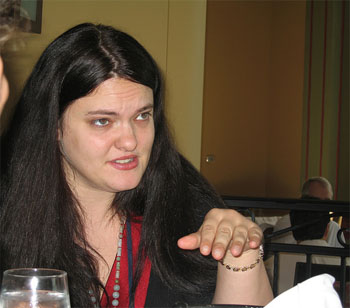
Catherynne M. Valente appeared on The Bat Segundo Show #266.

Catherynne M. Valente is most recently the author of Palimpsest.
segundo266

Condition of Mr. Segundo: Looking for a way into a secret city.

Author: Catherynne M. Valente

Subjects Discussed: Writing a novel with four character perspectives, how structure influences perspective, the importance of numbers, color theory, thriving on restriction, Neal Stephenson, the importance of flow and reading out loud, Mark Danielewski’s House of Leaves, synesthesia, the purpose of puns, being a child of the Internet generation, Italo Calvino and the literature of the new millennium, planning a book entirely in one’s head, PersonalBrain, on not outlining a novel, having semiotics for breakfast, writers with kinks, multiple topographies within Palimpsest, perceptions of New York, the individual relationship to a city in relation to one’s individual sensibilities, genre classification, New New Weird and mythpunk, thinking while doing other things, the factors that cause Valente to write very fast, fighting the forces of marketability, chick lit, a future project involving the myth of Prester John, the problems with accessibility, the addiction to story, geek outreach and the publishing industry, Lev Grossman’s article, the communal experience, novel patches, the book as a permanent medium, secretive networks, the Kindle and the Sony eReader, Cory Doctorow, the bridge between print and online, Eric Kraft, and the signal-to-noise ratio in e-books.

EXCERPT FROM SHOW:
valenteCorrespondent: Which number is your favorite? Or maybe one of your five favorite numbers?

Valente: Oh, my favorite number!

Correspondent: Do you do this on a single digit scenario?

Valente: I’m going to have to go with seven.

Correspondent: Seven!

Valente: Actually, a little girl came to one of my Orphan’s Tales readings. She came up to me after and said, “Why are there all those sevens in your book?” And I love seven. It’s a prime number. And it’s a typically mystical number. And it’s fascinating to me. But I almost never use it in structure. Because it doesn’t fit very well. It’s kind of an ornery number that way, which, I suppose, is why I’m attracted to it. Because I’m kind of ornery myself.

Correspondent: Well, you know, Neal Stephenson told me that seven was the ideal number of guests at a dinner table.

Valente: Oh, wow. I hadn’t thought about that.

Correspondent: What are the applications of seven? Not just to your fiction, but also to your general life?

Valente: Well, I guess it’s the number that I don’t use though. Seven is a number that doesn’t occur in nature very often. There aren’t too many seven-leafed or seven-petaled plants. That is why it’s a mystical number. Because it exists outside of the world. And so I don’t actually use it all that much. When I’m arranging things, I go with three. I go with four a tremendous amount. Of course, four is a very thorny number in Eastern culture. Because there’s four noble truths. But four also means death in Chinese and Japanese. And so they will often, much as our number thirteen, consider it unlucky, remove it from hotel rooms, and things like that. But I love the number four. I love the number eight. But seven is the number apart. So I use it in fairy tales all the time in terms of time. Seven days, seven years, seven months. There’s a character named Seven in The Orphan’s Tales. And that particular character deals with coins that have a seven-pointed star on them. But seven, I love, because it’s weird.

Correspondent: What’s your position on The Magnificent Seven or The Seven Samurai?

Valente: Well, of course, those come from Seven Against Thebes! Which is a wonderful ancient Greek play. I’m a classicist. So I always go straight back to that. And, of course, Seven Against Thebes comes from the seven dragon teeth that Cadmus planted in the earth. Yeah. Seven’s great.

(Photo credit: Ellen Datlow)

BSS #266: Catherynne M. Valente (Download MP3)

This text will be replaced

The Bat Segundo Show: Neil deGrasse Tyson

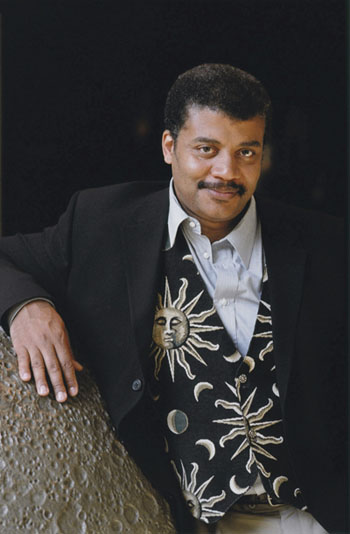
Neil deGrasse Tyson appeared on The Bat Segundo Show #265.

Neil deGrasse Tyson is most recently the author of The Pluto Files.

segundo265

Condition of Mr. Segundo: Reconfiguring his planetary paradigm, with the aid of minatory electrodes.

Author: Neil deGrasse Tyson

Subjects Discussed: The Great Planet Debate, sensible classification systems, “reorganizing” the solar system, why the International Astronomical Union wasn’t approached before the Rose Center display was established, the usefulness of the word “planet,” playing 20 Questions to gain insight into what Tyson talks about, Copernicus, acceptable groupings, quibbles with the New Horizons reconnaissance mission to “complete” the exploration of the solar system, government and space exploration, Sedna vs. Pluto, efforts to explicate Sedna’s orbit, the ethical implications of scientists who write popular books, scientists and get rich quick schemes, pedagogical paradigms, manned missions to Mars, the celebrity culture of astronauts, manned space program vs. robotic expeditions, how science can endure in the face of looming budgetary cuts, the financial return of science, communications with the Obama Administration, and the possibility of the asteroid Apophis colliding against the Earth in 2036.

EXCERPT FROM SHOW:

ngtTyson: We just reorganized the solar system, combining objects of like properties together. And at the time, more frozen bodies — small with tipped orbits, crossing the orbits of other planets — were found in the outer solar system that looked more like Pluto. And Pluto looked more like them than any one of them looked like anything else in the solar system. So all we did was group Pluto with its brethren in the outer solar system. Then we grouped the gas giants together as a family. Then we grouped the terrestrials — Mercury, Venus, Earth, and Mars — together. So the family photo of the solar system was presented in these groupings. At no time did we recount the planets in the solar system. And, in fact, the word “planet” is undervalued in the exhibits entirely. We prefer to focus on physical properties of these objects, rather than try and salvage a word that hasn’t been formally defined since before Copernicus.

Correspondent: Well, to talk about the notion of introducing this exhibit and not tipping anybody off initially, until this New York Times reporter ran with the ball and created something of a media storm, you…

Tyson: Something of a media storm?

Correspondent: Something of a media storm.

Tyson: Just say “media storm.”

Correspondent: Well, I’d like to use reverse hyperbole here. But in the case of this considerable media storm, you didn’t tip anybody off. And I’m curious. I mean, the sentiment in this book that you express multiple times is “Science is not a democracy.” And I’m wondering though why you didn’t approach the IAU to essentially get them to get with the program. That Pluto is not a planet. That it is essentially a TNO, and…

Tyson: Trans-Neptunian Object.

Correspondent: Yes, exactly. Exactly. I’m wondering why. Perhaps you could have smoothed things over a little bit with the IAU before introducing this. Does the IAU really not matter in this particular group?

Tyson: IAU cares about what a planet is. And we didn’t. It’s that simple. We didn’t present a case for planethood or not. All we did was say, “Here’s an interesting way to look at the solar system.” Put Pluto with the icy bodies and present it as such. We didn’t say Pluto was not a planet. We made no such claims. We were widely stereotyped for having done so. And that’s the simplest — if you don’t have the time to read what we did, then that’s the simplest thing that people did. Many interviewers — media — would come up to me and say, “So how many planets are there in your exhibits?” And I said, “We don’t count planets.” We just simply don’t count planets. So I had no interest in lobbying the International Astronomical Union. Because they’re concerned with the definition of planet. And when they do, fine. Define it however they want. It doesn’t change sensible ways to organize the information content of the solar system.

Correspondent: But in the minds of people. You had to be aware of the public perception. I mean, in this book, you point, of course, to the Caltech parade in Pasadena, the funerals for Pluto, the endless editorial cartoons and the like. In fact, I actually saw a Discover magazine headline that said, “Beyond the nine planets.” That was a week ago. So people are still struggling with this taxonomy, even though it’s clearly not a planet. I mean, you had to have been aware of this in some sense. What kind of adjustment period do we need? What kind of outreach do we need? Even to the IAU members. The 10% who voted against the idea, who voted for Pluto being a planet.

Tyson: Obtaining its planet status.

Correspondent: Yes, exactly.

Tyson: A mere 10%, I might add.

Correspondent: Yeah.

Tyson: Well, let me make it clear. There are people who have a lot invested in the word “planet.” Odd. Because like I said, “planet” had no formal definition. Not since ancient Greece. Planet means — it comes from the Greek “planetas,” meaning “wanderer.” And it referred to the objects in the night sky, from night to night, would wander against the background stars. There were seven of them — Mercury, Venus, Mars, Jupiter, Saturn, the sun, and the moon. Did I get the seven there? Mercury, Venus, Mars, Jupiter, Saturn, the sun, and the moon. Seven. That’s an unambiguous definition. No argument there. Seven planets. Copernicus says, “Wait a minute. The Sun is in the middle. Earth is one of these objects that goes around the sun. The moon goes around the earth.” So Earth became a planet. The sun became not a planet. The moon became not a planet. And so, okay. But even at Copernicus’s time, the word “planet” did not get a formal definition. It was only, “It just seems right. Let’s just keep it.” It was not formally defined until the IAU in August 2006. I’m fine with their definition! Because it doesn’t matter to me. The word is not useful.

BSS #265: Neil deGrasse Tyson (Download MP3)

This text will be replaced

Another New Review

There’s a lot of fresh content that will be unloaded onto these pages over the course of the day, including three podcasts and a film review. But while you’re waiting on all this, you can find my review of Christopher Moore’s Fool in today’s Barnes and Noble Review. About a month ago, this assignment caused me to delve into any number of King Lear adaptations and reworkings, getting in touch with a rather obsessive interest of mine that I’ve kept quiet about (for reasons cited in the review). And while I’ve long championed the work of Christopher Moore (who was interviewed on The Bat Segundo Show in 2007), this review asks a number of very important questions about the satirical novelist’s present output. To find out what those questions are, and what my ultimate conclusion about Fool was, you can read my review.

Amazon Profiting Incommensurately Off Bloggers?

As I pointed out more than a year ago, Amazon has been offering monthly blog subscriptions to Kindle readers, but, in some cases, it hasn’t been paying the bloggers a reasonable cut of the revenue. And as my investigation revealed, in some cases, Amazon didn’t even bother to ask permission from the bloggers. While the monthly subscription cost has gone down to 99 cents per month, as Rebecca Skloot discovered on Twitter this afternoon, Maud Newton’s site is now for sale on the Kindle. (Maud has since revealed that a nonexclusive contract she signed with Newstex gives them the right to distribute her content through the Kindle.)

But there’s a big question here. If Amazon makes 99 cents per subscription, how much of this goes to the bloggers?

I am now in the early stage of a major investigation to determine, once again, if the bloggers listed on the Kindle store are collecting any commensurate revenue or granting their permission to Amazon to have their blogs distributed. And I will be updating this site with my findings. If your blog is listed on the Kindle Store, please contact me so that we can begin to hold Amazon accountable for seizing content generously offered for free and selling it to others on the open market.

There are currently 1,280 blogs listed at the Amazon Kindle Store.