The Bat Segundo Show: Robert G. Kaiser

Robert G. Kaiser recently appeared on The Bat Segundo Show #264.

Robert G. Kaiser has worked at the Washington Post since 1963. He is most recently the author of So Damn Much Money: The Triumph of Lobbying and the Corrosion of American Government.

segundo264

Condition of Mr. Segundo: Still waiting for the lobbyists to work out a deal with him.

Author: Robert G. Kaiser

Subjects Discussed: Obama’s first executive order, revolving door bans, Tom Daschle’s recent troubles, “exceptions in extraordinary circumstances,” candidates for office with lobbying backgrounds, Gerald Cassidy, picking a character for a Washington narrative, the birth of the lobbying firm Schlossberg-Cassidy Associates, the Bankruptcy Abuse Prevention and Consumer Protection Act of 2005, Cassidy falling into second place, lobbying problems and the 1994 Republican Revolution, the K Street Project, lobbying and partisan politics, Cassidy’s lobbying style vs. Abramoff’s lobbying style, Tom DeLay, safe seats, John Lewis, Richard Lugar, Chuck Schumer, the likelihood of an equitable earmarking system, Columbia’s early lobbying efforts with the chemistry lab, peer review, attempting to sort out differing accounts concerning the Tufts Nutrition Center, Jean Meyer, Edward Bernays and why his influential essay, “The Engineering of Consent,” took a few decades to catch on in Capitol Hill, Joe McGinnis’s The Selling of the President, Roger Ailes, the abandonment of objective reality over the past 45 years, the Jim Wright ethics investigation and whether or not Cassidy was culpable in Wright’s downfall, Newt Gingrich’s rise, and the potential for a return to the comparatively virtuous pre-Nixon Congress.

EXCERPT FROM SHOW:
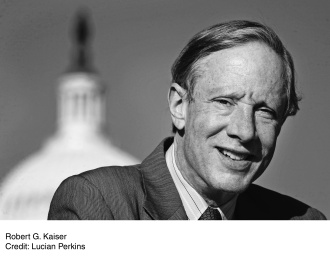
kaiserCorrespondent: You also bring up one moment in the book, where you depict Senator John Stennis — the man, of course, who wrote one of the first Senate ethics codes; in fact, the first Senate ethics code. And who had not raised more than $5,000 for all of his campaigns in the past. Now here he is up for reelection in 1982. And he needs to raise $2 million. He is now forced to accept this devil’s bargain. This leads me to wonder whether, in fact, there is even room for a Sam Rayburn type of Congressman anymore. Whether it’s even possible for someone of any ethical core to be in this deeply ingrained system. If John Stennis can’t do it, then who can?

Kaiser: Well, it’s one of my favorite stories in the book. I’m glad you noticed it. But all these things are complicated. For example, in today’s Congress, in the House, we have 435 members. Probably 200 of them — or even 220 — are in totally safe seats. That is to say, they can win reelection without campaigning at all probably. Or very minimally. And that’s because of the impact of, now, two generations of very aggressive gerrymandering. We call it redrawing of the districts and state legislatures every ten years after the census is done, in which both parties have accepted the same rule of thumb that the ideal outcome is to maximize the number of safe seats for our side and minimize them for the other side. You remember this episode in Texas, which actually lead to DeLay’s downfall, when he overplayed his hand on this subject and got the Texas legislature as soon as it was under Republican control to add four more Republican seats from Texas. Which he got away with initially. But he eventually got indicted for it. And that, I think, was the beginning of the end for DeLay.

Anyhow, there are opportunities because of these safe seats for people who don’t raise any money. And they don’t participate in the corrupt system at all. Which is an interesting footnote. It just means that a large portion of members are exempt from the usual pains and tribulations of trying to raise all this money. Not true in the Senate, where everybody is theoretically more vulnerable in a way. They all try and raise the dough.

Correspondent: But if there are so many safe seats, is it possible that there could be some sort of Sam Rayburn type in a safe seat? Someone who refuses to, of course, accept any money. Pays his own way, as Rayburn did.

Kaiser: John Lewis of Atlanta. The great leader of the civil rights movement and fascinating figure, who I know slightly. I heard him preach on Sunday before the inauguration in a black church in Washington, which I just went to by chance. I didn’t realize he was going to be preaching there. He gave a remarkable presentation. But John Lewis has a very safe seat in parts of Atlanta. He’s a revered figure. I have no idea how much he raises for his elections. I should probably check that out. But Lewis is a good example of a distinguished citizen in Congress who is not corrupted by this system, as far as I know. And there are people who build up a kind of invincible status. Richard Lugar of Indiana would be a really good example of this. Lugar: former mayor of Indianapolis, Rhodes Scholar, good citizen. Conservative Republican. Nixon Republican originally when he came to town in the 70s. Lugar wins reelection, as he did this time, by huge majorities and doesn’t have to do any bad stuff, I don’t think, to raise money. There are a number of such figures who could fulfill your definition, I think, of a Sam Rayburn-like independent man. But they are the exceptions certainly.

BSS #264: Robert G. Kaiser (Download MP3)

This text will be replaced

The Bat Segundo Show: Nick Antosca

Nick Antosca recently appeared on The Bat Segundo Show #263.

Nick Antosca is most recently the author of Midnight Picnic.

segundo263

Condition of Mr. Segundo: Terrified about what his ex-wife does during a midnight picnic.

Author: Nick Antosca

Subjects Discussed: The lack of picnics in Midnight Picnic, Jackie Corley’s confusion with the title, Midnight Picnic vs. Midnight Panic, dream logic, mouth birth dogs, Mr. Antosca’s lifelong dog trauma, writing about dogs being hurt, being self-conscious about writing, Charlie Huston, interviewers who use the phrase “blown your load” in relation to Mr. Antosca, Ned Vizzini, drinking as the natural fatal flaw for a homicidal maniac, short sentences, word counts and trauma, James Salter and ghost stories, the two year waiting period before assessing, unconventional chapter headings, the geography of the afterlife, tumbling into other memories, smell of the living vs. smell of the dead, the relationship between lap dancing and rigor mortis, dining experiences at Roy Rogers restaurants, New Orleans, the reality of midgets, high school deaths, “Appalachian monsters” in Florida, breastbone descriptions, razors with frightening blades, blocking, 2666, on being self-conscious and subconscious while writing, “You can’t take the dogs out of Nick Antosca,” science and melting pit bulls in an Antosca screenplay from the early years, the last-minute publishing shift from Impetus to Word Riot, the Clinton and Obama of publishers (but no Bush apparently), the publishing apocalypse, working a day job, writing for the now defunct New York Sun books section, demand for Antosca’s work, and anxiety.

EXCERPT FROM SHOW:

antosca2

Correspondent: Do you have any personal experience of putting your mouth around a dog? How did this come about? It’s rather extraordinary. There are four of them.

Antosca: No, I can’t. I don’t know where that came from. I think the idea was just that there had to be something pretty disturbing that this kid wanted to do to the man who had killed him. Well, I don’t want to describe what the mouth birth dogs are too much for people who haven’t read the book. But it’s supposed to be a shocking moment in the book, and kind of disgusting and disturbing.

Correspondent: Enthralling, I would say.

Antosca: Yeah.

Correspondent: But then that’s just me.

Antosca: I hope it’s pretty memorable. But I don’t know. I can’t remember where the idea of them came from. I think I saw a picture of a giant Continental Rabbit somewhere. I think these are rabbits. They’re as big as dogs. And they’re sort of cute and sort of disgusting. And for some reason, I pictured that as half-rabbit and half-dog, and that became this image. Like I said, with this book, I was willing — like I encouraged myself to just follow imagery where it would lead.

Correspondent: Is there something in the obvious spelling scenario? In which dog spells “god” backwards. That this might be your inverted way of coming to terms with a potential deity. And the fact that it comes from the mouth as opposed to from the skies. I mean, I don’t know. You tell me here.

Antosca: Well…

Correspondent: Are you a religious man, Nick?

Antosca: No, not really.

Correspondent: Okay. So the dog is your religion then?

Antosca: Well, the idea of the dog god mouth is a pretty fascinating question. I don’t think that my interest in dogs has anything to do with concern about god. Or whether god exists. I think it’s more a concern about possibly being betrayed by something that you trust, aren’t close to, and think is not ever going to harm you. You think of a kid and his dog as a pure relationship. And the idea that it might turn on you and shred you is sort of compelling.

Correspondent: It certainly is.

Antosca: The idea that you might still feel an allegiance to that animal. It’s almost a cliche. The idea of the kid being attacked by the dog when the parents want to put the dog to sleep. “No! No! Don’t do that!” Which I think is what I remember from when I was five or six. When that happened.

(Photo credit: Sonja Ostrow)

BSS #263: Nick Antosca (Download MP3)

This text will be replaced

The Bat Segundo Show: Shauna Reid

Shauna Reid recently appeared on The Bat Segundo Show #262.

Shauna Reid is most recently the author of The Amazing Adventures of Dietgirl.

segundo262

Condition of Mr. Segundo: Still stinging from his measly memoir efforts.

Author: Shauna Reid

Subjects Discussed: Whether the pursuit of truth is more natural through an anonymous journal, writing as “burdening people,” compartmentalizing online identities, self-esteem, contending with the permanent nature of personal stories contained within a book, how the weight loss journey never ends, remaining fallible with the success story label, connective possibilities that exceed expectations, negotiating the Weight Watchers points system, applying group rules to an individual struggle, differences between the American and the UK versions of the book, being branded “Dietgirl,” the vampire method of exercise, amazing fitness instructors, battling against body image, “perfect” people, societal guides for individual struggles, using spreadsheets to keep track of health statistics, substituting one obsession with another, reprogramming a life, the relationship between physical distance from home and moving ahead with one’s life, placing fabricated news stories within the book, being the largest size in the shop at 23, the false connections between happiness and weight, how not talking about problems put strains on friendships, finding an auctorial voice, adjustments to early journal entries, chronicling friends and marriage, Vegemite parties, immigration, marriage, and entrapment, deportation, not living life because of weight issues, “wasting” one’s twenties, and balancing anarchy and being grounded.

EXCERPT FROM SHOW:

shaunareidReid: You don’t want to burden people with this depressing stuff. So the blog is just my little haven to finally be honest with myself about how I felt.
Correspondent: But “burdening” people. This is an interesting word that you use. I mean, do you feel that all of your writing in general involves “burdening” people? Certainly, I’ve read your stuff for quite a long time and I have never felt any sense of burden. And I’m wondering how this interior sense of burdening people — do you still feel this way?

Reid: No, I don’t feel that way anymore. I think it just goes to show just how crap my self-esteem was back when I started it. Because What’s New, Pussycat? was my original blog. It was where I kind of separated my physical self from everything that was happening in my head. It was where I could be funny. And it didn’t matter what I weighed. I felt so free to be my true self there. Whereas I felt the need to keep outside to do something about my weight. I didn’t feel comfortable letting that audience know that this was the real me. This was this problem I was dealing with. So I just had this ridiculous two separate online lives. It was very hard keeping them up, to be honest.

Correspondent: Yeah, you had to compartmentalize these identities.

Reid: Yeah, I was totally compartmentalizing my life. Because my offline friends and family didn’t know anything about this diet blog. The diet blog didn’t know about the non-diet blog. And vice versa. So it was just keeping all these ridiculous secrets. But that’s just the way I felt at the time. Even though it seems quite strange to me now that I felt that way.

Correspondent: Interesting. I want to actually talk about this notion of self-esteem. I mean, you were fighting, I think, esteem issues on multiple fronts. You had the weight loss and the job scenario and the unemployment. How much do you feel that, for example, your employment history and your employment scenarios tied into the obstacle of losing weight? You point out that staying busy at work “didn’t give you time to think about Kit-Kats and hamburgers and your general state of fatness.” And I’m curious. When did you detect these particular connections? Or by compartmentalizing them, as you indicate in your last answer, this was a way for you to tie all the various threads together.

Reid: Yeah, I think the more I tried to compartmentalize everything, the more I realized they were all connected. And it was pointless for me to try and separate everything. Because one issue rolled into another. Staying busy at work, like I said. Not thinking about Kit-Kats. And then when things got really stressful at work, I would find myself reaching for the Kit-Kats. So it’s all quite a big mess, I think, in the end. It’s not possible. I think I kept it up for about five years — these two separate identities and everything. But in the end, I think when I finally came out of the closet and stopped trying to hide parts of my personality from other people, that’s when I did tackle all of the problems and come out of the other side.

Correspondent: But coming out of the closet now, you’re also dealing with a scenario in which, well, how much do I keep privately to myself? How many of my identities do I compartmentalize? I mean, for all I know, you could have a secret blog somewhere about some other pressing issue that I don’t know about and nobody else knows about. So what is this relationship between the private and the public? Are you done compartmentalizing things at the present time?

Reid: Oh yeah. I’m totally over that now. I don’t feel the need to do that anymore.

Correspondent: Just a phase.

Reid:: Yeah, a very lengthy phase. But the book’s out now. It’s been out for over a year. The most raw, down, dark moments of my life are captured forever in that book. But I do feel a certain detachment from that time in my life now. Because writing about it is a good way of tying up all those loose ends in my own head.

BSS #262: Shauna Reid (Download MP3)

This text will be replaced

Bleak House

This morning, my video card committed suicide, shooting out a very impressive burst of orange flame that I was thankfully able to extinguish. No other components were harmed during the making of this conflagration. The video card was not a suicide bomber. I suppose it had come to know the other components it shared the case with over the past three years, and had decided that it was too depressed to live. All this is a pity. But this explains the computer display problems I’ve experienced over the past few weeks. The video card has been replaced (and I have had a heart-to-heart with the new video card, persuading it that there are plenty of reasons to live and that there will be love for it guaranteed by me) and the display is much better. But between this unexpected technical snafu, and getting unexpectedly caught up in a very fun novel (of which more anon), the podcasts I had intended to complete this afternoon will have to be postponed another day. There are lessons to this story: Nurture the components in your computer or they may spontaneously combust. And be sure your computer case is not a bleak house!

Review: Fanboys (2009)

fanboys

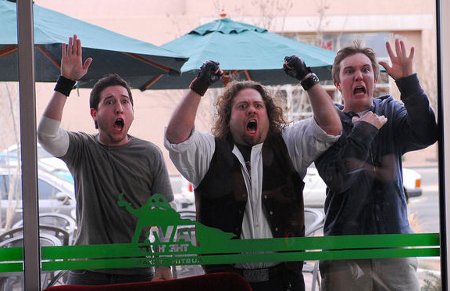
There have been nearly eighteen months of production problems for Fanboys, the comedy film made by geeks for geeks involving a 1998 pilgrimage to Skywalker Ranch to steal a rough cut of The Phantom Menace. A rough cut of Fanboys made the rounds in 2007, earning plaudits from George Lucas and Kevin Smith, with the former granting permission to use Star Wars sound effects and the latter asking for and receiving a cameo. More money was allocated to director Kyle Newman to shoot additional scenes that were prohibited by the original version’s five million dollar budget. Months passed, as Newman attempted to extricate the actors from their respective obligations. Additional scenes were shot. Then there were reports that the film was being saturated with more crude jokes with the cancer plot removed. (Having seen the film, I can report that the cancer plot has metastasized.) Fanboys was scheduled to come out last year, but it remained in the vault. There were delays and a few inquiries from online circles, and an Internet campaign eventually emerged demanding that Newman’s original vision be restored. But this week, Fanboys is finally being unfurled into theaters, perhaps with a few “Greedo shoots first” compromises. And I’m pretty certain that additional speculation will spiral into more online melees.

But I have only the version I screened to go by. If there are better versions of the film to be made, this will likely have to be settled by Phantom Edit man Mike J. Nichols. As cheap thrills go, Fanboys isn’t bad. The film won me over. It plays like an Animal House for geeks, and, if Jeffrey Lyons snoring through half the movie is any indication to go by, it will likely not appeal to entitled snobs who remain incurious about this subculture. But I think it has a pretty good shot of finding an audience in the heartland.

Ernest Cline’s screenplay has reportedly been bouncing around since 1998, but his collaborators (Dan Pulick credited on the story and Adam F. Golberg credited on the screenplay) have transformed the film into a celebration of geek culture just before the dawn of a new millennium. After a scrolling yellow prologue with a “Sent from my iPhone” postscript, we’re then taken to Ohio 199 days before the Phantom Menace release date. Chumbawumba’s “Tubthumping” blasts at a house party, where stormtrooper and Super Mario costumes are copious, with a “Picasso’s blue period” thrown in for good measure. This is still the time of dialup, and a bespectacled geek named Windows (Jay Baruchel) has secured an online girlfriend. Windows is so consumed by his perfervid IMing that he cannot even notice a geek girl flashing her breasts in his direction. Hutch (Dan Fogler) lives in a garage, paying rent to his parents. He insists that he lives in a “carriage house.” Then there’s Eric (Sam Huntington), the “responsible” character you typically find in these teen comedies who works at his father’s car lot and is primed to take over the business. This trio learn that their pal Linus (Christopher Marquette) is dying of cancer. A trip to California is agreed upon.

As you may have already guessed, this setup follows any number of cinematic formulas. But much like the original Star Wars trilogy, Fanboys is more about the journey, rather than the destination (or even the beginning). It does find a few funny moments that prevent this film from entirely succumbing to stereotyping. An R2D2 Pez dispenser is confused with a prominent member. Hutch, who drives a van adorned with Star Wars detailing, sets a few ground rules: “All Rush, all the time” is the only music to be played during the cross-country journey. There’s a side quest to Riverside, Iowa — the birthplace of James T. Kirk — in large part because Hutch says, “I’ll drive all night for the chance to pimp dog some Trekkies.” And this pugilistic vow is carried out over the preposterous question of whether Han Solo’s a bitch. A Star Wars fan has unthinkingly burned in a Jar Jar Binks tattoo without knowledge of the character.

A sequence involving peyote and stripping, suggesting that geeks are as marginalized as gays, doesn’t quite live up to its potential, nor does a running gag about Hutch having one testicle. But the film does poke some insinuative fun at all the forthcoming junk that those associated with Star Wars will soon be involved in. When the group discusses whether or not Harrison Ford is the greatest actor of all time, the van passes by a Six Days Seven Nights billboard. I also enjoyed the idea of Harry Knowles portrayed as an ass-kicker in the know, where trust is established by the number of esoteric film facts at your immediate disposal.

Many of the film’s cameos — which include William Shatner, Carrie Fisher, and Billy Dee Williams (as Judge Reinhold) — are funny. Some, like Kevin Smith and Jason Mewes, are just pointless. The film quotes lines from the original Star Wars trilogy liberally, but not obnoxiously.

The film also delves a bit into geek double standards pertaining to gender. During a moment in Vegas, the aforementioned geeky girl Zoe (played by Kirsten Bell) flirts wildly with Windows, but he and Hutch see only the airbrushed professionals. And while Windows and Hutch do receive a collective comeuppance for their oversight, I wondered whether there may have been something more here lost in all the reshoots and the rewrites.

Fanboys isn’t as good as 1998’s Free Enterprise, largely because Mark A. Altman and Robert Meyer Burnett went to the trouble of portraying geeks as real people. It doesn’t quite have the guts to plunge completely into the complexities of geekdom. And my main gripe with Fanboys is that the “real” moments here were terribly treacly. Perhaps there was some reasonable justification for attempts to rework the cancer plot. But I did laugh, and the film that emerged from the fracas does entertain.