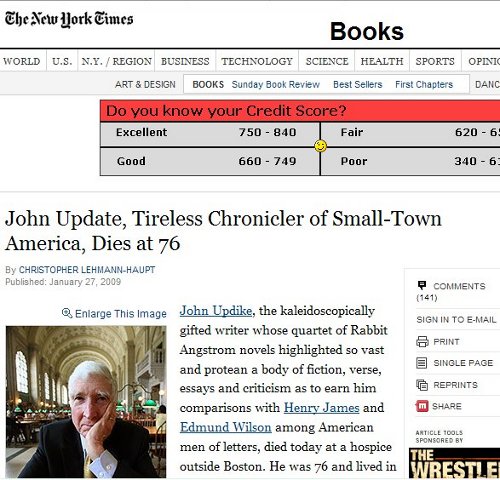
Regretting the Error

updateupdike

[UPDATE: Apparently, it’s amateur hour at the New York Times. After fixing the above headline, Matt Bucher observed that The Broken Estate was not published in 1966. James Wood was then only a year old. (And, no, the above screenshot wasn’t faked. I resized it to fit it into the window.)]

[UPDATE 2: More errors in the piece. “More important, the move to a small town seemed to stimulate his memories of Shillington and his creation of its fictional counterpart, Ollington.” It’s Olinger. Also, John Updike was interviewed by the Paris Review in 1968, not 1967. Also, it’s Terrorist, not The Terrorist. It should be “outsized talents,” not “outsize talents.” Good Christ, don’t they employ copy editors and fact checkers at the Gray Lady?]

[UPDATE 3: The Gray Lady has fixed these errors, without “regretting the error.” In the haste of my horror, I added an extra L to Olinger — as pointed out by a pedantic commenter named Albert. This has been fixed. I regret the error.]

RIP John Updike

I have just been informed by several people that John Updike is dead.

Words fail me right now. And I have been lurched over for the last few minutes. Updike meant a lot to me. As much as Westlake, McGoohan, and David Foster Wallace. And I hope that I can bring myself to articulate something in the next few hours.

In the meantime, I will just say that one of my favorite Segundo interviews was Show #50, in which I had the good fortune to interview the man. I will reveal more of the story behind that interview later, and offer more words when I have a clearer head. But this is a major blow to American letters. Rabbit and Bech are now truly dead.

Theater Review: Queens Girl

Queens Girl is a one-woman show written and performed by Lauren LoGuidice. It is playing here in New York at a venue called Stage Left on January 29, 30, and 31st. From there, it moves on to San Francisco. I was contacted out of the blue by a publicist and opted to attend. My +1 had to back out. My alternate +1 likewise found himself busy. I was frankly too lazy to enlist a third +1. So I attended alone. I was one of two press members in the audience. I am still not entirely sure why I was contacted.

I am informed by Ms. LoGuidice’s website that the show was once called Skinny Girl, but there is no specific reason given for this title change. My own titular preference is Queens Girl. And having seen the show, my own preference would have involved less multimedia and more performance. I suppose the idea here was to suggest distractions which present one from being true to one’s self, but bombarding the audience with often needless visual information and regrettably obvious musical cues (e.g., The Godfather theme playing when we learn about the Italian neighborhood Ms. LoGuidice grew up in) only succeeded in this reviewer wondering why the real Ms. LoGuidice was still hiding, and why she cared so much about appealing to the crowd. The show’s truest moment came with Ms. LoGuidice impersonating a homophobic ruffian shrieking at “Ms. LoGuidice” to leave the neighborhood. That such a moment comes from the portrayal of another figure reveals the show’s central problem. We learn that Ms. LoGuidice has spent all of her adult life running to other places. Bombay, San Francisco, the Meatpacking District. But to what end? We never know. The multimedia proves too intoxicating.

Now ancillary information is sometimes a regrettable obstacle that hinders an individual from telling the truth. I can tell you that the show’s running time was sometime between 32 and 37 minutes. Had my cell phone battery not expired, I would be able to give you a precise figure. The other journalist attending the show, who was diffident about revealing his name and outlet to me, informed me that the show was 37 minutes. But he had determined this fact from looking at his own cell phone once the show had concluded. It read 8:37 PM. There was then a minor but conciliatory point of argument between us in the elevator ride down over whether the show started at 8:00 PM or 8:05 PM. I advocated the latter time, even though I truthfully wasn’t paying attention and suspected I was wrong. This was not what I would call a prevarication. I was merely being jocose. The idea here was to present a possibly erroneous piece of temporal information for this gentleman to correct me on. But I apparently conveyed my position to him with some entirely unintentional authority, a deadpan confidence that had him believing that the show had started at 8:05 PM. And even though I began to get the sense that I was probably wrong, I politely agreed that the running time might possibly be 32 minutes instead of the 37 minutes he had initially estimated. We both agreed that it was a bit unusual to attend a theatrical presentation that lasted considerably shorter than our subway ride to Stage Left.

Stage Left itself is located on the fifth floor of an edifice located on West 37th Street. There is nothing, aside from the space’s proximity on the western side of the building, that suggested a possible origin for the name. Perhaps there was another imputation behind the name: fringe theater that came out of left-field. But none of this really matters.

I can also report that I was one of only five men in the audience. My audience estimate was 25 people, most appearing to be friends of Ms. LoGuidice. I took notes in a five subject notebook — a knockoff that I had purchased two nights before for $2.79 from a small shop in Tribeca that was something between a bodega and a pharmacy. The pen I used to take notes — a black Uniball — was on its last legs. In looking at the eight pages of notes I took, I am struck by two things: the gradual waning of the ink and my own fierce efforts in the dark to force more ink on the pages. Given that I also took notes on Wednesday night during the Barnes and Noble New York Times event and did not use any of them, I think that I will do the same for this piece. But I will present one note, picked entirely at random, that might give you some sense of my theatergoing experience: “Relies too much on music.”

Those last three paragraphs may be interesting to my friends, but they don’t really tell you anything.

The Bat Segundo Show: David Denby

David Denby recently appeared on The Bat Segundo Show #261.

David Denby is most recently the author of Snark.

Please also see our lengthy essay, in response to Adam Sternbergh’s review. This conversation represents an effort to get Denby to answer questions raised by both pieces.

segundo261

Condition of Mr. Segundo: Ordered against using a snarky tone.

Author: David Denby

Subjects Discussed: Whether or not Denby feels battered, unsuccessful attempts to pinpoint the definition of snark, the club of the clued-in, newspapers and narratives, Denby’s reservations about the Web and decentralization, snark’s relationship to voice, Sturgeon’s law, panic in mainstream journalism, satire and a corresponding set of virtues by implication, prototypical voice, the Sarah Palin prank, Spy, contempt for New York celebrities vs. contempt for money and power, investigative reporting and the Web, peer-to-peer journalism, Josh Marshall and the attorney scandal, Private Eye, Sgt. Pepper’s Lonely Hearts Club Band, the need to take sacred cows to task, Pitchfork, “Ugandan discussions,” endearing jargon vs. in-the-know references, why Denby doesn’t find Gawker and Wonkette funny, fickle public memory and disappearing websites, Perez Hilton at 40, fighting slander, accounting for corrective impulses on the Web, privacy as a bourgeois triumph, whether or not Denby can truly have an informed opinion on Twitter if he’s never used it, quibbling with Denby’s uniform assessments of mediums, accounting for the visual innovations of Spy Magazine, the visual notion of snark, Kurt Andersen and Graydon Carter, circumstances in which being ruthless towards someone is okay, Mike Barnacle, nastiness and self-deprecation, Penn Jilette, snark practitioners as flip-floppers, Maureen Dowd, superfluous anger vs. righteous indignation, constructing a narrative in which you can locate yourself, Alcanter de Brahm’s irony symbol, Perez Hilton’s lack of anonymity, defending Tom Cruise, why photographers haven’t fought Perez Hilton, legal remedies, being dragged into the celebrity culture, and raising an army of thoughtful writers.

EXCERPT FROM SHOW:

denbyCorrespondent: Let’s talk about this idea of trash talk vs. snark. You indicate in this book that it’s okay to have a vituperative remark or a savage wit, if there is a corresponding set of virtues. And, in fact, you say “a corresponding set of virtues by implication.” Now “implication,” I think, is the important word here. Because to go back to the Sternbergh review, I would argue, to defend him briefly, that he is attempting to point out that Television Without Pity and the snark tone that he champions — I mean, is there not a corresponding set of virtues perhaps that is in the initial stages? In the prototypical stages perhaps? I mean, don’t people have to start from somewhere before they reach this level of thought that you are advocating in this particular book?

Denby: Well, we don’t know, do we? But I don’t see much of that in Television Without Pity. Mostly, it seems to me, whenever I look, it’s enormously long plot summaries with a lot of snarky adjectives. And it’s fun. Because it’s like friends who gather at a house to watch a TV show, and you compete with one another to see who can be funnier. But I would forgive them everything if they jumped up and down with joy when something original and difficult came out. Like in their movie stuff, I don’t notice them celebrating There Will Be Blood or The Diving Bell and the Butterfly. What gets their jets going is trash like Bride Wars. In other words, they’re invested in trash. And that’s why I say that these people are really thugs of the conglomerate in a way. In other words, they’re part of the commercial system. They’re not really interested in anything adversary. For all of their nasty tone, they’re part of the commercial system. They’re not adversarial at all. They don’t push the little guy — you know, the protest against the system or the artistic revolutionary. That’s not what they’re into. They’re into fandom. Now let me come back to Sternbergh.

Correspondent: But also to point out the initial thrust of this question. As a prototypical model, for some people, snark is the way to get to this more virtuous plane that you’re advocating here.

Denby: Well, I hope you’re right. And maybe they’ll just…

Correspondent: I can say this from experience. Because I was a little snarky when I started writing.

Denby: But people get older and they realize that I’m not pushing my weight. That this is too easy.

Correspondent: Yeah. Jessica Coen, who ended up going from Gawker to New York Magazine. She wrote an essay. I’m sure you’re familiar with this. You don’t quote it in the book. But I’m sure in the course of your research, you found it out. She pointed to the negative feelings that she had, and she wanted to go to this more thoughtful plane.

Denby: Right.

Correspondent: So I’m saying that perhaps, maybe, instead of essentially fanning the flames of discontent against this type, it’s steering them in the right direction. Which you do do in this book. Maybe this is just a growing stage before they blossom into some writer of virtue.

Denby: Well, that would be nice. Also, I think they’re naive if they think that they can make a whole professional career out of this. Because you cannot underestimate the ruthlessness of editors. In other words, this is something that Adam Sternbergh doesn’t know. That his kind of wise guy stuff pales very quickly. And when styles of humor change, editors get rid of you if you don’t keep up. So there can be something naive. It’s a way of gaining a professional foothold. But you’ve got to move beyond it pretty fast. But just to return to Sternbergh, as I remember, the main thrust of his critique was that snark is an appropriate response to a corrupt and dishonorable world. Well, I’m not going to argue with his characterization. I think it is a corrupt and dishonorable world. But the appropriate response to it is not snark. The appropriate response to it is criticism, analysis, and, best of all, satire. Which is what I praise over and over again. The kind of stuff that Stewart and Colbert do. Most of snark is weak. It’s mostly impotent. It’s more a confession of defeat than an appropriate response to anything. I mean, he’s way off on that.

Correspondent: Okay, well, to look at this question of prototypical voice from a different vantage point, you suggest that Philip Weiss’s infamous Spy article, in which he infiltrated Bohemian Grove “discovered only where power hung out and what its vulgar habits are.”

Denby: Yeah, who took a pee where?

Correspondent: Yeah. But if we are to discount this article as nothing more than an amusing prank, I point to the Quebec comedy duo who revealed Sarah Palin’s lack of qualifications with this wonderful prank. And while their particular tone may not have been thoughtful or political, it did lead to people rethinking Sarah Palin’s qualifications.

Denby: Absolutely.

Correspondent: Isn’t there something to be said about how people react to a particular prank or an act? Or how people run with the ball of, say, the Bohemian Grove scenario? And try to investigate it further? I mean, that’s what thought is.

Denby: Yeah, but that’s what Spy never did. I mean, it kept promising more than it delivered. The Sarah Palin prank was brilliant. And that she didn’t catch on for, what was it? Ten minutes? They had her going. It’s just astounding. But the trouble with Spy was that it never did investigative reporting. It did a kind of junior league infiltration of the powerful, rather than the hard work of going to the library and looking up records, and so on and so forth. That true investigative reporting requires before you can nail someone in dishonest behavior or corrupt behavior or collusive behavior. So it never actually delivered. And since it was written basically for people who wanted to join the money….

Random Stranger Shouting Into Mike (Presumably Disenfanchised): Wha…what?

Denby: (to Stranger) Thank you. That was good.

Stranger: You’re welcome.

(Photo credit: Casey Kelbaugh)

BSS #261: David Denby (Download MP3)

This text will be replaced

The Bat Segundo Show: Azar Nafisi

Azar Nafisi recently appeared on The Bat Segundo Show #260.

Azar Nafisi is most recently the author of Things I’ve Been Silent About, as well as Reading Lolita in Tehran.

segundo260

Condition of Mr. Segundo: Reliving transcendent memories.

Author: Azar Nafisi

Subjects Discussed: Authenticity, W.G. Sebald, photographs and text, Iranian birth certificates, being true to the story when writing a memoir, accuracy and memoirs, the extraordinary nature of the ordinary, “A Memoir in Books,” constructs within constructs, Emily Dickinson, dreams that are tainted by reality, The Great Gatsby, Nafisi’s mother creating a dream out of a frozen past, unhappy marriages, presenting a cardboard version of yourself, frankness, books vs. reality, Dorothy Sayers, Henry James and World War I, asserting life in totalitarianism, Italian neorealists, great things that come from limitations, Samira Makhmalbaf’s The Apple, Czslew Milosz vs. Witold Gombrovich, Ferdowski, The Prince, and others as frameworks to understand 20th century Iran, human beings and the creative impulse, writing a book of literary criticism on Nabokov that resonates with the Islamic Republic, prying mothers and outrage, personal connections and subjective viewpoints in relation to books, collection vs. hording in relation to storytelling, feeling regret, the commercial shadow of Reading Lolita, avoiding the Iran categorization, subconscious Nabokovian themes, the memoir as betrayal, Muriel Spark, Speak, Memory, and self-consciousness.

EXCERPT FROM SHOW:

nafisiCorrespondent: Fariba’s birth certificate is fake, you note later on in the book.

Nafisi: Yes.

Correspondent: And also the marriage of your parents was built, as you say, on a lie. So you have this scenario throughout your life in which you have the most authoritative text, being a birth certificate, being unreliable. So this brings me back to the question of the pictures and the text.

Nafisi: Definitely. I mean, authenticity itself is such a dubious word, isn’t it? Authentic to whom? And at what point in your life? Authenticity itself changes. But definitely. And especially in regards to my life in Iran and with my mother. The question of what appeared and what people claimed to be real. And what one discovered to be the truth. Those two were running parallel to one another. Seldom meeting, actually.

Correspondent: I guess the question though is: How can you, who specializes in books throughout your life — I mean, that’s your living!

Nafisi: (laughs)

Correspondent: So here you have this unreliable relationship with text that your life is predicated upon. How you can even trust text if there is this lack of authenticity?

Nafisi: Well, you have to trust the story. Because if you want the story to be good, quote unquote, you have to be true to the story. And it takes you places where sometimes you don’t want to go. It forces you to reveal things that you don’t want to reveal. But if you’re focused on the story, you realize that the story will take its revenge if you don’t give it what it needs. So that is why I think so many authors, or so many people keep saying — like Vita Sackville-West, in terms of her diaries. She says that, “I am writing because of truth. Because there’s so many pieces of the truth. And you reveal your truth.” It is not because you have hold of the truth, but because the process of storytelling reveals the truth both to you and hopefully to the readers.

Correspondent: Does it matter then if you don’t quite have the exact truth? I mean, there’s a lot of controversy — here in America, in particular — about what a memoir really should be and how accurate it needs to be.

Nafisi: Well, there’s two thins I need to say about that. One is when you deliberately fabricate something. And unfortunately, a lot of times, in terms of the recent events, it is to sell. I tried to very much — actually, the scandalous parts of my book are very much buried. This was a test for me. Can you write a memoir? Which is a family memoir. Which doesn’t come out with fireworks. And it can still attract people. Because what is extraordinary to me is what we call the ordinary. You know, nothing is ordinary. That was what I was trying to investigate. So if you deliberately fabricate, I think then that we are entering a different world.

But a memoir, because its a narrative and its a story, by nature, it’s a construct. I think we should admit that at the outset. That it is a construct. You try and remain true to facts. But what are facts? From whose point of view? And one thing that I discovered — which is very obvious now to me, but it wasn’t then — is how much you select. There were people in my life who were very central to my life. Like my brother, whom I love and we’ve had many, many experiences together. But he was not necessarily central to the story. So you cut-and-paste, according to the themes that your story demands. And so how can you say that a memoir is not a construct?

(Photo credit: wip_partnership)

BSS #260: Azar Nafisi (Download MP3)

This text will be replaced