The Bat Segundo Show: Paul Schrader

Paul Schrader recently appeared on The Bat Segundo Show #255.

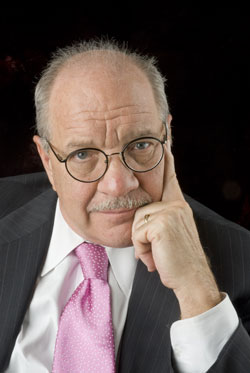
Paul Schrader is a filmmaker who is most recently the director of Adam Resurrected. The film opens in limited release on December 12.

segundo255

Condition of Mr. Segundo: Waiting for Deborah Harry to call him.

Guest: Paul Schrader

Subjects Discussed: Being asked to direct vs. originating a film project, Jeff Goldblum working against his natural tics, Goldblum’s considerable preparation for the role, balancing the element of play with too much preparation, making a film from Yoram Kaniuk’s untranslatable novel, initial efforts to adapt Adam Resurrected, defying the fixed notion of a Holocaust film, adapting books into films, working with cinematographer Sebastian Edschmid, mimicking the memory of specific historical times, making a film without the prospect of financial returns, why the present time is the worst for independent film, clarifying the details about Extreme City, recent events in Mumbai, the opening scene in Lolita, allowing for a minimum of verisimilitude within a magical realist narrative, actors barking like dogs, clearing up some of the information in Peter Biskind’s Easy Riders, Raging Bulls, keeping a loaded gun, Sam Peckinpah, the importance of being crazy, and whether or not Schrader has exorcised all of his demons.

EXCERPT FROM SHOW:

schraderCorrespondent: Did you have any of the actors study dog movement at all?
Schrader: Jeff did. He hung out with this guy. The dog whisperer guy. And the boy who plays the dog….

Correspondent: Tudor [Rapiteanu]?

Schrader: Tudor. He spent a fair amount of time with dogs. And the dog in the film, Sam, he was with us quite a while. Jeff spent quite a lot of time with Sam. The two of them.

Correspondent: Tudor is hiding under the blanket. At least, that is what we are led to believe. I don’t think that he hid under the blanket the entire time. Or did he? Was there at any point somebody else? Did he have a dog double? Was there a Tudor double? Was there an actual dog there?

Schrader: Oh, no, no. That’s always Tudor.

Correspondent: Really?

Schrader: Yeah. He’s a rather exceptional kid. He was twelve at the time. Smart as a whip. He had just placed fourth in the Romanian Academic Olympics. But he was totally into that whole dog. He would play a dog even when we weren’t shooting.

Correspondent: And the actors were perfectly okay and happy? They felt fairly safe being dogs like this? Because you’re working on all fours. I don’t think I’ve done that for longer than an hour, I suppose, in my life. And so I’m wondering, what did you do to ensure that their performances would be safe? To perform and have this, I guess, canine verisimilitude.

Schrader: Well, you have to sort of watch out for their knees. You can hurt your knees trying to go around down on all fours.

BSS #255: Paul Schrader (Download MP3)

This text will be replaced

The Bat Segundo Show: Nacho Vigalondo

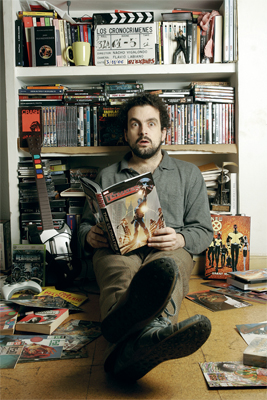
Nacho Vigalondo appeared on The Bat Segundo Show #254. Vigalondo is a filmmaker who is most recently the writer and director of Timecrimes, a film that opens in New York and Los Angeles on December 12.

segundo254

Condition of Mr. Segundo: Searching for future Bats.

Guest: Nacho Vigalondo

Subjects Discussed: What to expect when attending one’s first press day in New York, being isolated from the Hollywood scene by making films in Spain, unexpected attention, Darren Aronofsky’s The Wrestler, the current speed in adapting comic books, Mark Millar, the Timecrimes remake, the pink bandaged head as an old Universal Horror motif, finding the monster within the movie, writing a script out of sequence, Steven Zaillian, trying not to bore the audience, showing the ridiculous side of the situation, using the best bits of Karra Elejalde’s cinematic career for the different Hectors, the influence of fashion choices upon performance, making a movie work in a natural way, the criticism of “improvisation,” criticizing the reasons behind Chica’s nudity, not explaining everything within a movie, the tendency for music to blare throughout every environment, learning from Hitchcock, practical locations vs. planned sets, and making a timeless movie.

EXCERPT FROM SHOW:

nacho-vigalondoVigalondo: When you’re writing a script, sometimes the script is put into a nightmare. Sometimes, it’s giving you some gift. And in this case, when I was writing Timecrimes, I found a monster inside the story. But the story itself gave me the monster. I needed someone with a hidden face, with a scissors on the hand. So I found out that the story was building a monster. A monster that had these classical resonances, as you are telling. So I feel so fortunate. Because when you have a monster in your movie, the movie gets better most of the time. Every movie with a monster is better than the same story without the monster. You can apply this to all the other — to every example. I don’t know. If Million Dollar Baby had a monster, it would be a better film.

Once you find a monster inside your film, well, in my case, it’s something you have to celebrate. For two reasons. It’s a monster that sounds like a Universal classic film monster. And at the same time, it’s a pretty cheap Halloween costume. If the people like your film, they can disguise as the big mummy with little money on the bandages and the scissors. So if you want to dress like Freddy Krueger, it’s more expensive than my monster in my film. So it’s like giving something to the people. In depression times, giving cheap monsters to the people is something I really appreciate. (laughs)

BSS #254: Nacho Vigalondo (Download MP3)

This text will be replaced

Cry of the Hornet

The loud flashes pierced into his eyes as they ushered him before the cameras. The shrapnel of sharp questions sliced into inextricable loss that the men behind the massacre could never tally up or scratch away, and for which they still hadn’t apologized.

He still flinched from the stench left in the wake of the carcass that had once been his home, the hillock of his humble life, the now obliterated pile for which he had moved hard mountains. He had wanted to die with them, but he was halfway through a twelve-hour shift when he got the call. At the moment his cell phone chirped, he was selling a pack of Marlboros to a gloomy guy sliding dimes across the counter, grumbling about the economy. But he knew he had to go on.

He couldn’t believe the news and he couldn’t close the store. There was nobody else. And if he didn’t move a hundred dollars by day’s end, they’d be short for the month. There were no savings.

The pilot had lived, ejecting just before the Hornet rammed into their humble stucco home. He wanted answers, but his neighbors only offered spooky silent stares. Shadowy details loosened once they saw his dark inquisitive face. The deaths had been sudden. The wreckage would be remunerated. The tall thin plumes could be seen as far away as Poway.

Now he was here. Lost in a crackling haze of slapdash queries he’d somehow felt obliged to answer. The journalists asked him what he thought of the pilot, but they’d never know the fluke of this sacrifice. They asked him what he was going to do next. Forgive so that he could go somewhere and grieve, but not forget.

God, he had loved them. It wasn’t so much not seeing his daughters grow up or his wife grow old or even his grandmother’s kind smile, but the comforts of their happy routine. The knowing twinkle that came when she read his mind. His kids discovering some pedantic joy he’d somehow overlooked. All now dry and irreplaceable rivers frozen into the hazy pool of memory.

He couldn’t remember the words that the cameras and the microphones had recorded. But he must have said something. The phone never stopped ringing. The letters kept coming. They’d even tracked down his email address. They called him a hero, but he had only done the right thing. And he wanted to go back to work because it was the only regular routine he had left. Even if it meant crying and remembering in the lonely terrain of the dark while they sung the stark ballads now attached to his name.

Revised Thoughts on Twitter

Twitter has changed everything for me. I say this after last year’s unsuccessful initial plunge. Back then, I did not understand Twitter and dismissed it, as Tito Perez suggested in the comments, with the reactionary zeal of an old fogey waving a scolding finger at blogging. Perhaps part of the problem was that Twitter hadn’t quite found its sea legs. Much like the early days of blogging, Twitter was then an unruly expanse of stray text messages. It was a bit like attempting to sail in a murky lake littered with barnacles and driftwood. You’d hear sharp cracks against the hull when all you really wanted to do was sail forward.

But now that I’ve warmed up to it considerably, I’ve found Twitter to be an essential medium that can be used to collect interesting bits of information and communicate with others. It’s something of a conceptual lab, where everyone can throw around crazy ideas. It’s also a handy way of checking in on friends. Much like Wikipedia, it provides invaluable (and possibly untrue) leads that you can independently corroborate. And when you verify something, you begin to think about it. And when you think about it, you begin to write in some relatively cogent form. Twitter may very well be one of the reasons why my already overactive brain is capable of churning out a livelier conceptual stew. (In cases like this, where concepts often threaten to dislodge the noggin, I find it wise to heed ZeFrank’s helpful advice about “brain crack.” Assuming people are using Twitter the way that I am, perhaps Twitter is, in its own way, assisting people in departing from their brain crack.)

Because the medium is communal, and because there are so many tweets that fly across your screen, the power laws controversy that riled up bloggers back in 2003 may not necessarily apply here. I understand that there have been efforts to log the most popular Twitter users, but such exercises miss the point of tweeting. Yes, you’ll find John Cleese, Stephen Fry, Warren Ellis, and Shaquille O’Neal. But since you determine who you follow, you likewise determine how Twitter works for you. You can avoid the charlatans who want to sell you things, the newspapers and websites who spam you with thirty links in three minutes, or the narcissists who want to drag you into the morass. And when someone tweets you out of the blue, you then find another interesting soul to follow or tweet with. Somehow, it all works out. It never becomes too overwhelming. As someone who was around during the early days of blogging, which some have framed as a golden age of possibilities, I find myself having similar thoughts about Twitter. Yes, it will likely become monetized. These mediums always do. But for now, enjoy it while it lasts. It’s a tool that can work for you.

It is possible to spend too much time on Twitter and get on a mad roll of prolific tweets. With the exception of important political events or live coverage, I try to avoid such exercises out of deference to my followers, who I know are following other people. (I remain quite surprised that apparently some people are interested in what I have to say within 140 characters. You will not find much pith within this barrier.) To negotiate Twitter, one must practice some restraint. Just as one must practice some restraint in relation to the Internet. Because I’ve seen good people go mad. Twitter, like anything, can overrun your brain. And it is vital to think.

But Twitter has also had a positive effect on this blog and my writing in general. I find myself writing slower here and faster on Twitter. Suddenly, the roundups that I’ve generated sometimes seem like extraneous exercises. I’ve become more inclined to go on mad tangents. After all, I’ve already thrown the link around on my Twitter feed. I find myself more enthralled with the long form. More willing to be some kind of half-assed chronicler. Maybe Twitter is just what the blogosphere needed to mature. It’s not so much about who links where. It’s now about the voice, which is what attracted many of us to this medium in the first place.

The folks who run Twitter have found a way of making feeds work for us. Just about any self-respecting geek has long hoped that RSS feeds would catch on. But they haven’t. At least not in the way that the feed founders intended. Mechanisms such as Google Reader, Twitter, and podcasting permit us to visualize and use the feed in a way that makes it work for us.

Having said all this, I don’t see how Twitter can make any money. So many people use it. And there are often regrettable Twitter outages. But there is no Con Ed representative to shout at. If these outages come at times when you need to sift through information, it can feel something close to withdrawal from a drug. Yes, one can plant some of the information into a blog entry. But it doesn’t feel the same. The Twitter interface is very particular.

For now, the great circus carries on, sans advertisements or sponsored links. The truth of the matter is that we’re all waiting for Google to buy it. But in the meantime, many of us can use it and feel that we’re now in the midst of something exciting. Until Paul Boutin writes his premature elegy for Twitter sometime in 2010.

My experience with Twitter has caused me to attempt a shift in direction for this blog. Something akin to what I tried with the Filthy Habits incarnation of this site before I returned back to the quasi-Reluctant voice. I’m going more long-form. I’ll be putting up posts that are around 600 to 1,000 words. Strange essays. Prose exercises. I’ll even review a few things here. Books and movies. Etcetera. I think this website is probably going to be more like a newspaper column than a blog. And I’ll still happily edit anything that people want to send me. But I have no conscious plan other than long-form musings. I’m going to see how this all plays out while I do it. If you’ve liked the short form, well, you can always follow my Twitter feed.

I have Twitter to thank for this wholly unintentional development.